

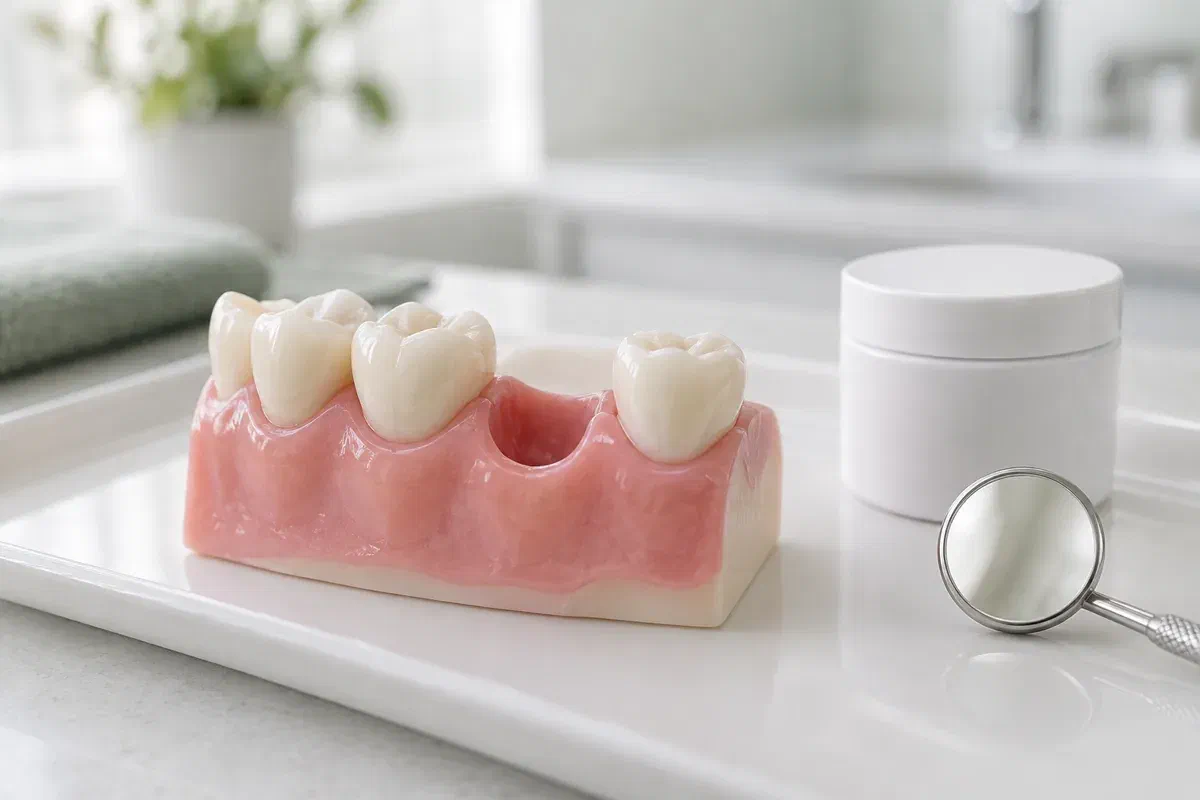
Illustrative consultation about an extraction site and future replacement planning
Restorative Dentistry

Socket Preservation in Oakville

Not sure yet whether you want an implant, a bridge, or nothing at all? That uncertainty is a good reason to talk before extraction. From Oakville, ask us how socket preservation works, what it would add, and how it keeps the conversation about replacement realistic.

Deciding without all the answers

Is it worth grafting a socket when the replacement is still a maybe?

That is one of the most common questions before an extraction, and it is a fair one. A tooth’s roots sit in a socket of bone. When they are removed, the area fills in and reshapes over the following months, often becoming narrower. Socket preservation tries to reduce some of that reshaping at the moment of removal, where the plan calls for it.

Typically the clinician packs graft material into the socket and may add a membrane or other cover to protect it. Which technique applies depends on the site and your circumstances. Grafting doesn’t save the tooth, doesn’t freeze the ridge exactly as it is, and doesn’t settle whether an implant will be suitable in future.

So the honest answer is that it depends on where the tooth is and which replacements you might want. Bring your uncertainty to the planning visit. Coming from Oakville, it helps to raise this before the extraction is booked, so the reason for removal, the state of the site, and your open options can all be weighed together.

Plan the site while options are open
Illustrative dental teaching model showing an empty socket between neighbouring teeth
Where your thinking might be now

Three common starting points.

Any of these is a reasonable place to begin. Tell the clinician where you are, and they can explain whether preservation is relevant to you.

Leaning toward an implant

Implant planning depends on how much bone is present and where the new tooth needs to sit. Ask whether managing this socket could help with that, and which separate assessments would still be required before an implant could be confirmed.

Weighing several replacements

A fixed bridge, a removable partial, and a future implant consultation each relate to the healed ridge differently. Talk them through before the removal if you can. The clinician can describe how the site’s shape matters to each, without one step locking you into another.

Worried the site isn’t straightforward

Infection, missing bone around the root, or a damaged socket wall can change what is recommended. Ask what is already clear from imaging and what will only become clear during removal. How the plan might change should be covered in the consent conversation.

Even if preservation sounds appealing, it doesn’t answer whether the tooth must go. Ask about reasonable ways to keep it, where the situation permits, before agreeing to an irreversible extraction.

Weighing the value honestly

A possible advantage, not an automatic step.

Preservation is meant to limit some of the bone and gum change that follows extraction, so the area remains better suited to the replacement you eventually choose. Ask the clinician to explain the difference they would expect for this tooth. Its value should be described in terms of your tooth’s position and likely future care, not presented as standard for everyone.

Weigh the extras as well: graft and membrane materials, added fees, aftercare, and review visits. People heal differently, and further augmentation might still be needed later. Compare what grafting may help with, what it cannot guarantee, and what healing without a graft would mean for your options.

Patient information: British Dental Journal — socket preservation

Linked to a future decision

Even without a final choice, ask how this socket relates to the replacements you are considering. Models or images can make the contours easier to follow. Understanding the purpose now helps you decide calmly later.

Clear about the materials

Grafts and membranes come from a range of sources. Raise any personal preference or concern early. Ask what exactly is planned, why it suits this site, and whether choosing an alternative would affect the expected treatment.

A review that answers real questions

Ask when the site will be examined and what will show it is ready for the next stage. A comfortable gum doesn’t reveal everything about the bone underneath. Booking a review gives you a natural point to return to your undecided options.

The planning sequence

Talk, agree, treat, review.

Details depend on the tooth and the socket. Ask which steps are fixed and which might be adjusted after the tooth has been removed.

  1. Examine and discuss the possibilities

    The clinician reviews the tooth, the surrounding gum and bone, any X-rays or scans, and your health history. You talk about why removal is advised and whether grafting fits. Mention smoking, medications, slow healing in the past, and any replacement ideas, however tentative.

  2. Confirm the site plan and alternatives

    Go over the graft source, the expected technique, costs, and other options. Ask whether stitches or a cover will be used and whether anything will be removed later. Decide what you will rely on for appearance and chewing while you heal.

  3. Extraction with planned socket care

    If you go ahead as agreed and the site allows, the clinician removes the tooth and carries out the preservation steps. What they find may change the approach. Comfort measures and instructions are given for the treatment actually provided.

  4. Follow up and reopen the replacement question

    Attend the review and report any worries in between. More examination or imaging may come before a replacement is confirmed. Ask whether further site preparation is needed and when to revisit your choices.

Caring for the grafted site

Your sheet of instructions beats any general rule.

Keep the written aftercare and the team’s contact details. The technique used, the materials, and any temporary tooth all affect what you should and shouldn’t do while healing.

Protect the socket from disturbance

Follow the advice on rinsing, brushing nearby, food choices, and activity. Avoid touching the site or repeatedly pulling your lip away to look. Check before introducing any new rinse or cleaning product near the area.

Ask about any temporary replacement

A removable tooth or a denture you already wear may need adjusting or limited use so it doesn’t press on the site. Bring it to your appointments and confirm when it can be worn. Fitting in place doesn’t mean the pressure is right.

Report anything that worries you

Tell the team about pain that is building, unexpected bleeding, discharge, or concerns about stitches or the cover. Describe when it began and follow their guidance. Don’t try to replace graft material or adjust the wound.

Patient information: Cambridge University Hospitals — graft materials and healing considerations

Options for the socket itself

Graft now, wait and see, or stage it?

Different sockets suit different approaches. Ask how this site’s condition and your undecided plans influence the recommendation.

If you decide against grafting

Natural healing, assessed later

The socket heals without graft material, and the ridge is assessed when you are ready to choose a replacement. Ask what changes are expected and whether site preparation might be needed later. This is a legitimate choice when made with full information.

If managing the fresh socket suits the site

Grafting during removal

Graft material and any indicated cover are placed as part of your plan. Ask about the benefit expected, the limits, and the aftercare. It doesn’t guarantee you will avoid further grafting once a replacement is planned.

If findings call for another sequence

A different or staged route

Some sites need ridge augmentation later, or another carefully assessed strategy. Immediate implant placement is a separate suitability question. Ask what that sequence involves and how the area is managed while you decide on the next stage.

Undecided? Start here

Straight answers for an open-ended decision.

Ask about the removal and the socket care separately. They are connected choices, not one procedure.

(905) 876-4488
If I never get an implant, was socket preservation wasted?
Not necessarily. Ridge shape can matter for other replacements too, such as how a bridge or partial denture looks and fits. Ask the clinician how the site relates to each option you are considering, so you can judge whether grafting makes sense even without an implant.
How long can I take to decide about a replacement after grafting?
There is no fixed answer, and waiting indefinitely without review isn’t advised. The site and your wider oral health should be reassessed when you are ready. Tell the clinician your expected timing and ask when a check-up should happen.
Will socket preservation affect how a future bridge looks?
Ridge shape beneath a bridge can influence its appearance, especially toward the front of the mouth. Ask the clinician whether this is relevant to your tooth and how they would expect the site to heal with or without grafting.
Is grafting the socket a way of starting implant treatment?
No. Managing the socket is separate from placing an implant. In selected cases some steps are combined, but that needs its own assessment. Ask which stages your appointment and estimate actually cover.
What happens if the clinician discovers more damage during removal?
The findings may change whether preservation still suits the site or which technique is used. Talk about this beforehand and ask how decisions are made during the procedure. Any change should be explained, including its effect on aftercare and later planning.
Can I plan my visits from Oakville around a busy schedule?
Yes. Let us know your availability when booking the planning visit, extraction, and review. Our hours are Monday to Thursday, 11am to 7pm, with Friday to Sunday by appointment. If pain or swelling develops, call rather than waiting for a convenient slot.
Socket planning for Oakville

Keep your options open on purpose.

Visit our Bronte Street practice before a planned extraction where possible. We will review the tooth, explain the socket care choices, and help you see how healing relates to the replacement decisions you haven’t made yet.

If the tooth hurts or swelling is starting, call for advice about prompt assessment rather than delaying while you consider your replacement.

Visit Milton Dental Clinic
Unit 1, 342 Bronte St. S, Milton, ON L9T 5B7
Get directions Clinic hours
Monday–Thursday
11am–7pm
Friday–Sunday
By appointment only

Areas we serve

  • Milton
  • Oakville
  • Mississauga
  • Georgetown
  • Halton Hills
  • Acton
  • Campbellville
  • Brampton
  • Burlington
  • Puslinch
  • Rockwood
  • Erin
  • Caledon
  • Etobicoke
  • Old Milton
  • Bronte Meadows
  • Timberlea
  • Dorset Park
  • Dempsey
  • Clarke
  • Beaty
  • Coates
  • Harrison
  • Scott
  • Willmott
  • Ford
  • Bowes
  • Cobden
  • Walker
  • Mountain View
  • Milton Heights
  • Hawthorne Village
  • Valley View
  • Fallingbrook
  • Nassagaweya
  • Trafalgar
  • Esquesing
  • Nelson
  • Brookville
  • Moffat
  • Glen Williams
  • Norval
  • Limehouse
  • Stewarttown
  • Ashgrove
  • Hornby
  • Silver Creek
  • Speyside
  • Scotch Block
  • North Oakville
  • River Oaks
  • Glen Abbey
  • West Oak Trails
  • Palermo
  • Bronte Creek
  • College Park
  • Joshua Creek
  • Uptown Core
  • Preserve
  • Iroquois Ridge
  • Lisgar
  • Meadowvale
  • Meadowvale Village
  • Churchill Meadows
  • Erin Mills
  • Central Erin Mills
  • Streetsville
  • East Credit
  • Creditview
  • Heartland
  • Sheridan
  • Mount Pleasant
  • Credit Valley
  • Huttonville
  • Churchville
  • Springbrook
  • Northwest Brampton
  • Bram West
  • Fletcher's Meadow
  • Fletcher's Creek South
  • Alton Village
  • Orchard
  • Millcroft
  • Headon Forest
  • Tansley
  • Brant Hills
  • Tyandaga
  • Kilbride
  • Lowville
  • Aberfoyle
  • Morriston
  • Arkell
  • Hillsburgh
  • Freelton
  • Carlisle
  • Waterdown
  • Flamborough
  • Mountsberg

How can we help?

Milton Dental Clinic

Have a question about your smile? Choose the option that works best for you.

For urgent dental concerns, please call.
Messages are reviewed during clinic hours.