

Illustrative consultation about a temporary replacement for missing teeth
Restorative Dentistry

Temporary Partial Dentures in Acton

Bridge, implant or a long-term partial? You do not have to decide on the day a tooth is lost. From Acton, an interim partial can cover the space while you compare options at a pace that suits you.

Time to choose well

Three possible final teeth, and no need to rush

Losing a tooth can open a decision that feels bigger than it first seemed. A bridge, an implant and a long-term partial each involve different costs, visits, upkeep and effects on neighbouring teeth. Many people would rather think it through than choose in a single appointment. A temporary partial denture can make that easier: it is a removable appliance holding one or more replacement teeth, worn for a set period while you heal and decide.

You may hear the small acrylic kind called a flipper. Whatever the name, the useful starting point is what you need from it during the deciding months. Is it mainly about appearance in public? Comfort while speaking? Light eating? We look at those needs together with your remaining teeth, the ridge where the tooth was and any surgery that is already planned.

For anyone weighing choices from Acton, an interim appliance should come with a clear explanation of its limits and a date to review both the partial and your thinking. If you have opinions or records from another dentist or specialist, bring them. That way the temporary step supports your decision rather than complicating it.

Start comparing your options
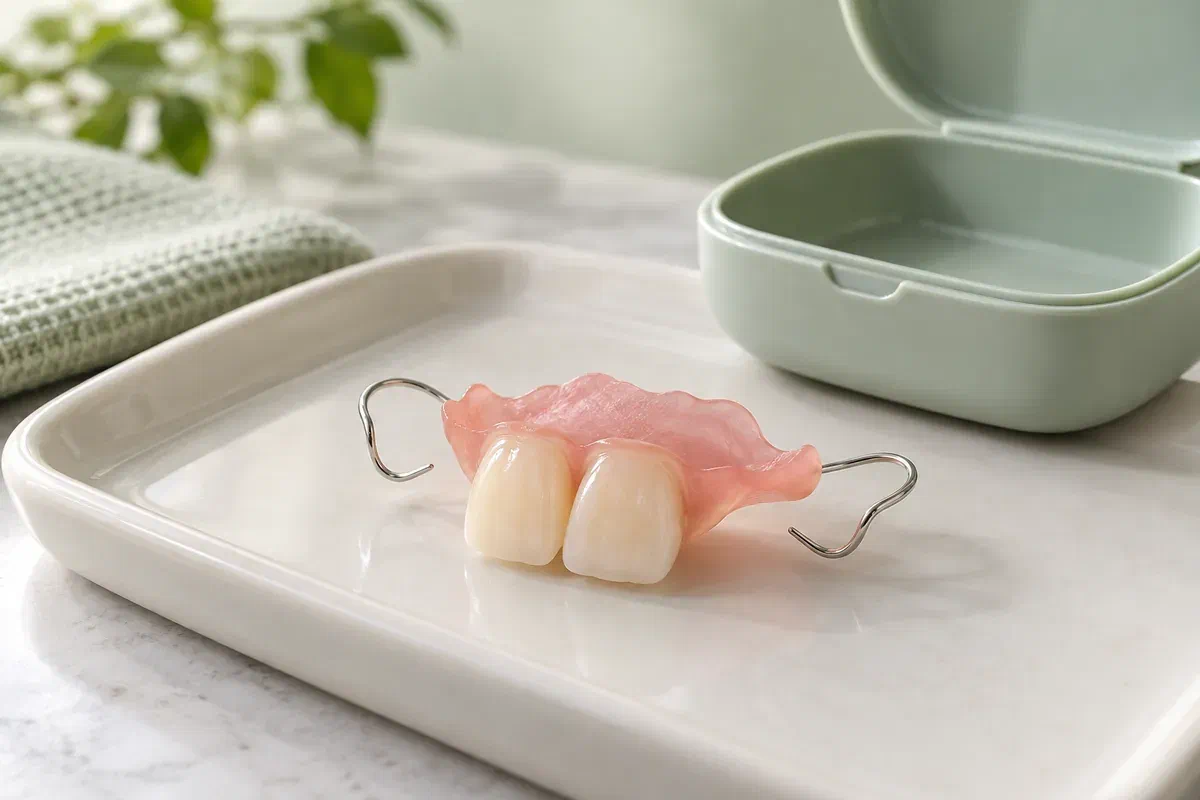
Illustrative removable acrylic partial appliance with two replacement front teeth
Where this fits

Do any of these sound familiar?

An assessment establishes whether an interim partial is suitable, when it could be placed and what to expect while it is worn. It is no substitute for treating active disease or planning for your remaining teeth.

A tooth needs to come out soon

If the tooth shows when you smile, raise replacement before the extraction is done. An immediate partial is prepared in advance from records and placed after removal where that is suitable. Arranging this needs notice, so an extraction appointment on its own does not mean an appliance will be ready.

Treatment will come in stages

You may need healing time, gum therapy or an implant assessment before the final step. Ask whether wearing an appliance during each phase is safe for you, particularly if pressure must be kept off a surgical site.

You simply have not decided

That is a reasonable place to be. An interim partial can cover the space while you compare options, costs and maintenance. Share your budget and priorities early. Wearing it is not a commitment to any particular final procedure.

Covering a gap is not the same as treating the reason for it. Persistent pain, infection, gum disease or weak neighbouring teeth need their own evaluation and care.

Why an interim step helps

Room to think, with a tooth in place

While you weigh up final options, a temporary partial can keep a missing tooth from dominating your smile. The shade and shape are chosen to suit you. Comfort in daily life also comes down to the appliance’s bulk, its retention, how it affects speech and how it meets the teeth opposite.

Interim designs are typically not meant to tackle every food or to feel as firm as a finished long-term restoration. Check what yours is for and which signs would mean it needs looking at. A well-made plan lays out what this stage gives you and what remains to be done.

A trial of removable wear

Taking the appliance out for cleaning and tissue rest, as instructed, gives you a feel for living with something removable. Handling it takes practice, so make sure the team demonstrates the technique at fitting.

Less pressure on the decision

With the gap covered, the choice between a bridge, an implant and a definitive partial can be made more calmly. Mention any key dates early so fabrication and adaptation can be planned.

A natural point to decide

The review that follows healing is an ideal time to compare final options with up-to-date information. Agree who will book it and what records or estimates you would like to see.

The interim pathway

What happens between the first visit and the decision

Tell us about extraction dates, specialist appointments and anything else on your calendar. That helps us explain which timings are realistic and where some flexibility may be needed.

  1. Assess and set priorities

    We examine the space or the tooth to be removed, the supporting tissues and the teeth on either side, which may matter for a future bridge or partial. Your medical history and preferences are discussed. More records or imaging may be suggested before prescribing an appliance.

  2. Records and a staged estimate

    We take impressions, or other appropriate records, so the appliance can be made for you. You will see the design and an estimate for the interim stage, ideally with a sense of what the final options might involve. Ask what adjustments and relines would cost separately.

  3. Fit the partial and learn to use it

    On fitting day, we check how the appliance sits against your teeth and gums and relieve any tight spots. You rehearse seating and removing it until it feels manageable. If fitted after an extraction, you leave with instructions for the socket as well as the appliance.

  4. Review, then choose

    Your follow-up checks fit, comfort and cleaning. Gum changes during healing can alter how the appliance sits. Once things have settled, we go over the final options with you again, so the temporary partial does not quietly become permanent by default.

Caring for it while you decide

Keep the supporting teeth in good shape

Use the instructions given for your design. In the first days after an extraction, the advice may differ from the routine for a healed mouth, so please ask about anything that is unclear.

Be careful with food

Find out whether to keep the partial in while eating and which foods to avoid. If eating with it is advised, start soft and cut food small. Biting into hard foods with the replacement front teeth risks damage.

Protect future options

The teeth near the space may later support a bridge or a new partial, so keep them clean. Remove the appliance, clean it as advised for its material and give your natural teeth and the clasp areas careful daily attention.

Ask before fixing

A partial that rubs, rocks, cracks or will not seat should be checked. Do not bend wires, file it or use household glue; the team will want to see the appliance, and any broken parts, as they were.

Patient information: American Dental Association — removable partial denture care

The options you are comparing

Different routes to a lasting replacement

An interim appliance is a step in the process and does not decide the outcome. Weigh each option as healing progresses, thinking about your remaining teeth, your routine and the ongoing care each one asks for.

If you would like to stay removable

Definitive removable partial

Once the tissues settle, a long-term partial may be planned, possibly with a different design and materials. Ask how it would be retained, which teeth would support it, what might show and how to keep it clean.

If the adjacent teeth can support one

Fixed bridge

A bridge stays in and depends on suitable support from neighbouring teeth. Their condition, how wide the space is and your bite all affect suitability. Ask how those teeth would be affected and what cleaning involves.

If an assessment finds it suitable

Implant-supported tooth

An implant requires its own review of your health, bone, gums and the space available, along with discussion of surgery, healing, fees and maintenance. A temporary partial does not confirm suitability, and you remain free to choose otherwise.

Patient information: Leeds Teaching Hospitals — partial dentures and alternatives

Deciding from Acton

Questions to ask before you choose a final tooth

Bring questions about daily wear, an upcoming extraction or how to compare final replacements. Answers help most when they relate to your appliance and your treatment sequence.

(905) 876-4488
How long can I wait before choosing a final replacement?
There is no single answer. Healing needs time anyway, and the dentist can advise when the tissues are ready for a long-term option. Waiting too long with an interim appliance may not be ideal, so plan to revisit the decision at your review.
Could wearing a partial help me decide whether I like removable teeth?
It can give you some sense of handling a removable appliance. Keep in mind that a definitive partial is often designed differently and may feel different. Ask how the two compare in retention, coverage and cleaning.
Will the clasps affect teeth I might later use for a bridge?
Clasps rest on neighbouring teeth, and plaque can build up there if cleaning is missed. Careful daily care helps keep those teeth healthy. Ask the dentist to check them at each review, especially if a bridge is being considered.
Is it all right to get another opinion while wearing the interim partial?
Yes. Many people like to hear more than one view on a bridge or implant. Ask for copies of relevant records to share, and let us know any advice you receive so the overall plan stays coordinated.
What information will help me compare the final options?
Useful details include the condition of the neighbouring teeth, any imaging needed for implant planning, the number of visits each option involves, upkeep and estimated fees. Ask for estimates that clearly separate each stage of treatment.
My appliance no longer feels secure. Should I wait for the final tooth?
Book a fit check rather than waiting. Healing changes the shape of the gums and bone, so the partial may need adjusting, relining or replacing. The best step depends on its condition and how soon the next treatment stage is likely to start.
Acton to our Bronte Street clinic

Compare your options with someone who will explain each one.

Book a visit at our Bronte Street clinic, and we can talk over an extraction you are expecting or an existing gap. Bring any previous opinions or records, and let us know which factors weigh most in your decision. We will explain interim options and the choices still to make.

Phone instead if a recent extraction site is painful, swollen or worrying you. Online requests are for non-urgent bookings.

Visit Milton Dental Clinic
Unit 1, 342 Bronte St. S, Milton, ON L9T 5B7
Get directions Clinic hours
Monday–Thursday
11am–7pm
Friday–Sunday
By appointment only

Areas we serve

  • Milton
  • Oakville
  • Mississauga
  • Georgetown
  • Halton Hills
  • Acton
  • Campbellville
  • Brampton
  • Burlington
  • Puslinch
  • Rockwood
  • Erin
  • Caledon
  • Etobicoke
  • Old Milton
  • Bronte Meadows
  • Timberlea
  • Dorset Park
  • Dempsey
  • Clarke
  • Beaty
  • Coates
  • Harrison
  • Scott
  • Willmott
  • Ford
  • Bowes
  • Cobden
  • Walker
  • Mountain View
  • Milton Heights
  • Hawthorne Village
  • Valley View
  • Fallingbrook
  • Nassagaweya
  • Trafalgar
  • Esquesing
  • Nelson
  • Brookville
  • Moffat
  • Glen Williams
  • Norval
  • Limehouse
  • Stewarttown
  • Ashgrove
  • Hornby
  • Silver Creek
  • Speyside
  • Scotch Block
  • North Oakville
  • River Oaks
  • Glen Abbey
  • West Oak Trails
  • Palermo
  • Bronte Creek
  • College Park
  • Joshua Creek
  • Uptown Core
  • Preserve
  • Iroquois Ridge
  • Lisgar
  • Meadowvale
  • Meadowvale Village
  • Churchill Meadows
  • Erin Mills
  • Central Erin Mills
  • Streetsville
  • East Credit
  • Creditview
  • Heartland
  • Sheridan
  • Mount Pleasant
  • Credit Valley
  • Huttonville
  • Churchville
  • Springbrook
  • Northwest Brampton
  • Bram West
  • Fletcher's Meadow
  • Fletcher's Creek South
  • Alton Village
  • Orchard
  • Millcroft
  • Headon Forest
  • Tansley
  • Brant Hills
  • Tyandaga
  • Kilbride
  • Lowville
  • Aberfoyle
  • Morriston
  • Arkell
  • Hillsburgh
  • Freelton
  • Carlisle
  • Waterdown
  • Flamborough
  • Mountsberg

How can we help?

Milton Dental Clinic

Have a question about your smile? Choose the option that works best for you.

For urgent dental concerns, please call.
Messages are reviewed during clinic hours.