

Illustrative consultation about a temporary replacement for missing teeth
Restorative Dentistry

Temporary Partial Dentures in Burlington

Implant treatment can involve months of healing before the final tooth arrives. From Burlington, you can plan a temporary partial that respects surgical sites, keeps the specialist in the loop and is reviewed as you go.

The long wait for a final tooth

Bridging the healing months

Some treatment plans move slowly on purpose. An extraction may need to heal before bone grafting, a graft may need to mature before an implant, and the implant itself may need time before a crown can be placed. During that stretch, a temporary partial denture can hold the place of the missing tooth. It is a removable appliance with one or more replacement teeth, intended for an interim period rather than for good.

People often call a small acrylic appliance a flipper. The nickname is fine in conversation, but each design behaves differently, and what matters is how this one will sit over a healing area and what it should and should not be asked to do. In an implant pathway, the key question is often how to cover the gap without placing unwanted pressure on the surgical site.

Your surgeon's proposed dates sit at the centre of that conversation, together with your general health and the state of the teeth on either side of the space. For anyone coming from Burlington, sharing those letters and timelines with us early lets the interim partial be planned within the overall sequence, with clear limits and review dates set from the start.

Discuss a partial during implant healing
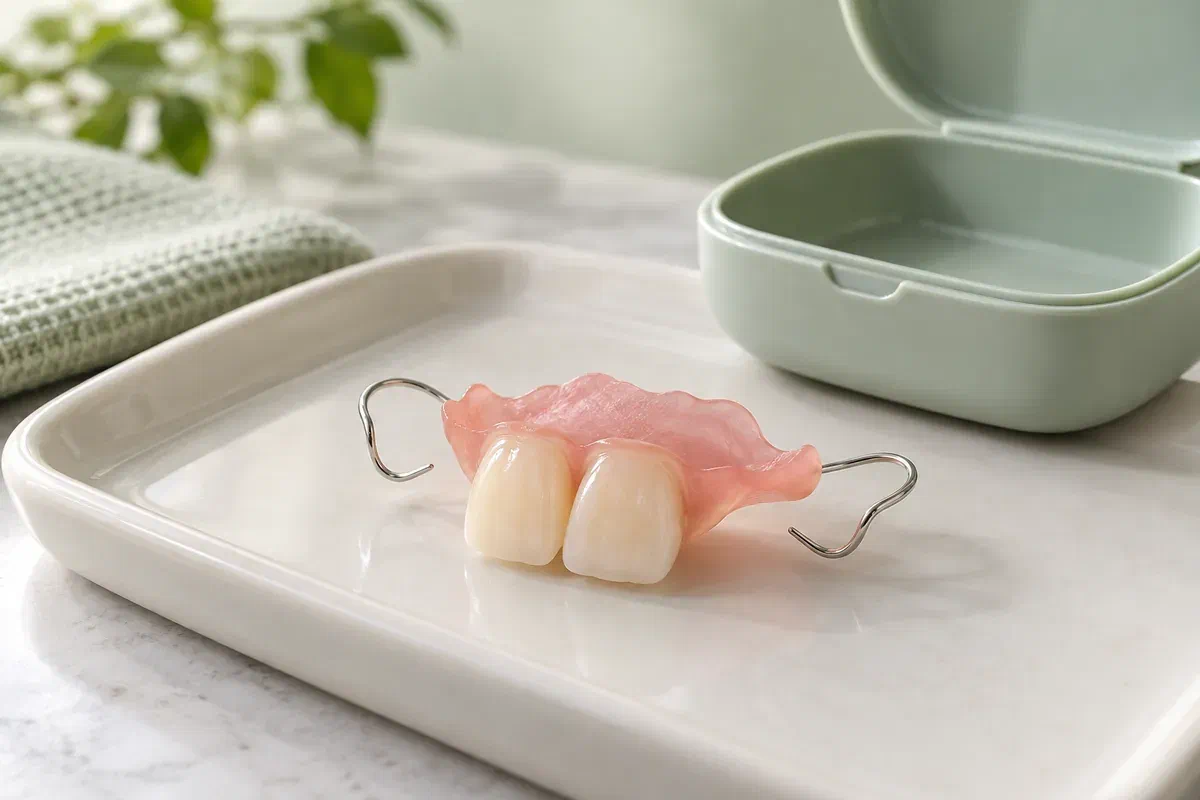
Illustrative removable acrylic partial appliance with two replacement front teeth
Where a temporary partial fits a plan

Three reasons the topic comes up

A careful assessment helps establish whether an interim partial suits you, when it could be fitted and how it may need to change. It cannot replace treating active disease or planning for the teeth that remain.

A tooth is coming out first

If the tooth is visible, raise the question of replacement before the extraction. An immediate partial is made ahead of time and placed after removal where that is clinically appropriate. Coordination is needed, so an appliance is never automatic just because a removal date exists.

Grafting or implant surgery is planned

Healing stages can leave a long period before the final restoration. Ask whether a partial can be worn safely during each stage and how it may be modified so it does not press on a graft or implant site that needs protection.

You are still comparing approaches

An interim appliance can give you time to look at a bridge, a definitive partial or an implant more closely. Be open about budget and priorities from the beginning. The temporary step should never be presented as committing you to one final option.

A temporary partial replaces the look of a tooth; it does not deal with what caused the loss. Pain, infection, gum disease or weakened neighbouring teeth require their own care.

Why an interim step can help

Time to heal, without hiding your smile

When healing takes months, a temporary partial can reduce the visible impact of the space while the surgical stages run their course. The replacement tooth is shaped and shaded to suit your mouth. Its bulk, how securely it is held, its effect on speech and how it meets the opposing teeth matter just as much as its appearance.

Interim designs are generally not made to cope with every food or to feel as solid as a completed implant crown or bridge. Ask what yours is intended for and which signs suggest it needs adjusting. A thoughtful plan describes the gains during this stage as clearly as the work that remains.

Easy to remove for care

You can take the appliance out as advised for cleaning and to rest the tissues. There is a knack to placing and removing it, and the team should demonstrate that with you at the fitting appointment.

Steadier through each surgical stage

Knowing the gap will be covered between procedures can make a long plan feel more manageable. Share important dates early, keeping in mind that assessment, fabrication and adaptation all take time.

Regular chances to recheck

Each stage of an implant plan is a natural moment to look at the appliance again. Agree who arranges reviews, and what information from your surgeon is needed before the next decision.

Planning alongside surgery

Coordinate the appliance with every stage

Share your planned extraction, grafting and implant dates, plus any personal deadlines. With that information, we can explain what can be arranged and where timing may have to stay open.

  1. Assess the space and the surgical plan

    We examine the gap or tooth to be removed, the gums and bone, and neighbouring teeth, and we review your surgeon's plan if one exists. Your medical history and everyday needs are part of the picture. Further records or imaging may be suggested before the appliance is prescribed.

  2. Record the mouth and outline costs

    Impressions or other suitable records allow the partial to be made for you. We discuss its design, the estimated fees and the likely fitting sequence. Ask whether modifications after surgery, relines or a replacement appliance would be charged separately.

  3. Fit and learn the routine

    At fitting, the appliance is checked against teeth and tissues and areas of unwanted pressure are addressed. You practise inserting and removing it with guidance. If it is placed after an extraction or surgery, you receive instructions that cover the healing site as well as the partial.

  4. Revisit after each change

    Follow-up visits check comfort, stability and home care. Healing and surgery can alter the fit, so a partial that suited one stage may need adjusting for the next. Each review also looks ahead to the final restoration, so the temporary arrangement does not simply continue by default.

Caring for it between procedures

Protect the healing area first

Your instructions are specific to the appliance and the surgical stage you are in. Advice after an extraction or implant placement may differ from the usual routine for a healed mouth, so ask whenever it is unclear.

Ease into eating

Check whether the partial should be worn for meals and which foods to avoid, especially near a surgical site. If you are advised to eat with it, choose soft textures and small pieces, and avoid biting firmly with the replacement front teeth.

Keep every natural tooth clean

Take the appliance out and clean it with the products suited to its material. Carry on brushing and cleaning your own teeth carefully, including where clasps make contact. The partial offers no protection against plaque or decay.

Report changes rather than adjusting

Rubbing, rocking, a crack or trouble seating the appliance should be reported to the clinic. Do not bend clasps, trim acrylic or use household glue. Bring the partial and any fragments with you so the cause can be identified.

Patient information: American Dental Association — removable partial denture care

If the implant plan changes

Keep every final option on the table

Even partway through an implant pathway, plans can shift. Reassess your choices as healing progresses, considering your remaining teeth and the ongoing care each option requires.

If removable suits you best

A definitive removable partial

When the tissues are stable, a long-term partial may be designed. It may differ in materials and retention from the temporary appliance. Ask about supporting teeth, visible components and cleaning rather than assuming it will look the same.

If adjacent teeth are suitable

A conventional fixed bridge

A bridge is fixed in place and relies on an appropriate support arrangement. The condition of nearby teeth, the size of the space and your bite all play a part. Ask what preparing those teeth would involve and how you would keep the area clean.

If assessment confirms suitability

An implant-supported crown

An implant requires its own evaluation of health, bone, gums and space. Surgery, healing, costs and maintenance should be discussed openly. Wearing a temporary partial does not confirm that an implant will work, and you can still choose a different path.

Patient information: Leeds Teaching Hospitals — partial dentures and alternatives

Implant-stage questions from Burlington

What should I ask while I wait?

Bring questions about wear during healing, surgical dates or how you will move to the final tooth. Answers are most useful when they relate to your actual appliance and treatment plan.

(905) 876-4488
Can a temporary partial sit over a new implant or graft?
Sometimes, but it may need to be designed or adjusted so it does not press on the healing area. Your dentist and surgeon will advise based on the procedure. Follow their instructions closely, and call if the appliance seems to be touching the site.
Who adjusts my partial if a specialist does the surgery?
Agree on this before treatment begins. Often the dentist who made the appliance handles adjustments, with information from the surgeon about what was done. Clear communication helps avoid gaps in care between appointments.
Is extra saliva normal with a new partial?
Many people notice more saliva for the first while, because the mouth reacts to something new. It usually settles as you adapt. If it continues, or if you have other concerns such as gagging or soreness, mention it at your review.
My gums have shrunk under the partial. Does it need remaking?
Not always. After an extraction, the tissues reshape as they heal, which can loosen the appliance. A reline or adjustment may be enough, or a replacement may be better. The choice depends on the partial’s condition and where you are in the implant plan.
Should a new partial be worn overnight during healing?
Use the schedule you were given. Immediately after surgery or an extraction, you may be told to keep it in for a set time. Later, taking it out at night to rest the tissues is commonly recommended. Ask how and when your routine should change.
If I change my mind about implants, is the partial wasted?
No. It has served its interim role, and you are free to reconsider. Before treating it as long term, have it and your supporting teeth reassessed. The team can explain whether a different removable design or another option would suit you better.
Coming from Burlington

Bring your surgical timeline, and we will plan around it.

Arrange a visit at our Bronte Street clinic to discuss an extraction, an implant pathway or a space you already have. Bring your specialist's letters and dates, and tell us which situations worry you most. We will explain the interim options and the steps ahead.

Call about pain, swelling or problems at a recent surgical or extraction site. Online requests are for non-urgent bookings only.

Visit Milton Dental Clinic
Unit 1, 342 Bronte St. S, Milton, ON L9T 5B7
Get directions Clinic hours
Monday–Thursday
11am–7pm
Friday–Sunday
By appointment only

Areas we serve

  • Milton
  • Oakville
  • Mississauga
  • Georgetown
  • Halton Hills
  • Acton
  • Campbellville
  • Brampton
  • Burlington
  • Puslinch
  • Rockwood
  • Erin
  • Caledon
  • Etobicoke
  • Old Milton
  • Bronte Meadows
  • Timberlea
  • Dorset Park
  • Dempsey
  • Clarke
  • Beaty
  • Coates
  • Harrison
  • Scott
  • Willmott
  • Ford
  • Bowes
  • Cobden
  • Walker
  • Mountain View
  • Milton Heights
  • Hawthorne Village
  • Valley View
  • Fallingbrook
  • Nassagaweya
  • Trafalgar
  • Esquesing
  • Nelson
  • Brookville
  • Moffat
  • Glen Williams
  • Norval
  • Limehouse
  • Stewarttown
  • Ashgrove
  • Hornby
  • Silver Creek
  • Speyside
  • Scotch Block
  • North Oakville
  • River Oaks
  • Glen Abbey
  • West Oak Trails
  • Palermo
  • Bronte Creek
  • College Park
  • Joshua Creek
  • Uptown Core
  • Preserve
  • Iroquois Ridge
  • Lisgar
  • Meadowvale
  • Meadowvale Village
  • Churchill Meadows
  • Erin Mills
  • Central Erin Mills
  • Streetsville
  • East Credit
  • Creditview
  • Heartland
  • Sheridan
  • Mount Pleasant
  • Credit Valley
  • Huttonville
  • Churchville
  • Springbrook
  • Northwest Brampton
  • Bram West
  • Fletcher's Meadow
  • Fletcher's Creek South
  • Alton Village
  • Orchard
  • Millcroft
  • Headon Forest
  • Tansley
  • Brant Hills
  • Tyandaga
  • Kilbride
  • Lowville
  • Aberfoyle
  • Morriston
  • Arkell
  • Hillsburgh
  • Freelton
  • Carlisle
  • Waterdown
  • Flamborough
  • Mountsberg

How can we help?

Milton Dental Clinic

Have a question about your smile? Choose the option that works best for you.

For urgent dental concerns, please call.
Messages are reviewed during clinic hours.