

Illustrative consultation about a temporary replacement for missing teeth
Restorative Dentistry

Temporary Partial Dentures in Erin

Where does the partial go at night, and when should it stay in? For anyone coming from Erin or Hillsburgh, we explain the wearing schedule, storage and care that keep an interim appliance comfortable.

The bedtime routine

Out at night, safe until morning

The question people often forget to ask at fitting is the one that arrives at bedtime: does this come out, and where does it go? With a temporary partial denture, the answer can change over time. This removable appliance holds one or more artificial teeth for an interim period, usually during healing or while other treatment is finished, and the schedule just after an extraction may not be the one you follow a month later.

Some people know the small acrylic version as a flipper. Whichever design you have, it helps to agree on its job first. Perhaps it is there mainly for appearance in company, or perhaps you hope to eat and speak comfortably with it all day. That decision is weighed with the health of your remaining teeth, the gum ridge under the space and any surgery ahead.

From Erin, it makes sense to leave the fitting with written instructions for each stage, so you are not left guessing on a Sunday night. Every interim appliance also comes with a frank explanation of its limits and a review date. Bring records from any specialist or other dentist so the partial fits the plan already in place.

Ask about wearing and storing a partial
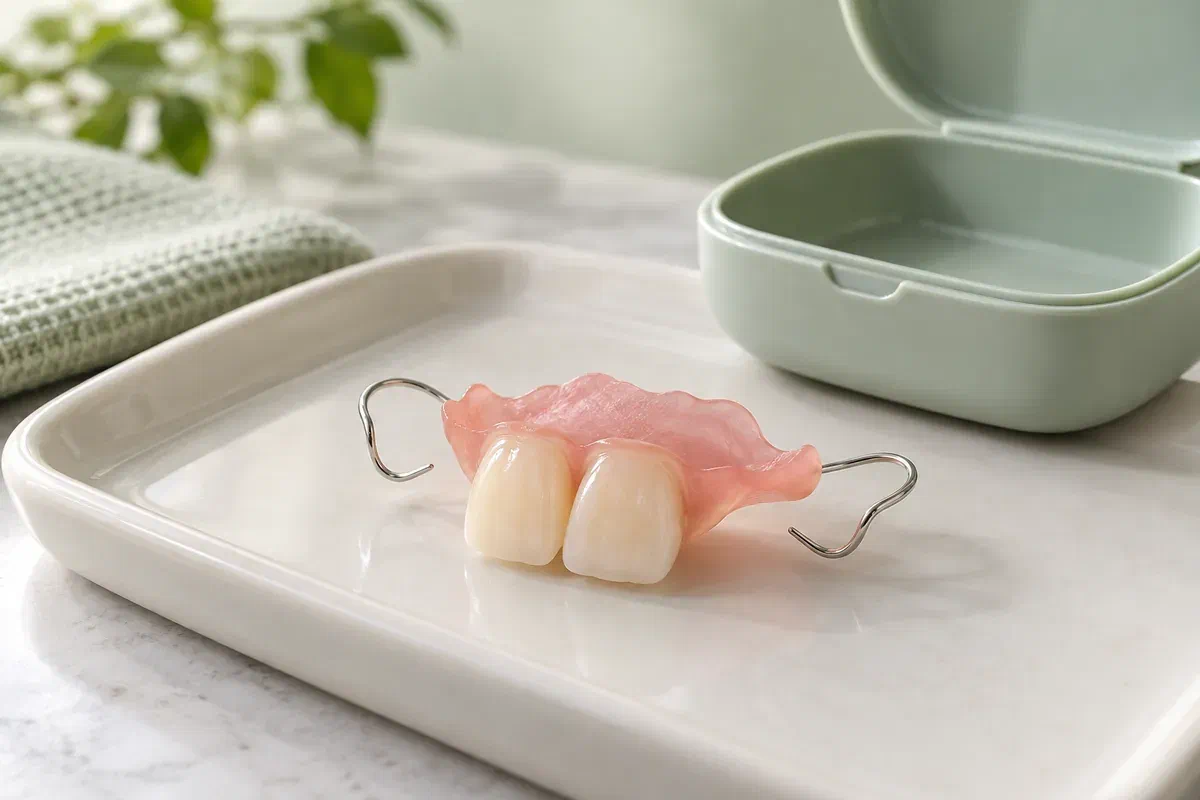
Illustrative removable acrylic partial appliance with two replacement front teeth
Why it comes up

An extraction, a long plan or an open question

An exam establishes whether an interim partial suits you, when it might be fitted and how it may change. Treating active disease and planning care for your remaining teeth still need to happen alongside it.

A tooth that shows is being removed

Ask about a replacement before the extraction date. Records are taken beforehand so an immediate partial can be made and placed after removal, if that suits your situation. Without that planning, an extraction appointment does not come with an appliance ready.

The final step is months off

Healing, periodontal treatment or an implant review can create a long wait. Check whether wearing an appliance is safe throughout, particularly over a surgical area that may need to be kept clear of pressure for a time.

You have not chosen a final tooth

Covering the space can give you time to look into a bridge, a long-term denture or implant treatment. Share your budget and priorities early. Wearing a temporary appliance does not tie you to one particular outcome.

An interim partial covers the gap; the reason for the tooth loss still needs attention. Pain, infection, gum disease or weakened nearby teeth require their own assessment and care.

Living with an interim appliance

Comfort comes from a routine you understand

During healing, an interim partial can make the missing tooth much less obvious. Its colour and outline are chosen to suit you. Comfort also depends on the thickness of the base, how well it is held, its effect on speech and how it meets your other teeth, and on a sensible daily and nightly routine.

Most temporary designs are not intended for every food or for the steadiness of a completed restoration, so find out what yours is for and which signs mean it needs adjusting. A thoughtful plan explains what you gain in this stage and what still has to be done.

Time out for your gums

Once early healing allows, removing the appliance as advised gives the tissues a rest and makes cleaning easier. Learning to take it out and put it back takes practice, so ask for a demonstration before you leave.

A gentler transition

Knowing that a front-tooth gap will be covered can make the change feel more manageable. Mention any special dates early, allowing time for assessment, fabrication and a period of adapting.

A review when it matters

The interim stage brings a natural point to revisit comfort, the wearing schedule and the long-term plan. Agree who books that review and what details should be ready.

Getting started

Each visit, and what you take home from it

Tell us about extraction dates, specialist appointments and other commitments. Then we can explain what is realistic, which visits might be grouped and where the timeline should stay open.

  1. An unhurried assessment

    We examine the gap or tooth to be removed, the gums and bone and the neighbouring teeth, and talk about your health history and routine. More records or imaging may be suggested if they would help clarify the plan before an appliance is chosen.

  2. Records and a plan in writing

    Impressions or another suitable record let the appliance be made for your mouth. You will see the proposed design, an itemized estimate and the expected order of visits. Check which later costs, such as relines or a new appliance, sit outside that estimate.

  3. Fitting and your first routine

    The partial is tried in, its contact with teeth and gums is checked and pressure points are eased. You practise handling it, and we go through cleaning, storage and the wearing schedule. After an extraction, you also get socket care instructions.

  4. A follow-up to adjust the plan

    At the review, we look at fit, comfort and how the routine is working. Healing can change the shape of the gums, so the appliance may need attention. We also discuss the next stage, so the temporary partial is reassessed rather than continued by default.

Day and night care

What to do before bed, and what to avoid

Follow the instructions written for your appliance. Straight after an extraction, the wearing schedule may differ from later advice, so check if anything seems unexpected.

Clean before storing

Remove the partial and clean it with the method recommended for its material. Store it as instructed, often moist and in a closed case. Avoid very hot water, which can distort some materials.

Care for your mouth too

With the appliance out, brush your natural teeth and clean between them, paying attention to clasp areas. Gently cleaning your gums and tongue can also help keep the mouth fresh.

Eat and repair with care

Confirm whether to eat with the partial in; if so, choose soft foods in small pieces. For rubbing, rocking or a crack, call us instead of bending, filing or gluing it, and bring any broken pieces.

Patient information: American Dental Association — removable partial denture care

After the temporary stage

Will the final tooth come out at night too?

The interim partial is one stage, not a forecast. Reassess your preferences as healing progresses, keeping in mind your remaining teeth and the daily routine each option requires.

Removable, with a routine to match

A long-term removable partial

Once the tissues are stable, a definitive partial may be designed. Like the interim one, it is typically removed for cleaning, but its design may differ. Ask about retention, support, visible parts and care.

Stays in, if nearby teeth can support it

A fixed bridge

A bridge does not come out at night and relies on suitable supporting teeth. Their health, the gap’s width and your bite affect suitability. Ask what it would mean for those teeth and how to clean beneath it.

Fixed, if an assessment supports it

An implant-supported tooth

Before an implant is considered, your general health, the bone and gum tissue and the room for a crown are evaluated on their own. You would also talk through the surgery, the months of healing, fees and upkeep. Wearing an interim partial does not confirm you are suitable, or oblige you to go ahead.

Patient information: Leeds Teaching Hospitals — partial dentures and alternatives

Night-time questions from Erin

Sleep, storage and the morning after

Questions about night wear, storage, an extraction you are expecting or the final replacement are all welcome. The best answers relate to your own appliance and treatment sequence.

(905) 876-4488
Where should my partial go while I sleep?
Once you have been told it can come out overnight, clean it and keep it in a closed case, stored the way your dentist recommends for its material. Put the case somewhere children and pets cannot reach.
What happens if the appliance dries out?
Some materials can change shape if allowed to dry, which may affect the fit. Follow the storage advice you were given. If the partial feels different after being left out, book a check rather than forcing it in.
Can I rinse my partial with hot water to sanitize it?
No. Very hot or boiling water can warp some denture materials. Use cool or lukewarm water and the cleaning products recommended for your appliance, and rinse it well before wearing it.
Is it a problem if I fall asleep with the partial in?
An occasional night is unlikely to be serious, but regular overnight wear may not give your tissues the rest they need. If you have been advised to remove it at night, try to make that part of your routine, and mention any soreness.
How should I travel overnight with a partial?
Bring its case, your cleaning supplies and any instructions you were given. Avoid wrapping it in tissue, where it can be thrown away by mistake. If it breaks while you are away, keep the pieces and contact the clinic.
Do I still need to clean my gums when the partial is out?
Gentle cleaning of the gums and tongue is often recommended, along with brushing your natural teeth. Around a recent extraction site, follow the specific advice you were given and avoid disturbing the healing area.
Planning from Erin

Leave with instructions you can follow at bedtime.

Our Bronte Street clinic is the place to talk through an expected extraction or a gap you already have. Bring specialist notes and tell us about your daily routine. We will go through interim options, care instructions and the decisions ahead.

If a recent extraction site becomes painful or swollen, please phone. Online requests are for non-urgent enquiries.

Visit Milton Dental Clinic
Unit 1, 342 Bronte St. S, Milton, ON L9T 5B7
Get directions Clinic hours
Monday–Thursday
11am–7pm
Friday–Sunday
By appointment only

Areas we serve

  • Milton
  • Oakville
  • Mississauga
  • Georgetown
  • Halton Hills
  • Acton
  • Campbellville
  • Brampton
  • Burlington
  • Puslinch
  • Rockwood
  • Erin
  • Caledon
  • Etobicoke
  • Old Milton
  • Bronte Meadows
  • Timberlea
  • Dorset Park
  • Dempsey
  • Clarke
  • Beaty
  • Coates
  • Harrison
  • Scott
  • Willmott
  • Ford
  • Bowes
  • Cobden
  • Walker
  • Mountain View
  • Milton Heights
  • Hawthorne Village
  • Valley View
  • Fallingbrook
  • Nassagaweya
  • Trafalgar
  • Esquesing
  • Nelson
  • Brookville
  • Moffat
  • Glen Williams
  • Norval
  • Limehouse
  • Stewarttown
  • Ashgrove
  • Hornby
  • Silver Creek
  • Speyside
  • Scotch Block
  • North Oakville
  • River Oaks
  • Glen Abbey
  • West Oak Trails
  • Palermo
  • Bronte Creek
  • College Park
  • Joshua Creek
  • Uptown Core
  • Preserve
  • Iroquois Ridge
  • Lisgar
  • Meadowvale
  • Meadowvale Village
  • Churchill Meadows
  • Erin Mills
  • Central Erin Mills
  • Streetsville
  • East Credit
  • Creditview
  • Heartland
  • Sheridan
  • Mount Pleasant
  • Credit Valley
  • Huttonville
  • Churchville
  • Springbrook
  • Northwest Brampton
  • Bram West
  • Fletcher's Meadow
  • Fletcher's Creek South
  • Alton Village
  • Orchard
  • Millcroft
  • Headon Forest
  • Tansley
  • Brant Hills
  • Tyandaga
  • Kilbride
  • Lowville
  • Aberfoyle
  • Morriston
  • Arkell
  • Hillsburgh
  • Freelton
  • Carlisle
  • Waterdown
  • Flamborough
  • Mountsberg

How can we help?

Milton Dental Clinic

Have a question about your smile? Choose the option that works best for you.

For urgent dental concerns, please call.
Messages are reviewed during clinic hours.