

Illustrative consultation about a temporary replacement for missing teeth
Restorative Dentistry

Temporary Partial Dentures in Halton Hills

Words can feel strange for a few days with something new behind your front teeth. If you are in Halton Hills and facing a missing tooth, we explain how a temporary partial affects speech, comfort and the plan ahead.

Talking with a new appliance

Your tongue will notice before anyone else does.

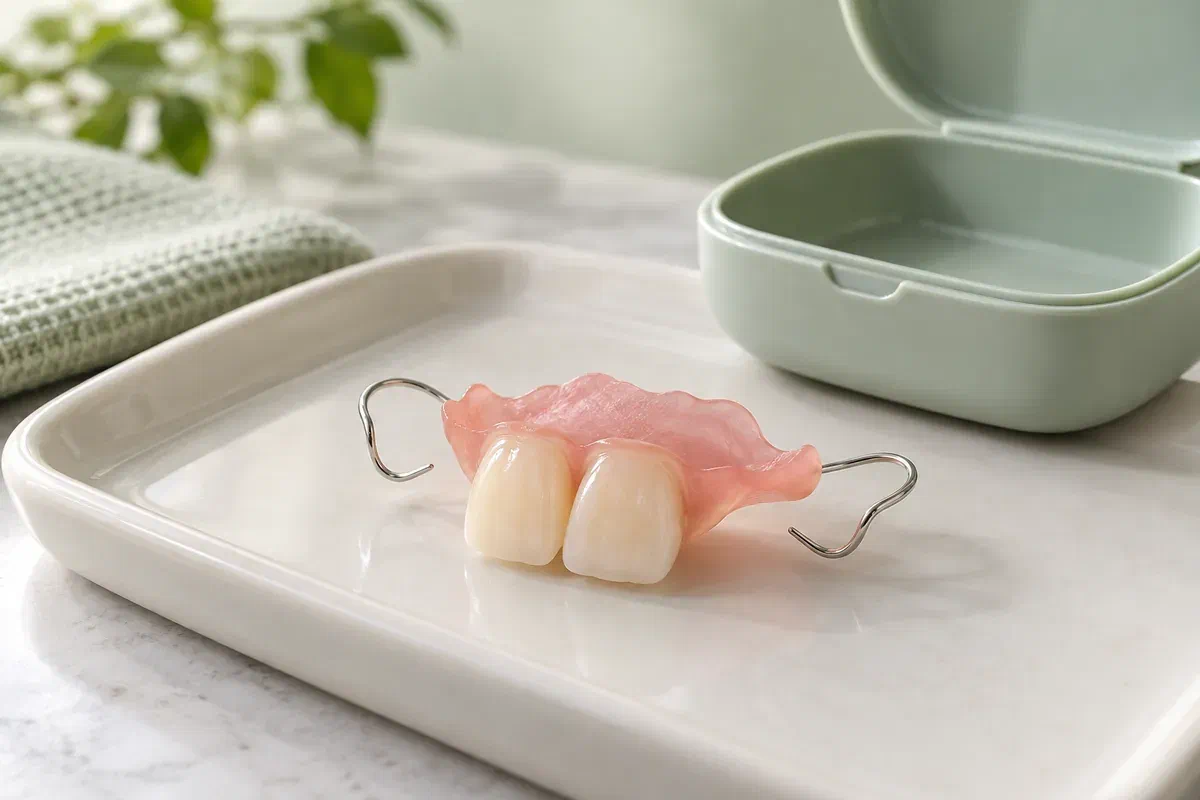
People expect a missing tooth to change their smile. Fewer expect it to change how “s” and “th” sound, or how the tongue moves when a new appliance sits behind the front teeth. A temporary partial denture is a removable device that replaces one or more teeth for an interim period, often while an extraction heals or while further treatment is planned. The lightweight acrylic type is commonly called a flipper.

Getting used to one involves practice as much as fit. Most people adapt, though the first days can feel awkward, and the shape of the appliance matters. Our first conversation is about what you need from it: speaking at work, leading a meeting, chatting with grandchildren or simply eating without a gap. That is balanced with the condition of your other teeth, the ridge under the space and any surgery still planned.

From anywhere in Halton Hills, whether Georgetown, Acton or a smaller hamlet, you deserve a clear picture of the appliance's limits before it is made, along with a review date. Bring notes from a specialist or previous dentist if you have them, so the partial suits the treatment order already set out.

Ask how a partial may affect your speech
Illustrative removable acrylic partial appliance with two replacement front teeth
Why people consider one

The gap, the timeline and the decision still ahead

An assessment shows whether a temporary partial suits you, when it might be fitted and how things are likely to change over time. It is not a substitute for treating active problems or caring for the teeth you keep.

Removal of a visible tooth is planned

The time to raise replacement is before the extraction. Records are taken ahead so an immediate partial can be made and, if suitable, placed after removal. That relies on coordination, so a booked extraction does not on its own mean an appliance will be waiting.

Healing will take some time

Socket healing, periodontal care or an implant assessment can mean months before the final replacement. Check whether you can safely wear an appliance during that period, particularly if a surgical area must be kept free from pressure.

You are still exploring options

An interim partial gives you space to compare a bridge, a definitive partial and an implant. It helps to mention your budget and priorities early. The temporary step should not be presented as agreeing to any one final procedure.

Replacing the look of a tooth does not resolve the reason it was lost. Infection, discomfort, gum disease or weak neighbouring teeth require separate assessment and treatment.

Living with it day to day

What improves, and what takes adjusting to

A temporary partial can make a gap much less visible during the months before a final tooth. Shade and shape are chosen to blend in. For speech in particular, though, the thickness of the base, how securely it is held and the way it meets your opposite teeth make a real difference, which is why those details are discussed before the design is settled.

Interim appliances are often not intended to cope with every food or to feel as stable as a completed restoration. Ask what yours is made to do and which signs mean it should be adjusted. A clear plan describes the benefits of this stage and the work still to come in equal measure.

You decide when it is out

Following your instructions, the appliance can be removed for cleaning and to let the tissues rest. Seating it neatly takes practice, so ask the team to coach you through it before you head home.

Practice brings ease

Reading aloud, saying tricky words slowly and talking with people you are comfortable with can help speech settle. Mention upcoming events where you need to speak, leaving time for fitting and adaptation.

Reviews built into the plan

The interim phase includes a natural checkpoint for comfort, speech and the long-term option as healing continues. Agree who books it and what details should be ready beforehand.

Step by step

How the appliance is planned, made and checked

Share any extraction dates, specialist appointments and personal deadlines. With those in view, we can say what is realistic and where the schedule may need to stay flexible.

  1. Assessment and purpose

    The dentist looks at the gap or the tooth to be removed, the supporting gums and bone and the nearby teeth. We ask about your medical history, how much you speak each day and what you would like to achieve. More records or imaging may be suggested before an appliance is prescribed.

  2. Records and a shared decision on design

    Impressions or other suitable records are taken so the partial can be made for your mouth. We talk about how much of the palate it may cover, the costs involved and the expected sequence. Ask whether relines, adjustments or a later replacement are itemized separately.

  3. Fitting, speech and handling

    When the appliance is fitted, its contact with your teeth and gums is checked and pressure spots are eased. We encourage you to say a few sentences and practise inserting and removing it. After an extraction, you receive guidance covering the socket as well as the partial.

  4. A review as tissues change

    Your follow-up looks at how the partial sits, how speech is settling and how you are cleaning at home. The gums change as they heal, so the fit may need attention later. We also revisit the next treatment stage so the interim appliance is not simply left in place.

The first fortnight

Settling in without harming the healing area

Follow the specific instructions for your appliance. Advice in the days after an extraction can differ from the routine once healed, so call if something does not make sense.

Start with easy textures

Check whether you should eat with the partial in and what to avoid. When eating with it is advised, try soft foods cut small and chew slowly. Avoid testing the replacement front teeth on anything firm.

Care for the teeth it touches

Remove the appliance and clean it as recommended for its material. Your natural teeth still need thorough daily care, particularly the surfaces that clasps rest on, since plaque and decay can develop there.

Report problems promptly

Rubbing, rocking, a crack or trouble seating it are worth a call. Please do not bend wires, file the base or use household glue. Bring the partial, plus any broken bits, so the team can see what went wrong.

Patient information: American Dental Association — removable partial denture care

When the interim stage ends

Each final option feels different to speak with

The temporary appliance is a stage rather than a prediction. As healing progresses, review your preferences alongside the condition of your remaining teeth and the upkeep each choice involves.

A longer-term removable option

A definitive removable partial

Once the gums have stabilized, a long-term partial may be designed, often with a different outline from the interim one. Ask about retention, supporting teeth, any parts that would show and the cleaning routine.

When nearby teeth are suitable

A fixed bridge

A bridge is fixed and relies on an appropriate support arrangement, with nothing covering the palate. Neighbouring teeth, the width of the gap and your bite affect suitability. Ask how those teeth would be prepared and cleaned.

When an assessment is favourable

An implant-supported replacement

Whether an implant is possible depends on a separate look at your general health, the bone, the gum tissue and the room available. The surgery itself, healing time, fees and long-term upkeep all deserve a frank talk. Wearing a temporary partial does not establish suitability or mean an implant has to be your final choice.

Patient information: Leeds Teaching Hospitals — partial dentures and alternatives

Halton Hills questions

Speech, comfort and the weeks ahead

Ask about wearing the appliance, an extraction you are expecting or the move to a final replacement. The most useful answers relate to the design and plan proposed for you.

(905) 876-4488
Why do some words sound different with my partial in?
Sounds such as “s”, “th” and “f” rely on precise tongue and lip positions near the front teeth. A new appliance changes that space slightly. Most people adjust with practice, but persistent difficulty is worth raising, as the shape may be reviewed.
Will the lisp from my new partial go away?
For many people it fades as the tongue adapts over the first days or weeks. Reading aloud and speaking slowly can help. If it does not improve, or if it affects your work, book a review so the fit and outline can be checked.
Does a temporary partial cover the roof of my mouth?
Some designs cover part of the palate for support, while others are smaller. Coverage can affect speech, the sense of temperature and the feel of food at first. Ask what your proposed design will cover and why.
Can my partial be fitted right after the extraction?
If an immediate partial is planned, records are taken first and the appliance is made in advance. It may then be placed once the tooth is removed, if clinically suitable. Tell the team that leaving without a gap is important, and confirm the sequence.
The partial rocks a little now. Is something wrong?
Healing changes the shape of the gums and bone, so an appliance can loosen over time. Book a fit check rather than using adhesive. Adjustment, relining or replacement may be suggested depending on the partial’s condition and your next stage of treatment.
Do I leave the partial out at night?
Use the schedule from your fitting. You may be asked to keep it in for a set period straight after an extraction, and removal overnight for tissue rest is commonly advised later. Store it as instructed for its material while it is out.
Halton Hills to Bronte Street

Bring your questions about speech to a first visit.

Arrange an appointment at our Bronte Street clinic to go over an expected extraction or an existing gap. Bring specialist notes and tell us when clear speech matters most. We will explain interim options and the decisions still to come.

A sore, swollen or bleeding extraction site calls for a phone call, not a web form. Online requests work best for non-urgent appointments.

Visit Milton Dental Clinic
Unit 1, 342 Bronte St. S, Milton, ON L9T 5B7
Get directions Clinic hours
Monday–Thursday
11am–7pm
Friday–Sunday
By appointment only

Areas we serve

  • Milton
  • Oakville
  • Mississauga
  • Georgetown
  • Halton Hills
  • Acton
  • Campbellville
  • Brampton
  • Burlington
  • Puslinch
  • Rockwood
  • Erin
  • Caledon
  • Etobicoke
  • Old Milton
  • Bronte Meadows
  • Timberlea
  • Dorset Park
  • Dempsey
  • Clarke
  • Beaty
  • Coates
  • Harrison
  • Scott
  • Willmott
  • Ford
  • Bowes
  • Cobden
  • Walker
  • Mountain View
  • Milton Heights
  • Hawthorne Village
  • Valley View
  • Fallingbrook
  • Nassagaweya
  • Trafalgar
  • Esquesing
  • Nelson
  • Brookville
  • Moffat
  • Glen Williams
  • Norval
  • Limehouse
  • Stewarttown
  • Ashgrove
  • Hornby
  • Silver Creek
  • Speyside
  • Scotch Block
  • North Oakville
  • River Oaks
  • Glen Abbey
  • West Oak Trails
  • Palermo
  • Bronte Creek
  • College Park
  • Joshua Creek
  • Uptown Core
  • Preserve
  • Iroquois Ridge
  • Lisgar
  • Meadowvale
  • Meadowvale Village
  • Churchill Meadows
  • Erin Mills
  • Central Erin Mills
  • Streetsville
  • East Credit
  • Creditview
  • Heartland
  • Sheridan
  • Mount Pleasant
  • Credit Valley
  • Huttonville
  • Churchville
  • Springbrook
  • Northwest Brampton
  • Bram West
  • Fletcher's Meadow
  • Fletcher's Creek South
  • Alton Village
  • Orchard
  • Millcroft
  • Headon Forest
  • Tansley
  • Brant Hills
  • Tyandaga
  • Kilbride
  • Lowville
  • Aberfoyle
  • Morriston
  • Arkell
  • Hillsburgh
  • Freelton
  • Carlisle
  • Waterdown
  • Flamborough
  • Mountsberg

How can we help?

Milton Dental Clinic

Have a question about your smile? Choose the option that works best for you.

For urgent dental concerns, please call.
Messages are reviewed during clinic hours.