

Illustrative consultation about a temporary replacement for missing teeth
Restorative Dentistry

Temporary Partial Dentures in Old Milton

When a crown or bridge that has served you for years finally gives out, a temporary partial can hold the space while you rethink the long-term plan. Our team near Old Milton explains what it can and cannot do.

When long-serving dental work fails

The tooth lasted decades. The next step deserves a little time.

Plenty of people around Old Milton, the town's historic downtown, have dental work that has quietly done its job for twenty or thirty years. When a supporting tooth under an old bridge breaks down, or a heavily restored tooth can no longer be kept, the question becomes what fills the space now. A temporary partial denture is a removable appliance that carries one or more replacement teeth for an interim period, often while healing happens or other care is completed.

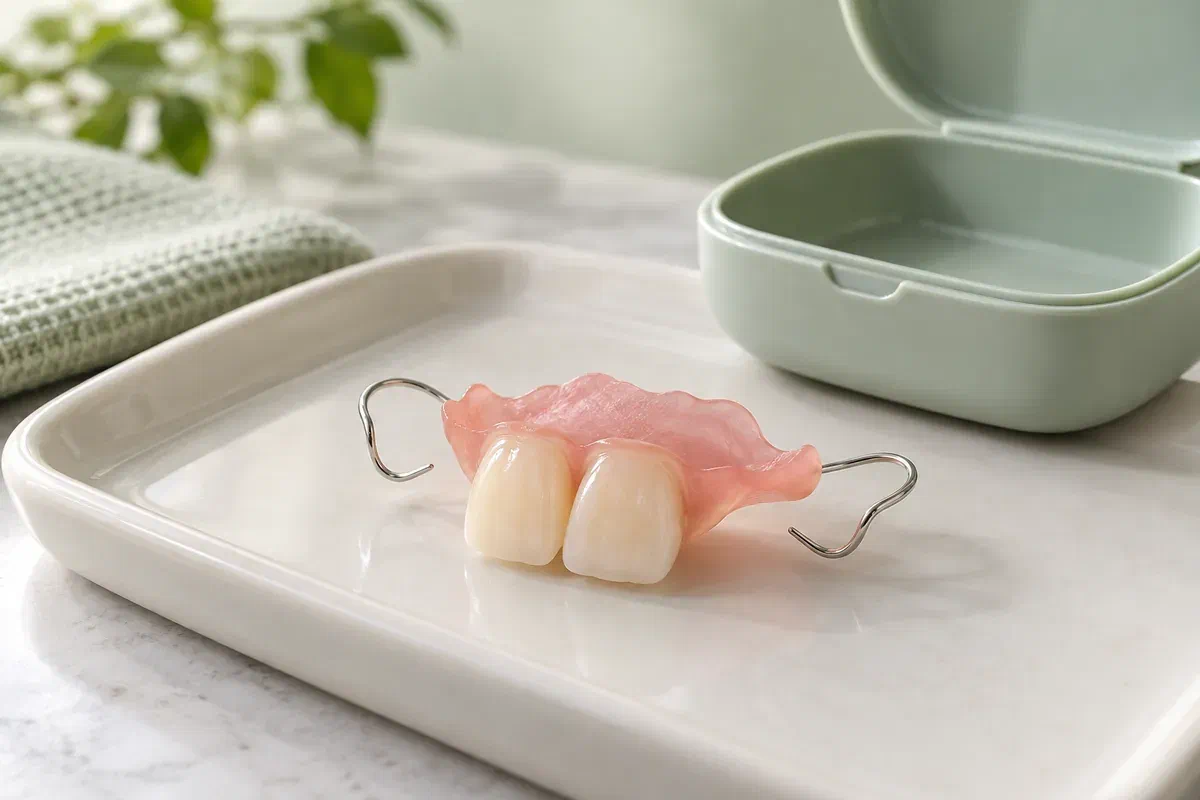
You may hear a small acrylic version called a flipper. That word is handy, but it does not tell you how a given appliance will sit, how secure it will feel or whether you can chew with it. What helps more is deciding together what this stretch of treatment needs to accomplish: a presentable smile, clearer speech, easier meals, or simply time to think without a gap on show.

Those goals are balanced against your remaining teeth, the gums and bone that will carry the partial, any surgery that is planned and your general health. From our Bronte Street practice, we explain the appliance's limits plainly and set a review date. If records from a previous dentist exist, bring them so the interim step fits sensibly with what came before.

Plan an interim replacement with us
Illustrative removable acrylic partial appliance with two replacement front teeth
Is a temporary partial right for this?

Where an interim appliance tends to fit in

An exam helps confirm whether a temporary partial is sensible for you, when it could go in and what will likely change as you wear it. Any active decay, infection or gum disease still needs treatment in its own right.

A tooth or bridge abutment will be removed

Ask about a replacement before the extraction is booked rather than after. An immediate partial is fabricated ahead of time and inserted after removal when the situation allows. Coordinating this takes notice, and it is not guaranteed simply because the extraction is scheduled.

Several stages are still ahead

Healing, periodontal care or an implant consultation can mean a wait before the final tooth is placed. Check whether wearing an appliance in the meantime is safe for you, particularly where a surgical area may need to be protected from pressure.

You would rather not rush the decision

After years with the same restoration, weighing a new bridge, a definitive partial or an implant can take thought. Share your priorities and budget at the outset. Choosing an interim appliance should not lock you into any one final treatment.

Covering a space is not the same as resolving why the tooth failed. Discomfort, infection, gum disease or weak neighbouring teeth need separate assessment and care.

The value of a pause

Breathing room, not a finished result

While the bigger plan comes together, an interim partial can make a missing tooth far less noticeable. Its shade and shape are matched to your smile as closely as practical. Even so, appearance is only one piece. How thick the appliance feels, how well it is retained, how it affects your words and how it meets the opposing teeth all influence day-to-day comfort.

Temporary designs are often not meant to manage every food or to match the steadiness of a completed restoration. Ask what yours is intended to do and what changes would mean it should be checked. A sound plan sets out what you gain in this stage and what will still need care down the road.

You control when it comes out

A removable appliance can be lifted out, as instructed, for cleaning and to give the gums a rest. Placing and removing it takes some learning, so expect a hands-on demonstration at the fitting rather than a leaflet.

Less disruption to routine

If the missing tooth is visible, knowing a replacement is arranged can make the transition easier to face. Mention upcoming occasions early, and leave room for assessment, fabrication and a settling-in period.

A planned moment to reassess

The interim stage gives you a set point to review comfort and the long-term plan as your mouth heals. Agree on who books that visit and what you should bring to it.

Your appointments, in order

Four steps, each with a clear purpose

Share the dates of extractions, specialist visits and any personal events coming up. With that information, we can explain what is realistic to arrange and where the schedule might need some flexibility.

  1. Examine and agree on the aim

    We look at the space or the tooth planned for removal, the supporting gums and bone, and the health of nearby teeth, including any older crowns or bridges. Your medical history and daily priorities are part of the discussion. Additional records or X-rays may be recommended to clarify the plan first.

  2. Capture the shape and confirm costs

    Impressions or other suitable records allow the appliance to be made for your mouth. We go over the proposed design, the estimated fees and the expected fitting sequence. Ask whether adjustments, relines or a later replacement are treated as separate items.

  3. Fit, check and rehearse

    At the fitting appointment, the partial is assessed against your teeth and gums, and any pressure points are reviewed. You practise inserting and removing it with guidance. If it is placed straight after an extraction, you will get instructions covering both the healing site and the appliance.

  4. Follow up as the mouth settles

    A review visit checks comfort, stability and how home care is going. Gum changes during healing can affect the fit, so something comfortable at first may later need attention. This is also when the next stage of treatment is discussed, rather than letting the interim arrangement simply continue.

Day-to-day care

Two things to look after: the appliance and your gums

Use the instructions given for your design. What you are told in the first days after an extraction may differ from the routine once the area has healed, so ask if something does not match what you expected.

Meals with a new partial

Check whether it should be worn while eating and which foods are best avoided. If you are advised to eat with it, begin with easy textures in small bites. Resist the urge to test the replacement front teeth on crusty bread or anything hard.

Your own teeth still need attention

Take the appliance out and clean it with the products suited to its material. Keep brushing and flossing your natural teeth, paying attention to the areas where clasps sit. An appliance offers no protection against plaque or decay on neighbouring teeth.

No home repairs

Tell us about rubbing, rocking, a crack or difficulty seating it. Do not bend the clasps, file the acrylic or use glue from around the house. Bring the appliance and any broken pieces along so the team can see what went wrong.

Patient information: American Dental Association — removable partial denture care

Thinking about the final replacement

A new plan may look different from the old one

The interim partial is a waypoint. What worked years ago may not be the best fit now, so revisit your options as healing progresses, the condition of your remaining teeth becomes clear and you think about upkeep.

For a long-term removable choice

A definitive removable partial

Once the tissues have stabilized, a new partial can be designed. It may differ considerably from the interim appliance. Ask about how it is retained, which teeth support it, whether metal will show and how you clean it.

When supporting teeth are suitable

A new fixed bridge

A bridge is cemented in place and depends on healthy, appropriate support. The state of the neighbouring teeth, the size of the space and your bite all affect suitability, particularly if an earlier bridge has failed. Ask how those teeth would be affected and cleaned.

When an assessment supports it

An implant-supported tooth

An implant requires its own evaluation of your health, bone, gums and the space available. Surgery, healing, cost and long-term maintenance all need discussion. A temporary partial does not confirm suitability or commit you to that route.

Patient information: Leeds Teaching Hospitals — partial dentures and alternatives

Old Milton questions

What people ask after older dental work fails

Bring questions about wearing the appliance, an upcoming extraction or how you will move to the final tooth. Answers are most helpful when they relate to the appliance and sequence planned for you.

(905) 876-4488
My old bridge came loose. Can a temporary partial fill the space?
It may, once the dentist has examined the supporting teeth. Sometimes a bridge can be recemented or repaired; sometimes a supporting tooth needs removal. If replacement is needed, an interim partial is one option to cover the space while healing and longer-term planning happen.
Will the metal clasps show when I smile?
That depends on the design and which teeth it rests against. Some interim partials are mainly acrylic, while others use wire clasps that may be visible. Ask to discuss where the retaining parts would sit and what trade-offs exist between appearance and stability.
How soon after removal can the immediate partial go in?
When an immediate partial has been planned and made in advance, it is often placed at the same appointment as the extraction. Suitability is still confirmed on the day. Ask what to expect if anything changes, and how the first days of wear will be managed.
My partial feels different now than it did at fitting. Why?
As an extraction site heals, the gums and bone remodel, so the appliance may no longer sit the way it first did. Book a fit check. It may need adjusting, relining or eventually replacing, depending on its condition and the plan for the next stage.
Can I go without the partial for a few hours each day?
Often, yes, once the early healing phase is over, and removal for tissue rest is commonly recommended. In the first days after an extraction, though, you may be asked to keep it in for a set period. Follow the specific schedule you were given.
Do I have to decide on an implant before I get a temporary partial?
No. An interim appliance can give you time to compare options. You can raise implants later, and the team can explain what an assessment would involve. Wearing a temporary partial does not oblige you to choose any particular final treatment.
Temporary partials near Old Milton

Bring the old records. We will help plan what comes next.

Book a visit at our Bronte Street clinic to talk through a failing bridge, an extraction you are expecting or an existing space. Bring any past treatment notes, and let us know which daily moments concern you. We will review interim options and the decisions that remain.

Call the clinic about pain, swelling or trouble at a recent extraction site. Online booking requests are for non-urgent matters.

Visit Milton Dental Clinic
Unit 1, 342 Bronte St. S, Milton, ON L9T 5B7
Get directions Clinic hours
Monday–Thursday
11am–7pm
Friday–Sunday
By appointment only

Areas we serve

  • Milton
  • Oakville
  • Mississauga
  • Georgetown
  • Halton Hills
  • Acton
  • Campbellville
  • Brampton
  • Burlington
  • Puslinch
  • Rockwood
  • Erin
  • Caledon
  • Etobicoke
  • Old Milton
  • Bronte Meadows
  • Timberlea
  • Dorset Park
  • Dempsey
  • Clarke
  • Beaty
  • Coates
  • Harrison
  • Scott
  • Willmott
  • Ford
  • Bowes
  • Cobden
  • Walker
  • Mountain View
  • Milton Heights
  • Hawthorne Village
  • Valley View
  • Fallingbrook
  • Nassagaweya
  • Trafalgar
  • Esquesing
  • Nelson
  • Brookville
  • Moffat
  • Glen Williams
  • Norval
  • Limehouse
  • Stewarttown
  • Ashgrove
  • Hornby
  • Silver Creek
  • Speyside
  • Scotch Block
  • North Oakville
  • River Oaks
  • Glen Abbey
  • West Oak Trails
  • Palermo
  • Bronte Creek
  • College Park
  • Joshua Creek
  • Uptown Core
  • Preserve
  • Iroquois Ridge
  • Lisgar
  • Meadowvale
  • Meadowvale Village
  • Churchill Meadows
  • Erin Mills
  • Central Erin Mills
  • Streetsville
  • East Credit
  • Creditview
  • Heartland
  • Sheridan
  • Mount Pleasant
  • Credit Valley
  • Huttonville
  • Churchville
  • Springbrook
  • Northwest Brampton
  • Bram West
  • Fletcher's Meadow
  • Fletcher's Creek South
  • Alton Village
  • Orchard
  • Millcroft
  • Headon Forest
  • Tansley
  • Brant Hills
  • Tyandaga
  • Kilbride
  • Lowville
  • Aberfoyle
  • Morriston
  • Arkell
  • Hillsburgh
  • Freelton
  • Carlisle
  • Waterdown
  • Flamborough
  • Mountsberg

How can we help?

Milton Dental Clinic

Have a question about your smile? Choose the option that works best for you.

For urgent dental concerns, please call.
Messages are reviewed during clinic hours.