

Illustrative consultation about a temporary replacement for missing teeth
Restorative Dentistry

Temporary Partial Dentures in Puslinch

An interim partial replaces one tooth, but it rests on several others. If you are coming from Puslinch, we plan the appliance with the health of your remaining teeth in mind and show you how to keep them clean.

The teeth around the gap

Look after the neighbours

Most of the attention goes to the tooth that is missing. Yet an interim appliance leans on, hooks around or rests against the teeth that remain, and those teeth will matter for whatever replacement you choose later. Put simply, a temporary partial denture lifts out, carries one or more artificial teeth and is meant for a defined period while healing or other treatment is completed. The simple acrylic type is often nicknamed a flipper.

Before choosing a design, it helps to settle what the partial must do for you. Covering a gap for work? Speaking clearly? Managing light meals? We set those needs beside the condition of your natural teeth, the gum tissue under the space, your general health and any surgery still planned. The aim is an appliance that serves its purpose without making the surrounding teeth harder to keep healthy.

Households in rural Puslinch often like to group appointments, and we can talk about how to arrange reviews with that in mind. Every interim appliance still comes with a clear account of its limits and a follow-up date. If a specialist or another dentist is involved, please bring their records so the plan holds together.

Plan a partial that protects your teeth
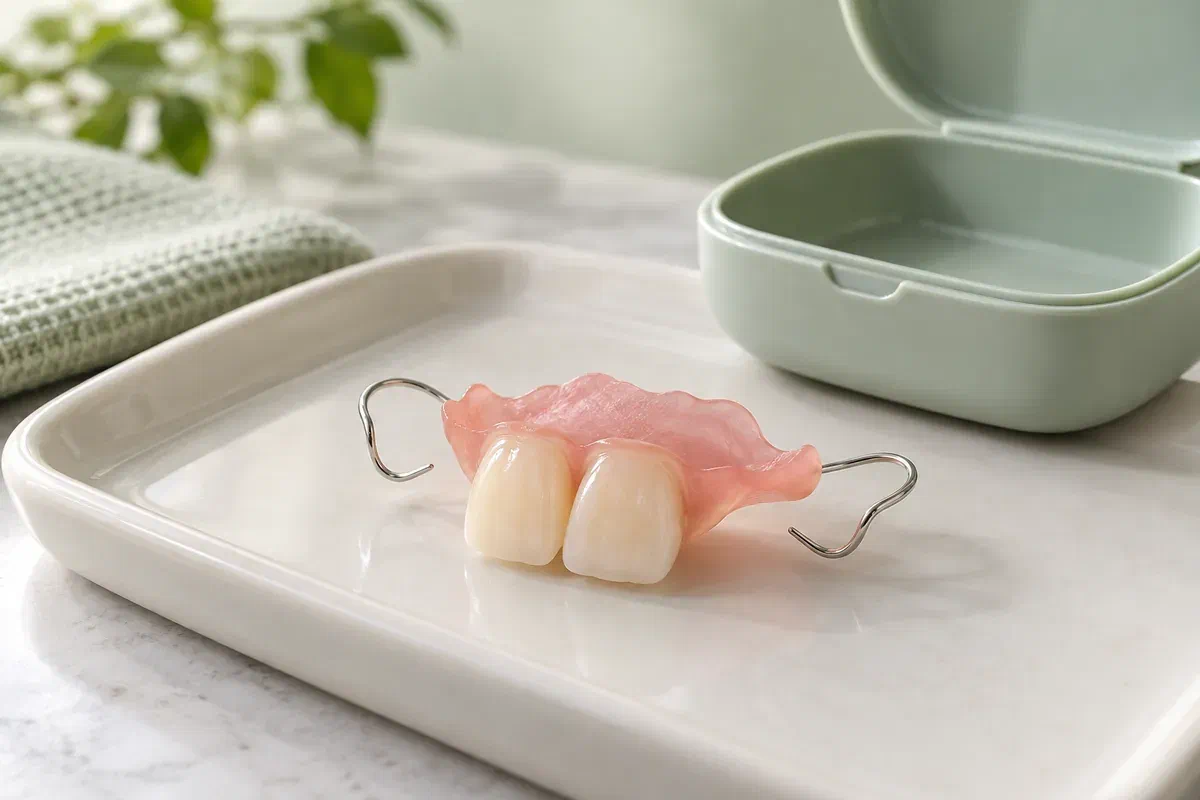
Illustrative removable acrylic partial appliance with two replacement front teeth
Reasons to look into one

When the gap arrives at an awkward time

An examination clarifies whether a temporary partial suits you, when it could go in and what to expect as the mouth changes. It never replaces treating active disease or caring for the remaining teeth.

A visible tooth must be extracted

Ask about replacement before the removal appointment. An immediate partial is made from earlier records and fitted after the tooth comes out, when clinically suitable. This takes coordination, so do not assume one will be ready simply because the extraction is booked.

There is a long road to the final tooth

Healing, gum treatment or an implant consultation can mean a long interim period. Ask whether wearing an appliance throughout is safe for you, and whether any surgical area should be spared from pressure while it heals.

You are weighing your choices

Covering the space can buy time to compare fixed, removable and implant options. Share your priorities and budget early on. The interim appliance should never be treated as a decision about your final treatment.

Filling a space does nothing about the reason the tooth was lost. Infection, discomfort, gum disease or weak neighbouring teeth need proper assessment and care of their own.

What this stage can provide

A useful appliance that asks something of you

In the months before a lasting replacement, an interim partial can make a missing tooth much less noticeable. The replacement is shaded and shaped to suit you. Everyday comfort also hinges on the thickness of the base, how it is retained, how it affects speech and how it meets the opposing teeth.

Interim appliances are generally not intended to manage every food or to feel as secure as a completed restoration. They also add surfaces where plaque can gather, so cleaning matters more, not less. Find out what yours is for and which changes mean it should be checked.

Removable for thorough cleaning

Taking the appliance out as instructed lets you clean it properly and reach every surface of your own teeth. Ask the team to show you how to remove it without straining the clasps.

Something in the space meanwhile

A front-tooth gap is often easier to live through when a replacement has already been arranged. Mention significant dates early, allowing for assessment, fabrication and getting used to it.

A chance to check the supporting teeth

Reviews during the interim stage are a good time to look at the gums and teeth around the clasps, as well as comfort and the long-term plan. Agree who books them.

How it comes together

Planned around the teeth that remain

Tell us about extraction dates, specialist care and times of year when visits are harder. That helps us explain what can be arranged, what might be grouped and where flexibility is needed.

  1. Check the supporting teeth first

    We assess the gap or the tooth to be removed, the gums and bone, and the condition of the teeth that might carry clasps. Your medical history and routines are part of this. Additional X-rays or records may be recommended to confirm those teeth are suitable.

  2. Records, design and costs

    Impressions or other suitable records are taken so the partial can be made for you. We talk about where clasps would sit, the itemized estimate and the order of visits. Ask whether adjustments, relines or a future replacement are separate charges.

  3. Fitting with a cleaning lesson

    At fitting, the appliance is checked against teeth and gums and pressure spots are relieved. You practise inserting and removing it, and we show you how to clean it and the clasp areas. After an extraction, you also get instructions for the socket.

  4. Review the fit and the gums

    Your follow-up looks at comfort, stability and the health of the teeth and gums the partial touches. Healing may change the fit over time. We also discuss the next step so the temporary appliance does not continue without reassessment.

A daily routine

Clean the partial, then clean around it

Follow the guidance written for your appliance. Advice in the days right after an extraction may differ from your routine once healed, so please ask if anything is confusing.

Two separate cleaning jobs

Take the partial out and clean it with the method recommended for its material. Then brush your natural teeth and clean between them, giving extra time to the surfaces where clasps rest, since plaque can collect there.

Mealtimes with care

Confirm whether the appliance should be worn while you eat and what to avoid. When meals with it are allowed, choose soft foods in small pieces. Do not bite hard foods with the replacement front teeth.

Let us adjust it

Call if the partial rubs, rocks, cracks or will not seat. Do not bend clasps, as that can strain both the wire and the tooth it holds. Avoid filing or gluing it, and bring any broken parts with the appliance.

Patient information: American Dental Association — removable partial denture care

Long-term replacement

Each option treats your other teeth differently

The interim partial is one stage and does not decide the outcome. Revisit your preferences as you heal, thinking about the health of neighbouring teeth and the upkeep each option involves.

Removable, designed for the long term

A definitive partial denture

Once the tissues are stable, a long-term partial may be designed, possibly with different clasps or support. Ask about retention, which teeth it would rest on, visible parts and how you would clean it.

If neighbouring teeth are suitable

A fixed bridge

A bridge is fixed in place and is supported by nearby teeth, which usually need preparation. Their health, the span of the gap and your bite decide suitability. Ask what that preparation would mean and how to clean under the bridge.

If an assessment supports it

An implant-supported tooth

An implant does not rely on neighbouring teeth for support, but it needs its own evaluation of health, bone, gums and space. Surgery, healing, fees and maintenance all need discussion. Wearing an interim appliance first proves nothing about suitability and commits you to nothing.

Patient information: Leeds Teaching Hospitals — partial dentures and alternatives

Puslinch questions about daily care

Keeping teeth healthy around an interim partial

Bring questions about cleaning, an extraction you are expecting or the final replacement. Our answers are most helpful when they relate to your actual appliance and plan.

(905) 876-4488
Why does plaque build up around the clasps?
Clasps and the edges of the appliance create small sheltered areas where plaque and food can collect. Removing the partial and cleaning those tooth surfaces carefully each day helps. Your dental team can point out the areas to focus on.
What kind of brush should I use on the appliance?
Use a soft brush, often one designed for dentures, along with the cleanser recommended for your appliance’s material. Ordinary toothpaste can be too abrasive for some materials. Keep a separate brush for your natural teeth.
Can I soak my partial in any denture cleaner?
Not necessarily. Some cleansers are not suitable for appliances with metal parts, and bleach-based products can damage them. Ask which product to use and how long to soak it, and rinse it well before putting it back in.
Does wearing a partial make cavities more likely?
It can if cleaning is not thorough, because the appliance gives plaque more places to sit against your teeth. Good daily cleaning and regular checks help manage that risk. Mention any sensitivity near a clasp at your next visit.
My gums look red under the partial. Should I worry?
Redness or soreness can mean pressure, rubbing or irritation. Leave the appliance out for a while if you have been advised that is safe, and call the clinic. Do not adjust it yourself, especially near a recent extraction site.
How often should my teeth be checked while I wear an interim partial?
Your dentist will suggest a review schedule based on healing and your plan. Regular checks of the supporting teeth and gums are worth keeping, and they can often be arranged alongside fit reviews to reduce separate trips.
Puslinch to Bronte Street

Bring your questions about clasps, cleaning and what comes next.

Set up an appointment with us on Bronte Street to talk about an expected extraction or a space you already have. Bring records from other providers and let us know which days suit your household. We will explain interim options and the decisions still ahead.

Call the clinic about pain, swelling or concerns at a recent extraction site. Online requests are for routine, non-urgent visits.

Visit Milton Dental Clinic
Unit 1, 342 Bronte St. S, Milton, ON L9T 5B7
Get directions Clinic hours
Monday–Thursday
11am–7pm
Friday–Sunday
By appointment only

Areas we serve

  • Milton
  • Oakville
  • Mississauga
  • Georgetown
  • Halton Hills
  • Acton
  • Campbellville
  • Brampton
  • Burlington
  • Puslinch
  • Rockwood
  • Erin
  • Caledon
  • Etobicoke
  • Old Milton
  • Bronte Meadows
  • Timberlea
  • Dorset Park
  • Dempsey
  • Clarke
  • Beaty
  • Coates
  • Harrison
  • Scott
  • Willmott
  • Ford
  • Bowes
  • Cobden
  • Walker
  • Mountain View
  • Milton Heights
  • Hawthorne Village
  • Valley View
  • Fallingbrook
  • Nassagaweya
  • Trafalgar
  • Esquesing
  • Nelson
  • Brookville
  • Moffat
  • Glen Williams
  • Norval
  • Limehouse
  • Stewarttown
  • Ashgrove
  • Hornby
  • Silver Creek
  • Speyside
  • Scotch Block
  • North Oakville
  • River Oaks
  • Glen Abbey
  • West Oak Trails
  • Palermo
  • Bronte Creek
  • College Park
  • Joshua Creek
  • Uptown Core
  • Preserve
  • Iroquois Ridge
  • Lisgar
  • Meadowvale
  • Meadowvale Village
  • Churchill Meadows
  • Erin Mills
  • Central Erin Mills
  • Streetsville
  • East Credit
  • Creditview
  • Heartland
  • Sheridan
  • Mount Pleasant
  • Credit Valley
  • Huttonville
  • Churchville
  • Springbrook
  • Northwest Brampton
  • Bram West
  • Fletcher's Meadow
  • Fletcher's Creek South
  • Alton Village
  • Orchard
  • Millcroft
  • Headon Forest
  • Tansley
  • Brant Hills
  • Tyandaga
  • Kilbride
  • Lowville
  • Aberfoyle
  • Morriston
  • Arkell
  • Hillsburgh
  • Freelton
  • Carlisle
  • Waterdown
  • Flamborough
  • Mountsberg

How can we help?

Milton Dental Clinic

Have a question about your smile? Choose the option that works best for you.

For urgent dental concerns, please call.
Messages are reviewed during clinic hours.