

Illustrative conversation about the appearance of a tooth-coloured repair
Restorative Dentistry

Tooth-Coloured Dental Fillings in Burlington

A thin dark outline has appeared around a white filling, and you want to know what it means. For Burlington households, an examination sorts stain from a failing edge before anything is redone.

That line around the filling

A shadow at the edge

White fillings that looked seamless when they were placed can, over the years, develop a faint brown or grey border. Sometimes that is only surface stain. Sometimes the seal at the edge has started to break down. Telling the two apart is the first job, long before any talk of replacement.

A tooth-coloured filling is a repair made from a material that imitates enamel, usually composite resin, although other tooth-coloured materials are chosen for specific needs. When one is placed or replaced, the dentist considers the tooth's location, the size of the damage, how the filling will be cleaned and how it will look.

When you come in from Burlington, point out the line that concerns you and say whether the tooth has changed in feel as well as colour. The dentist can then explain whether the filling should be watched, refinished, repaired or replaced, and what a new direct filling could and could not achieve compared with other approaches.

Ask about a stained filling edge
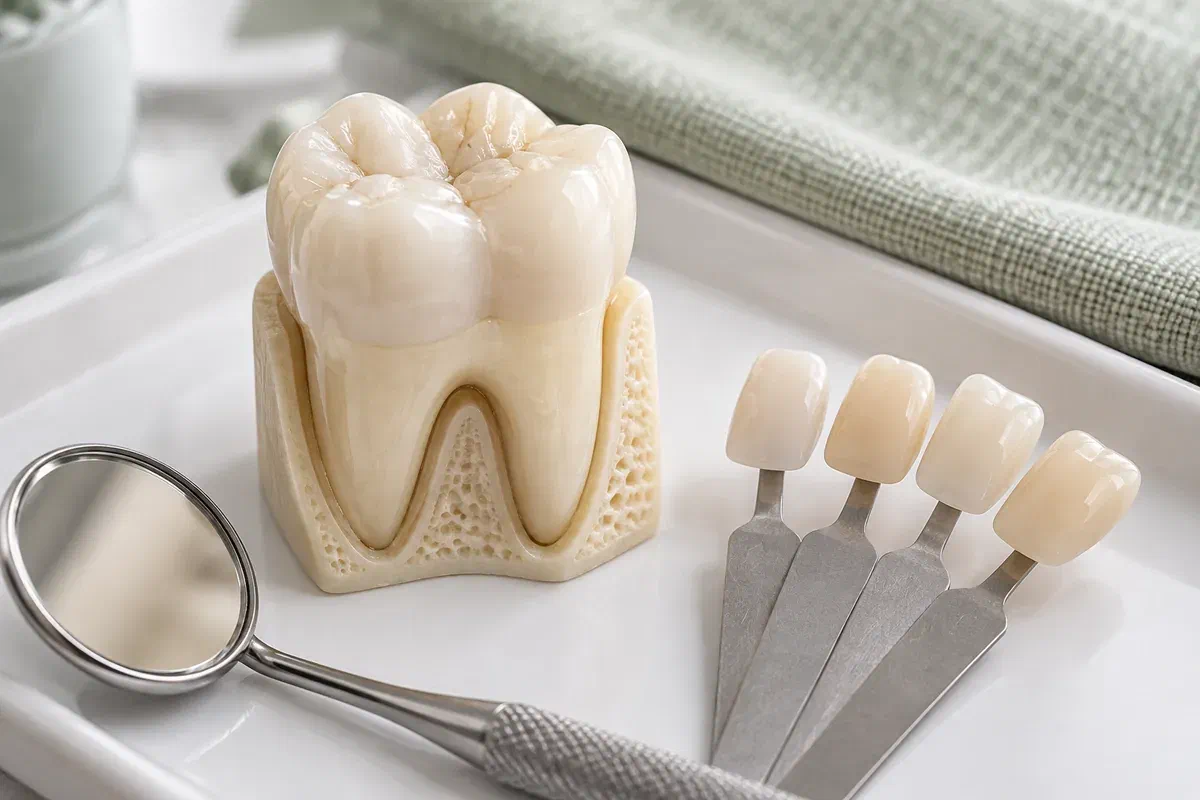
Illustrative molar model beside dental shade samples and a mirror
When to book a check

Changes that deserve an explanation

Colour, texture and sensitivity are useful clues, but none of them is a diagnosis. Share when you noticed the change and whether it affects eating, cleaning or how you feel about your teeth.

New decay that shows

A cavity that needs repair may be restored with tooth-coloured material, depending on how deep it reaches and whether the tooth can be restored reliably. An early change without a hole in the enamel may need only preventive care and watching.

Small breaks or chips

A modest chip can often be bonded. The dentist will want to know why it happened, so mention any injury, repeated chipping, or habits like biting nails or caps. A deeper crack or a larger missing piece may change the advice.

Edges that have darkened

Stain sitting on the surface, discolouration of the material and a leaking margin can each produce a dark line. Examination decides whether to monitor, polish, repair or replace. A colour change alone does not prove the filling has failed.

If a tooth starts hurting without a trigger, pain lingers, or swelling appears, call for an assessment. A filling chosen for colour cannot resolve a problem inside the tooth.

Why material choice matters here

Good looks are only useful if the seal holds

Composite can be selected to suit the shade of the tooth and shaped on the spot, which makes it a practical option for repairs of an appropriate size in visible places. It is also used on some back teeth, where the dentist looks carefully at chewing pressure and how much natural tooth surrounds the filling.

A tight seal depends on conditions during placement. The area must stay dry, deeper repairs are more exacting, and access can be awkward. Where a large filling will take heavy pressure, another design might last better. You are entitled to ask why a given material is right for your tooth.

Patient information: American Dental Association — tooth-coloured fillings

A shade that suits the area

Natural teeth vary in colour and translucency, even across one surface. Discuss which part will be seen when you talk or smile and what match is realistic, particularly if a new filling replaces a broad visible one.

Edges that are easy to clean

Contour and contact affect both your bite and how well you can clean beside the filling. Mention food packing between those teeth before treatment, so the point of contact with the neighbouring tooth is assessed.

Only as much as needed

A direct repair can often address a defined area without covering the whole tooth. How much is prepared depends on the damage and the material, not on making each tooth uniform.

What to expect

Four stages, explained as we go

Mention dental anxiety, past sensitivity, any reaction to dental materials, or interest in whitening. These details affect how treatment is discussed and the order in which it is planned.

  1. Find out what has changed

    The dentist checks the tooth, the existing filling and the area around it. X-rays may be advised if they would answer a clinical question about the margin. You can discuss whether a new filling is needed, the alternatives, and the expected fee before you agree.

  2. Remove and prepare

    If replacement with composite is appropriate, a shade is selected and the old material and any damage are removed. Local anaesthetic may be used. The surface is kept clean and dry enough for the material to bond as intended.

  3. Rebuild the tooth

    Composite is added in layers and hardened with a curing light, while other tooth-coloured materials follow different steps. The dentist creates a contour suited to the tooth, including the contact with the tooth beside it.

  4. Finish the surface

    Polishing smooths the new filling and the bite is checked. Let us know if anything feels like it touches first. You will be given guidance on eating, cleaning, and symptoms to report if they continue or get worse.

Keeping edges sound

Care that protects the seal

A restored tooth still needs daily brushing and cleaning between teeth. Follow the advice for your material, and tell the clinic about discomfort that persists instead of putting up with it.

Give the numbness time

Avoid chewing until full feeling is back, and be careful with hot drinks. Ask about any other eating restrictions for your restoration. A bite judged while your cheek and lip are still numb is not a fair test of the result.

Keep notes on sensitivity

Some teeth are sensitive after a new filling. Note whether cold, pressure or another trigger causes it and how quickly it settles. Have a tooth that feels high, worsening pain, or sensitivity that does not ease looked at rather than tested repeatedly.

Look after the margin

Brush with fluoride toothpaste and clean between teeth as advised, paying attention to the filling's edges. Keep regular examinations. Tell us about clenching, chips or wear, because a replacement that ignores repeated loading may not fix the underlying cause.

If replacement is advised

Three ways a tooth-coloured repair can be made

Ask the dentist to name the material and what it is for. Compare the benefits, drawbacks, upkeep and fees for your tooth, rather than choosing by colour.

For a suitable bonded repair

Composite, placed directly

Direct composite can give a natural-looking result for many defects of the right size. The size of the cavity, moisture control and the forces on the tooth all matter. It does not mean every damaged tooth is suited to the same repair.

When needs are different

Other direct materials

Glass ionomer and related materials may be proposed in selected situations. They differ in strength, look and handling. Ask what the recommendation is meant to solve and whether it is planned as a temporary or definitive repair.

When more support is required

Inlay, onlay or crown

Where a direct filling cannot adequately address the damage or the tooth's structure, an indirect restoration may be considered. It has a different design and fee, and the decision should follow the tooth's condition rather than its colour.

Patient information: FDA — treatment options and restorative materials

About older white fillings

Questions about stains, edges and replacement

Material, shade and the condition of the tooth all play a part. If a dentist in Burlington or elsewhere placed fillings that later stained or broke, mention them, so the plan can be explained alongside your experience.

(905) 876-4488
Can a stained white filling be polished instead of replaced?
Sometimes. If the discolouration sits on the surface and the edges are sound, polishing or refinishing may improve it. If the margin is open or there is decay, a repair or replacement is more likely. The dentist explains which applies after an examination.
Is it possible to repair part of a white filling?
In some cases, yes. If one edge is chipped or stained but the rest of the filling is sound, the dentist may suggest repairing that area rather than removing everything. Whether that is sensible depends on what the examination shows.
How do I know if decay has started under an old filling?
Often you cannot tell by looking or feeling. A dark margin, food catching or new sensitivity can be signs, but none is definite. An examination, sometimes with an X-ray, is how the dentist checks what is happening beneath the edge.
Does replacing a filling make the hole in my tooth bigger?
Removing old material can take a little extra tooth with it, which is one reason sound fillings are not replaced without a reason. The dentist aims to remove only what is needed to deal with the problem and place a reliable new filling.
My silver fillings have dark edges too. Should they come out?
Amalgam often looks grey or dark at the edges without being faulty. The FDA does not suggest routine removal of intact amalgam with no decay unless there is a medical need, partly because removal costs healthy tooth. The dentist can examine the edges and explain the findings.
Will my insurance treat a replacement differently from a first filling?
It may, depending on your plan and the procedure codes submitted. Ask for a pre-treatment estimate and check any frequency limits with your benefits provider. The clinic can clarify which surfaces are being treated so the estimate is easier to follow.

Patient information: FDA — decisions about existing amalgam fillings

Planning a visit from Burlington

Have the filling edge checked

Book time at our Bronte Street practice in Milton to have a stained edge, cavity or chip examined. Tell us what you see and feel, and whether it has changed recently. We will explain the findings and talk through a repair that suits both the look and the health of the tooth.

A sore, broken filling, marked pain or any swelling deserves a phone call. Booking requests sent online are handled as routine.

Visit Milton Dental Clinic
Unit 1, 342 Bronte St. S, Milton, ON L9T 5B7
Get directions Clinic hours
Monday–Thursday
11am–7pm
Friday–Sunday
By appointment only

Areas we serve

  • Milton
  • Oakville
  • Mississauga
  • Georgetown
  • Halton Hills
  • Acton
  • Campbellville
  • Brampton
  • Burlington
  • Puslinch
  • Rockwood
  • Erin
  • Caledon
  • Etobicoke
  • Old Milton
  • Bronte Meadows
  • Timberlea
  • Dorset Park
  • Dempsey
  • Clarke
  • Beaty
  • Coates
  • Harrison
  • Scott
  • Willmott
  • Ford
  • Bowes
  • Cobden
  • Walker
  • Mountain View
  • Milton Heights
  • Hawthorne Village
  • Valley View
  • Fallingbrook
  • Nassagaweya
  • Trafalgar
  • Esquesing
  • Nelson
  • Brookville
  • Moffat
  • Glen Williams
  • Norval
  • Limehouse
  • Stewarttown
  • Ashgrove
  • Hornby
  • Silver Creek
  • Speyside
  • Scotch Block
  • North Oakville
  • River Oaks
  • Glen Abbey
  • West Oak Trails
  • Palermo
  • Bronte Creek
  • College Park
  • Joshua Creek
  • Uptown Core
  • Preserve
  • Iroquois Ridge
  • Lisgar
  • Meadowvale
  • Meadowvale Village
  • Churchill Meadows
  • Erin Mills
  • Central Erin Mills
  • Streetsville
  • East Credit
  • Creditview
  • Heartland
  • Sheridan
  • Mount Pleasant
  • Credit Valley
  • Huttonville
  • Churchville
  • Springbrook
  • Northwest Brampton
  • Bram West
  • Fletcher's Meadow
  • Fletcher's Creek South
  • Alton Village
  • Orchard
  • Millcroft
  • Headon Forest
  • Tansley
  • Brant Hills
  • Tyandaga
  • Kilbride
  • Lowville
  • Aberfoyle
  • Morriston
  • Arkell
  • Hillsburgh
  • Freelton
  • Carlisle
  • Waterdown
  • Flamborough
  • Mountsberg

How can we help?

Milton Dental Clinic

Have a question about your smile? Choose the option that works best for you.

For urgent dental concerns, please call.
Messages are reviewed during clinic hours.