

Illustrative conversation about the appearance of a tooth-coloured repair
Restorative Dentistry

Tooth-Coloured Dental Fillings in Halton Hills

Floss that shreds in one spot, or food that wedges in after every meal, can point to a rough filling or a cavity. From Halton Hills, have the area checked and talk about a tooth-coloured repair.

That spot where food catches

Floss keeps tearing. Here's why it matters.

A strand of floss that frays in the same gap every night is easy to shrug off. Yet a catch like that can come from a rough filling edge, a small break, or decay between teeth. Finding the cause is more useful than switching to a tougher floss, and it often leads to a simple repair.

When a filling is the answer, a tooth-coloured one rebuilds the tooth with a material designed to look like enamel. Composite resin is used most, and other tooth-coloured materials suit some circumstances. Just as important as colour is the shape: a repair has to meet the next tooth properly and be easy to clean.

Across Halton Hills, from Glen Williams to the smaller hamlets, people often notice these spots during their usual routine. Mention exactly where the floss catches and what you feel when you eat. The dentist can explain what a direct filling might correct, when another approach suits better, and what result to expect.

Ask about a spot where food catches
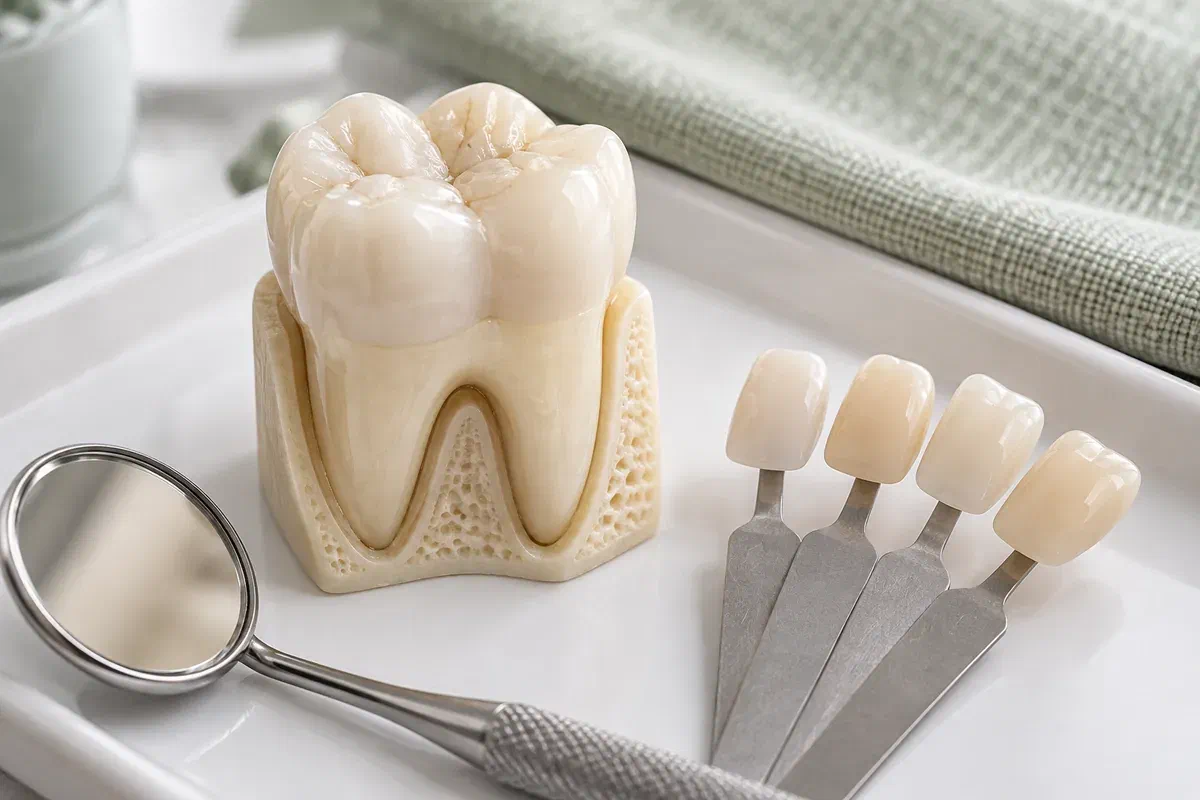
Illustrative molar model beside dental shade samples and a mirror
Clues to bring up

Small annoyances, real reasons

A catch, a stain or a twinge tells part of the story, not all of it. Let us know when it began and whether it changes how you eat, floss or feel when you smile.

Decay between teeth

Decay hiding where two teeth meet is a frequent reason floss snags. If it has formed a cavity, a tooth-coloured filling may be suitable once its depth is known and the tooth looks restorable. Very early changes can sometimes be watched and treated with prevention alone.

A rough or broken edge

A small break can often be smoothed or bonded, but its cause deserves a look. Mention any injury, recurring chips, or biting on hard objects. A deeper crack or a bigger missing piece could lead to a different recommendation.

An old filling with a ledge

Over time, an older restoration may stain, change colour, or develop a step at its margin that traps floss. These are distinct findings with distinct answers: keep an eye on it, smooth it, mend part of it, or redo it. Discolouration by itself is not evidence of failure.

Call promptly if a tooth throbs on its own, pain lingers after eating or drinking, or swelling appears. A neatly shaped filling cannot treat a problem inside the tooth.

Shape, contact and colour

A filling you can clean around

Composite comes in shades that relate to the surrounding enamel and is shaped directly on the tooth, so the dentist can sculpt its contours and contact in the chair. That makes it useful for appropriately sized repairs, including some on back teeth, once biting forces and remaining structure have been evaluated.

Its limits are real. The tooth needs to stay dry during placement, deep or awkward areas are harder to restore, and a broad repair on a hard-working tooth may need a different design. Asking why the proposed material suits your particular tooth is sensible, not awkward.

Patient information: American Dental Association — tooth-coloured fillings

A snug contact point

The spot where two teeth touch should let floss pass with a gentle snap, not shred it or leave a gap. If food catches, tell us before treatment so the contact can be assessed and rebuilt as the filling is shaped.

Colour that suits the tooth

Few teeth are a single even shade; most carry subtle bands and translucent areas. Point out which parts are on view in conversation, and ask how close a blend is likely, especially if the repair spreads across a visible face.

Care sized to the defect

For a contained problem, a direct filling can leave the healthy remainder of the tooth uncovered. The extent of the damage and the chosen material set how much drilling is involved, rather than any aim of uniform teeth.

What the visit involves

Diagnose, prepare, rebuild, refine

Say if you feel nervous, have had sensitive teeth, have reacted to a dental product, or hope to whiten later. Each of those can change what we discuss and how the work is ordered.

  1. Find the cause of the catch

    The dentist examines the tooth, nearby fillings and the gum around them, and may suggest an X-ray if it would answer a question about decay between teeth. Before any work, you hear whether a filling is really called for, what else could be done, and roughly what it will cost.

  2. Prepare the tooth

    If composite is right, a shade is chosen and the area is prepared, with local anaesthetic if needed. Decay or broken material comes out, and the area is isolated from saliva so the new material can bond to it.

  3. Rebuild the contour

    Composite goes in as thin layers hardened by a blue curing light; other materials are handled in their own way. The dentist may use a thin band to help form a firm contact with the neighbouring tooth as the filling takes shape.

  4. Smooth and test

    The surface is polished and the bite checked, and floss may be passed through the contact. Mention anything that feels high. Before you go, you will know how to eat and clean around the new filling, and which symptoms deserve a call if they hang on.

After the filling

Floss should glide now. Notice if it doesn't.

The repaired tooth needs the same daily brushing and flossing as every other. Stick to any instructions given for your material, and get in touch if soreness outstays its welcome.

Wait out the freezing

If you were numbed, skip chewing until sensation returns, and let hot drinks cool first. Check whether your material brings other eating limits. Your bite may feel strange while numb, so judge it once the feeling is back.

Report lasting sensitivity

A filled tooth can be sensitive for a while. Notice whether cold or biting sets it off and how quickly it passes. If the tooth seems to hit first, the ache is increasing, or the sensitivity refuses to fade, have it checked rather than prodding it.

Keep flossing that gap

Brush with a fluoride toothpaste and clean the contact daily. If floss starts catching again, let us know. Checkups give the dentist a chance to inspect the edges, and mentioning clenching, chips or wear helps address forces that could undo a repair.

Possible repairs

From a smoothed edge to a new restoration

It helps to know exactly what is going into the tooth and why. Set the pros, cons, upkeep and cost of each option side by side for this particular repair before deciding.

For a suitable bonded repair

Composite filling

Direct composite can rebuild many suitable defects with a natural look and a carefully formed contact. Cavity size, moisture control and chewing forces affect whether it is appropriate, and it is not a promise that every tooth can be repaired this way.

For particular situations

Glass ionomer or other material

Now and then a different direct material fits better, for example close to the gumline. Each behaves differently in strength, finish and placement. Find out which problem it addresses and whether it is a stopgap or the intended final repair.

If the damage is broader

Inlay, onlay or crown

An indirect restoration may be considered when a direct filling would not properly manage the damage or support the tooth. Its design and fee differ from a filling's, and it is warranted by how much tooth is left, never by colour.

Patient information: FDA — treatment options and restorative materials

Questions about contact and fit

Why the shape of a filling matters

Every answer here leans on the tooth's condition, the material and the shade. If earlier fillings in Halton Hills or elsewhere trapped food or felt rough, say so, and the plan will be explained with that in mind.

(905) 876-4488
Why does floss shred on one tooth but not the others?
A rough filling edge, a chip, tartar or decay between teeth can all catch floss. Sometimes the contact is simply very tight. An examination, and sometimes an X-ray, helps the dentist find the cause and explain whether a repair is needed.
Can a rough filling edge be smoothed without a new filling?
Sometimes. If the filling is otherwise sound, polishing or adjusting the edge may be enough. Decay, a gap or a fracture usually points toward mending or redoing it instead. You will hear which applies once the area has been examined.
Is food getting stuck a sign the filling is failing?
Not always, but it is worth checking. An open contact, a worn edge or a cavity next door can trap food. Leaving it can make the area harder to keep clean, so book an assessment if food catches regularly.
Does a white filling look different from the tooth between my teeth?
On surfaces between teeth, a tooth-coloured filling is usually hard to see. Where it shows, the shade is chosen to suit that area. The dentist can explain how closely the repair is likely to blend with the enamel around it.
Do my silver fillings need replacing to stop food trapping?
Only if they have a problem such as a broken edge or decay. The FDA does not recommend removing intact amalgam without decay unless medically necessary, and replacement takes away tooth structure. The dentist can check the contact and suggest what would help.
How does my insurance decide what to pay for a white filling?
Insurers generally look at the procedure code and the number of surfaces involved, and each plan sets its own rules. A pre-treatment estimate is the clearest way to find out. Check limits with your provider, and ask us to walk through the planned work if it is unclear.

Patient information: FDA — decisions about existing amalgam fillings

From Halton Hills

Show us where the floss catches

A rough edge, a cavity, a chip or a tired old filling can all be looked at during one visit to our Bronte Street practice. Point to where food collects and describe how chewing feels. You will leave knowing what is going on and which repair fits the tooth and your smile.

A broken filling that hurts, strong pain or swelling calls for a phone call. Use the online form for routine, non-urgent visits.

Visit Milton Dental Clinic
Unit 1, 342 Bronte St. S, Milton, ON L9T 5B7
Get directions Clinic hours
Monday–Thursday
11am–7pm
Friday–Sunday
By appointment only

Areas we serve

  • Milton
  • Oakville
  • Mississauga
  • Georgetown
  • Halton Hills
  • Acton
  • Campbellville
  • Brampton
  • Burlington
  • Puslinch
  • Rockwood
  • Erin
  • Caledon
  • Etobicoke
  • Old Milton
  • Bronte Meadows
  • Timberlea
  • Dorset Park
  • Dempsey
  • Clarke
  • Beaty
  • Coates
  • Harrison
  • Scott
  • Willmott
  • Ford
  • Bowes
  • Cobden
  • Walker
  • Mountain View
  • Milton Heights
  • Hawthorne Village
  • Valley View
  • Fallingbrook
  • Nassagaweya
  • Trafalgar
  • Esquesing
  • Nelson
  • Brookville
  • Moffat
  • Glen Williams
  • Norval
  • Limehouse
  • Stewarttown
  • Ashgrove
  • Hornby
  • Silver Creek
  • Speyside
  • Scotch Block
  • North Oakville
  • River Oaks
  • Glen Abbey
  • West Oak Trails
  • Palermo
  • Bronte Creek
  • College Park
  • Joshua Creek
  • Uptown Core
  • Preserve
  • Iroquois Ridge
  • Lisgar
  • Meadowvale
  • Meadowvale Village
  • Churchill Meadows
  • Erin Mills
  • Central Erin Mills
  • Streetsville
  • East Credit
  • Creditview
  • Heartland
  • Sheridan
  • Mount Pleasant
  • Credit Valley
  • Huttonville
  • Churchville
  • Springbrook
  • Northwest Brampton
  • Bram West
  • Fletcher's Meadow
  • Fletcher's Creek South
  • Alton Village
  • Orchard
  • Millcroft
  • Headon Forest
  • Tansley
  • Brant Hills
  • Tyandaga
  • Kilbride
  • Lowville
  • Aberfoyle
  • Morriston
  • Arkell
  • Hillsburgh
  • Freelton
  • Carlisle
  • Waterdown
  • Flamborough
  • Mountsberg

How can we help?

Milton Dental Clinic

Have a question about your smile? Choose the option that works best for you.

For urgent dental concerns, please call.
Messages are reviewed during clinic hours.