

Illustrative consultation about restoring the shape and function of worn teeth
Restorative Dentistry

Worn Tooth Restoration in Campbellville

A bonded edge that chipped, or an old repair on a worn tooth that keeps breaking, deserves more than another quick patch. From Campbellville, you can have the tooth, the bite, and the reasons for the damage looked at together.

When an earlier repair gives way

A chip in last year’s bonding

You had a worn front edge built up, and now a corner has broken off. Or a molar has been patched twice and feels rough again. A chipped restoration on a worn tooth is common, and a single small chip is often fixable. When the same area keeps failing, though, the useful question is why. The answer could lie in the material, the shape, the bite, or the habits the tooth lives with.

Wear has several sources, and they continue after treatment. Clenching and grinding place heavy loads on edges; acid softens the enamel surrounding a repair; hard brushing and biting on objects add their own strain. A restoration rebuilds lost structure but leaves those forces in place. That is why a fresh assessment can be more useful than repeating the same repair.

Bring the broken piece if you kept it, along with any guard you wear and notes about when the problem started. Whether you are coming from Campbellville or elsewhere in Nassagaweya, we will examine the tooth, the surrounding teeth, and how they meet, then explain whether a simple repair, a different design, or a broader plan with more records or specialist input is the sensible next step.

Have a broken wear repair checked
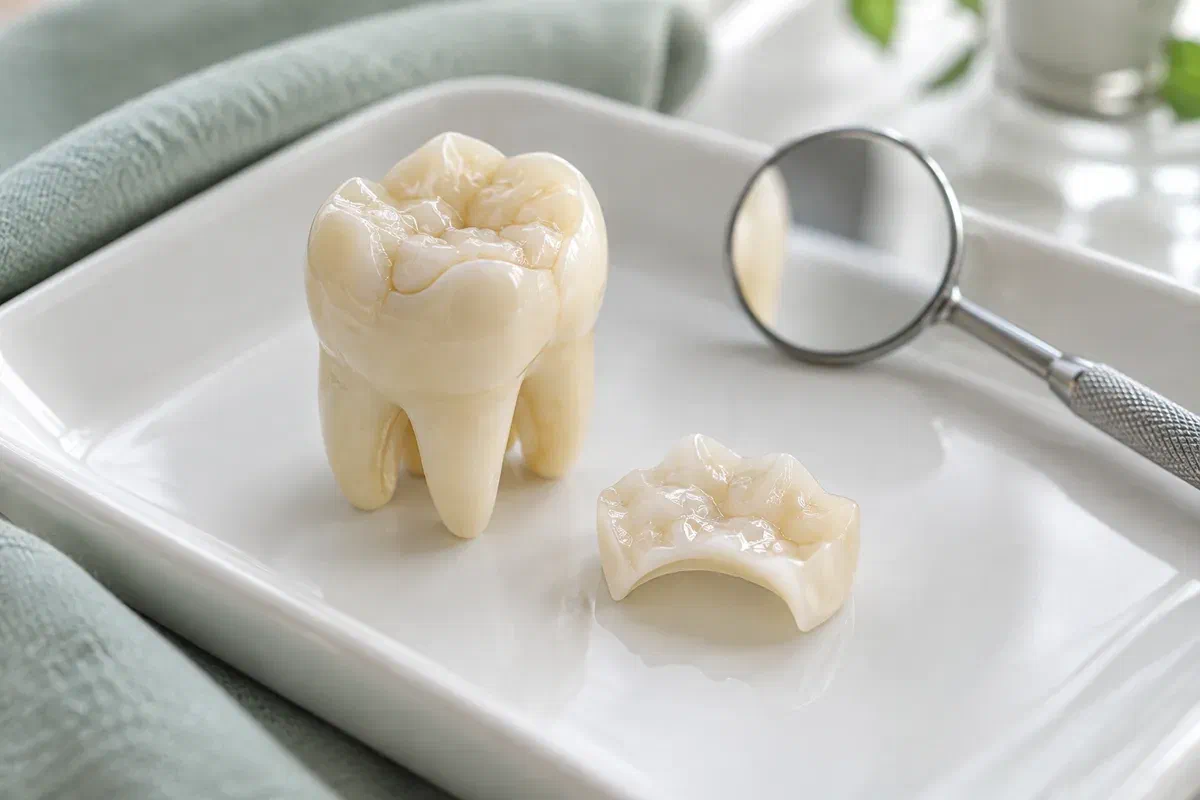
Illustrative molar teaching model and a separate partial-coverage restoration
Signs a repair needs a rethink

Why did it break?

An examination shows whether a chip is a one-off or part of a pattern. Records from when the tooth was first restored, or photos taken since, can help reveal what has changed.

The tooth has become sensitive again

A chipped or worn-through repair can re-expose sensitive dentine, though a crack, leakage under the restoration, or gum recession can feel the same. Note what triggers it and for how long. The cause is confirmed before anything is redone.

The edge breaks in the same place

Repeated chipping often reflects how that tooth meets the opposing teeth during biting or grinding. Tell us when breaks have happened and what you were eating. Space and bite influence whether a different shape or material would cope better.

Several repairs are failing

When more than one restoration keeps breaking, the bite as a whole may need attention. Ask how a revised plan would treat the teeth together, whether protection like a guard would help, and whether the work could be staged. The explanation should be thorough.

If a worn or repaired tooth breaks sharply, cracks, hurts when you bite, or has swelling nearby, call promptly. A new break deserves assessment, not just a quick smooth.

What a revised plan can do

Fix the cause, not only the chip

Bonded composite has a useful advantage: in many cases it can be repaired by adding material, without removing the whole restoration or more healthy tooth. That makes it a sensible starting point for worn teeth, and it means a chip need not be a disaster. When breaks repeat, a different contour, a guard, or a change of material may give the tooth a better chance.

Talk about what a successful repair would look like now. It might be an edge that stays intact between checkups, a smoother feel, or a plan that finally stops the cycle of patching. Ask what limits remain. Teeth exposed to heavy forces may always need closer maintenance than others.

Patient information: Leeds Teaching Hospitals — restorative dentistry services

Repair before replacement

Where the remaining restoration is sound, adding to it can preserve tooth structure. Ask whether the damaged area can be repaired, or why a full replacement is needed. Moving to a larger restoration should have a clear reason.

A shape that handles your bite

The redesigned contour must meet the opposing teeth in a way that spreads load. Discuss how it will affect biting and cleaning, and whether a trial shape or more records would help before a bigger change.

A realistic review schedule

Polishing, adjustment, repair, or replacement may be needed over time, especially with grinding. Knowing how often the tooth will be checked and what to report helps you weigh the whole commitment.

Working out the next step

Investigate, then redesign

A small chip may be fixed in one visit; a pattern of failures usually needs more investigation. We explain the records and appointments that fit what we find before going ahead.

  1. Examine the break and its surroundings

    We ask when and how the damage happened, about grinding, diet, and health history, and examine the restoration, the tooth beneath it, and the bite. X-rays or photos may be used to check for decay, cracks, or other hidden problems.

  2. Explain repair versus redesign

    We compare a straightforward repair with a revised shape, a different material, or added protection. Ask what each would change and why. Fees, the number of visits, and anything that could alter the plan are discussed before you decide.

  3. Rebuild or replace as agreed

    Composite may be added to the existing restoration or replaced, or a restoration may be made off-site and fitted later. The tooth can be frozen if needed and is isolated during bonding. Where several teeth are involved, the work may be staged.

  4. Check bite movements and follow up

    We test how the teeth meet when biting and sliding, then explain care for the area. Reviews look at comfort, durability, and appearance. If you wear a guard, bring it so its fit can be checked against the new shape.

Helping the repair hold

Protect the tooth from what broke it

A better restoration still faces the same mouth. Keep following the advice on grinding, acid, and brushing, wear any recommended guard, and tell the team if part of the plan is hard to stick to.

Give it a careful start

Follow any instructions about eating, and avoid chewing while the area is still numb. Biting directly into very hard foods with a rebuilt edge may be discouraged. Ask how the tooth should feel and what would warrant a call.

Keep the margins clean

Brush twice daily with a fluoride toothpaste and clean between teeth each day. The edges where a restoration meets the tooth can collect plaque and decay. If the new contour makes cleaning harder, ask for a demonstration.

Report early, before it spreads

Contact us about a new chip, roughness, or change in comfort, and keep any fragment. If breakage continues despite changes, the plan may need further reassessment, possibly including a referral for specialist advice.

Patient information: UK oral health guidance — monitoring and managing tooth wear

Choices after a failure

Patch, rethink, or cover

Several responses may be reasonable, and the simplest one is sometimes right. Compare preparation, expected benefit, maintenance, and cost before choosing how to proceed.

For a minor chip that does not need rebuilding

Smooth, protect, and watch

Polishing may be all a minor chip needs, combined with protection such as a guard and a plan to review the area. Ask what would make further treatment necessary and how the edge will be monitored.

When the tooth suits bonding

Repair or rebuild in composite

Composite can be added to a damaged restoration or used to rebuild the area in a revised shape. It can often be repaired again later. Discuss whether a change in contour or approach would help it last better.

When bonding keeps failing or loss is greater

Move to an onlay or crown

If the tooth needs more support, an onlay, a crown, or a coordinated set of restorations may be discussed. These involve more preparation and different upkeep. The reasoning for coverage, and any smaller alternatives, should be explained.

Repairs on worn teeth

Questions after a chip or break

Ask why the restoration failed, what the options are, and what each will need over time. These questions apply to one broken edge or to several failing repairs.

(905) 876-4488
Can a chipped composite repair be fixed without starting over?
Often, yes. If the remaining restoration is well bonded and the tooth underneath is healthy, new material can usually be added. If the repair is loose, stained underneath, or has failed repeatedly, replacement or a different approach may be suggested.
Why does the same tooth keep chipping?
Common reasons include heavy contact with an opposing tooth, grinding, biting hard objects, or a shape that concentrates force on a thin edge. The dentist will look at how your teeth meet in different movements to find a likely cause.
Is porcelain stronger than composite for a worn tooth?
Each material has strengths and limits. Porcelain is usually made outside the mouth and can resist wear well, but it often requires more preparation and can be harder to repair. Composite is easier to adjust and repair. The right choice depends on the tooth and bite.
Should I stop eating certain foods after a worn tooth is rebuilt?
You may be advised to avoid biting directly into very hard items with a restored front edge, and to avoid chewing ice or hard candy. Most normal foods are fine. The dentist will give advice specific to the restoration.
Do I need a guard if my repairs keep breaking at night?
If grinding or clenching seems to be the cause, a guard may be recommended to help protect the teeth and restorations. It does not change the habit itself. Bring any existing guard so its fit and condition can be checked.
If a repair breaks while I am at home in Campbellville, what should I do first?
Call the clinic and describe the problem. Keep any piece that came off and avoid chewing on that side. A small, painless chip can often wait for a planned visit, while pain, swelling, or a large break should be seen sooner.
Campbellville worn tooth repairs

Stop patching the same tooth

Visit our Bronte Street practice to have a chipped or repeatedly failing repair on a worn tooth assessed. Bring the broken piece, any guard you wear, and your questions. We will explain why it broke and whether the area needs repair, redesign, protection, or monitoring.

Phone us for severe pain, swelling, or a large break. Online requests are meant for non-urgent care.

Visit Milton Dental Clinic
Unit 1, 342 Bronte St. S, Milton, ON L9T 5B7
Get directions Clinic hours
Monday–Thursday
11am–7pm
Friday–Sunday
By appointment only

Areas we serve

  • Milton
  • Oakville
  • Mississauga
  • Georgetown
  • Halton Hills
  • Acton
  • Campbellville
  • Brampton
  • Burlington
  • Puslinch
  • Rockwood
  • Erin
  • Caledon
  • Etobicoke
  • Old Milton
  • Bronte Meadows
  • Timberlea
  • Dorset Park
  • Dempsey
  • Clarke
  • Beaty
  • Coates
  • Harrison
  • Scott
  • Willmott
  • Ford
  • Bowes
  • Cobden
  • Walker
  • Mountain View
  • Milton Heights
  • Hawthorne Village
  • Valley View
  • Fallingbrook
  • Nassagaweya
  • Trafalgar
  • Esquesing
  • Nelson
  • Brookville
  • Moffat
  • Glen Williams
  • Norval
  • Limehouse
  • Stewarttown
  • Ashgrove
  • Hornby
  • Silver Creek
  • Speyside
  • Scotch Block
  • North Oakville
  • River Oaks
  • Glen Abbey
  • West Oak Trails
  • Palermo
  • Bronte Creek
  • College Park
  • Joshua Creek
  • Uptown Core
  • Preserve
  • Iroquois Ridge
  • Lisgar
  • Meadowvale
  • Meadowvale Village
  • Churchill Meadows
  • Erin Mills
  • Central Erin Mills
  • Streetsville
  • East Credit
  • Creditview
  • Heartland
  • Sheridan
  • Mount Pleasant
  • Credit Valley
  • Huttonville
  • Churchville
  • Springbrook
  • Northwest Brampton
  • Bram West
  • Fletcher's Meadow
  • Fletcher's Creek South
  • Alton Village
  • Orchard
  • Millcroft
  • Headon Forest
  • Tansley
  • Brant Hills
  • Tyandaga
  • Kilbride
  • Lowville
  • Aberfoyle
  • Morriston
  • Arkell
  • Hillsburgh
  • Freelton
  • Carlisle
  • Waterdown
  • Flamborough
  • Mountsberg

How can we help?

Milton Dental Clinic

Have a question about your smile? Choose the option that works best for you.

For urgent dental concerns, please call.
Messages are reviewed during clinic hours.