

Illustrative consultation about restoring the shape and function of worn teeth
Restorative Dentistry

Worn Tooth Restoration in Old Milton

Decades of chewing leave their mark, and older fillings wear alongside the enamel around them. For Old Milton smiles with a long history, we sort out which changes need repair and which simply need watching.

Old Milton smiles with a long history

What have the years taken from your teeth?

In a mouth that has been chewing for sixty or seventy years, some flattening is expected. The question is whether the loss has started to matter: a lower front tooth that chips easily, a molar whose old filling now sits proud of thinned enamel, or a smile that looks shorter than it used to. A worn tooth is rebuilt when a reason like that exists, not simply because wear can be seen.

Long histories usually mean mixed causes. Years of grinding, a period of reflux, a fondness for citrus, or a firm sideways brushing style can each have contributed, and existing crowns or fillings change how forces land on neighbouring teeth. Rebuilding replaces structure, yet it cannot undo those influences, so part of our job is spotting which ones are still active.

Tell us what you have noticed and what you would like to change. Bring the name of a previous dentist if records might help. Our Bronte Street practice sits a short way from Milton’s historic downtown, and after an examination we can say whether one tooth needs a modest repair or whether a broader plan, possibly with specialist input, deserves a conversation.

Talk to us about a worn tooth
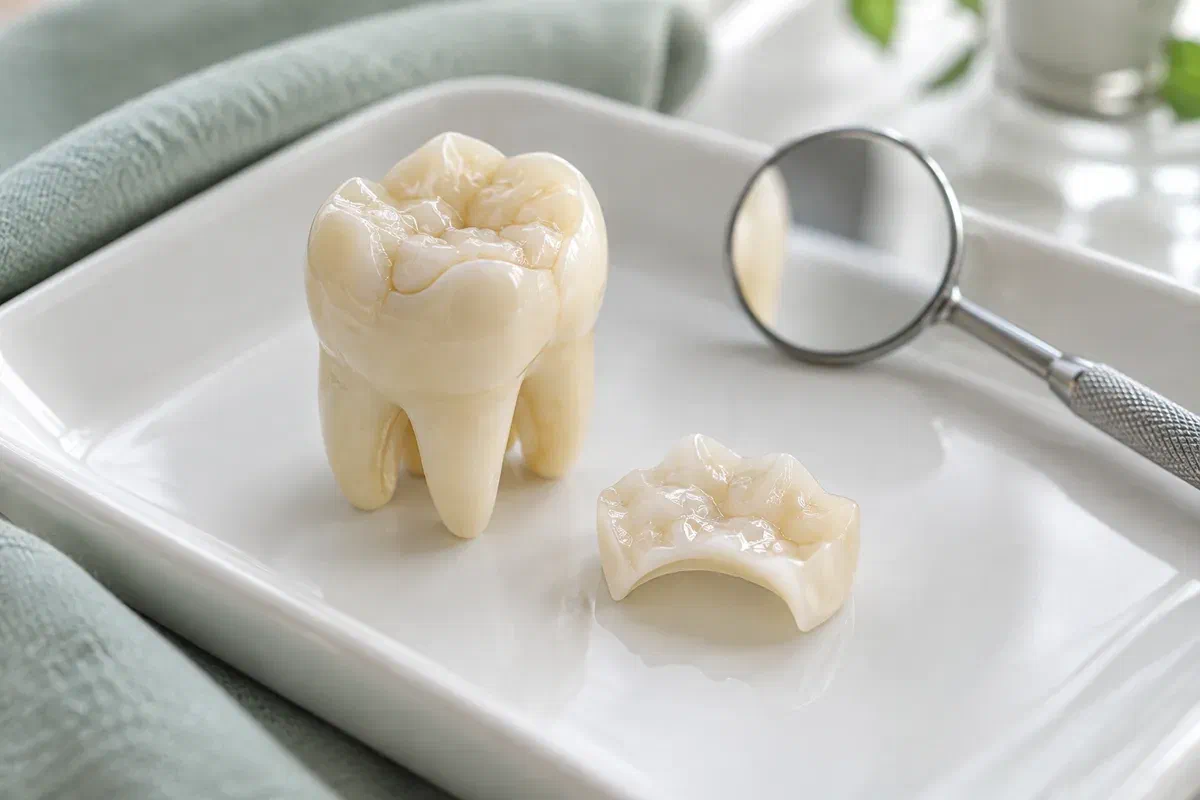
Illustrative molar teaching model and a separate partial-coverage restoration
Changes that deserve a look

Is the wear causing a problem yet?

Some worn teeth can be left as they are for years, while others need help sooner. An examination separates the two. If you have older photos or treatment summaries, they can show how much has changed and how fast.

A tooth now reacts to temperature

Wear can uncover the inner layer of a tooth, though receding gums, leaking fillings, and fine cracks cause similar twinges. Notice whether hot or cold sets it off and how long the feeling stays. Those details help the dentist decide whether wear is truly to blame.

Old work and natural teeth no longer line up

As enamel wears, an older filling or crown can end up higher or lower than the tooth around it, and chewing may feel uneven. Describe where food catches. Space between the upper and lower teeth affects which surfaces could be rebuilt and how.

Several teeth have changed together

Broad wear often raises questions about the bite as a whole. Ask how separate repairs would work together, whether treatment could be spread over time, and how your teeth will meet when it is done. A plan touching many teeth should be explained in plain terms.

If a worn tooth cracks, begins to hurt when you bite, or the gum near it swells, have it seen soon. A fresh symptom is not just another sign of age.

Why restore at all

Comfort and strength before perfection

For a mature smile, the most useful repair is often a modest one. Adding bonded material to a thinned edge, or covering a weak cusp beside an old filling, can make a tooth more comfortable and easier to chew with. Where it fits the case, additive work is usually weighed first, though it still needs a sound diagnosis and a realistic view of maintenance.

It helps to name the goal together. You might want a back tooth that no longer catches, front edges that look less ragged, or a first stage in a longer sequence of care. Expect an honest account of limits, too. Restorations age, as natural teeth do, and they may need attention again later.

Patient information: Leeds Teaching Hospitals — restorative dentistry services

Keeping as much of your own tooth as possible

Every option removes a different amount of structure, and older teeth often have less to spare. Ask what each approach would take away and why. A restoration that covers more is not automatically the better one.

Shapes that work with existing dental work

A new contour must meet opposing teeth and sit well beside crowns, bridges, or fillings already in place. Ask how it would affect chewing and cleaning, and whether further records or a trial would help before a bigger change.

A clear idea of future care

Polishing, small adjustments, repairs, or replacement may be needed down the line. Understanding how follow-up is arranged and what to watch for lets you judge the whole commitment, not only the first visit.

Step by step

A plan built around your history

Restoring one tired edge is a very different job from reworking several teeth and old restorations. How many visits and which records you need depend on the findings, and we explain the order before starting.

  1. Review the story and examine the mouth

    We go over symptoms, medications, health conditions, and habits such as clenching, then examine the teeth, gums, existing dental work, and bite. X-rays, photos, or models may be recommended if they would make the condition of a tooth clearer.

  2. Set out the realistic options

    Monitoring, preventive steps, and suitable restorations are compared side by side. You can ask which teeth would be involved and what each repair is meant to do. Fees, stages, and anything that could alter the sequence are discussed before you commit.

  3. Place or fit the restoration

    Bonded composite may be built up directly, or a restoration may be made in a lab and fitted later. Freezing and isolation of the tooth are used as needed. When many teeth are involved, work can be phased so each change is tried before the next.

  4. Test the bite and plan follow-up

    We check comfort and how the teeth come together, then explain how to look after the area. Later reviews consider function and appearance. If you wear a denture, guard, or other appliance, ask whether it should be checked against the new shape.

Once the tooth is rebuilt

Small routines protect the repair

The restoration handles the missing structure. Everyday habits handle the rest. Keep following the advice on acidic foods, grinding, cleaning, or other factors found during assessment, and say so if any of it is difficult.

Start with the specific guidance

Your instructions may cover what to eat at first or how to treat a temporary restoration. If the area was frozen, hold off on chewing until normal feeling is back. Ask how the bite should feel and when an odd sensation is worth reporting.

Brush and clean between with care

A fluoride toothpaste twice a day and a gentle technique help protect both the repair and the enamel around it. Floss, picks, or interdental brushes reach the contacts. Restored teeth can still decay, so ask for tips if the new shape is hard to clean.

Report a chip early

Let the clinic know about chipping, a sharp spot, or new discomfort, and keep any piece that breaks off. Bring your guard if you have one. A repair that keeps breaking may need a different design rather than another patch.

Patient information: UK oral health guidance — monitoring and managing tooth wear

Options for a worn tooth

Sometimes less is the right amount

Several paths can be sensible, and leaving a stable area alone is one of them. Compare how much tooth each choice removes, what it should achieve, how it is maintained, and what it costs.

When repair is not yet needed

Keep watch and protect

Wear that is stable and trouble-free can be checked at regular visits while contributing factors are managed. Ask how any progression will be recorded and what would signal that treatment is due. Monitoring should feel like a plan, not a postponement.

Adding back selected surfaces

Direct bonded composite

Composite resin can restore chosen edges and contours when enough tooth remains and the bite allows. It can often be touched up later, but it has limits under heavy force. Suitability is judged surface by surface.

For more extensive structural loss

Onlays, crowns, or combined work

When damage is deeper, an onlay, a crown, or several restorations planned together may be considered. Each asks different things of the tooth and of future maintenance. Ask why coverage is advised and whether a smaller option could do the same job.

Common questions

What people ask about worn teeth

Questions about purpose, appearance, and long-term care help in every case, from a single chipped edge to a plan involving many teeth and older restorations.

(905) 876-4488
My old fillings are worn too. Can they be part of the same plan?
Often, yes. Worn or leaking fillings may be repaired or replaced as part of restoring the surrounding tooth, and their condition can affect which approach makes sense. The dentist will look at each one and explain whether it can stay, needs attention, or should be included in a larger restoration.
Is it worth restoring worn teeth later in life?
Age alone does not decide it. What matters is whether the wear is causing discomfort, weakening a tooth, affecting chewing, or bothering you. Your general health and how much treatment you want are part of the discussion. Monitoring is a reasonable choice when no clear need exists.
Could my medications be playing a part in the wear?
Some medicines reduce saliva, and a dry mouth gives teeth less protection from acids. Bring a current list to your visit. The dentist may suggest ways to manage dryness, and any change to a prescription should be discussed with your physician or pharmacist, not made on your own.
Will bonded material look different from my natural teeth?
Composite is chosen to blend with surrounding teeth, but an exact match cannot be promised, and older teeth often have varied shades. Discuss the look you want. For larger changes, ask whether a trial shape can be assessed before the final restoration is placed.
Why would a repaired worn tooth chip again?
Heavy biting forces, grinding, the position of the repair, or the material itself can all play a part. A single small chip may be fixable. When chipping keeps happening, the design or the forces on it deserve a fresh assessment rather than a repeat of the same repair.
Do I need to book separate visits for each worn tooth?
Not necessarily. If you live near Milton’s downtown or elsewhere in town, ask whether several small repairs can be done together. Larger plans are often staged for good clinical reasons, and the dentist can explain how the visits would be spaced and what each one involves.
Worn tooth restoration in Old Milton

Bring us the tooth that has been bothering you.

Book a visit at our Bronte Street practice to look at worn edges, flattened molars, or older restorations that no longer fit well. Bring any appliance you wear and your questions about comfort and appearance. We will explain what we see and what, if anything, needs repair.

Please phone for severe pain, swelling, or a tooth that has just broken. Online requests are for routine appointments.

Visit Milton Dental Clinic
Unit 1, 342 Bronte St. S, Milton, ON L9T 5B7
Get directions Clinic hours
Monday–Thursday
11am–7pm
Friday–Sunday
By appointment only

Areas we serve

  • Milton
  • Oakville
  • Mississauga
  • Georgetown
  • Halton Hills
  • Acton
  • Campbellville
  • Brampton
  • Burlington
  • Puslinch
  • Rockwood
  • Erin
  • Caledon
  • Etobicoke
  • Old Milton
  • Bronte Meadows
  • Timberlea
  • Dorset Park
  • Dempsey
  • Clarke
  • Beaty
  • Coates
  • Harrison
  • Scott
  • Willmott
  • Ford
  • Bowes
  • Cobden
  • Walker
  • Mountain View
  • Milton Heights
  • Hawthorne Village
  • Valley View
  • Fallingbrook
  • Nassagaweya
  • Trafalgar
  • Esquesing
  • Nelson
  • Brookville
  • Moffat
  • Glen Williams
  • Norval
  • Limehouse
  • Stewarttown
  • Ashgrove
  • Hornby
  • Silver Creek
  • Speyside
  • Scotch Block
  • North Oakville
  • River Oaks
  • Glen Abbey
  • West Oak Trails
  • Palermo
  • Bronte Creek
  • College Park
  • Joshua Creek
  • Uptown Core
  • Preserve
  • Iroquois Ridge
  • Lisgar
  • Meadowvale
  • Meadowvale Village
  • Churchill Meadows
  • Erin Mills
  • Central Erin Mills
  • Streetsville
  • East Credit
  • Creditview
  • Heartland
  • Sheridan
  • Mount Pleasant
  • Credit Valley
  • Huttonville
  • Churchville
  • Springbrook
  • Northwest Brampton
  • Bram West
  • Fletcher's Meadow
  • Fletcher's Creek South
  • Alton Village
  • Orchard
  • Millcroft
  • Headon Forest
  • Tansley
  • Brant Hills
  • Tyandaga
  • Kilbride
  • Lowville
  • Aberfoyle
  • Morriston
  • Arkell
  • Hillsburgh
  • Freelton
  • Carlisle
  • Waterdown
  • Flamborough
  • Mountsberg

How can we help?

Milton Dental Clinic

Have a question about your smile? Choose the option that works best for you.

For urgent dental concerns, please call.
Messages are reviewed during clinic hours.