
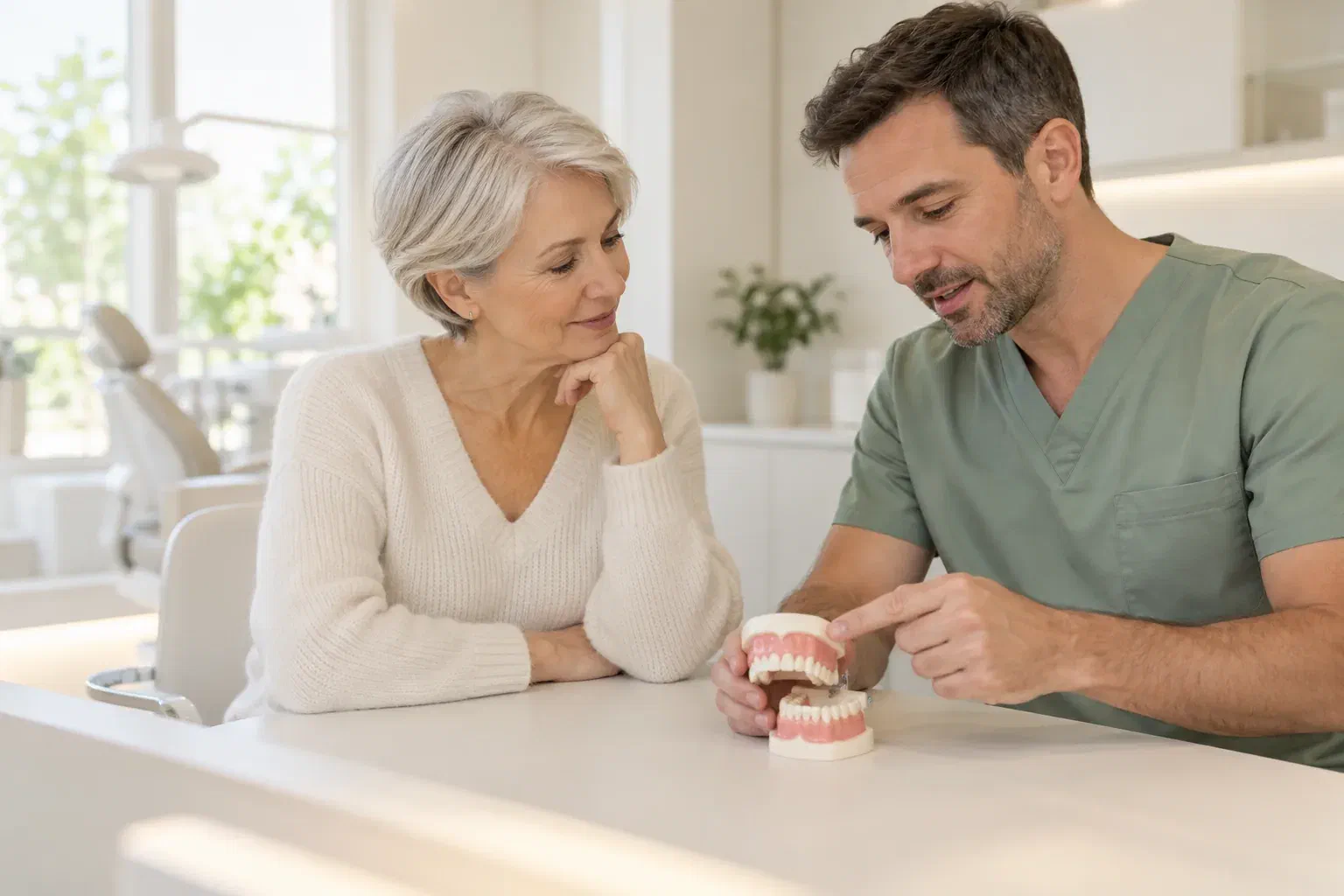
Illustrative patient and clinician discussing upper and lower tooth contacts using a dental model
Specialized Care

Bite and Occlusion Assessment in Rockwood

Your jaw clicks when you yawn, and someone has suggested your bite is to blame. Before accepting that, it helps to know what a click does and does not mean. From Rockwood, you can have your jaw, teeth and contacts examined together, with any next step kept cautious and well explained.

Clicks, pops and the bite question

A noise in the jaw is not a verdict on your teeth.

Many people first think about their bite because of a sound: a click on opening wide, a pop while chewing, a grating feeling near the ear. It is natural to connect that with the way the teeth fit. Occlusion describes how upper and lower teeth contact each other, and a proper assessment looks at that alongside the jaw joints, the muscles, the teeth and any dental work.

Those parts can be involved separately or together. A painless click, a jaw that aches after chewing, a tooth that hurts when you bite and a filling that sits high are distinct complaints, even though they live in the same area. Treating them as one thing risks aiming care at the wrong target, so the visit begins by teasing them apart.

Tell us when the sound started, whether it hurts, and whether your jaw ever catches, locks or struggles to open fully. Mention dental work, an injury or a change in a guard that came before it. We will explain the findings, be straightforward about what remains unclear and help you choose a next step, without assuming your teeth need to be reshaped.

Ask about a clicking jaw
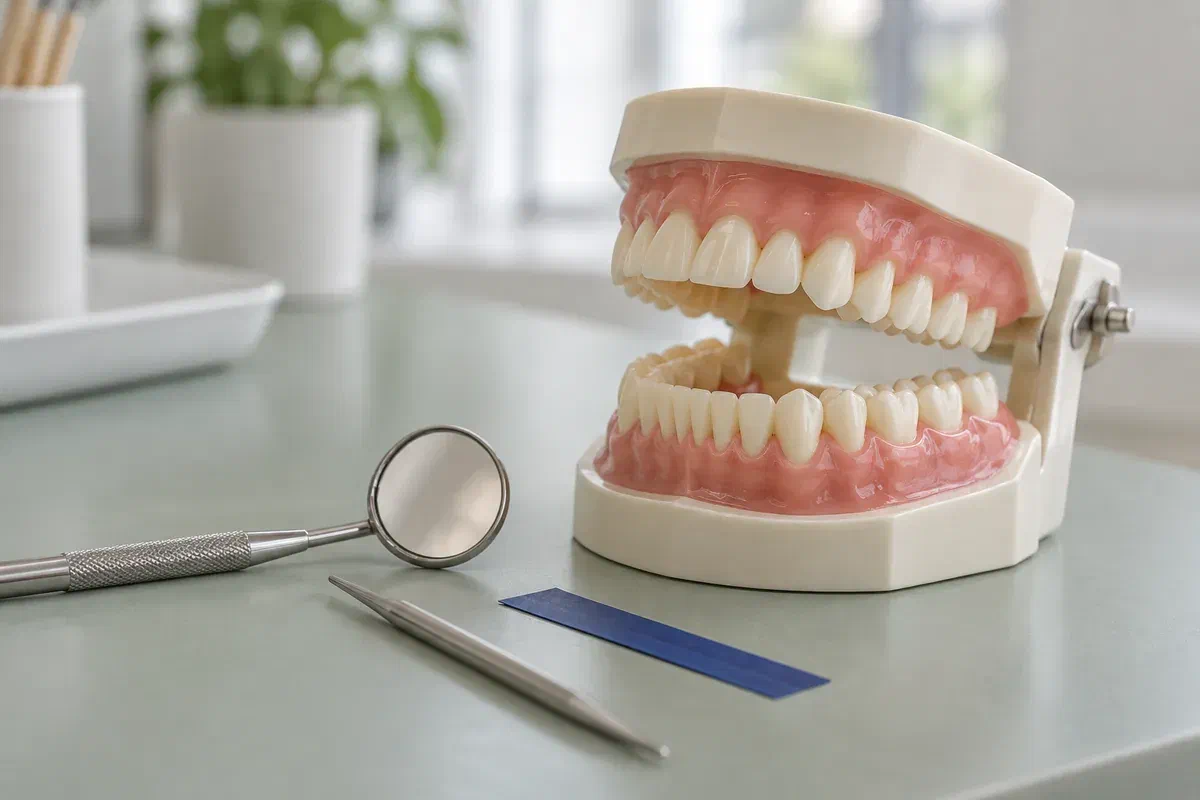
Illustrative hinged dental model beside a mirror and blue bite-marking paper on a pale surface
What people from Rockwood ask about

Sound, pain and fit are three different things.

Notice whether the jaw sound comes with discomfort, whether eating or opening is limited and whether your teeth feel different when they meet. There is no need to keep clicking the jaw or pressing a sore tooth to check.

Teeth that meet differently since dental work

If a new filling, crown or bridge feels high, aches when you chew or simply feels foreign, say which tooth. This is a separate question from a jaw sound. Recent work should go back to the office that placed it for review rather than being left to wear in.

Worn or chipped teeth alongside the jaw noise

Flat edges and chips can sit alongside clicking without one causing the other. Bring any guard or retainer, and the history of repairs. The question is whether the way your teeth meet accounts for that wear, or whether habits or diet play a bigger part. A worn facet shows contact, not a diagnosis.

Pain, catching or limited opening

A click with pain, a jaw that catches or locks, or difficulty opening wide deserves careful description. The joints and muscles may need their own assessment, and sometimes a different kind of clinician. Jaw symptoms on their own do not justify reshaping teeth.

Research does not support assuming that a bad bite is behind temporomandibular disorders, and painless jaw sounds are common. If jaw pain is part of your concern, ask how the problem is being diagnosed and why the suggested approach fits.

Why it is worth sorting out

Peace of mind, or a clearer path.

Often the most valuable result is understanding. The examination sets your symptoms beside findings that can be explained: whether the jaw moves smoothly, whether the click is painful, whether a tooth or restoration is involved, and what is still uncertain. For many people, learning that a painless click needs no treatment is a real relief.

Where something does need attention, the assessment shows how much. Checking one high filling, protecting teeth from grinding and changing many contacts are not the same. For any suggestion, ask what it aims to fix, what else could be tried and what its limits are, and whether it addresses the symptom that worries you.

Separating joint, muscle and tooth

Findings may point to a tooth or restoration, to the muscles or joints, or to something needing more assessment. Knowing which keeps care targeted and avoids a broad plan without clear reasoning. If more than one issue is present, ask which comes first.

A baseline for the jaw and the teeth

Agree on what should be noted now, perhaps how wide you can open, whether the click hurts and how chewing feels. Decide what would count as improvement. Later visits then measure something concrete.

Caution about irreversible steps

If reshaping teeth is suggested for a jaw complaint, ask why, what would be removed and what the alternatives are. Weigh uncertainty against the hoped-for benefit. Another opinion before any permanent change is entirely reasonable.

During the visit

Jaw first, then teeth, then a conversation.

The assessment is shaped around your concern. The records needed vary, and attending an examination is not agreement to have teeth or restorations adjusted.

  1. Describe the sound and any symptoms

    Explain when the click began, whether it is painful, and whether opening, chewing or yawning is affected. Mention recent dental care and anything you have tried. If your teeth also feel different, describe that as a separate concern.

  2. Observe jaw movement and examine teeth

    The clinician may watch how your jaw opens and closes, feel the muscles, and check the teeth and restorations. Thin coloured paper can show where teeth touch. Each finding is interpreted with the others rather than on its own.

  3. Discuss whether more input is needed

    For some concerns, x-rays, tooth tests or another clinician’s assessment may add something; for others they will not. The decision follows from what was found. Not every jaw sound calls for imaging or special devices.

  4. Agree on a cautious next step

    That might be reassurance and monitoring, conservative care, a restoration review or a referral. Any adjustment to teeth is a separate decision that is reviewed afterward. If symptoms remain unexplained, the plan should be further investigation rather than experimentation.

In the weeks ahead

Gentle habits, honest notes.

An examination by itself rarely needs any recovery. Your instructions will differ if care was given, a guard was looked at or another assessment is being lined up.

Leave the teeth and guard alone

Please do not file teeth, trim a filling or reshape a guard yourself, and avoid deliberately clicking the jaw to test it. If something feels worse, contact the team and explain. Keep any appliance available for review.

Note what changes

Record whether the click, any discomfort and chewing feel better, unchanged or worse, and whether a new symptom has started. Short notes help more than repeated testing. Ask at the visit when a persistent symptom should be rechecked.

Bring everything to the next visit

Keep any treatment summary, referral details and appliance instructions together. Tell the clinician about care you have received elsewhere, including from other health professionals. A clear record keeps the next appointment focused.

If something needs doing

Start with the least you need.

Ask which problem each option is aimed at and what supports it. A jaw sound, a high contact and a painful joint are separate issues with separate possible answers.

When findings are minor or limited to one tooth

Reassurance, monitoring or a restoration check

A painless click may simply be watched, while a filling that sits high may need review. Ask what any change would achieve, what material it affects and how it will be followed. The examination should decide, not the sound or sensation alone.

When muscle strain or grinding seems involved

Conservative care or appliance review

If clenching, grinding or an existing guard plays a part, it can be assessed and the purpose of any new care explained. Guards can protect teeth, but they are not a cure for every jaw complaint. Ask about fit, how to wear it, its limits and how you will judge it.

When jaw symptoms persist or are complex

Further dental or specialist assessment

Ongoing pain, locking or restricted opening may warrant another opinion. Find out what the referral should answer and how to look after yourself in the meantime. Permanently changing the bite is not an accepted routine treatment for jaw joint pain.

Patient information: NIDCR — bruxism assessment, symptoms, and protection of teeth

Rockwood jaw and bite questions

What does a click actually mean?

Jaw, teeth and dental history are read side by side. The visit can clarify options even if the answer is that nothing needs to change.

(905) 876-4488
Someone told me my jaw clicks because my bite is off. Is that true?
Not necessarily. Jaw sounds are common and can have various explanations, and research does not support assuming a bad bite is the cause. An assessment looks at the jaw and the teeth separately before drawing any conclusion.
When does a clicking jaw become something to have checked?
It is worth mentioning if the click becomes painful, if your jaw catches or locks, if opening becomes limited or if the pattern changes. A long-standing painless click on its own usually does not need treatment.
Could grinding my teeth be connected to the jaw sound?
Grinding and clenching can tire the jaw muscles and wear the teeth, and they sometimes occur alongside joint sounds. Mention any signs of grinding, such as morning soreness, and the clinician will consider them as part of the overall picture.
Will my teeth be reshaped to stop the click?
Reshaping teeth is not a routine treatment for jaw sounds or jaw pain. Assessment and treatment are separate decisions, and any proposal should come with a clear reason, alternatives and an explanation of what would be removed.
Is there anything I should avoid before the appointment?
Try not to test the jaw by repeatedly opening wide or clicking it, and avoid chewing hard on a tooth that hurts. Keep using any prescribed guard as instructed and bring it along.
My jaw locked briefly. Should I call before travelling from Rockwood?
Yes. Locking, especially if it happens again or your jaw will not fully open or close, should be discussed by phone first so the team can advise on urgency and what to do before setting out.

Patient information: NIDCR — painless joint sounds and caution about permanent bite changes for TMD

From Rockwood, by appointment

Bring the click, and the questions behind it.

Contact our Bronte Street practice about a jaw that clicks or aches, teeth that meet unevenly or a restoration that feels different. We can examine the jaw and teeth and explain whether reassurance, care or further assessment makes most sense.

What is examined, any records, treatment or referral, and the fees depend on the findings. Teeth are not adjusted by default, and a particular explanation or outcome cannot be guaranteed in advance.

Visit Milton Dental Clinic
Unit 1, 342 Bronte St. S, Milton, ON L9T 5B7
Get directions Clinic hours
Monday–Thursday
11am–7pm
Friday–Sunday
By appointment only

Areas we serve

  • Milton
  • Oakville
  • Mississauga
  • Georgetown
  • Halton Hills
  • Acton
  • Campbellville
  • Brampton
  • Burlington
  • Puslinch
  • Rockwood
  • Erin
  • Caledon
  • Etobicoke
  • Old Milton
  • Bronte Meadows
  • Timberlea
  • Dorset Park
  • Dempsey
  • Clarke
  • Beaty
  • Coates
  • Harrison
  • Scott
  • Willmott
  • Ford
  • Bowes
  • Cobden
  • Walker
  • Mountain View
  • Milton Heights
  • Hawthorne Village
  • Valley View
  • Fallingbrook
  • Nassagaweya
  • Trafalgar
  • Esquesing
  • Nelson
  • Brookville
  • Moffat
  • Glen Williams
  • Norval
  • Limehouse
  • Stewarttown
  • Ashgrove
  • Hornby
  • Silver Creek
  • Speyside
  • Scotch Block
  • North Oakville
  • River Oaks
  • Glen Abbey
  • West Oak Trails
  • Palermo
  • Bronte Creek
  • College Park
  • Joshua Creek
  • Uptown Core
  • Preserve
  • Iroquois Ridge
  • Lisgar
  • Meadowvale
  • Meadowvale Village
  • Churchill Meadows
  • Erin Mills
  • Central Erin Mills
  • Streetsville
  • East Credit
  • Creditview
  • Heartland
  • Sheridan
  • Mount Pleasant
  • Credit Valley
  • Huttonville
  • Churchville
  • Springbrook
  • Northwest Brampton
  • Bram West
  • Fletcher's Meadow
  • Fletcher's Creek South
  • Alton Village
  • Orchard
  • Millcroft
  • Headon Forest
  • Tansley
  • Brant Hills
  • Tyandaga
  • Kilbride
  • Lowville
  • Aberfoyle
  • Morriston
  • Arkell
  • Hillsburgh
  • Freelton
  • Carlisle
  • Waterdown
  • Flamborough
  • Mountsberg

How can we help?

Milton Dental Clinic

Have a question about your smile? Choose the option that works best for you.

For urgent dental concerns, please call.
Messages are reviewed during clinic hours.