

Illustrative clinician discussing tooth support with a patient using a physical teaching model
Specialized Care

Bone-Loss Assessment in Acton

Pink in the sink after brushing is easy to shrug off, until you start to wonder whether the problem has gone deeper than the gums. If you’re coming from Acton, a bone-loss assessment checks whether the supporting bone is involved, using an examination, suitable images and your history.

Beyond bleeding gums

Surface irritation, or something underneath?

Gum inflammation that stays at the surface is common and often settles with better cleaning. When it persists, it can sometimes progress to the attachment and bone that anchor the teeth. You usually cannot tell the difference from the bathroom mirror. A bone-loss assessment combines a gum examination, relevant images and your history to see whether that deeper support has changed.

Should the answer be yes, the words bone loss are only the beginning. They do not say which teeth are involved, how far the change has gone, what is driving it, or what should be done. The plan for a single deep pocket between two molars looks very different from a plan for widespread changes, and each needs its own explanation.

Before your visit from Acton, think about how long the bleeding or tenderness has been going on and anything that makes it better or worse. Bring previous images or gum charts if they are easy to find. We will examine your gums, explain what we find, and discuss care aimed at calming the condition and maintaining teeth with a reasonable outlook.

Get bleeding gums checked properly
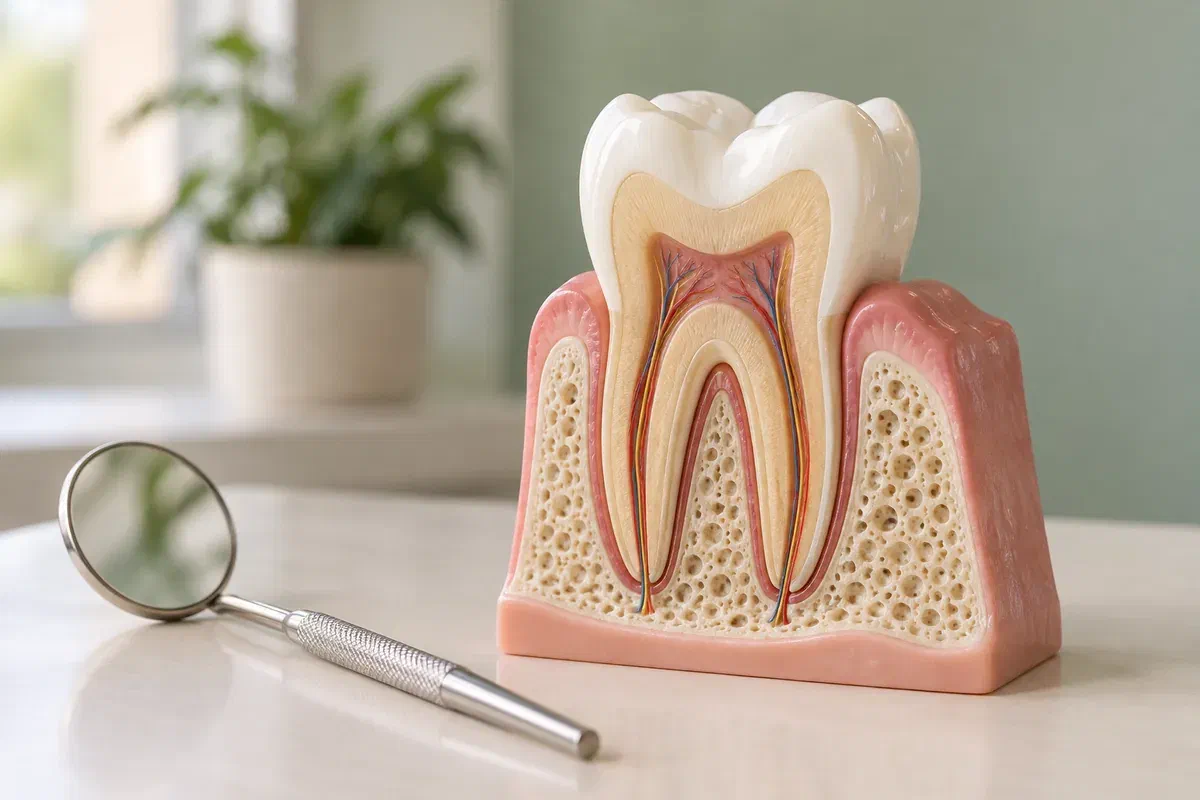
Illustrative cross-section tooth model showing roots within supporting gum and bone beside a dental mirror
Signs that lead people to book

Bleeding is a clue. So are these.

Let us know whether something on an image, a change in a tooth or your gum history is behind the question. We will link it to a careful look at your mouth today.

A report that mentions bone levels

If you were told an X-ray shows reduced bone, ask which area and how that matches the gum examination. A brief comment does not capture the full situation. Earlier images may show whether anything has changed, if they are similar enough to compare.

A tooth that seems less secure

Movement or a shift in position alongside bleeding gums is worth having examined. Note when it started, whether there is pain and whether there was any injury. Avoid repeatedly pressing on it; let the examination judge how urgent it is.

Gum problems that keep coming back

Maybe you had a deep cleaning before and the bleeding returned, or you never finished a course of treatment. Share what you remember and what made follow-up difficult. That background helps us plan something you can sustain.

Bleeding, gum measurements and images all need to be read together. The absence of pain does not mean the bone is healthy, and changes at one site do not decide the outlook for every tooth.

Why look deeper

Find out how far it has gone.

Knowing whether the problem is limited to the gum surface or involves the supporting bone changes what care makes sense. The assessment helps show which areas need treatment, which can be watched and what remains unclear. Ask us to walk you through the measurements and images so the reasoning is visible.

It also records a starting point. Future visits can be compared against today’s findings, and your recall interval should be linked to what is being monitored. Once the bleeding settles, that explanation makes it easier to keep up the routine rather than assuming the job is done.

Patient information: American Academy of Periodontology — combining clinical and radiographic findings

Detail on where the problem sits

Ask whether the changes are confined to a few areas or spread more widely, and how that affects the options. If one tooth stands out, request an explanation specific to it. Its situation should not be assumed for every other tooth.

A fair view of what is known

Ask what the current records show and what only follow-up can confirm. Earlier images or charts help when they are comparable. A single assessment cannot forecast precisely how your gums will behave in future.

Care arranged in a logical order

If restorations or cosmetic changes are on your list, ask whether calming the gums should come first. Find out how each proposed step relates to the underlying condition. Staging the plan makes appointments, effort and fees easier to understand.

What we do at the visit

Checking beneath the gumline.

The records we need depend on what we are trying to find out. If an image or measurement is recommended, ask what it will add to the decision.

  1. Start with your symptoms and history

    We ask how long the bleeding or tenderness has lasted, about past gum treatment, missing teeth and any earlier explanations. Medical conditions, medicines and tobacco use can be relevant. If older records are held elsewhere, ask whether to request them.

  2. Measure around each tooth

    The clinician gently probes the gum at several points per tooth, checking pocket depth, bleeding, recession and stability. Ask which readings point to the surface gum and which suggest deeper involvement. This is how the support below the gumline is assessed.

  3. Look at images where needed

    A probe tells us about the gum; an X-ray shows where the bone edge sits along each root. Whether new images are worth taking is a clinical call, and they only mean something when read with your measurements. Ask what they cannot show; a 3D scan is not required for most bone-support questions.

  4. Explain the diagnosis and the plan

    We describe what the findings mean, which areas need care and the suggested order. Ask whether a periodontist’s view would help and what to do while you wait. Agree on how the response to early treatment will be checked.

Settling the gums

Calmer gums take steady effort.

An assessment directs care but does not regrow bone. Follow the advice for your diagnosis and let us know if part of it is hard to fit in.

Practise cleaning the areas that bleed

Ask for a demonstration around the gums that bleed most, and around any gaps or dental work that are tricky. Confirm which aids suit you. Some bleeding may happen as you start, but if an area stays sore or a tool catches, tell us.

Know what each visit is for

Clarify which appointments are active treatment and which check whether the gums are stable. If a specialist is involved, ask who is coordinating and where follow-up happens. Bring outside reports so the advice fits together.

Call if things change

Contact us about new looseness, swelling, discomfort or a change in chewing, and let us know about health or medication changes. A future maintenance date is not a reason to hold back a new concern.

Where treatment may head

Calm the gums, consult a specialist, or reconsider a tooth.

For each option, ask what it is meant to accomplish, why your findings suggest it and what continuing care it needs. Treatment should match your results, not just the label.

When controlling inflammation is the first task

Periodontal therapy with follow-up visits

This can include professional cleaning below the gumline, home-care coaching and planned reviews. Ask how improvement will be measured and what remains uncertain. Gums that stop bleeding are a good sign, but lost bone does not return as a result.

When one site may suit further periodontal treatment

Specialist assessment of a deep defect

A periodontist can consider whether additional care, possibly a regenerative technique in a suitable case, is reasonable. Ask about the specific site, the likely benefit, its limits and the upkeep. Grafting is not a standard response to every pattern of bone loss.

When one tooth’s prognosis affects the plan

Discussing a tooth that may not hold

If a tooth is unlikely to be maintained, ask why and compare the options that follow. The decision should reflect the health of the rest of your mouth. Reduced support alone does not mean an extraction or implant is needed.

Patient information: American Academy of Periodontology — selected regenerative and surgical procedures

Acton gum and bone questions

From bleeding gums to bone support.

Gum symptoms often raise questions about what lies underneath. Bring them, along with any records, and we will go through the answers.

(905) 876-4488
What is the difference between gingivitis and periodontitis?
Gingivitis is inflammation of the gums without loss of the deeper attachment. Periodontitis involves changes to the attachment and bone supporting the teeth. The examination and images help the clinician tell which is present.
Can bad breath be a sign of bone loss?
Persistent bad breath or a bad taste can be associated with gum disease, but it has other causes too. Mention it during the assessment so the clinician can consider it alongside the gum findings.
Should I use a mouthwash for bleeding gums?
A mouthwash is not a substitute for cleaning between the teeth and professional assessment. Ask the team whether a rinse would help in your case and how it fits with your routine.
Does an X-ray showing bone loss mean I will lose teeth?
Not necessarily. Location, extent, the condition of each tooth and how your gums respond to treatment all affect the outlook. Where a particular tooth worries you, ask what its own findings suggest.
Can better home care bring the bone back?
Improved cleaning helps the gums heal and is central to managing the condition, but it is not expected to rebuild lost bone. Ask what your treatment aims to stabilize and whether any further procedure might suit your findings.
Do my teeth need checking if only my gums bleed and nothing hurts?
Yes, it is reasonable to have them checked. Gum disease often causes little discomfort, so pain is not a reliable guide. The examination can show whether treatment, monitoring or more information is needed.
Acton bone-support assessment

Don’t wait for it to hurt.

Book with our Bronte Street practice to look into bleeding gums, an X-ray comment about bone, or past periodontal care you want reviewed. We will examine the concern and explain a reasonable plan for care or further evaluation.

Your diagnosis, each tooth’s outlook, any imaging, treatment choices, referral and fees are confirmed once we have assessed you. Keeping a tooth or regaining support cannot be promised beforehand.

Visit Milton Dental Clinic
Unit 1, 342 Bronte St. S, Milton, ON L9T 5B7
Get directions Clinic hours
Monday–Thursday
11am–7pm
Friday–Sunday
By appointment only

Areas we serve

  • Milton
  • Oakville
  • Mississauga
  • Georgetown
  • Halton Hills
  • Acton
  • Campbellville
  • Brampton
  • Burlington
  • Puslinch
  • Rockwood
  • Erin
  • Caledon
  • Etobicoke
  • Old Milton
  • Bronte Meadows
  • Timberlea
  • Dorset Park
  • Dempsey
  • Clarke
  • Beaty
  • Coates
  • Harrison
  • Scott
  • Willmott
  • Ford
  • Bowes
  • Cobden
  • Walker
  • Mountain View
  • Milton Heights
  • Hawthorne Village
  • Valley View
  • Fallingbrook
  • Nassagaweya
  • Trafalgar
  • Esquesing
  • Nelson
  • Brookville
  • Moffat
  • Glen Williams
  • Norval
  • Limehouse
  • Stewarttown
  • Ashgrove
  • Hornby
  • Silver Creek
  • Speyside
  • Scotch Block
  • North Oakville
  • River Oaks
  • Glen Abbey
  • West Oak Trails
  • Palermo
  • Bronte Creek
  • College Park
  • Joshua Creek
  • Uptown Core
  • Preserve
  • Iroquois Ridge
  • Lisgar
  • Meadowvale
  • Meadowvale Village
  • Churchill Meadows
  • Erin Mills
  • Central Erin Mills
  • Streetsville
  • East Credit
  • Creditview
  • Heartland
  • Sheridan
  • Mount Pleasant
  • Credit Valley
  • Huttonville
  • Churchville
  • Springbrook
  • Northwest Brampton
  • Bram West
  • Fletcher's Meadow
  • Fletcher's Creek South
  • Alton Village
  • Orchard
  • Millcroft
  • Headon Forest
  • Tansley
  • Brant Hills
  • Tyandaga
  • Kilbride
  • Lowville
  • Aberfoyle
  • Morriston
  • Arkell
  • Hillsburgh
  • Freelton
  • Carlisle
  • Waterdown
  • Flamborough
  • Mountsberg

How can we help?

Milton Dental Clinic

Have a question about your smile? Choose the option that works best for you.

For urgent dental concerns, please call.
Messages are reviewed during clinic hours.