

Illustrative clinician discussing tooth support with a patient using a physical teaching model
Specialized Care

Bone-Loss Assessment in Brampton

Watching a parent lose teeth to gum disease can leave you wondering about your own. For adults coming from Brampton, a bone-loss assessment examines your gums, reviews suitable images and your history, and explains your situation on its own terms rather than through someone else’s story.

When it runs in the family

Your parent’s dentures are not your destiny.

Many adults remember a relative who wore dentures early or talked about “soft gums.” That memory tends to resurface the moment a dental report mentions bone. A bone-loss assessment looks at your own situation: the gum and bone supporting each tooth, interpreted through a clinical examination, appropriate images and your personal history.

Family background can be worth mentioning, but it is only one piece. Being told you have some bone loss does not reveal where it is, how much support is involved, why it developed or what should be done next. Care, habits and health all influence the picture, so the outlook for your teeth has to be judged directly.

Before travelling in from Brampton, gather any X-rays or gum charts from previous offices, and think about what you know of your family’s dental history. Share the findings that worry you most. We can review them, explain what additional information would help, and discuss care focused on maintaining the teeth that can reasonably be kept.

Check your own bone support
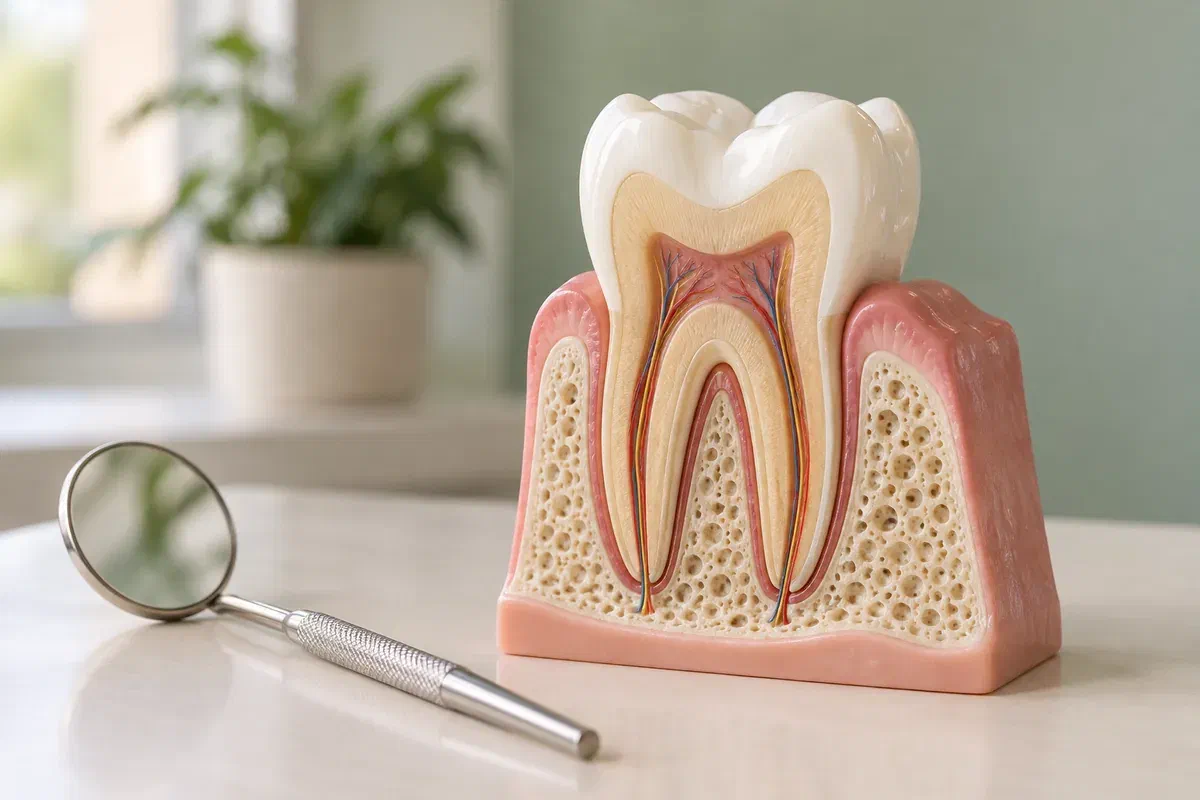
Illustrative cross-section tooth model showing roots within supporting gum and bone beside a dental mirror
Why you are asking now

A family story is a reason to look, not an answer.

Tell us what brought the question to mind. The clinician will tie that background to a careful examination of your mouth today.

A note about bone on your X-ray

Ask which teeth were mentioned and how the image matches the gum examination. A picture of a screen or a brief summary leaves out a great deal. If older images exist, the clinician can explain whether they are suitable for seeing change over time.

A tooth that seems to be shifting

Note when you first noticed the change, whether it is sore and whether anything happened beforehand. Avoid pushing on the tooth to test it. An examination will help determine whether the movement needs quick attention or can be addressed as part of a planned approach.

Gum trouble in your own past

Beyond family history, your own earlier treatment matters. Share what was done, including at other clinics, and anything that interrupted regular care. That background helps us understand present needs and plan something sustainable, without any judgment. Even a rough timeline, such as “a deep cleaning around ten years ago,” gives the clinician something useful to work from.

Images, gum readings and symptoms must be read together. A comfortable mouth does not guarantee healthy support, and a finding at one tooth does not mean every tooth shares its outlook.

What an assessment offers

Facts about your mouth, not your relatives’.

Worry tends to grow when the information is vague. A detailed review sorts your teeth into those needing treatment, those to monitor and those where more information would help. Ask the clinician to explain the findings visually, using images or a model, until they make sense to you.

Today’s findings also give you a baseline. Later visits can be compared against it, and your maintenance interval should be explained in terms of what is being tracked. With a family history in mind, that kind of steady monitoring can be reassuring rather than something to dread.

Patient information: American Academy of Periodontology — combining clinical and radiographic findings

Individual explanations where they matter

Ask whether the change is limited or widespread and what that means for your options. For a tooth with a less certain outlook, ask for reasons particular to it. Don’t assume one tooth’s situation applies to the others.

Realism about the future

Ask what the records show now and what would need follow-up to confirm. Previous images or measurements may help if they are comparable. No single assessment can predict exactly what will happen over time, whatever your family history.

A sensible order for any treatment

If several treatments are suggested, ask which come first and which can wait. Find out how each relates to controlling the gum condition. A staged plan makes it easier to understand the commitment, appointments and fees.

How the appointment unfolds

Background, examination, images, then a plan.

We tailor the records to the question being asked. If a test or image is recommended, feel free to ask what it will add to the decision.

  1. Share your history and your family’s

    We ask about your past gum care, any lost teeth, current symptoms and what relatives experienced, if you know. Medical conditions, medicines and tobacco use also matter. If you have records elsewhere, ask whether they should be requested first.

  2. Assess the gums and each tooth

    Using a small probe, the clinician gently checks the space between gum and tooth at several points, and looks for bleeding, receding gum and any movement. Ask which of those readings bear most on your worry. The goal is to evaluate the full supporting structure, not just the visible gum, so a tooth that looks healthy from the outside is still checked.

  3. Interpret the right images

    X-rays can show bone levels and other changes around the roots. The clinician decides what is appropriate and considers it alongside the examination. Ask what the images can’t show, and don’t assume a 3D scan is required. For most questions about bone support, standard dental images read together with the gum examination are where the clinician begins.

  4. Discuss findings and next steps

    We explain the diagnosis, any areas of concern and a sensible sequence of care. Ask whether a periodontist could add useful insight and what to do meanwhile. Agree on how progress will be reviewed before committing to larger stages.

Doing your part

What you do each day can change the story.

An assessment informs your care; it doesn’t rebuild bone. Stick with the steps that suit your findings, and tell us when any of them become a struggle.

Ask for a hands-on lesson

Request a demonstration around the teeth of concern, including spaces and dental work that are tricky to clean. Confirm which tools and techniques suit you. If something catches or hurts, mention it so the approach can be refined.

Link treatment with maintenance

Clarify which visits are active treatment and which are follow-up checks. If a specialist is involved, confirm who coordinates and where reviews will take place. Bring outside reports so everything is considered together.

Let us know about changes early

Contact us about a tooth that loosens further, gum swelling, discomfort or a change in your bite. Share new health conditions or medicines too. Don’t wait for a planned review to raise a new concern.

Where care can go from here

Managing support and rebuilding it are separate questions.

Ask what each option is intended to do, why your findings make it suitable and what long-term care it requires. Treatment should fit your results, not the label.

When control and stability come first

Consistent gum care and recall visits

This may involve professional cleaning, gum treatment, home-care coaching and regular reassessment. Ask how stability will be measured and what is still uncertain. Improved gum health does not mean lost bone has returned.

When advanced periodontal care might be considered

Specialist input for a specific defect

A periodontist can judge whether further treatment, including a regenerative approach in a suitable case, makes sense. Ask about the site, the likely benefit, the limitations and the maintenance required. Grafting is not a universal answer.

When one tooth’s prognosis shapes the rest

Thinking through a tooth that may not last

If a tooth cannot reasonably be maintained, ask why and compare what could follow. The decision should take the surrounding mouth into account. Reduced support does not automatically mean extraction or an implant.

Patient information: American Academy of Periodontology — selected regenerative and surgical procedures

Brampton family questions

Inherited worry, individual answers.

Family history can make a dental finding feel heavier than it is. Bring your questions and records, and we will look at your mouth on its own merits.

(905) 876-4488
Is gum disease hereditary?
Family background is thought to influence some people’s risk, but it does not decide what happens to your teeth. Daily care, regular professional care and general health also play important roles. The assessment looks at your own gums and bone support directly.
My mother lost her teeth young. Should I be checked even if mine feel fine?
It is reasonable to ask for an assessment. Teeth that feel comfortable can still have reduced support, and early information can help guide care. Mention your family history so the clinician can consider it alongside the examination.
Can my children inherit bone loss from me?
Children are not assessed for adult bone loss in the same way, but healthy habits and regular checkups matter at every age. If you have concerns about a child’s gums, ask the team at their next visit.
Does finding bone loss mean I will end up with dentures?
No. The extent and location of the change, each tooth’s condition and the response to care all shape the outlook. Ask for an explanation of any tooth with a questionable prognosis rather than assuming the worst.
Why measure my gums if the X-ray already shows the bone?
The image shows bone levels from one view, while gum measurements describe attachment and inflammation around each tooth. Together they give a fuller picture. Ask how each record shapes the recommendations you receive.
Can bone that has been lost grow back with good care?
Good daily and professional care helps keep gums healthy and is central to management, but it should not be expected to restore all lost bone. Ask what your plan aims to stabilize and whether any additional treatment is suitable for your findings.
Brampton bone-loss assessment

Find out where your own teeth stand.

Contact our Bronte Street practice to discuss a bone-support finding, a family history of gum disease, or a treatment recommendation you want explained. We can examine the concern and outline a reasonable plan for care or further evaluation.

Diagnosis, tooth prognosis, imaging, treatment suitability, referral and fees are determined at assessment. Keeping a tooth or regenerating lost support cannot be guaranteed ahead of time.

Visit Milton Dental Clinic
Unit 1, 342 Bronte St. S, Milton, ON L9T 5B7
Get directions Clinic hours
Monday–Thursday
11am–7pm
Friday–Sunday
By appointment only

Areas we serve

  • Milton
  • Oakville
  • Mississauga
  • Georgetown
  • Halton Hills
  • Acton
  • Campbellville
  • Brampton
  • Burlington
  • Puslinch
  • Rockwood
  • Erin
  • Caledon
  • Etobicoke
  • Old Milton
  • Bronte Meadows
  • Timberlea
  • Dorset Park
  • Dempsey
  • Clarke
  • Beaty
  • Coates
  • Harrison
  • Scott
  • Willmott
  • Ford
  • Bowes
  • Cobden
  • Walker
  • Mountain View
  • Milton Heights
  • Hawthorne Village
  • Valley View
  • Fallingbrook
  • Nassagaweya
  • Trafalgar
  • Esquesing
  • Nelson
  • Brookville
  • Moffat
  • Glen Williams
  • Norval
  • Limehouse
  • Stewarttown
  • Ashgrove
  • Hornby
  • Silver Creek
  • Speyside
  • Scotch Block
  • North Oakville
  • River Oaks
  • Glen Abbey
  • West Oak Trails
  • Palermo
  • Bronte Creek
  • College Park
  • Joshua Creek
  • Uptown Core
  • Preserve
  • Iroquois Ridge
  • Lisgar
  • Meadowvale
  • Meadowvale Village
  • Churchill Meadows
  • Erin Mills
  • Central Erin Mills
  • Streetsville
  • East Credit
  • Creditview
  • Heartland
  • Sheridan
  • Mount Pleasant
  • Credit Valley
  • Huttonville
  • Churchville
  • Springbrook
  • Northwest Brampton
  • Bram West
  • Fletcher's Meadow
  • Fletcher's Creek South
  • Alton Village
  • Orchard
  • Millcroft
  • Headon Forest
  • Tansley
  • Brant Hills
  • Tyandaga
  • Kilbride
  • Lowville
  • Aberfoyle
  • Morriston
  • Arkell
  • Hillsburgh
  • Freelton
  • Carlisle
  • Waterdown
  • Flamborough
  • Mountsberg

How can we help?

Milton Dental Clinic

Have a question about your smile? Choose the option that works best for you.

For urgent dental concerns, please call.
Messages are reviewed during clinic hours.