

Illustrative clinician discussing tooth support with a patient using a physical teaching model
Specialized Care

Bone-Loss Assessment in Burlington

A tooth that gives slightly when you bite, or a gap that was not there last year, can make you wonder what is happening beneath the gum. For adults travelling from Burlington, a bone-loss assessment checks the gums, suitable images and your history, then explains what we find.

When a tooth feels less steady

Biting into an apple shouldn’t feel uncertain.

Sometimes the first hint is physical. A lower front tooth feels a touch springy, food starts collecting in a new space, or your bite meets differently. Those changes can have more than one cause, and reduced support around the root is one possibility. A bone-loss assessment examines the gum and bone holding your teeth, alongside appropriate images and your history, to find out.

Even when bone change is confirmed, that phrase does not settle the important details. It says nothing about which teeth are involved, how much support remains, what started it, or what care makes sense. A tooth that moves a little is not automatically a tooth that must go, and the answer often depends on what the surrounding gum and teeth show.

Before a visit from Burlington, jot down when you first felt the change and anything that might have triggered it. Bring earlier images or gum records if you can get them. We will examine the area, explain what we see and what else might help clarify it, and talk through care aimed at keeping the teeth that can reasonably be kept.

Have a moving tooth checked
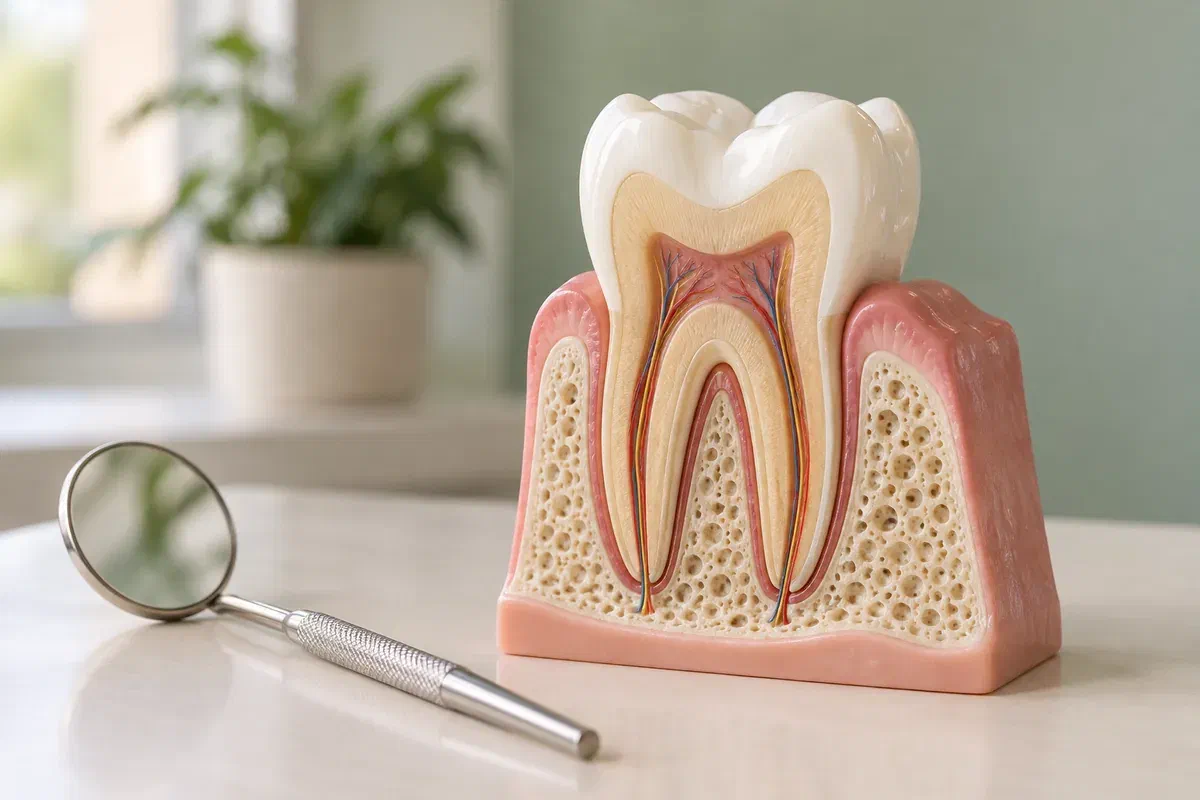
Illustrative cross-section tooth model showing roots within supporting gum and bone beside a dental mirror
Three common reasons people call

Something changed, and you want to know why.

Let us know whether the concern began with a feeling, an image or your dental past. We will connect it to what a careful examination finds today.

An image that raised a question

If a dentist or hygienist pointed to bone levels on an X-ray, ask which teeth were involved and how it relates to the gum examination. The image alone gives only one view. Earlier radiographs of the same area may offer context, though the clinician will explain how reliable such a comparison is.

Movement, drifting or a new gap

Describe when you noticed it, whether chewing hurts, and whether there was a knock, a fall or a sports injury first. Resist the urge to test it with your tongue or fingers. The examination helps decide whether this needs prompt care or can be planned step by step.

Gum problems that came and went

Bleeding that faded, a deep cleaning you never followed up, treatment that ended when you moved: all of it is useful background. Share what you can and mention anything that made regular visits difficult. We are interested in a workable plan, not in how long it has been.

Gum measurements, images and symptoms only make sense when read together. Feeling no pain does not confirm healthy support, and one weaker tooth does not mean the rest share its outlook.

What you gain from knowing

Answers you can act on.

The assessment can show which teeth need treatment, which need watching and where information is still incomplete. That is far more practical than a general sense that something is wrong. Ask the clinician to point to the findings on your images or on a model until the explanation makes sense to you.

Your first assessment also becomes the yardstick for later visits. The interval for your maintenance appointments should come with a reason, linked to what is being monitored. Once you understand that reason, returning while your teeth feel steady seems less like a routine and more like a check that matters.

Patient information: American Academy of Periodontology — combining clinical and radiographic findings

Detail for the tooth you are worried about

Ask whether the change is limited to that tooth or appears in several places, and what that means for treatment. If its outlook is less favourable than its neighbours, ask for reasons specific to it. Advice for one tooth should not be applied wholesale to the others.

Clarity about what we can and cannot predict

Today’s records describe the present. Ask what they show and what only a later comparison could tell you. Previous images or measurements help only if they are comparable, and no single visit can promise a precise forecast.

Priorities that make sense

If you are thinking about a bridge, a crown or straightening, ask whether gum stability needs attention first. Find out how each proposed treatment connects to the underlying condition. Laying care out in phases helps you compare effort, appointments and fees.

How we put the picture together

Four parts, one explanation.

The records we gather depend on what we are trying to understand. If something is recommended, ask how it will help decide your next step.

  1. A conversation about your mouth and health

    We ask about past gum treatment, any teeth lost, the movement you have noticed and what you have heard before. Relevant medical conditions, medicines and tobacco use are discussed too. If useful records sit at another office, ask whether to request them before new ones are taken.

  2. A close examination of the gums

    The clinician checks the tissue and may record pocket depths, recession, bleeding and the stability of each tooth. Ask which measurements matter for the tooth you are worried about. Support is judged around the whole tooth, not just at the visible edge of the gum.

  3. Images read with the exam

    Radiographs can show bone levels and other features near the roots. The clinician decides what is warranted and interprets it in light of the examination. Ask what the image leaves out, and don’t assume every bone question calls for a 3D scan.

  4. A clear plan and a time to review

    We explain the diagnosis, which teeth need care and the suggested sequence. Ask whether a specialist assessment might help and what to do while you wait. Before agreeing to later stages, confirm how the response to early care will be judged.

Looking after loosened support

Small daily steps, checked over time.

An assessment guides care but does not replace lost bone. Follow the advice matched to your diagnosis, and tell us if something is difficult to do at home.

Clean gently around a tooth that moves

Ask for a demonstration of how to clean the affected area without pressing on it, plus any gaps or dental work that are hard to reach. Confirm which tools suit you. If a brush or floss catches or hurts, let us know so the routine can be changed.

Understand each appointment’s purpose

Ask which visits are active treatment and which are follow-ups to confirm stability. If a periodontist is involved, check who is coordinating and where reviews will happen. Bring outside reports so every recommendation is considered together.

Call when something new happens

Increased movement, swelling, discomfort or a change in chewing are reasons to contact us. Mention new medications or health changes as well. Do not hold a new symptom until your next maintenance date.

Possible next steps

Stabilize, refer, or reconsider a single tooth.

Ask what each option is designed to achieve, what about your findings makes it suitable, and what care it needs over time. Treatment should be chosen from your results, not the label.

When steadying the condition is the priority

Gum therapy and maintenance

Care can include professional cleaning, gum treatment, home-care coaching and regular reassessment. Ask how stability will be judged and what remains uncertain. Firmer, healthier gums are welcome, but they do not mean lost bone has grown back.

When a defect might suit further periodontal care

A specialist opinion on one area

A periodontist can assess whether extra treatment, sometimes a regenerative procedure in a suitable case, is worth considering. Ask about the specific defect, the expected benefit, the limitations and the maintenance. Grafting is not right for every bone-loss pattern.

When one tooth’s outlook affects the wider plan

Keeping or replacing a loose tooth

If a tooth cannot reasonably be maintained, ask why and compare the options that follow. The decision should account for the rest of your mouth. Finding reduced support does not by itself mean extraction or an implant is needed.

Patient information: American Academy of Periodontology — selected regenerative and surgical procedures

Questions from Burlington

What a shifting tooth can and can’t tell you.

Movement is a reason to look closer, not a verdict. Bring your questions and any records, and we will go through what the examination shows.

(905) 876-4488
What can make an adult tooth start to feel loose?
Several things, including reduced gum and bone support, infection, heavy biting forces such as grinding, or an injury. The examination looks at the tooth, its gum and the images together to work out which factors are involved and what care fits.
Should I avoid chewing on a tooth that moves?
Being gentle with it until it is examined is sensible. Avoid testing it repeatedly. If it becomes suddenly looser, painful or swollen, call the clinic for advice rather than waiting for a routine appointment.
Can grinding my teeth affect the bone around them?
Heavy forces from clenching or grinding can contribute to tooth movement and wear, and they may matter more when support is already reduced. Mention any grinding habits during the assessment so the clinician can consider them alongside the gum findings.
Does reduced support mean every tooth will eventually loosen?
No. Changes are often uneven, and the outlook depends on each tooth, the extent of support and how the gums respond to care. Ask for an explanation of the teeth that concern you most.
My tooth feels solid now. Is an assessment still worth it?
It can be. A tooth that feels firm today can still have reduced support, and an earlier finding may deserve explanation. Bring whatever prompted your concern and ask what examination is appropriate to clarify it.
Is grafting always offered after bone loss is found?
No. Treatment decisions follow the assessment. Many people are managed with periodontal care and maintenance, and only some specific defects warrant a specialist discussion about regenerative options. If it comes up, ask why your site is suitable and what limits to expect.
Burlington bone-loss assessment

Tell us what moved, and when.

Call or book with our Bronte Street practice to discuss a tooth that has shifted, an X-ray finding about bone support, or past gum treatment you want reviewed. We can examine the area and explain a reasonable plan for care or further evaluation.

Diagnosis, the outlook for each tooth, imaging, treatment options, referral and fees are confirmed after assessment. Keeping a tooth or rebuilding lost support cannot be guaranteed beforehand.

Visit Milton Dental Clinic
Unit 1, 342 Bronte St. S, Milton, ON L9T 5B7
Get directions Clinic hours
Monday–Thursday
11am–7pm
Friday–Sunday
By appointment only

Areas we serve

  • Milton
  • Oakville
  • Mississauga
  • Georgetown
  • Halton Hills
  • Acton
  • Campbellville
  • Brampton
  • Burlington
  • Puslinch
  • Rockwood
  • Erin
  • Caledon
  • Etobicoke
  • Old Milton
  • Bronte Meadows
  • Timberlea
  • Dorset Park
  • Dempsey
  • Clarke
  • Beaty
  • Coates
  • Harrison
  • Scott
  • Willmott
  • Ford
  • Bowes
  • Cobden
  • Walker
  • Mountain View
  • Milton Heights
  • Hawthorne Village
  • Valley View
  • Fallingbrook
  • Nassagaweya
  • Trafalgar
  • Esquesing
  • Nelson
  • Brookville
  • Moffat
  • Glen Williams
  • Norval
  • Limehouse
  • Stewarttown
  • Ashgrove
  • Hornby
  • Silver Creek
  • Speyside
  • Scotch Block
  • North Oakville
  • River Oaks
  • Glen Abbey
  • West Oak Trails
  • Palermo
  • Bronte Creek
  • College Park
  • Joshua Creek
  • Uptown Core
  • Preserve
  • Iroquois Ridge
  • Lisgar
  • Meadowvale
  • Meadowvale Village
  • Churchill Meadows
  • Erin Mills
  • Central Erin Mills
  • Streetsville
  • East Credit
  • Creditview
  • Heartland
  • Sheridan
  • Mount Pleasant
  • Credit Valley
  • Huttonville
  • Churchville
  • Springbrook
  • Northwest Brampton
  • Bram West
  • Fletcher's Meadow
  • Fletcher's Creek South
  • Alton Village
  • Orchard
  • Millcroft
  • Headon Forest
  • Tansley
  • Brant Hills
  • Tyandaga
  • Kilbride
  • Lowville
  • Aberfoyle
  • Morriston
  • Arkell
  • Hillsburgh
  • Freelton
  • Carlisle
  • Waterdown
  • Flamborough
  • Mountsberg

How can we help?

Milton Dental Clinic

Have a question about your smile? Choose the option that works best for you.

For urgent dental concerns, please call.
Messages are reviewed during clinic hours.