

Illustrative clinician discussing tooth support with a patient using a physical teaching model
Specialized Care

Bone-Loss Assessment in Erin

A drawer full of floss picks and brushes you never quite got the hang of says a lot about how gum care really goes at home. For adults in Erin and Hillsburgh, a bone-loss assessment explains the support around your teeth and turns the findings into a daily routine that fits your mouth.

From the chair to the bathroom sink

The plan only works if it works at home.

Most of what happens to your gums happens between appointments. That is why a bone-loss assessment does more than record findings. It examines the tissue and bone supporting each tooth, reviews appropriate images and your history, and then links what was found to what you can realistically do at home, every day, for years.

First, though, the findings need to be clear. Hearing that you have some bone loss does not explain which teeth are affected, how much support has changed, what contributed or what treatment makes sense. A routine designed for one deep pocket between molars is different from one aimed at changes around many teeth, so the details matter.

When you book from Erin, think about which parts of cleaning you find awkward and which tools you have tried. Bring earlier X-rays or gum charts if they are handy. We will examine your mouth, explain the results and what more might be useful, and discuss care that helps preserve teeth with a sound outlook.

Get findings and a routine that fit
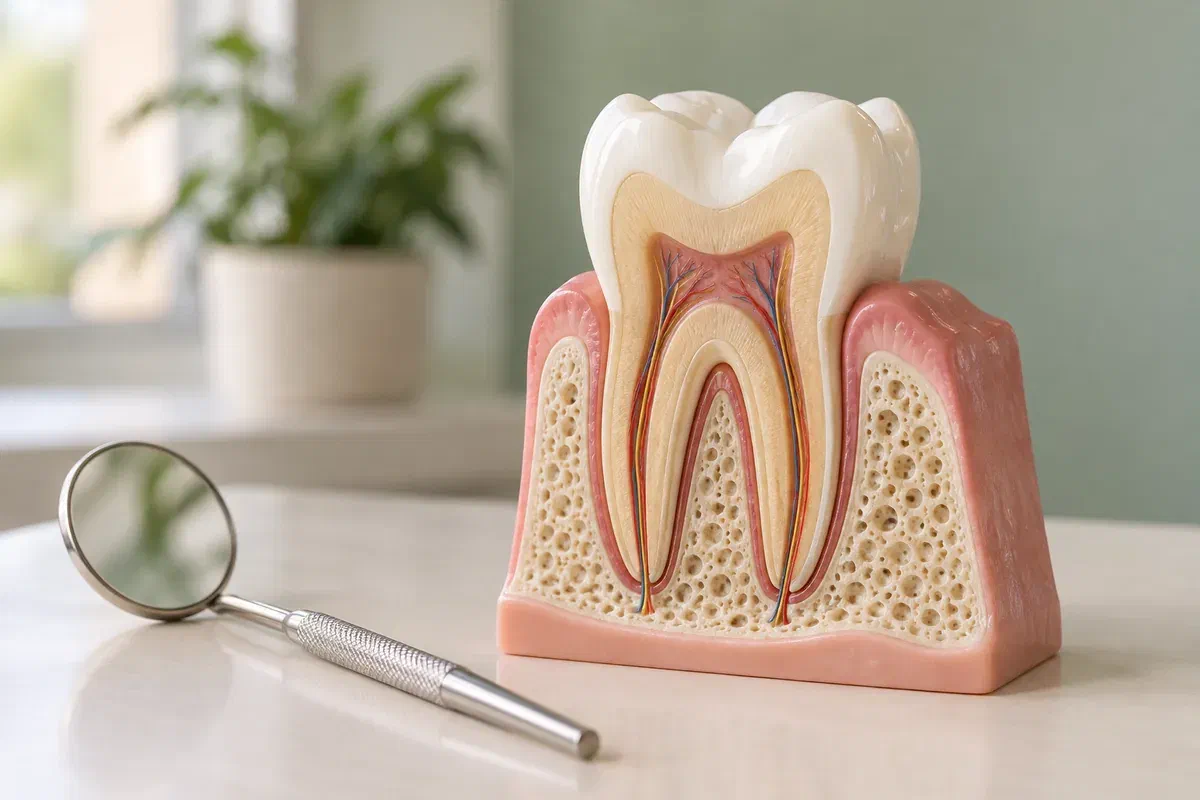
Illustrative cross-section tooth model showing roots within supporting gum and bone beside a dental mirror
What brought you here

Usually it starts with one of three things.

Whether it began with an image, a tooth or your gum history, telling us helps the assessment focus. We will tie that background to what we see now.

Bone levels noted on an X-ray

Ask which teeth were involved and how the image matches the gum findings. A brief written note leaves gaps. Older images may help show whether anything has changed, if they are comparable, and the clinician can explain how much weight to give them.

A tooth that has begun to drift

Should a tooth have shifted or started to feel less steady, note when it started, whether it hurts and whether anything triggered it. Try not to check it repeatedly. The examination will help determine how soon it needs attention.

A routine that never quite stuck

Perhaps you had gum treatment before and the home-care advice faded after a few weeks. Share what you were shown, what you tried and what got in the way. That honesty helps us suggest a routine you’ll actually keep, without any judgment.

Images, gum measurements and symptoms need to be considered together. Teeth that feel fine can still have reduced support, and the situation at one tooth doesn’t settle the outlook for others.

Why the details help at home

Clean where it matters most.

Once you know which areas have reduced support, home care can be targeted rather than generic. The assessment shows which spots need treatment, which need closer watching and where information is still missing. Ask the clinician to show you those areas on your images or in a mirror so you know exactly where to focus.

It also gives you a baseline for later. Future visits can be compared with today’s findings, and the timing of your reviews should be explained. Seeing measurements improve or hold steady over time can be encouraging, and it helps you understand why continuing matters.

Patient information: American Academy of Periodontology — combining clinical and radiographic findings

A tooth-by-tooth focus

Ask whether the change is limited or widespread and how that affects both treatment and home care. If one tooth needs extra attention, ask what makes it different, rather than applying the same routine everywhere.

An honest account of what is known

Ask what today’s findings show and what only a later comparison can tell. Earlier images help if they are comparable. No single visit predicts exactly how support will change.

Priorities in the right order

If other treatment is suggested, ask whether gum stability should come first and how each step fits. There is little point learning to clean around a new bridge before the gums beneath it have settled. A staged plan makes the effort at home, the appointments and the fees easier to manage.

During the visit

Examine, explain, then practise.

Records are chosen for the question we are trying to answer. Ask why any image or test is recommended and how it will guide your care.

  1. Review your history and habits

    We discuss previous gum care, missing teeth, symptoms, what you were told before and how you clean now. Health conditions, medicines and tobacco use matter too. If records are held elsewhere, ask whether they should be requested.

  2. Measure the gums around each tooth

    The clinician gently probes to record pocket depths and notes bleeding, recession and how firm each tooth is. Ask which areas show the most change, because those are often where home care needs the most attention.

  3. Add images where they are useful

    Dental X-rays can show bone levels and other features around the roots. The choice of images is a clinical decision, and they are interpreted with the examination. Ask what they can’t show; a 3D scan is not routine for bone-support questions.

  4. Agree on care and a practice plan

    We explain the diagnosis, the areas needing care and the order of treatment, then show you how to clean the key spots. Ask whether a specialist would add useful information, and confirm how progress will be checked.

Day to day

Small tools, used often, make the difference.

The assessment guides care but cannot rebuild bone. Keep to the routine that matches your findings, and tell us honestly which parts are difficult.

Pick the right tools and try them in the chair

Interdental brushes, floss, picks and water flossers suit different mouths. Ask which ones fit your spaces and dental work, and practise with them during the visit. If a tool catches, bleeds a lot or feels sore, let us know so we can switch it.

Connect home care with your appointments

Ask which visits are treatment and which check stability, and bring your tools to a review if you want your technique checked. If a specialist is involved, confirm who coordinates, and share any outside reports.

Notice changes and call

Contact us when a tooth starts moving more, a gum puffs up, chewing feels different or a new ache appears. It is easy to brush these off during a busy week, but they are worth a quick call. Mention changes in health or medications too. You don’t need to wait for your next booked review.

Options after your findings

Steady care at home is part of every path.

Ask what each option aims to achieve, why it suits your results and what ongoing care it requires. Treatment should fit your examination, not the label.

When stability is the priority

Gum treatment plus a home routine

This may include professional cleaning, gum therapy, home-care coaching and scheduled reviews. Ask how stability will be judged and what remains uncertain. Healthier gums do not mean lost support has returned.

When one area may suit specialized treatment

A periodontist’s opinion for a defect

A specialist can consider whether further care, sometimes a regenerative procedure in a suitable case, is reasonable. Ask about that site, its expected benefit and limits, and the home care afterward. Grafting is not right for every bone-loss pattern.

When one tooth affects the rest of the plan

Deciding about a hard-to-keep tooth

If a tooth is unlikely to last despite good care, ask why and compare the alternatives. The decision should consider your whole mouth. Reduced support does not on its own call for extraction or an implant.

Patient information: American Academy of Periodontology — selected regenerative and surgical procedures

Erin home-care questions

Practical answers for everyday gum care.

Most questions after a bone-loss finding are about what to do at home. Bring them, along with the tools you use, and we will help you sort through them.

(905) 876-4488
Are interdental brushes better than floss?
It depends on the spaces between your teeth. Interdental brushes often suit larger gaps, while floss may work better where teeth are close together. Ask which fits each area of your mouth and have the team check your technique.
Is an electric toothbrush worth it with gum problems?
Many people find a powered brush helpful, but a manual brush used well can also be effective. Ask the clinician what suits your gums and dexterity, and how to use it without pressing too hard.
Do water flossers help with bone loss?
A water flosser may help some people clean around gaps or dental work, but it is not a replacement for professional care. Ask whether it suits your mouth and how it fits with other cleaning aids.
How long until my gums show improvement?
Response to care varies. The clinician will explain when your gums will be re-checked and what changes they will look for. Keep up the routine even if you don’t notice a difference straight away. Less bleeding when you clean is often one of the first things people notice, though the measurements at your review give a more reliable picture than how the gums feel.
Will a better routine bring back the bone I’ve lost?
Good home care supports healthier gums and is central to managing the condition, but it is not expected to rebuild lost bone. Ask what your plan aims to stabilize and whether additional treatment suits your findings.
Does bone loss mean my teeth are going to fall out?
No. The outlook depends on the extent and location of the change, each tooth’s condition and how it responds to care. Ask the clinician to explain any tooth whose future is uncertain.
Erin bone-loss assessment

Bring your toothbrush and your questions.

Contact our Bronte Street practice about a bone-support finding, gum treatment you want to build on, or home-care advice that hasn’t worked for you. We will examine the concern and explain sensible care, a practical routine or further evaluation.

Diagnosis, each tooth’s prognosis, imaging, suitable treatment, referral and fees are confirmed after assessment. We can’t promise ahead of time that a tooth will be kept or that support will regenerate.

Visit Milton Dental Clinic
Unit 1, 342 Bronte St. S, Milton, ON L9T 5B7
Get directions Clinic hours
Monday–Thursday
11am–7pm
Friday–Sunday
By appointment only

Areas we serve

  • Milton
  • Oakville
  • Mississauga
  • Georgetown
  • Halton Hills
  • Acton
  • Campbellville
  • Brampton
  • Burlington
  • Puslinch
  • Rockwood
  • Erin
  • Caledon
  • Etobicoke
  • Old Milton
  • Bronte Meadows
  • Timberlea
  • Dorset Park
  • Dempsey
  • Clarke
  • Beaty
  • Coates
  • Harrison
  • Scott
  • Willmott
  • Ford
  • Bowes
  • Cobden
  • Walker
  • Mountain View
  • Milton Heights
  • Hawthorne Village
  • Valley View
  • Fallingbrook
  • Nassagaweya
  • Trafalgar
  • Esquesing
  • Nelson
  • Brookville
  • Moffat
  • Glen Williams
  • Norval
  • Limehouse
  • Stewarttown
  • Ashgrove
  • Hornby
  • Silver Creek
  • Speyside
  • Scotch Block
  • North Oakville
  • River Oaks
  • Glen Abbey
  • West Oak Trails
  • Palermo
  • Bronte Creek
  • College Park
  • Joshua Creek
  • Uptown Core
  • Preserve
  • Iroquois Ridge
  • Lisgar
  • Meadowvale
  • Meadowvale Village
  • Churchill Meadows
  • Erin Mills
  • Central Erin Mills
  • Streetsville
  • East Credit
  • Creditview
  • Heartland
  • Sheridan
  • Mount Pleasant
  • Credit Valley
  • Huttonville
  • Churchville
  • Springbrook
  • Northwest Brampton
  • Bram West
  • Fletcher's Meadow
  • Fletcher's Creek South
  • Alton Village
  • Orchard
  • Millcroft
  • Headon Forest
  • Tansley
  • Brant Hills
  • Tyandaga
  • Kilbride
  • Lowville
  • Aberfoyle
  • Morriston
  • Arkell
  • Hillsburgh
  • Freelton
  • Carlisle
  • Waterdown
  • Flamborough
  • Mountsberg

How can we help?

Milton Dental Clinic

Have a question about your smile? Choose the option that works best for you.

For urgent dental concerns, please call.
Messages are reviewed during clinic hours.