

Illustrative clinician discussing tooth support with a patient using a physical teaching model
Specialized Care

Bone-Loss Assessment in Etobicoke

Driving out from Etobicoke for a dental question means you want each appointment to settle as much as possible. A well-prepared bone-loss assessment gathers your records, examination and images in one visit, explains the support around your teeth, and sets out a plan that keeps further trips purposeful.

Planning the visit from Etobicoke

Make the trip count.

When the clinic is not around the corner, preparation does a lot of the work. Records that arrive before you do, a clear description of the concern and a list of questions mean less time repeating things in the chair. The assessment itself evaluates the gum and bone around your teeth, weighing a hands-on examination with relevant images and your dental background.

Keep in mind that “bone loss” is a broad description rather than a diagnosis with a plan attached. By itself it does not identify the teeth involved, the degree of change, the likely cause or what treatment, if any, is sensible. Expect the conversation to move tooth by tooth, because one site’s outlook rarely predicts another’s.

A week or two ahead, ask your previous dentist to forward X-rays and gum charts, or bring copies yourself. Write down what you were advised and which parts confused you. We can then review everything together, explain any extra information needed, and talk about care designed to preserve the teeth with a reasonable outlook.

Plan a bone-support assessment
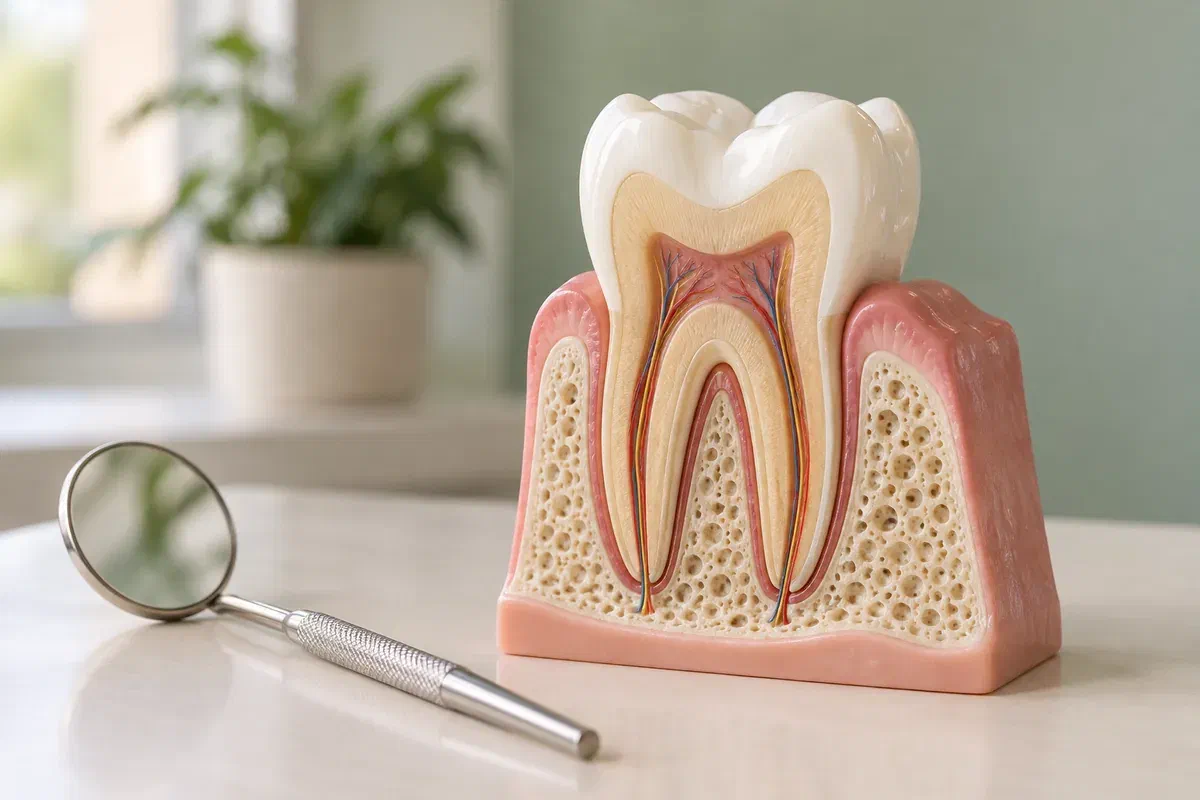
Illustrative cross-section tooth model showing roots within supporting gum and bone beside a dental mirror
Getting the reason for the visit clear

Tell us the trigger, and we can prepare.

Knowing in advance whether your concern is an image, a symptom or an older diagnosis helps us use the appointment well. We will then relate it to what we find on the day.

An X-ray comment from another office

Ask the other clinic which teeth were flagged and request the image itself, not just a note. A description over the phone cannot replace looking at your gums. If they also hold older radiographs, those may help show whether anything has changed, within the limits the clinician will explain.

A tooth that has started to shift

Record when it began, whether it aches and whether there was a bump or injury. Try not to keep checking it. If the change is recent and paired with pain or swelling, call before setting out, because it may need care sooner or closer to home.

Gum care that was never finished

Many people start periodontal treatment and drift away from the follow-up. Bring what you know about earlier care and mention anything, including the commute, that made regular visits hard. A realistic plan matters more than a perfect record.

Images, gum readings and symptoms make sense only together. Teeth that feel normal can still have reduced support, and a finding at one site does not mean every tooth carries the same risk.

What one thorough visit can give you

Fewer loose ends to drive home with.

A careful assessment separates the areas that need treatment from those that can be observed, and is clear about anything still unknown. Ask for the findings to be shown on your images or a model so you leave understanding them, not just holding a printout. That clarity is worth more than a label you cannot act on.

It also sets a baseline for future comparison. Ask how often reviews are needed and what each one checks, so you can plan the travel ahead. When you understand why an interval was chosen, it becomes easier to protect that time in your calendar even when nothing hurts.

Patient information: American Academy of Periodontology — combining clinical and radiographic findings

Explanations sorted by tooth

Ask whether the concern is localized or spread across your mouth and how that shapes the choices. If one tooth looks weaker, ask what makes it different. Its recommendation should not automatically be applied to every other tooth.

Honesty about what is still uncertain

Ask what can be concluded from today’s records and what only a future comparison will answer. If you brought older images, the clinician can tell you whether they are comparable. One assessment is not a precise forecast.

Treatment arranged to limit extra trips

When more than one kind of care is proposed, ask which must come first and whether some steps can be combined. Ask how restorative or cosmetic decisions depend on gum stability. A staged plan makes appointments, responsibilities and fees easier to judge.

On the day

What to expect, start to finish.

We select records for the question at hand. If an image or test is recommended, ask how it will help, and whether it can be done during the same visit.

  1. Review what you sent and what you know

    We look over any forwarded records and go through earlier gum treatment, missing teeth, symptoms and previous explanations. Your health history matters, including conditions, medicines and tobacco use. Anything already on file may save repeating it.

  2. Examine gum and tooth together

    Gentle probing around each tooth shows how deep the gum pockets are, where gum has pulled back, whether it bleeds and how firmly the teeth sit. Ask which readings relate to your concern. Support is judged below the surface, not just at the gumline.

  3. Add images where they help

    Radiographs can show bone height and other findings around roots. The clinician decides what is needed and reads it alongside the examination. Ask what each image can and cannot reveal; a 3D scan is not routinely required for bone-support questions.

  4. Leave with a plan and a schedule

    We explain the diagnosis, the areas needing care and the order of treatment. Ask whether a specialist opinion would help and where that would take place. Confirm how and when early results will be reviewed before booking later stages.

Between trips

Most of the care happens at home.

The assessment points the way; it does not restore bone. Follow advice suited to your diagnosis, and tell us if anything is difficult to manage between visits.

Take the technique home with you

Ask for a practical demonstration around the affected teeth and any hard-to-reach work or spaces. Confirm the tools to buy and how to use them. If something catches or feels sore later, call or mention it at your next visit so the method can be adjusted.

Keep providers on the same page

If a specialist or another dentist is involved, ask who coordinates and where each follow-up happens. Clarify which appointments are treatment and which are checks. Shared reports help avoid separate plans that pull in different directions.

Know when to call and when to go nearby

Contact us about increased looseness, swelling, discomfort or a change in your bite, and mention new health conditions or medicines. For severe swelling, fever or trouble swallowing or breathing, seek urgent care close to where you are rather than making the drive.

What may follow

Three directions, decided by the findings.

For each option, ask what it aims to do, what makes it suitable for you and what upkeep it involves. Choices should be built from your results rather than from the term bone loss.

When steadying the gums is the main aim

Ongoing periodontal management

Care can include thorough cleaning, gum therapy, guidance on home care and planned reviews. Ask what signs of stability will be looked for and what remains unsure. Healthier gums do not mean that previously lost support has been restored.

When one site may justify further treatment

A periodontist’s opinion on a defect

A specialist can consider whether additional care, sometimes regeneration in a suitable case, is reasonable. Ask about that defect, the expected benefit, the limits and the follow-up required. Grafting does not suit every pattern of bone change.

When a single tooth affects the overall plan

Rethinking a tooth with doubtful support

If a tooth cannot reasonably be kept, ask why and compare alternatives. The decision should reflect the condition of the surrounding mouth. Finding reduced support does not on its own mean removal or an implant.

Patient information: American Academy of Periodontology — selected regenerative and surgical procedures

Questions before you travel

Preparation questions, answered.

A bit of planning can make one visit go a long way. Here are questions people ask before coming in, along with a few about bone support itself.

(905) 876-4488
Can I send my records before the appointment?
Yes. Ask your previous office to forward images and periodontal charts, or bring copies with you. Records that arrive early are ready to look at on the day, though a current examination is still needed before any recommendation.
What should I do if a tooth gets suddenly worse before my visit from Etobicoke?
Call us and describe what is happening. Sudden looseness, swelling or significant pain may need attention sooner, and in some situations care close to home is the better option. Severe swelling, fever or difficulty breathing or swallowing need urgent medical help.
Can treatment be grouped into fewer appointments?
Sometimes. It depends on the findings and what each stage involves. Ask at the end of the assessment how the plan could be arranged and which steps need to happen separately so healing or response can be checked.
Does reduced bone support mean my teeth need to be removed?
No. The location and amount of change, each tooth’s condition and how the gums respond to care all influence the outlook. Ask for a specific explanation of any tooth whose future seems uncertain.
Where would I go if a periodontist’s opinion is recommended?
We can discuss referral options, including periodontists who may be more convenient for you. Ask how records will be shared and how follow-up will be coordinated so your care stays connected.
Will brushing and flossing better reverse the bone loss?
Improved home care supports healthier gums and is essential to managing the condition, but it is not expected to rebuild lost bone. Ask what the plan aims to stabilize and whether any additional procedure is suitable for you.
Etobicoke bone-support visit

Send the records, then come in with your questions.

Contact our Bronte Street practice to plan an assessment of bone support, a previous gum diagnosis, or a treatment recommendation you want explained. We can examine the concern and set out a clear, well-organized plan for care or further evaluation.

Diagnosis, the outlook for each tooth, imaging, suitable treatment, referral and fees depend on assessment. Keeping a tooth or regaining lost support cannot be guaranteed beforehand.

Visit Milton Dental Clinic
Unit 1, 342 Bronte St. S, Milton, ON L9T 5B7
Get directions Clinic hours
Monday–Thursday
11am–7pm
Friday–Sunday
By appointment only

Areas we serve

  • Milton
  • Oakville
  • Mississauga
  • Georgetown
  • Halton Hills
  • Acton
  • Campbellville
  • Brampton
  • Burlington
  • Puslinch
  • Rockwood
  • Erin
  • Caledon
  • Etobicoke
  • Old Milton
  • Bronte Meadows
  • Timberlea
  • Dorset Park
  • Dempsey
  • Clarke
  • Beaty
  • Coates
  • Harrison
  • Scott
  • Willmott
  • Ford
  • Bowes
  • Cobden
  • Walker
  • Mountain View
  • Milton Heights
  • Hawthorne Village
  • Valley View
  • Fallingbrook
  • Nassagaweya
  • Trafalgar
  • Esquesing
  • Nelson
  • Brookville
  • Moffat
  • Glen Williams
  • Norval
  • Limehouse
  • Stewarttown
  • Ashgrove
  • Hornby
  • Silver Creek
  • Speyside
  • Scotch Block
  • North Oakville
  • River Oaks
  • Glen Abbey
  • West Oak Trails
  • Palermo
  • Bronte Creek
  • College Park
  • Joshua Creek
  • Uptown Core
  • Preserve
  • Iroquois Ridge
  • Lisgar
  • Meadowvale
  • Meadowvale Village
  • Churchill Meadows
  • Erin Mills
  • Central Erin Mills
  • Streetsville
  • East Credit
  • Creditview
  • Heartland
  • Sheridan
  • Mount Pleasant
  • Credit Valley
  • Huttonville
  • Churchville
  • Springbrook
  • Northwest Brampton
  • Bram West
  • Fletcher's Meadow
  • Fletcher's Creek South
  • Alton Village
  • Orchard
  • Millcroft
  • Headon Forest
  • Tansley
  • Brant Hills
  • Tyandaga
  • Kilbride
  • Lowville
  • Aberfoyle
  • Morriston
  • Arkell
  • Hillsburgh
  • Freelton
  • Carlisle
  • Waterdown
  • Flamborough
  • Mountsberg

How can we help?

Milton Dental Clinic

Have a question about your smile? Choose the option that works best for you.

For urgent dental concerns, please call.
Messages are reviewed during clinic hours.