

Illustrative clinician discussing tooth support with a patient using a physical teaching model
Specialized Care

Bone-Loss Assessment in Oakville

You have a treatment plan in hand, perhaps with extractions or grafts on it, and you want to understand the bone findings behind it before saying yes. From Oakville, you can bring that plan to us for an independent look at your gums, images and history, explained in plain terms.

Before you sign off on a plan

What exactly is the plan based on?

A long treatment estimate can arrive with very little explanation attached. Removing a tooth here, grafting there, maybe an implant later on. If reduced bone support is the reason given, it is sensible to understand that finding before deciding anything. A bone-loss assessment reviews the gum and bone around your teeth, combining an examination with suitable images and your dental history.

Hearing that support has been lost is not the same as knowing what to do about it. The label does not specify which teeth are affected, how severely, what caused the change, or whether removal is truly the best route. Two teeth with similar-looking images can have quite different prospects once the gums and the teeth themselves are examined.

Coming from Oakville for a second look, bring the written plan, any X-rays you were given and the name of the office that took them. Point out the recommendations you feel unsure about. We can examine the areas in question, explain where our findings agree or differ, and discuss care intended to keep the teeth that can reasonably be maintained.

Request a second look at bone support
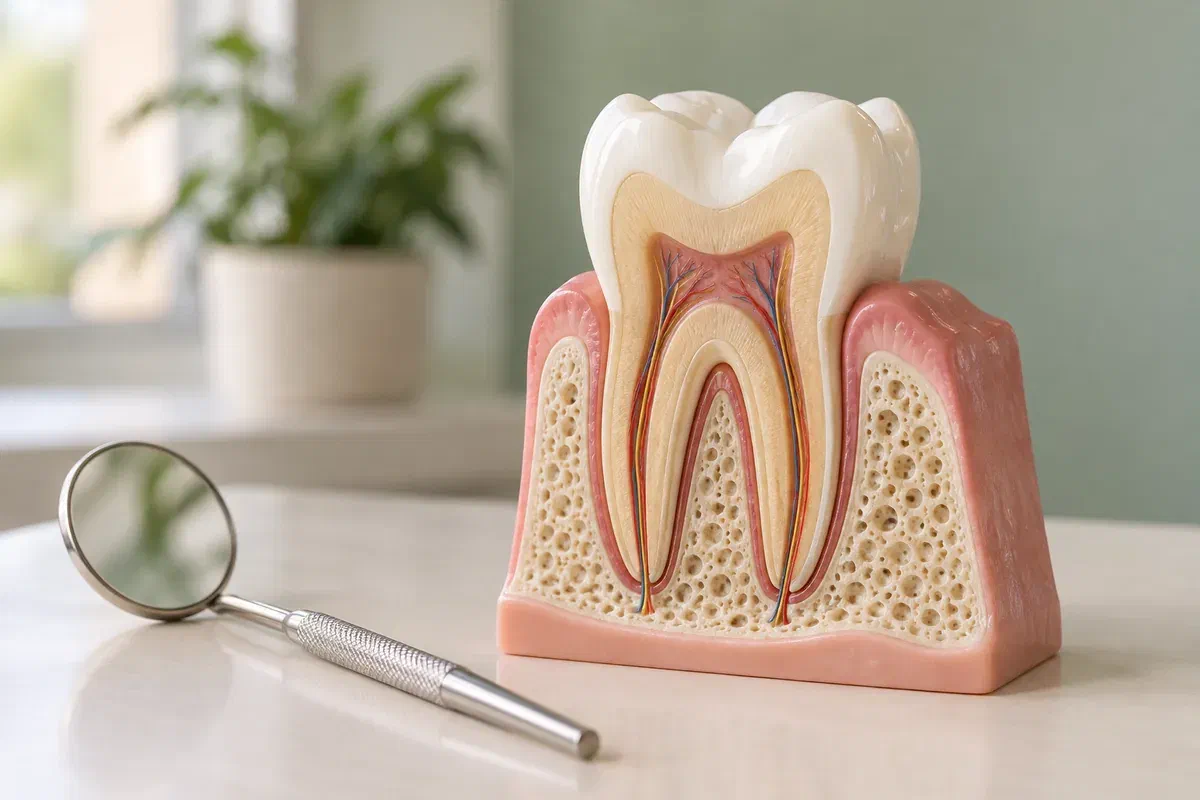
Illustrative cross-section tooth model showing roots within supporting gum and bone beside a dental mirror
What is behind the recommendation?

Images, movement and history each point somewhere different.

Tell us which piece of evidence the plan seems to rest on. The assessment then checks that evidence against a current examination of your mouth.

An X-ray used to justify treatment

Ask which sites the image shows and how they were assessed clinically. A copy of the radiograph is helpful, but it still needs to be matched with an examination of the gums. If older images are available too, we can discuss whether they reveal a trend or are too different to compare fairly.

Looseness offered as a reason for removal

Mobility has many possible causes, and some are more manageable than they first appear. Note when the movement started, whether there is pain, and whether you had any injury. A clinical check of how the tooth behaves gives far more information than testing it yourself.

A gum diagnosis made elsewhere

Share the diagnosis you received, the treatment already done and the maintenance that was advised, even if you stopped partway. Mention anything that got in the way. We want to understand where things stand now so the plan is realistic, not to question how you got here.

Bone levels, gum measurements and symptoms belong in one conversation. A painless mouth can still have reduced support, and a finding at one tooth does not prove that every tooth faces the same decision.

The value of a careful second opinion

Decide with reasons, not just a recommendation.

A detailed review can show which areas genuinely need treatment, which might be watched for now, and what information would make the picture clearer. Ask to see the findings in whatever way helps you, side by side with the plan you were given. Knowing why a tooth is on the list is what lets you weigh the proposal with confidence.

It also gives you a well-documented starting point. Whatever you decide, a maintenance plan should explain what will be monitored and why a particular interval suits you. With that understanding, regular reviews feel purposeful, even during long periods without symptoms.

Patient information: American Academy of Periodontology — combining clinical and radiographic findings

Reasons tied to each tooth on the plan

Ask whether the bone change is confined to a few sites or spread more widely, and how that affects your choices. For any tooth marked for removal, request an explanation that applies to that tooth. A conclusion about one site should not be quietly extended to the rest.

Separation of fact from forecast

Ask what today’s findings establish and what could only be confirmed with follow-up. If you bring older images or charts, the clinician can say whether they support a meaningful comparison. Predictions about exactly how bone will change in future should be treated with caution.

A logical order of treatment

Implants, crowns or cosmetic work may appear early on some plans. Ask how each item depends on first controlling the gum condition and which choices can safely wait. Staging care this way makes the costs, visits and your own role easier to judge.

Inside the review

Listen, measure, compare, explain.

We choose records based on the question in front of us. If we suggest an image or test, ask how it relates to the plan you are trying to evaluate.

  1. Hear the full background

    We go over past gum treatment, teeth already lost, symptoms and what the earlier plan proposed. Your general health counts, including conditions, medicines and tobacco use. If recent images exist, we may be able to use them instead of retaking them, depending on their quality.

  2. Examine the gums around every tooth

    The clinician checks the tissue and may record pocket depths, recession, bleeding and mobility. Ask which readings are most relevant to the teeth on your plan. The support system below the gum matters as much as what is visible at the surface.

  3. Interpret the images with the findings

    Radiographs can help show bone height and other changes around roots. We decide what is appropriate and read it alongside the examination. Ask about what an image cannot tell us, and keep in mind that a 3D scan is not needed for every question about bone support.

  4. Compare options and agree on a review

    We explain the diagnosis, the sites of concern and a reasonable sequence of care, including how it compares with your earlier plan. Ask whether a periodontist’s opinion would help. Confirm how progress will be checked before taking on later, larger stages.

Once you have decided

Whichever path you choose, the daily part is yours.

Assessment informs the plan; it does not rebuild bone. Follow the care that matches your diagnosis, and let us know if any part is hard to keep up.

Practise the technique in the chair

Ask for a demonstration focused on the teeth that concern you and any spaces or dental work that are tricky to reach. Confirm which aids to use and how. If a tool catches or an area is tender, tell us so we can adjust the method rather than having you force it.

Keep one coordinated plan

If you see more than one provider, ask who is leading and where follow-up will happen. Clarify which visits are active treatment and which are stability checks. Bring copies of any outside findings so advice is not split into separate, competing plans.

Don’t save changes for the next review

Contact us about increasing looseness, swelling, discomfort or a shift in your bite. Tell us about changes in your health or medications too. A maintenance appointment months away is not a reason to wait on a new problem.

Comparing the routes forward

Holding steady, adding treatment, or rethinking a tooth.

For each choice, ask what it aims to do, what makes it suitable for you and what care it needs long term. A good plan follows your findings rather than the phrase bone loss.

When stability is the main goal

Ongoing gum care and maintenance visits

This route can include professional cleaning, gum therapy, home-care support and scheduled reassessment. Ask how you will know the condition is stable and what remains unclear. Gums that improve do not mean lost support has returned.

When a site may merit additional periodontal treatment

Assessment by a periodontist

A specialist can consider whether further care, sometimes a regenerative approach for a well-suited defect, is reasonable. Ask about the site involved, the likely benefit, its limits and the maintenance afterward. Grafting is not the fix for every form of bone loss.

When retention or replacement shapes the plan

A frank conversation about one tooth’s future

If a tooth cannot reasonably be kept, ask why and compare the realistic alternatives. The decision should take the surrounding teeth and gums into account. Reduced support alone is not grounds to assume an extraction or implant.

Patient information: American Academy of Periodontology — selected regenerative and surgical procedures

Second-opinion questions

Fair questions to ask before committing.

It is reasonable to want a clear explanation before major treatment. Bring the plan you were given and the parts that left you uncertain.

(905) 876-4488
Is it okay to get a second opinion on a gum or extraction plan?
Yes. Asking for another assessment before significant treatment is a normal part of making an informed decision. Bring the plan and any records you have. We will examine the areas involved and explain our findings, including where they agree with what you were told.
Can you use the X-rays my other dentist already took?
Often, if they are recent and clear enough for the question. Ask the other office to share them. The clinician still needs a current examination and will tell you whether any additional image would add useful information.
If my tooth is loose, does it have to come out?
Not always. Looseness can relate to gum and bone support, bite forces, infection or injury, and the outlook varies. The clinician examines the tooth and its support before discussing whether it can reasonably be kept or whether other options deserve consideration.
Why would two dentists give different recommendations for the same tooth?
Borderline teeth can be judged differently, and new findings may change the picture. Ask each clinician to explain the reasons for their view. Understanding the evidence behind both opinions makes it easier to choose an approach you are comfortable with.
Will a deep cleaning bring my bone levels back up?
Periodontal cleaning aims to control inflammation and support healthier gums, which is important, but it is not expected to restore all lost bone. Ask what your care is designed to stabilize and whether any additional treatment suits your specific findings.
How do I plan visits from Oakville if more than one appointment is needed?
Ask at the end of the assessment how many visits the proposed care involves and what each one is for. That lets you book around work and family commitments. If something urgent comes up between appointments, call us first so we can advise on timing.
Oakville bone-support review

Bring the plan. We’ll go through it with you.

Contact our Bronte Street practice to discuss a recommendation based on reduced bone support, a previous gum diagnosis, or findings you would like explained again. We can assess the concern and describe a sensible plan for care or further evaluation.

Diagnosis, prognosis for individual teeth, imaging, suitable treatment, referral and fees depend on assessment. We cannot guarantee in advance that a tooth will be kept or that lost support will regenerate.

Visit Milton Dental Clinic
Unit 1, 342 Bronte St. S, Milton, ON L9T 5B7
Get directions Clinic hours
Monday–Thursday
11am–7pm
Friday–Sunday
By appointment only

Areas we serve

  • Milton
  • Oakville
  • Mississauga
  • Georgetown
  • Halton Hills
  • Acton
  • Campbellville
  • Brampton
  • Burlington
  • Puslinch
  • Rockwood
  • Erin
  • Caledon
  • Etobicoke
  • Old Milton
  • Bronte Meadows
  • Timberlea
  • Dorset Park
  • Dempsey
  • Clarke
  • Beaty
  • Coates
  • Harrison
  • Scott
  • Willmott
  • Ford
  • Bowes
  • Cobden
  • Walker
  • Mountain View
  • Milton Heights
  • Hawthorne Village
  • Valley View
  • Fallingbrook
  • Nassagaweya
  • Trafalgar
  • Esquesing
  • Nelson
  • Brookville
  • Moffat
  • Glen Williams
  • Norval
  • Limehouse
  • Stewarttown
  • Ashgrove
  • Hornby
  • Silver Creek
  • Speyside
  • Scotch Block
  • North Oakville
  • River Oaks
  • Glen Abbey
  • West Oak Trails
  • Palermo
  • Bronte Creek
  • College Park
  • Joshua Creek
  • Uptown Core
  • Preserve
  • Iroquois Ridge
  • Lisgar
  • Meadowvale
  • Meadowvale Village
  • Churchill Meadows
  • Erin Mills
  • Central Erin Mills
  • Streetsville
  • East Credit
  • Creditview
  • Heartland
  • Sheridan
  • Mount Pleasant
  • Credit Valley
  • Huttonville
  • Churchville
  • Springbrook
  • Northwest Brampton
  • Bram West
  • Fletcher's Meadow
  • Fletcher's Creek South
  • Alton Village
  • Orchard
  • Millcroft
  • Headon Forest
  • Tansley
  • Brant Hills
  • Tyandaga
  • Kilbride
  • Lowville
  • Aberfoyle
  • Morriston
  • Arkell
  • Hillsburgh
  • Freelton
  • Carlisle
  • Waterdown
  • Flamborough
  • Mountsberg

How can we help?

Milton Dental Clinic

Have a question about your smile? Choose the option that works best for you.

For urgent dental concerns, please call.
Messages are reviewed during clinic hours.