

Illustrative clinician discussing tooth support with a patient using a physical teaching model
Specialized Care

Bone-Loss Assessment in Old Milton

Decades of fillings, crowns and cleanings leave a long trail of records, and somewhere in that trail is a note about bone support. Close to Old Milton, our team can compare what was recorded before with what we find now and explain what it means for the teeth you want to keep.

Old Milton smiles, long histories

A folder of old X-rays and one nagging question.

Plenty of adults have seen three or four dentists over the years, each keeping their own charts. When a new examination mentions reduced bone, the obvious thing to wonder is whether this is new or something that has been sitting quietly for a long time. A bone-loss assessment examines the gum and bone around your teeth today and weighs that against any history available.

A label like “moderate bone loss” leaves out nearly everything useful. Where is it? How far has support changed? What likely caused it, and does it call for treatment? Teeth that have carried large fillings, bridges or crowns for years each have their own story, so the answer can differ from one tooth to the next.

Ask previous offices for copies of images and periodontal charts before you come, or bring a list of where you were seen. Tell us what earlier dentists said and which parts never quite made sense. We can work through the findings with you, explain whether older records allow a fair comparison, and talk about care focused on keeping the teeth that can reasonably stay.

Arrange a bone-support review
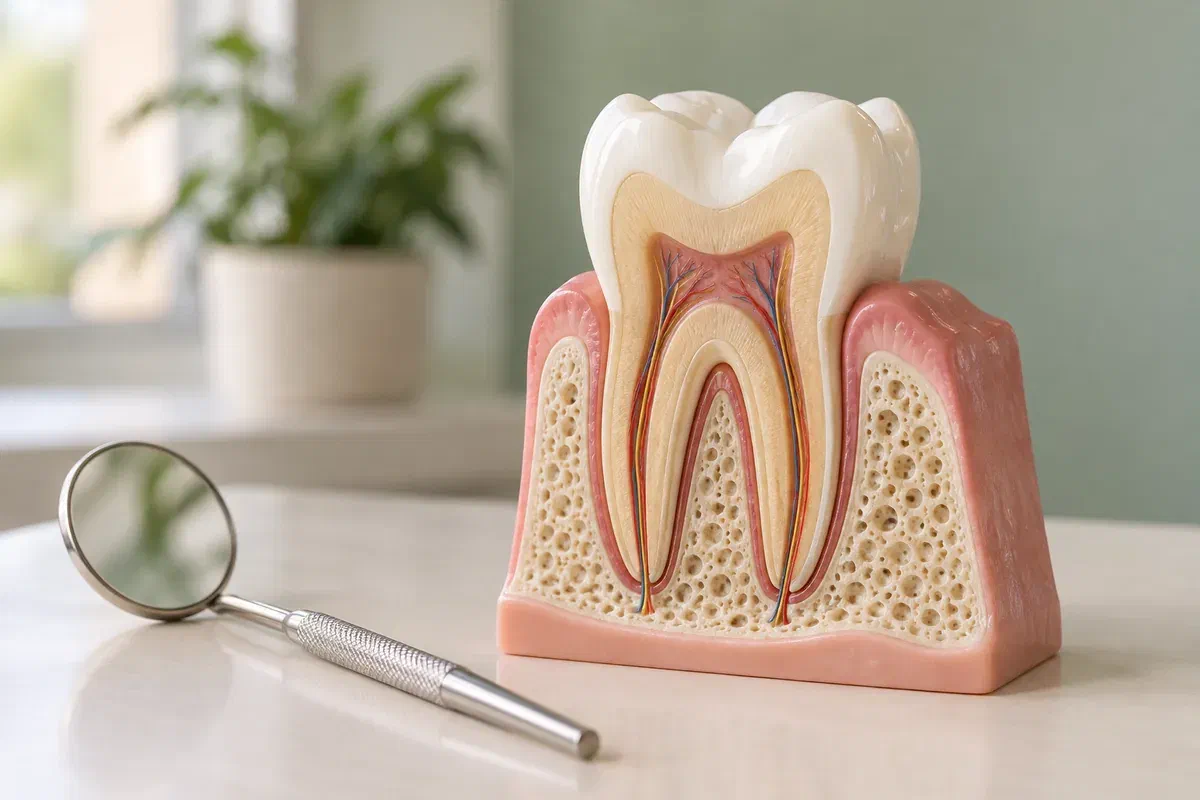
Illustrative cross-section tooth model showing roots within supporting gum and bone beside a dental mirror
Sorting out the starting point

New finding or old news?

The clinician needs to know what you have been told before, what has changed, and what you are noticing yourself. Connecting those pieces is the heart of the assessment.

A recent image that mentions bone levels

Ask which teeth the comment refers to and how it lines up with what an examination of the gums shows. A written summary from a report rarely tells the whole story. If an older image of the same area exists, the clinician can say whether it is similar enough to compare and how far that comparison can go.

A tooth that has started to feel different

Perhaps a front tooth seems to have tipped forward, or a back tooth shifts slightly when you chew. Note when it began, whether it is painful and whether anything preceded it, like a fall. Leave the testing to the examination rather than pressing on it at home.

Gum treatment from years ago

Deep cleanings or gum surgery decades back are still relevant. Share what you remember and any paperwork you can find, including from offices that have since closed. If regular follow-up stopped at some point, say why. That helps build a plan you can keep up, without any judgment about the gap.

Images, gum readings and symptoms each give part of the picture and must be read side by side. A tooth that never hurts can still have reduced support, and finding bone change in one area says nothing certain about the rest.

Why the review is worth it

Years of notes turned into one clear explanation.

When records come from several sources, it is easy to end up with conflicting impressions. A thorough assessment pulls them together and sorts the teeth into those that need care now, those to keep an eye on, and those where information is still missing. Ask the clinician to walk you through it with the images or a model so you can follow along.

This visit also becomes the reference point for everything after it. Your maintenance interval should come with an explanation of what is being tracked and why that spacing suits you. Understanding the reason makes it easier to keep coming back during long stretches when nothing feels wrong.

Patient information: American Academy of Periodontology — combining clinical and radiographic findings

Individual attention for teeth with a past

Heavily restored teeth, root-treated teeth and bridge supports may not share an outlook with their neighbours. Ask whether the concern is concentrated in one area or more general. If a single tooth looks weaker, request reasons that apply to it rather than to the mouth as a whole.

Honest limits on comparison

Old images can help, but only if they show the same area in a comparable way. Ask what today’s records support and what would need a later check to confirm. No single appointment can forecast exactly how support will change over the coming years.

A plan that puts first things first

Replacing an old crown or improving appearance may be on your mind, but stabilizing the gums usually matters first. Ask how any proposed restorations relate to the underlying condition. Breaking care into stages makes it simpler to judge the appointments, effort and fees involved.

Step by step

From the paper trail to a plan.

Which records are needed depends on the question you are trying to answer. If the clinician recommends a particular exam or image, it is fair to ask how it will help.

  1. Collect what is already known

    We ask about earlier gum care, any teeth removed, current symptoms and the explanations you have heard. Medical conditions, medicines and tobacco use are part of the conversation too. Where records exist elsewhere, ask whether requesting them first could save repeating an image.

  2. Examine each tooth and its gum

    The clinician assesses the tissue and may record pocket depths, recession, bleeding and how steady each tooth is. Ask which measurements bear most directly on your concern. Looking at the visible gumline alone is not enough to judge the support underneath.

  3. Read images in light of the exam

    A current radiograph sits beside the older ones you brought, and the clinician judges whether new images are needed at all. Whatever is used, it is interpreted against the probing results rather than on its own. Ask what each image can reveal and where it falls short, and do not assume every concern requires a 3D scan.

  4. Set out the options and timing

    We explain the diagnosis, the areas that need attention and the suggested order of care. Ask whether a specialist’s opinion would add anything and what to do while you wait. Before starting later phases, confirm how the results of early treatment will be reviewed.

Keeping it going

Habits matter more than the appointment.

The assessment identifies what is happening, but it does not replace bone. Follow the advice that fits your diagnosis and tell us if any part of it is difficult for you.

Adapt cleaning to older dental work

Bridges, crowns and wider gaps can trap plaque in ways a toothbrush alone may miss. Ask for a hands-on demonstration and confirm which aids to use. If something hurts or keeps catching, report it so the routine can be changed rather than forced.

Keep every part of care in one picture

Ask which appointments are treatment and which are stability checks. If a specialist becomes involved, confirm who is coordinating and where follow-up happens. Bring in reports from other providers so all recommendations are weighed together.

Report changes without waiting

Let the clinic know about a tooth that loosens further, gum swelling, new discomfort or a change in how you bite. Mention new diagnoses or medications as well. A maintenance date on the calendar is not a reason to hold off on something new.

What can come next

Three paths, each with a different goal.

Ask what each option is meant to accomplish, why your findings point to it, and what upkeep follows. The choice should rest on your examination, not on the words bone loss.

When stabilizing the gums comes first

Steady periodontal management

Care may involve professional cleaning, gum treatment, coaching on home care and routine reassessment. Ask how stability will be measured and what remains uncertain. Gums that look and feel healthier do not mean previously lost support has been rebuilt.

When a particular site may need further periodontal care

Referral for a closer periodontal opinion

A periodontist can judge whether additional treatment, possibly a regenerative procedure for a suitable defect, is worthwhile. Ask about that specific site, the expected gain, the limitations and the care required afterward. Grafting does not fit every pattern of bone change.

When an older tooth’s outlook affects everything else

Deciding the future of a long-serving tooth

If keeping a tooth is not realistic, ask why and compare the alternatives. That decision should consider the neighbouring teeth and existing dental work. Reduced support on its own does not mean extraction or an implant is the answer.

Patient information: American Academy of Periodontology — selected regenerative and surgical procedures

Common questions near Old Milton

Your history, your records, your questions.

An assessment can explain something you were told long ago or give you a fresh starting point. Bring old paperwork and any questions you have carried for years.

(905) 876-4488
How do I get my old X-rays from a dentist I saw years ago?
Contact that office and ask for copies of your images and charts to be sent to us or to you. Policies differ on how records are released. If the office has closed, let us know what you remember and we can discuss what can be learned without them.
Can bone loss show up around a tooth that has a crown or root canal?
Yes. Restored and root-treated teeth are still held by gum and bone, and their support can change like any other tooth. The clinician examines them along with the rest of the mouth and explains whether any finding relates to the gums, the restoration, or something else.
If I had gum treatment twenty years ago, does that still matter?
It can. Earlier treatment helps explain the present picture and may influence how often you are seen. Share what you recall, even roughly. The assessment focuses on your current condition and builds a plan from there.
Why measure my gums if the bone change is already on the X-ray?
An image and a set of gum readings answer different questions. Measurements describe the tissue, inflammation and attachment around each tooth, while the image shows bone levels from one angle. The clinician brings them together, and you can ask how each one shapes the recommendation.
Will I lose a tooth just because its bone support is reduced?
Not automatically. How much support remains, the condition of the tooth itself and how the gums respond to care all count. Ask for a clear explanation of any tooth with an uncertain outlook before making a decision about it.
Is a grafting procedure part of every bone-loss assessment?
No. The assessment comes first and treatment decisions follow. Many situations are managed with periodontal care and maintenance, while some specific defects warrant a specialist opinion. If grafting is suggested, ask why that site qualifies and what realistic results look like.
Bone-loss assessment for Old Milton

Gather the paperwork and let’s read it together.

Get in touch with our Bronte Street practice, just a short way from Milton’s historic downtown, to discuss reduced bone support, an earlier gum diagnosis, or a plan you want explained. We can examine the concern and set out sensible care or further evaluation.

Diagnosis, the outlook for each tooth, imaging, treatment options, referral and fees are determined at assessment. Neither keeping a tooth nor regenerating lost support can be guaranteed ahead of time.

Visit Milton Dental Clinic
Unit 1, 342 Bronte St. S, Milton, ON L9T 5B7
Get directions Clinic hours
Monday–Thursday
11am–7pm
Friday–Sunday
By appointment only

Areas we serve

  • Milton
  • Oakville
  • Mississauga
  • Georgetown
  • Halton Hills
  • Acton
  • Campbellville
  • Brampton
  • Burlington
  • Puslinch
  • Rockwood
  • Erin
  • Caledon
  • Etobicoke
  • Old Milton
  • Bronte Meadows
  • Timberlea
  • Dorset Park
  • Dempsey
  • Clarke
  • Beaty
  • Coates
  • Harrison
  • Scott
  • Willmott
  • Ford
  • Bowes
  • Cobden
  • Walker
  • Mountain View
  • Milton Heights
  • Hawthorne Village
  • Valley View
  • Fallingbrook
  • Nassagaweya
  • Trafalgar
  • Esquesing
  • Nelson
  • Brookville
  • Moffat
  • Glen Williams
  • Norval
  • Limehouse
  • Stewarttown
  • Ashgrove
  • Hornby
  • Silver Creek
  • Speyside
  • Scotch Block
  • North Oakville
  • River Oaks
  • Glen Abbey
  • West Oak Trails
  • Palermo
  • Bronte Creek
  • College Park
  • Joshua Creek
  • Uptown Core
  • Preserve
  • Iroquois Ridge
  • Lisgar
  • Meadowvale
  • Meadowvale Village
  • Churchill Meadows
  • Erin Mills
  • Central Erin Mills
  • Streetsville
  • East Credit
  • Creditview
  • Heartland
  • Sheridan
  • Mount Pleasant
  • Credit Valley
  • Huttonville
  • Churchville
  • Springbrook
  • Northwest Brampton
  • Bram West
  • Fletcher's Meadow
  • Fletcher's Creek South
  • Alton Village
  • Orchard
  • Millcroft
  • Headon Forest
  • Tansley
  • Brant Hills
  • Tyandaga
  • Kilbride
  • Lowville
  • Aberfoyle
  • Morriston
  • Arkell
  • Hillsburgh
  • Freelton
  • Carlisle
  • Waterdown
  • Flamborough
  • Mountsberg

How can we help?

Milton Dental Clinic

Have a question about your smile? Choose the option that works best for you.

For urgent dental concerns, please call.
Messages are reviewed during clinic hours.