

Illustrative clinician discussing tooth support with a patient using a physical teaching model
Specialized Care

Bone-Loss Assessment in Rockwood

A referral slip for a gum specialist, or the suggestion that you might need one, can leave you unsure what happens next. From Rockwood, a bone-loss assessment reviews your gum and bone support, explains whether a periodontist’s opinion would add useful information, and keeps the overall plan connected.

General dentist or specialist?

Who should look at this, and in what order?

Some people are told at a cleaning that a periodontist might be worth seeing, with little explanation of why. Others have already seen one and want help putting the advice into practice. Either way, it helps to understand your own findings first. A bone-loss assessment does that groundwork, checking how well each tooth is anchored through an examination, suitable images and your history.

A finding of reduced bone does not automatically mean specialist care. The phrase on its own does not tell you which teeth are affected, how much support has changed, what caused it or which kind of treatment fits. Many situations are managed through general dental care and maintenance, while particular defects or complex cases benefit from a specialist’s view.

For the visit from Rockwood, bring any referral letter, specialist report, X-rays and gum charts you have. Tell us what each provider recommended and where you feel the plans don’t line up. We can examine the areas involved, explain whether further opinions would help, and discuss care aimed at protecting the teeth that look maintainable.

Talk through a referral question
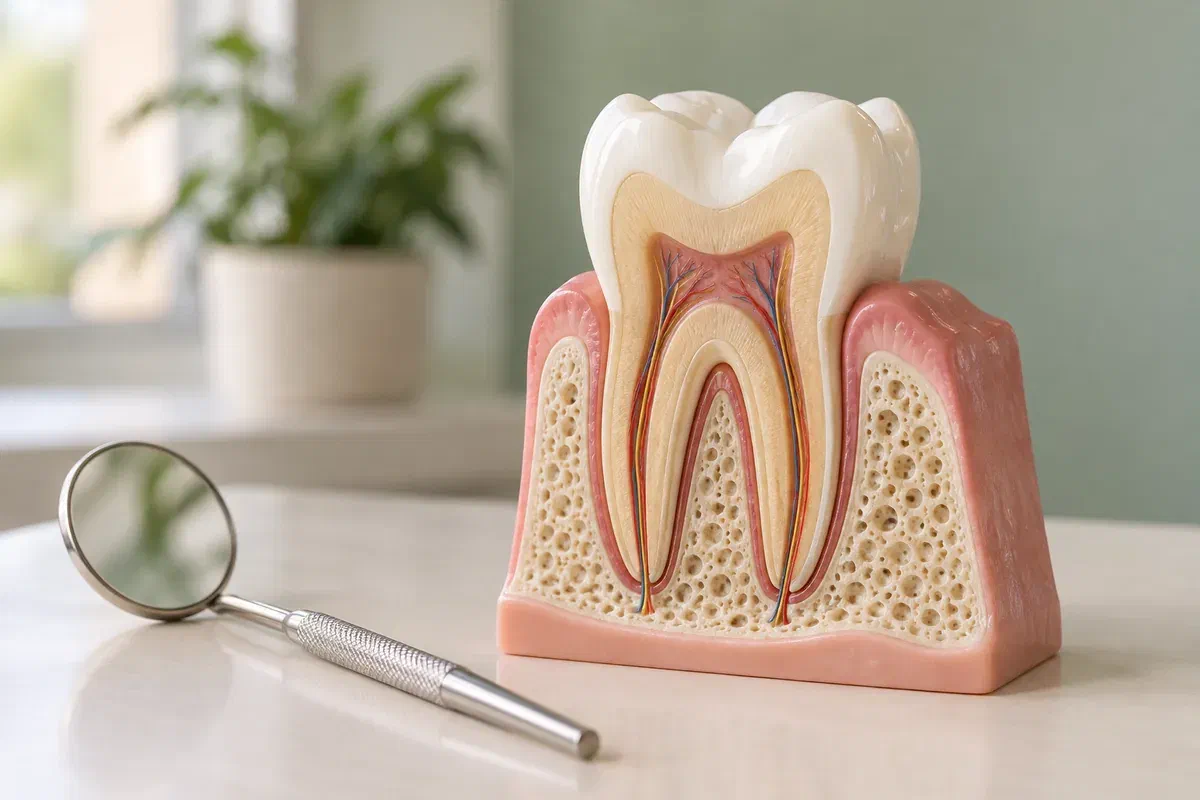
Illustrative cross-section tooth model showing roots within supporting gum and bone beside a dental mirror
Sorting out the starting point

What made someone mention a specialist?

The reason behind a referral matters. Share what you were told, and we will compare it with what a current examination shows.

An image with a deeper bone defect

Ask which site prompted the comment and how the image fits with the gum measurements. A note saying “see periodontist” doesn’t explain the reasoning. Earlier images may help show whether the area is stable, if they are comparable.

A tooth that has started to move

Describe when it began, whether there is discomfort and whether you had an injury. Mobility can have several causes. Avoid testing it at home and let the examination determine whether it needs prompt attention or a planned approach.

Gum treatment that hasn’t settled things

If pockets or bleeding persisted after earlier care, share the details and any reports. Mention anything that interrupted follow-up. That background helps decide whether further general care, specialist input or both would be sensible. Areas that did not respond the first time are often the ones a second opinion is most useful for.

Images, gum readings and symptoms need to be interpreted together. A painless tooth can still have reduced support, and the need for specialist care at one site does not mean the whole mouth needs it.

What you gain

Knowing why before deciding where.

A detailed assessment can show which areas need treatment, which can be monitored and which might benefit from a specialist’s input. Ask the clinician to explain each finding in a way you understand, using your images, a chart or a model. That makes a referral feel like a reasoned step rather than an unexplained instruction.

It also creates a common record for everyone involved. If you see a periodontist, today’s findings can be shared, and your maintenance plan should make clear who checks what and when. Knowing the purpose of each visit makes it easier to keep up the schedule.

Patient information: American Academy of Periodontology — combining clinical and radiographic findings

Clear reasons for each site

Ask whether the concern is limited to one area or spread more widely, and whether that changes the case for referral. If one tooth has a less favourable outlook, ask what makes it different, rather than applying its plan to every tooth.

A distinction between today and tomorrow

Ask what the current findings establish and what would need follow-up. Older records help when they are comparable. A single assessment cannot predict with precision how support will change.

A plan with clear roles

If several treatments or providers are involved, ask who handles each step and in what order. Ask how restorative decisions depend on gum stability. A staged plan makes visits, responsibilities and fees easier to follow.

What the assessment covers

One review, shared with whoever needs it.

Records are chosen to answer the question in front of us. If an image or test is suggested, ask what it adds and whether it can be shared with a specialist.

  1. Collect the reports you have

    We go through referral letters, specialist notes, earlier gum treatment, lost teeth and your symptoms. Health conditions, medications and tobacco use are reviewed as well. Records already taken elsewhere may avoid repeating them.

  2. Measure and observe the gums

    The clinician probes around each tooth to record pocket depth and looks for bleeding, recession and mobility. Ask which findings are driving any referral recommendation. Support is assessed below the gumline, not only by appearance.

  3. Interpret appropriate images

    Dental X-rays can show bone levels and defects near the roots. Which images are taken is a clinical decision, and they are read alongside the examination. Ask about their limits; not every situation calls for a 3D scan.

  4. Decide on next steps and who leads

    We explain the diagnosis, the areas of concern and the order of care. If a periodontist’s opinion would help, we discuss why and how records will be shared. Confirm how early treatment will be reviewed before later phases.

After the assessment

Keep the plan in one piece.

Assessment guides the plan but does not restore bone. Stick with the care that matches your diagnosis, and tell us if something is hard to keep up.

Learn the routine for your mouth

Ask for a practical demonstration around the affected teeth and any gaps or dental work that are tricky. Confirm which aids to use and how. If a tool catches or an area is sore, let us know so the technique can be refined.

Be clear on who sees you when

If a specialist is involved, ask who coordinates and where each follow-up happens. Some practices share maintenance between offices, so confirm the arrangement. Bring every outside report so recommendations are considered together.

Raise new problems right away

Call about increasing mobility, gum swelling, discomfort or a change in how your teeth meet, and mention new medicines or health issues. Don’t hold a new symptom until whichever appointment is next.

What may come next

General care, specialist care, or a decision about one tooth.

For each route, ask what it is meant to achieve, why your findings support it and what ongoing care it involves. The plan should rest on your examination, not on the label.

When stabilizing the gums is the main need

Periodontal care at a general practice

This may involve professional cleaning, gum treatment, home-care guidance and planned reviews. Ask how stability will be judged and what remains uncertain. Healthier gums do not mean previously lost bone has been replaced.

When a site may need more specialized treatment

A periodontist’s assessment

A specialist can consider whether additional care, including a regenerative approach for a suitable defect, is reasonable. Ask about the specific site, the expected benefit, the limits and the maintenance. Grafting is not appropriate for every pattern of bone loss.

When one tooth’s prognosis shapes the plan

Deciding on a tooth with little support

If keeping a tooth isn’t realistic, ask why and compare the possible next steps. The decision should consider the rest of your mouth. Reduced support does not on its own mean removal or an implant.

Patient information: American Academy of Periodontology — selected regenerative and surgical procedures

Rockwood referral questions

Specialists, referrals and shared care.

Referral can feel like a big step. Bring any letters and reports, and we will help you understand where each part of your care fits.

(905) 876-4488
What does a periodontist do that a general dentist doesn’t?
A periodontist is a dentist with additional training in the gums and supporting structures. They may provide more advanced assessment and treatment for complex or specific problems. Many people receive gum care and maintenance through a general practice. Whether specialist input would help depends on your findings, and we can explain our reasoning either way so the decision doesn’t feel arbitrary.
Do I need a referral to see a gum specialist?
Arrangements vary between specialist offices. We can discuss whether a referral makes sense for you and help by sending relevant findings and records so the specialist has the background.
Can I have my maintenance cleanings here after seeing a specialist?
In some cases maintenance is shared between a general practice and a specialist. Ask both offices how they would like to arrange it, and confirm who checks your gum measurements over time. From a village like Rockwood, a shared arrangement can sometimes make regular visits easier to fit in, but it only works if the records travel with you.
Is surgery always the next step after a specialist visit?
No. A specialist may recommend non-surgical care, monitoring or a procedure, depending on the findings. If surgery is suggested, ask why that site needs it, what result is realistic and what upkeep follows.
Does bone loss mean my teeth will all have to come out?
No. Each tooth’s outlook depends on how much support remains, where the change is and how it responds to treatment. Ask for an explanation of the specific teeth that concern you.
Can a deep cleaning replace the bone that has been lost?
Periodontal cleaning aims to control inflammation and support healthier gums, but it does not restore lost bone. Ask what your treatment is meant to stabilize and whether any additional procedure would suit your findings.
Bone-loss assessment for Rockwood

Bring the referral letter, and let’s make sense of it.

Get in touch with our Bronte Street practice about a referral question, a bone-support finding or specialist advice you want to understand. We can examine the concern and explain how general care, specialist input or further evaluation might fit together.

Diagnosis, tooth prognosis, imaging, suitable treatment, specialist referral and fees depend on assessment. We cannot guarantee in advance that a tooth will be retained or that support will regenerate.

Visit Milton Dental Clinic
Unit 1, 342 Bronte St. S, Milton, ON L9T 5B7
Get directions Clinic hours
Monday–Thursday
11am–7pm
Friday–Sunday
By appointment only

Areas we serve

  • Milton
  • Oakville
  • Mississauga
  • Georgetown
  • Halton Hills
  • Acton
  • Campbellville
  • Brampton
  • Burlington
  • Puslinch
  • Rockwood
  • Erin
  • Caledon
  • Etobicoke
  • Old Milton
  • Bronte Meadows
  • Timberlea
  • Dorset Park
  • Dempsey
  • Clarke
  • Beaty
  • Coates
  • Harrison
  • Scott
  • Willmott
  • Ford
  • Bowes
  • Cobden
  • Walker
  • Mountain View
  • Milton Heights
  • Hawthorne Village
  • Valley View
  • Fallingbrook
  • Nassagaweya
  • Trafalgar
  • Esquesing
  • Nelson
  • Brookville
  • Moffat
  • Glen Williams
  • Norval
  • Limehouse
  • Stewarttown
  • Ashgrove
  • Hornby
  • Silver Creek
  • Speyside
  • Scotch Block
  • North Oakville
  • River Oaks
  • Glen Abbey
  • West Oak Trails
  • Palermo
  • Bronte Creek
  • College Park
  • Joshua Creek
  • Uptown Core
  • Preserve
  • Iroquois Ridge
  • Lisgar
  • Meadowvale
  • Meadowvale Village
  • Churchill Meadows
  • Erin Mills
  • Central Erin Mills
  • Streetsville
  • East Credit
  • Creditview
  • Heartland
  • Sheridan
  • Mount Pleasant
  • Credit Valley
  • Huttonville
  • Churchville
  • Springbrook
  • Northwest Brampton
  • Bram West
  • Fletcher's Meadow
  • Fletcher's Creek South
  • Alton Village
  • Orchard
  • Millcroft
  • Headon Forest
  • Tansley
  • Brant Hills
  • Tyandaga
  • Kilbride
  • Lowville
  • Aberfoyle
  • Morriston
  • Arkell
  • Hillsburgh
  • Freelton
  • Carlisle
  • Waterdown
  • Flamborough
  • Mountsberg

How can we help?

Milton Dental Clinic

Have a question about your smile? Choose the option that works best for you.

For urgent dental concerns, please call.
Messages are reviewed during clinic hours.