

Illustrative clinician explaining a tooth-and-gum model to a patient during a consultation
Specialized Care

Crown Lengthening in Acton

What will the first days after crown lengthening actually be like at home? From Acton, you can sit down with us to understand why the gum around a tooth might need to change, what tissue is involved, and how to prepare for meals, cleaning and the healing checks that follow.

Thinking ahead to recovery

Stock the fridge, clear the calendar, read the instructions.

Most questions about crown lengthening eventually turn practical: what can I eat, how do I brush, when will it feel normal? It helps to start with what the procedure is. The gum, and sometimes the bone under it, is reshaped so that more natural tooth stands above the tissue, ready for a restoration or, occasionally, for a cosmetic change.

That exposed tooth is the “crown” the name refers to; nothing artificial gets longer. The restorative reason is the common one, when a break or decay extends under the gum. A cosmetic request about short-looking teeth is a different conversation. Both depend on how much tooth, root and support you have.

Coming in from Acton, it’s worth asking about recovery at the same visit as the assessment. Bring any plan or X-rays you have. We can explain how the procedure fits your care, what still needs checking, whether a periodontist would be involved, and what home preparation makes sense before you agree to anything surgical.

Ask what recovery would involve for you
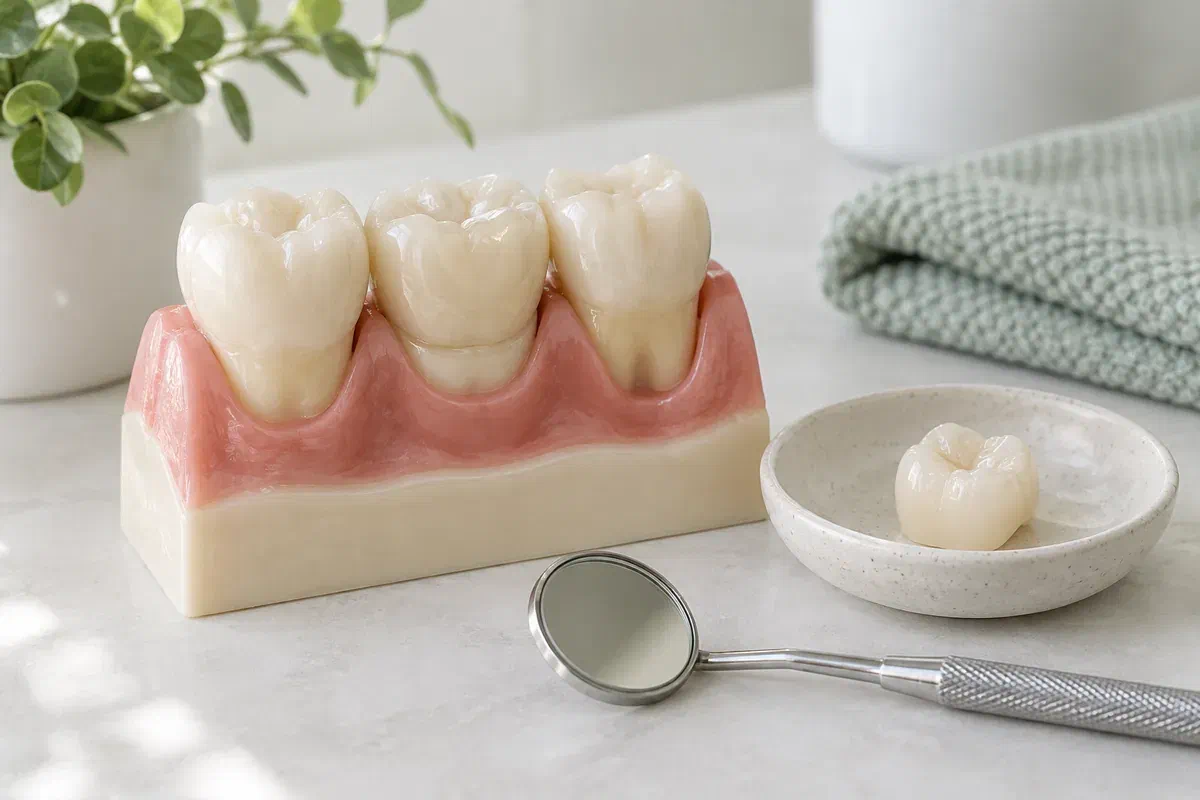
Illustrative tooth-and-gum teaching model beside a ceramic crown sample and dental mirror
Reasons for the procedure

Why the gum might need to move at all

Ask which tooth is involved and what the procedure is expected to fix. Making space for a restoration and adjusting how a smile looks are two separate goals, and recovery planning differs a little for each.

Damage that leaves little tooth to work with

Wear, a fracture or decay reaching under the gum can leave a restoration without enough to grip. Ask whether uncovering more sound tooth would make repair sensible and how the tooth is expected to hold up. A heavily weakened root may not be a good use of surgery.

A filling or crown margin crowding the tissue

When a restoration ends too near the bone, the gum around it can struggle. Ask what makes the current position unsuitable and how the change would improve things. The gum stage and the restorative stage should be thought through together.

Front teeth that look shorter than you’d like

Describe what bothers you and what you would keep. Several causes can lie behind visible gum, so the reason needs finding before surgery is considered. A celebrity photo can’t confirm that tissue removal suits your mouth.

The change can involve gum, bone or both, and that affects recovery. Ask which applies to you, whether other teeth are included, and what it means for support, appearance and later restoration.

Why preparation matters

Knowing the plan makes the healing weeks easier.

A clear consultation explains what surgery is meant to allow and whether that is worth it. Ask how much tooth and support would remain. Exposing more structure gives a restoration a better foundation, but it cannot promise the tooth will last a lifetime.

It also helps to know how many visits lie ahead and how long healing will be followed. When two clinicians share your care, find out who you call with a question after surgery. A plan everyone follows keeps the procedure, any temporary and the final work moving toward the same end.

What the treated area will look like

Ask where the new gumline and the edge of any restoration are expected to be, using a model or image. Check whether neighbouring teeth would change. Knowing in advance means the healing appearance won’t come as a shock.

A frank list of recovery tradeoffs

Set the intended gain against healing time, tenderness, sensitivity, visible changes and daily care. Ask which risks really apply to you. More assessment before deciding is always fine.

An estimate that lists every visit

Ask whether the estimate includes the assessment, the surgery, each review, any temporary and the final restoration, or whether parts are separate. Ask what could change the plan. Seeing every visit listed also helps you plan time off.

What to expect on each day

Assessment, a plan, the procedure and a healing period

How the procedure is done and when depends on your tooth, the tissues and the goal. Expect the clinician who treats you to describe it fully and to seek your agreement before starting.

  1. Assessment of the tooth and its support

    Roots, gum, bone and the teeth either side are reviewed with X-rays. Ask whether the tooth is a good candidate. Clear up any open questions before agreeing to a plan built around a positive answer.

  2. Planning, including the recovery

    Discuss which tissue will change, comfort, risks, expected healing and alternatives. Ask specifically what the first few days usually involve and what to have at home. Confirm any referral and who does what.

  3. The procedure

    Local anaesthetic is the usual approach. The gumline is lowered, with a little bone shaped as well if the plan requires it, and the site may be closed with stitches. You should go home with written guidance and a number to call.

  4. Healing checks, then restoration

    Attend each review and ask when stitches or a temporary need looking at. The final restoration is timed to healing and the goal. Feeling comfortable is encouraging, but ask what the clinician is still waiting to see before moving on.

The first days at home

Soft food, gentle cleaning and a phone number close by

Your written instructions from the clinician who did the procedure take priority over any general advice. They should explain cleaning, eating, activity, medicines and follow-up for your site.

Plan meals and cleaning around the site

Ask what to eat in the first days and which side to chew on, and when normal brushing and flossing can return near the treated area. Leave stitches undisturbed. Avoid checking under your lip every hour or trying rinses that weren’t suggested.

Know the difference between normal and not

Some tenderness and sensitivity can be part of recovery. Ask what is expected and when to phone. If pain builds instead of easing, bleeding keeps on, swelling grows, or something else worries you, call for advice rather than waiting until your next appointment.

Keep the reviews, even if it feels fine

The gum can settle in a slightly different position as it heals, which matters for any final restoration. Ask who will judge readiness and what to do if the temporary loosens. A good-looking result early on still needs its check.

Patient information: Cambridge University Hospitals — crown-lengthening risks and healing before final restoration

Is surgery the right fit?

Compare recovery and results across the options.

Ask which alternatives realistically apply to your tooth. What suits you depends on the remaining tooth, its support, how it looks and what each path would ask of your time.

When tooth and tissue make it sensible

Crown lengthening with a planned restoration

Look at exposure, tissue change and final restoration as a single plan. Ask how it balances healthy tooth access with support and appearance. The surgery has value only if the finished restoration is the right choice.

When a different approach may save tissue

Orthodontic extrusion or another restoration

Some teeth can be moved slowly to reveal more of them, or restored in another way. These involve different timelines and recovery, and they aren’t suitable for every case. Ask about fit, timing and who would provide them.

When surgery wouldn’t be worth it

Leaving things be, or a new plan for the tooth

For a cosmetic concern, keeping healthy gum as it is can be a good outcome. A tooth with a doubtful future may need a discussion about replacement. Ask what not going ahead would mean and how any health needs would still be covered.

Patient information: European Federation of Periodontology — selection of surgical and orthodontic approaches

Recovery questions

Food, brushing, stitches and the days after

Understanding each stage, including recovery, helps you judge a recommendation. Bring your plan along and find out what can be decided at the first visit and what needs more information.

(905) 876-4488
What can I eat after crown lengthening?
Soft, lukewarm foods chewed away from the treated area are commonly suggested for the first days, but your clinician’s instructions come first. Ask how long to avoid hard, crunchy or very hot foods.
When can I brush near the treated tooth again?
Timing varies with the site and the clinician’s approach. You will usually keep brushing the rest of your mouth as normal. Ask exactly when and how to resume cleaning beside the treated area.
Do the stitches dissolve, or do they need removing?
Either is possible, depending on what was used. Ask which type you have and whether a visit is needed to remove them. Avoid pulling at them in the meantime.
Is it normal for the tooth to feel sensitive afterward?
Some sensitivity can occur when more tooth surface is exposed, and it often settles. Ask what to expect and what to do if it persists or gets worse.
Can I exercise in the days after surgery?
Strenuous activity may be discouraged for a short time. Ask your clinician when you can return to your usual routine, including sports, heavy lifting or long workouts.
What should I have ready at home before driving back to Acton?
Soft foods, any medicines your clinician has recommended, gauze if supplied, and your written instructions with the aftercare number. Ask at the planning visit if there is anything else specific to your case.
From Acton

Prepare for recovery before the procedure is booked.

Call our Bronte Street practice to discuss a recommended crown lengthening, a tooth that is difficult to rebuild, or a gumline that concerns you. We can explain the purpose, what assessment is needed, what recovery may look like, and suitable care or specialist coordination.

Suitability, the tissues involved, who carries out treatment, recovery time, when any final restoration is placed, and fees are decided after assessment. Saving the tooth or achieving a set appearance cannot be guaranteed.

Visit Milton Dental Clinic
Unit 1, 342 Bronte St. S, Milton, ON L9T 5B7
Get directions Clinic hours
Monday–Thursday
11am–7pm
Friday–Sunday
By appointment only

Areas we serve

  • Milton
  • Oakville
  • Mississauga
  • Georgetown
  • Halton Hills
  • Acton
  • Campbellville
  • Brampton
  • Burlington
  • Puslinch
  • Rockwood
  • Erin
  • Caledon
  • Etobicoke
  • Old Milton
  • Bronte Meadows
  • Timberlea
  • Dorset Park
  • Dempsey
  • Clarke
  • Beaty
  • Coates
  • Harrison
  • Scott
  • Willmott
  • Ford
  • Bowes
  • Cobden
  • Walker
  • Mountain View
  • Milton Heights
  • Hawthorne Village
  • Valley View
  • Fallingbrook
  • Nassagaweya
  • Trafalgar
  • Esquesing
  • Nelson
  • Brookville
  • Moffat
  • Glen Williams
  • Norval
  • Limehouse
  • Stewarttown
  • Ashgrove
  • Hornby
  • Silver Creek
  • Speyside
  • Scotch Block
  • North Oakville
  • River Oaks
  • Glen Abbey
  • West Oak Trails
  • Palermo
  • Bronte Creek
  • College Park
  • Joshua Creek
  • Uptown Core
  • Preserve
  • Iroquois Ridge
  • Lisgar
  • Meadowvale
  • Meadowvale Village
  • Churchill Meadows
  • Erin Mills
  • Central Erin Mills
  • Streetsville
  • East Credit
  • Creditview
  • Heartland
  • Sheridan
  • Mount Pleasant
  • Credit Valley
  • Huttonville
  • Churchville
  • Springbrook
  • Northwest Brampton
  • Bram West
  • Fletcher's Meadow
  • Fletcher's Creek South
  • Alton Village
  • Orchard
  • Millcroft
  • Headon Forest
  • Tansley
  • Brant Hills
  • Tyandaga
  • Kilbride
  • Lowville
  • Aberfoyle
  • Morriston
  • Arkell
  • Hillsburgh
  • Freelton
  • Carlisle
  • Waterdown
  • Flamborough
  • Mountsberg

How can we help?

Milton Dental Clinic

Have a question about your smile? Choose the option that works best for you.

For urgent dental concerns, please call.
Messages are reviewed during clinic hours.