

Illustrative clinician explaining a tooth-and-gum model to a patient during a consultation
Specialized Care

Crown Lengthening in Caledon

Crown lengthening can involve more than one clinician: a dentist planning the restoration and sometimes a periodontist doing the gum work. For people coming from Caledon, we explain why the gumline might need to change, who does what, and how healing links the stages together.

Several hands, one plan

Who is looking after which part of the tooth?

It’s common to hear about crown lengthening from one dentist and then be referred elsewhere for the surgery. That can feel disjointed unless the plan is clear. The procedure itself reshapes the gum, and sometimes bone, so more natural tooth is exposed, usually so a restoration can be placed on solid structure.

The term describes your own tooth above the gum; an artificial crown isn’t made taller. Most cases are restorative, after decay or a break below the gumline. A few are cosmetic, for teeth that look short. Whatever the reason, remaining tooth, root and support are assessed together by whoever is involved.

If you’re travelling from Caledon, from Bolton or one of the smaller villages, bring your plan, any referral letter and X-rays. We can explain how crown lengthening relates to your care, what still needs assessing, and how coordination with a periodontist would work, so you know who to call at each stage.

Understand who does what in your plan
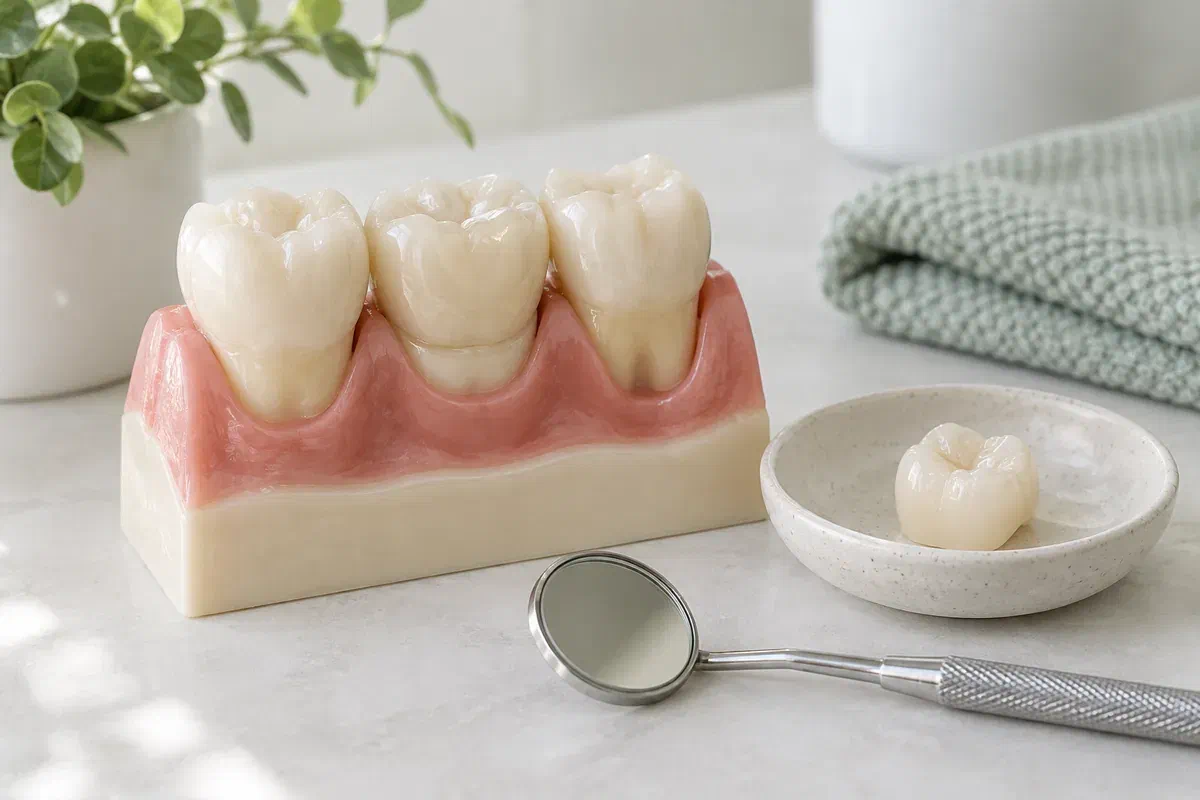
Illustrative tooth-and-gum teaching model beside a ceramic crown sample and dental mirror
Starting from the reason

Each clinician should know why the tooth needs this.

Ask which tooth is involved and what problem the procedure should solve. When a restoration is the goal, the surgeon and restoring dentist need to agree on it; an appearance concern brings a different set of questions.

A tooth that can’t be restored as it stands

When a break, wear or decay reaches below the gum, a restoration may have nothing firm to seal against. Ask whether exposing more tooth would make repair reasonable and how the tooth is expected to do. Both clinicians should share a view of the prognosis.

Where the future crown edge should finish

The restoring dentist decides roughly where the crown margin needs to be; the surgery creates room for it relative to gum and bone. Ask how that target is communicated between the two offices, and whether it is written into the referral. A gap between the two plans can lead to repeat work or an extra procedure later.

Changing how short teeth look

Describe what you see and what you value. Visible gum has several possible causes, which need identifying before surgery is considered. A celebrity smile cannot show whether removing tissue suits your proportions.

Gum, bone or both may be reshaped. Ask which, whether nearby teeth are involved, and how the change will affect support, appearance and the restoration that comes next.

When coordination works

Surgery and restoration aimed at the same target

A good plan sets out what the surgical stage is supposed to enable and whether that justifies it. Find out what will remain of the tooth and its support once the gum is moved. A sounder base helps the crown fit, but the procedure does not guarantee how long the tooth will last.

Knowing who does each part is just as important as knowing the steps. Ask which clinician performs the surgery, who reviews the healing, who places any temporary and who makes the final restoration. When they share records and a goal, fewer things fall between the cracks.

A shared picture of the final result

Ask both clinicians, or the one coordinating, to show where the gum and restoration edge are meant to sit. Check whether neighbouring teeth would be affected. This matters most for a tooth visible when you smile.

A joint view of risks and benefits

Compare the hoped-for improvement with healing time, sensitivity, appearance change and upkeep. Ask which risks really apply to you. More assessment is always a reasonable request before going ahead.

Estimates from everyone involved

If two offices are involved, you may receive separate estimates. Ask each what is included, from assessment to reviews and final restoration, and what could change the total. Putting them side by side shows the true cost of the plan.

The coordinated sequence

Referral, surgery, healing, then back for the crown

Technique and timing are tailored to your tooth, the surrounding gum and bone, and the treatment goal. The clinician performing the procedure will explain it and obtain your consent.

  1. Assessment and, if needed, referral

    Your dentist reviews the tooth, roots, gum and bone with X-rays and decides whether a specialist should be involved. Ask whether the tooth is a good candidate. Make sure records travel with the referral so assessment isn’t repeated unnecessarily.

  2. Agreeing on the plan with both clinicians

    Discuss the tissue change, comfort, risks, healing and alternatives. Confirm who does each step. Ask how the surgeon will know where the restoring dentist needs the crown edge, and how surprises would be communicated.

  3. The surgical appointment

    Local anaesthetic is typical. The clinician reshapes gum and, if indicated, bone to expose the agreed structure, and may place stitches. Ask who to call afterward, especially if the surgery is done at a different office.

  4. Healing reviews and the hand-back

    The surgeon may review healing first, then pass you back to your dentist for the final restoration once the tissue has settled. Ask who decides readiness. Comfort alone doesn’t mean it is time for the crown.

Healing with a clear contact

Know whose number to call.

Follow the written instructions from the clinician who did the surgery. They should cover cleaning, food, activity, medicines and follow-up for your treated site.

Care for the site as directed

Ask how to clean around the treated area and when normal brushing and flossing can resume there. Leave stitches alone, resist checking under your lip repeatedly, and avoid rinses that weren’t part of your instructions.

Contact the right person with concerns

Some tenderness or sensitivity is common. Ask what to expect and which office handles questions after surgery. If pain is increasing, bleeding won’t stop, swelling grows or something else worries you, call that clinician rather than waiting for a booked visit.

Return for the hand-back review

The gum can settle in a new position as it heals, which changes where the final restoration should end. Confirm who decides the site is ready and who maintains any temporary. Skipping a review because the tooth feels fine can lead to rework.

Patient information: Cambridge University Hospitals — crown-lengthening risks and healing before final restoration

Approaches to compare

Different routes may involve different clinicians.

Ask which alternatives truly apply to your tooth and goal. Suitability depends on how much tooth remains, its support, appearance and how complex each plan would be to coordinate.

When the tooth and tissue make it sensible

Crown lengthening coordinated with the restoration

The surgeon and restoring dentist plan the exposure, tissue change and final crown together. Ask how they balance access to sound tooth with support and appearance. The surgery is justified only if the finished crown is the right solution.

When another approach may preserve tissue

Orthodontic extrusion or a different restoration

Extrusion uses orthodontic movement to bring more tooth into view and may involve an orthodontist as well. A different restorative design may also suit. Ask about suitability, timing and who would be on the team.

When the benefit doesn’t outweigh the procedure

Declining surgery, or planning a replacement

For a cosmetic concern, leaving healthy gum unchanged can be the right call. When the tooth’s outlook is poor, a replacement discussion may be more useful. Ask what saying no would mean and how health needs would still be addressed.

Patient information: European Federation of Periodontology — selection of surgical and orthodontic approaches

Coordination questions

Referrals, records and who handles what

A clear sequence makes any recommendation easier to weigh. Bring the plan and referral details, and separate what can be agreed at this visit from what depends on the specialist’s findings.

(905) 876-4488
Why was I referred to a periodontist for crown lengthening?
Periodontists specialize in gum and bone around teeth, and some cases benefit from that expertise. Ask your dentist why the referral was made and what the specialist is being asked to do. It is also fair to ask whether the specialist will see you for a separate consultation first, and whether that visit could change the plan your dentist proposed.
Will my own dentist still place the final crown?
Often yes, with the surgeon handling the gum stage. Arrangements vary, so ask each office who is responsible for the temporary, the reviews and the permanent restoration. Writing the answers down in one place makes it easier to keep track once appointments start at two locations.
How do the surgeon and my dentist share information?
Usually through referral letters, X-rays and treatment notes. Ask whether records will be sent ahead and whether you should bring copies. Clear communication helps the crown edge end up where it is planned.
Who should I call if something goes wrong after surgery?
Generally the clinician who performed the procedure. Confirm this before the surgery day and keep that number handy, along with your dentist’s, in case the advice is to see one or the other.
What if the two clinicians recommend different things?
Ask each to explain their reasoning, and ask whether they can discuss the case together. You can also request time to think, more assessment, or a further opinion before deciding.
Can my Caledon appointments be grouped to save travel?
Ask both offices for an outline of expected visits early on. Some reviews may be combinable, and knowing the sequence helps you book around work, school runs and other family commitments. Ask too whether any routine checkups for the household could be scheduled on the same day.
Caledon coordination

One plan, clearly shared, before any surgery

Call our Bronte Street practice to talk about a crown-lengthening referral, a tooth that is difficult to restore, or a gumline concern. We can explain the goal and assessment needed, and how care with a periodontist would be coordinated.

Suitability, tissue changes, which clinicians are involved, healing, final restoration timing and fees are confirmed after assessment. Tooth retention and a particular appearance cannot be guaranteed.

Visit Milton Dental Clinic
Unit 1, 342 Bronte St. S, Milton, ON L9T 5B7
Get directions Clinic hours
Monday–Thursday
11am–7pm
Friday–Sunday
By appointment only

Areas we serve

  • Milton
  • Oakville
  • Mississauga
  • Georgetown
  • Halton Hills
  • Acton
  • Campbellville
  • Brampton
  • Burlington
  • Puslinch
  • Rockwood
  • Erin
  • Caledon
  • Etobicoke
  • Old Milton
  • Bronte Meadows
  • Timberlea
  • Dorset Park
  • Dempsey
  • Clarke
  • Beaty
  • Coates
  • Harrison
  • Scott
  • Willmott
  • Ford
  • Bowes
  • Cobden
  • Walker
  • Mountain View
  • Milton Heights
  • Hawthorne Village
  • Valley View
  • Fallingbrook
  • Nassagaweya
  • Trafalgar
  • Esquesing
  • Nelson
  • Brookville
  • Moffat
  • Glen Williams
  • Norval
  • Limehouse
  • Stewarttown
  • Ashgrove
  • Hornby
  • Silver Creek
  • Speyside
  • Scotch Block
  • North Oakville
  • River Oaks
  • Glen Abbey
  • West Oak Trails
  • Palermo
  • Bronte Creek
  • College Park
  • Joshua Creek
  • Uptown Core
  • Preserve
  • Iroquois Ridge
  • Lisgar
  • Meadowvale
  • Meadowvale Village
  • Churchill Meadows
  • Erin Mills
  • Central Erin Mills
  • Streetsville
  • East Credit
  • Creditview
  • Heartland
  • Sheridan
  • Mount Pleasant
  • Credit Valley
  • Huttonville
  • Churchville
  • Springbrook
  • Northwest Brampton
  • Bram West
  • Fletcher's Meadow
  • Fletcher's Creek South
  • Alton Village
  • Orchard
  • Millcroft
  • Headon Forest
  • Tansley
  • Brant Hills
  • Tyandaga
  • Kilbride
  • Lowville
  • Aberfoyle
  • Morriston
  • Arkell
  • Hillsburgh
  • Freelton
  • Carlisle
  • Waterdown
  • Flamborough
  • Mountsberg

How can we help?

Milton Dental Clinic

Have a question about your smile? Choose the option that works best for you.

For urgent dental concerns, please call.
Messages are reviewed during clinic hours.