

Illustrative clinician explaining a tooth-and-gum model to a patient during a consultation
Specialized Care

Crown Lengthening in Old Milton

An old crown or a large, long-serving filling has failed, and the break now sits below the gum. For people in Old Milton, we explain why crown lengthening may be raised before redoing that work, what tissue it changes, and how healing sets the pace.

Redoing long-standing dental work

When the old crown comes off and there isn’t much underneath

Restorations that have done their job for many years eventually need replacing, and sometimes the tooth beneath has worn, cracked or decayed down toward the bone. A new crown needs healthy tooth to grip. Crown lengthening lowers the gum, and where necessary reshapes bone, so that more natural tooth becomes reachable.

Despite the name, nobody is building a taller cap. The “crown” is the visible part of your own tooth. In other mouths the motive is cosmetic rather than repair, such as teeth that look short, and that calls for a separate discussion. Either way, the remaining tooth, root and support are judged together.

Old Milton, the town’s historic downtown, is close to our Bronte Street practice, which makes a relaxed first conversation easy to arrange. Bring the old crown if you kept it, along with any plan or records, and we can explain how the procedure relates to your care, what still needs checking and when a periodontist might be involved.

Ask about replacing a failed restoration
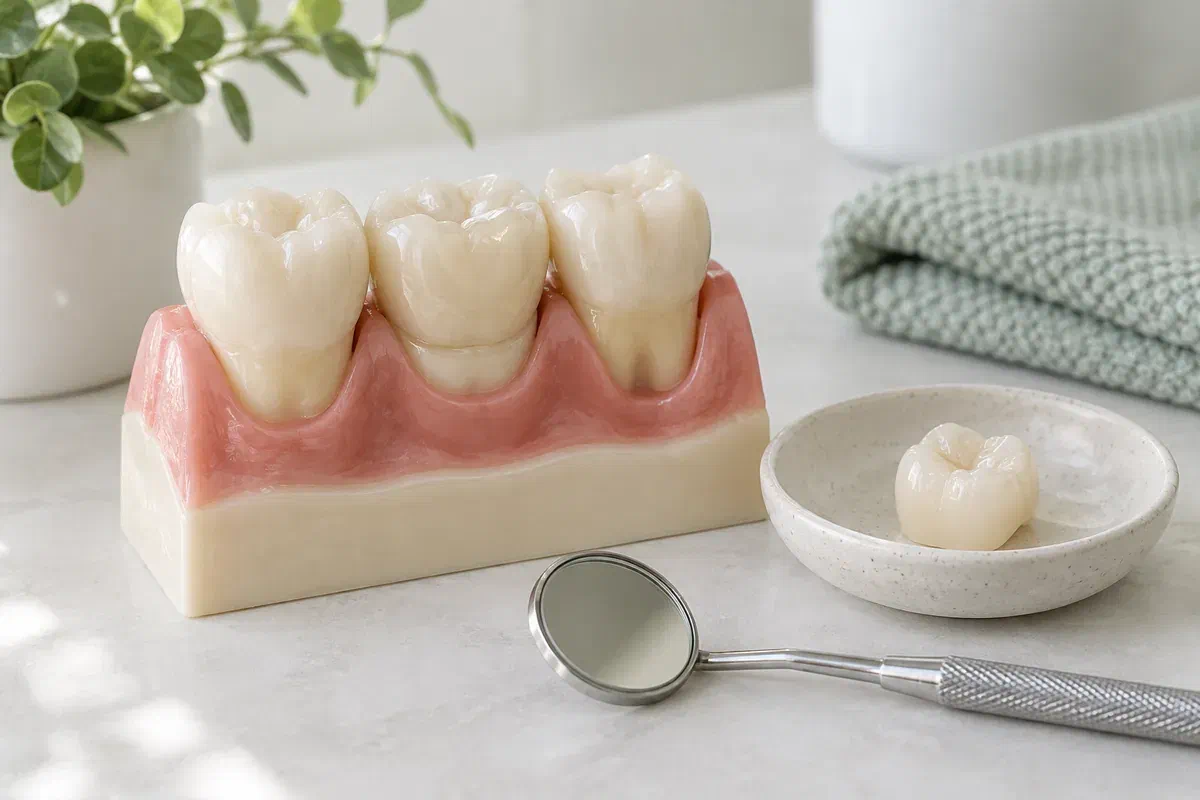
Illustrative tooth-and-gum teaching model beside a ceramic crown sample and dental mirror
What may be behind the suggestion

Is it about repair, the tissue edge or appearance?

Pin down which tooth is in question and the exact problem the procedure would solve. Rebuilding a worn-down tooth and changing how a smile looks are separate starting points with separate questions.

Too little sound tooth after years of wear

Repeated repairs, fractures and decay along an old margin can leave very little above the gum. Ask whether exposing more healthy structure would make a new restoration realistic and how the tooth’s future looks. A root that is badly split or heavily weakened may not be helped.

An old margin buried too far under the gum

A restoration edge that sits too close to the bone can be hard to keep clean and may irritate the tissue around it. Ask why the current position is a problem and how a change would help. The replacement crown and the gum work belong in one plan.

Short-looking teeth you would like to change

Say what you see in the mirror and what you want to keep. Gum display can come from several causes, and each needs checking before surgery is weighed. A picture of a different smile does not prove that removing tissue fits your own tooth shape.

The procedure may reshape gum, bone or both. Ask which applies to you, whether nearby teeth are part of it, and how the change affects support, appearance and the new restoration.

What a careful plan shows you

Surgery, healing and the new crown, judged as a whole

The point of a consultation is to understand what the procedure would make possible and whether that is worth it for this particular tooth. Ask how much tooth and support would be left after the gum moves. More exposed structure helps a restoration seat properly, but it is not a promise of permanence.

Equally useful is a clear order of visits and an idea of how long healing will be watched. If your dentist and a periodontist are sharing the care, find out who owns each part. When everyone works from the same plan, the surgery, the temporary and the final crown pull in one direction.

A clear picture of what will change

Ask to see, on an X-ray or model, where the gum and the new crown edge are expected to finish. Check how neighbouring teeth may be affected. This is especially worth doing for a front tooth that shows in conversation.

Benefits and downsides, side by side

Set the expected improvement against healing time, sensitivity, changes in appearance and day-to-day upkeep. Ask which risks really apply in your mouth. You can always request more assessment before deciding the result is worth the surgery.

Every stage in the estimate

Find out whether the estimate includes assessment, surgery, follow-ups, a temporary and the replacement crown, or if those come separately. Ask what could shift the plan or the cost. Knowing the full path is more informative than one line for the surgical step.

How the steps usually unfold

Four stages, from examining the old work to fitting the new

Technique and timing are shaped by the tooth, the surrounding tissue and the goal. The clinician carrying out the surgery explains the specifics and asks for your consent.

  1. Examine what remains under the old restoration

    The roots, gum health, bone support and adjacent teeth are reviewed with X-rays and other records. Ask plainly whether this tooth can benefit. If anything is unclear, settle it before you agree to a sequence that takes success for granted.

  2. Agree on what will be done and the other routes

    Discuss the planned tissue change, comfort, risks, typical healing and suitable alternatives. Confirm any referral and who does what. Ask how surprises would be handled and whether a finding during surgery could change the restorative plan.

  3. Have the surgical stage

    Local anaesthetic is the usual approach. The gum and, if needed, bone are reshaped to reveal the planned structure, and stitches may be placed. Your instructions should describe what was done, immediate care and how to reach the team.

  4. Let the tissue heal before the replacement crown

    Go to the planned checks and ask when stitches or the temporary need looking at. The final crown is timed to healing and the clinical aim. Feeling better after a few days is not the same as being ready, so ask what the clinician is watching for.

Recovery at home

Gentle with the site, firm about the follow-ups

Work from the written instructions of the clinician who did the procedure. Cleaning, eating, activity, medicines and review dates should all be tailored to your treated area.

Follow the site-specific cleaning and food advice

Ask how to look after the healing area while keeping the rest of your mouth clean, and when brushing and flossing there can return to normal. Don’t tug at stitches, keep lifting your lip to look, or invent a rinse that isn’t on the instruction sheet.

Call when something seems wrong

Mild soreness or sensitivity can happen, so ask what to expect and when to phone. Keep the aftercare number where you can find it. Rising pain, bleeding that continues, swelling that grows or another change that worries you should be talked through, not left until the next booking.

Keep the review before the new crown

The gum can move while it heals, and that shifts where the replacement should end. Ask who decides the site is ready and how to care for the temporary. Comfort or a better look is not a reason to drop the review.

Patient information: Cambridge University Hospitals — crown-lengthening risks and healing before final restoration

Other paths to consider

Is surgery the right route for this tooth?

Ask about the alternatives that genuinely fit your tooth and what you want from treatment. Suitability depends on structure, support, appearance and how demanding the full plan would be.

When the tooth and tissue support it

Crown lengthening followed by a new restoration

Look at the exposure, the tissue change and the final crown design together. Ask how the plan trades access to healthy tooth against keeping support and a natural appearance. The surgery serves the restoration; it doesn’t replace judging whether that restoration is sensible.

When another method may protect tissue you want to keep

A different way to manage the tooth

Some situations suit a different restorative design or orthodontic extrusion, which brings the tooth down to reveal more of it. These are not equal swaps for every case. Ask about suitability, the time involved and which clinicians are needed.

When the expected gain does not justify surgery

Monitoring, or a new decision about the tooth

If the concern is only cosmetic, leaving healthy gum alone may be wise. A tooth with a poor outlook might call for a talk about keeping or replacing it. Ask what declining would mean and how any remaining health needs would be met.

Patient information: European Federation of Periodontology — selection of surgical and orthodontic approaches

Questions we hear

Before you replace that old crown

Seeing every stage helps you weigh a recommendation. Bring your existing plan and ask which choices can be made now and which depend on what further assessment shows.

(905) 876-4488
My crown is decades old. Does replacing it always mean crown lengthening?
No. Many old crowns can be replaced without changing the gum at all. It tends to come up when the tooth underneath has broken or decayed below the gumline. Ask what was found and why it matters for the new restoration.
Could my old filling or crown be causing the gum problem?
A margin that sits deep or doesn’t fit well can make cleaning harder and may affect nearby tissue. Ask whether that is part of the concern in your case and how a replacement would be designed differently.
Does the procedure always involve reshaping bone?
Not always. Some cases need only gum changes, while others also involve bone, depending on how the tooth, gum and bone relate. Ask which applies to you and why, since the planning differs between the two.
Will the treated tooth look longer than the ones beside it?
It can, particularly if only one tooth is treated in a visible area. Ask whether neighbouring teeth would be included and how the gumline is expected to look afterward. This should be clear before you consent.
Do I need to stop any medications before surgery?
Never stop a prescribed medicine on your own. Tell the treating clinician about everything you take, including blood thinners and supplements, and any health conditions. They may coordinate with your physician if changes or precautions are needed.
Is it easy to come in from Old Milton for the follow-up checks?
Being near our Bronte Street practice usually makes short review visits simple to fit in. Ask at booking how many checks are likely and plan them alongside the temporary and final crown appointments, so none get skipped.
Old Milton visits

Understand the gum stage before the new crown is planned.

Reach our Bronte Street practice to discuss a crown-lengthening recommendation, an old restoration that has failed, or a gumline concern. We can go over the aim, the assessment needed, and appropriate care or referral to a specialist.

Suitability, tissue changes, who provides treatment, healing, timing of the final crown and fees all depend on assessment. The procedure cannot guarantee that the tooth will be kept or that a specific appearance will result.

Visit Milton Dental Clinic
Unit 1, 342 Bronte St. S, Milton, ON L9T 5B7
Get directions Clinic hours
Monday–Thursday
11am–7pm
Friday–Sunday
By appointment only

Areas we serve

  • Milton
  • Oakville
  • Mississauga
  • Georgetown
  • Halton Hills
  • Acton
  • Campbellville
  • Brampton
  • Burlington
  • Puslinch
  • Rockwood
  • Erin
  • Caledon
  • Etobicoke
  • Old Milton
  • Bronte Meadows
  • Timberlea
  • Dorset Park
  • Dempsey
  • Clarke
  • Beaty
  • Coates
  • Harrison
  • Scott
  • Willmott
  • Ford
  • Bowes
  • Cobden
  • Walker
  • Mountain View
  • Milton Heights
  • Hawthorne Village
  • Valley View
  • Fallingbrook
  • Nassagaweya
  • Trafalgar
  • Esquesing
  • Nelson
  • Brookville
  • Moffat
  • Glen Williams
  • Norval
  • Limehouse
  • Stewarttown
  • Ashgrove
  • Hornby
  • Silver Creek
  • Speyside
  • Scotch Block
  • North Oakville
  • River Oaks
  • Glen Abbey
  • West Oak Trails
  • Palermo
  • Bronte Creek
  • College Park
  • Joshua Creek
  • Uptown Core
  • Preserve
  • Iroquois Ridge
  • Lisgar
  • Meadowvale
  • Meadowvale Village
  • Churchill Meadows
  • Erin Mills
  • Central Erin Mills
  • Streetsville
  • East Credit
  • Creditview
  • Heartland
  • Sheridan
  • Mount Pleasant
  • Credit Valley
  • Huttonville
  • Churchville
  • Springbrook
  • Northwest Brampton
  • Bram West
  • Fletcher's Meadow
  • Fletcher's Creek South
  • Alton Village
  • Orchard
  • Millcroft
  • Headon Forest
  • Tansley
  • Brant Hills
  • Tyandaga
  • Kilbride
  • Lowville
  • Aberfoyle
  • Morriston
  • Arkell
  • Hillsburgh
  • Freelton
  • Carlisle
  • Waterdown
  • Flamborough
  • Mountsberg

How can we help?

Milton Dental Clinic

Have a question about your smile? Choose the option that works best for you.

For urgent dental concerns, please call.
Messages are reviewed during clinic hours.