

Illustrative patient discussing an oral appliance and care coordination with a dental clinician
Specialized Care

Custom Sleep Apnea Appliances in Caledon

Grinding at night, a crown on the schedule and a new sleep apnea diagnosis can all land at once. For adults in Caledon, we explain how a custom appliance is planned around other dental needs, fitted and checked by both teams.

More than one thing going on

When grinding, dental work and sleep apnea overlap

Real mouths rarely have one issue at a time. You might already wear a guard for grinding, have a filling or crown coming up, and then hear from your physician that obstructive sleep apnea is the reason you wake exhausted. Sorting out which appliance does what, and in what order things happen, is a big part of the dental planning.

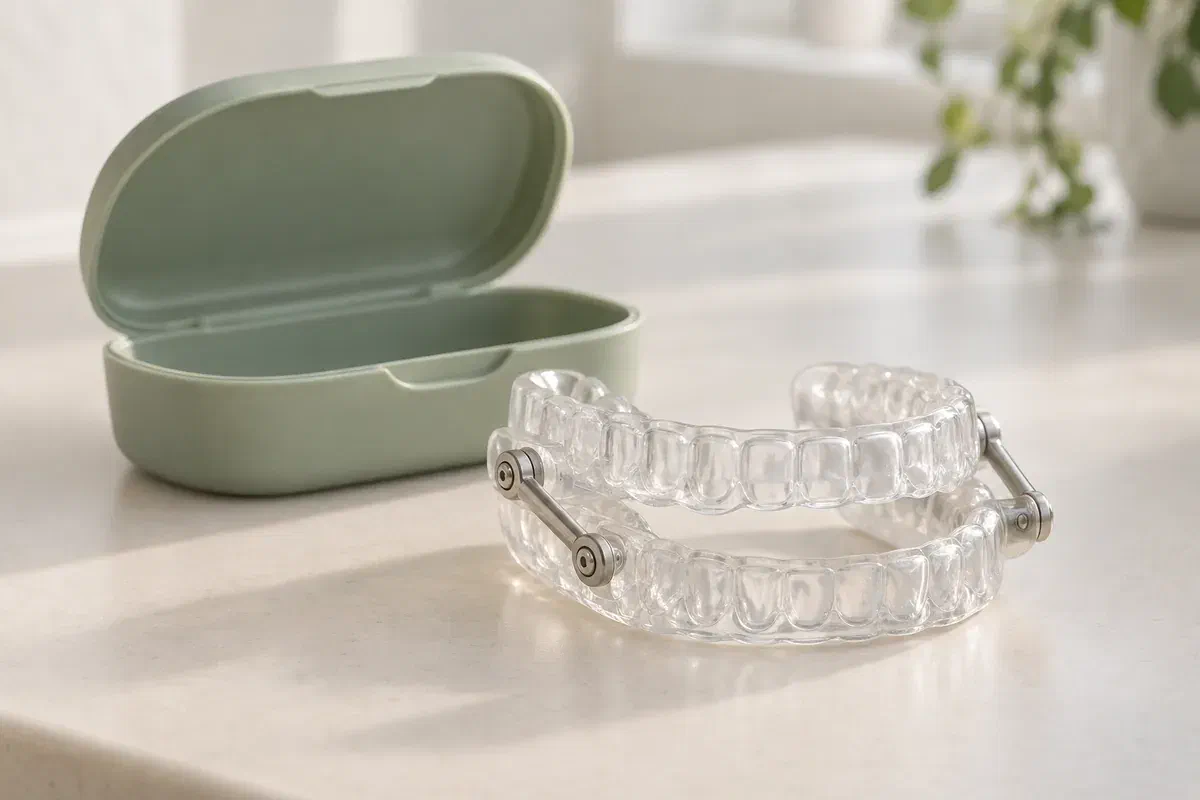
A custom sleep apnea appliance is a prescribed treatment for some diagnosed adults. The design most often used fits both arches and holds the lower jaw slightly forward so the airway is less likely to narrow during sleep. It is different from a grinding guard, which protects teeth. Your physician decides whether an appliance suits the diagnosis, and testing later confirms the effect.

For households in Caledon, from Bolton to the smaller villages, combining planning into fewer visits often helps. Bring your sleep report, your physician's recommendations, any guard you wear and details of upcoming dental work. We will talk through suitability, sequencing and coordination while you continue your prescribed treatment.

Plan an appliance around your dental needs
Illustrative connected upper and lower oral-appliance trays beside a pale sage storage case
Untangling the overlap

Which concern comes first?

Tell us what your physician has assessed and recommended, and what dental care is already planned. Dentists help with appliance decisions; diagnosis of sleep apnea is medical.

Snoring and grinding, but no sleep assessment

If breathing pauses have been noticed, sleep feels unrefreshing or you are drowsy in the day, see your family doctor. Grinding and snoring can each occur with or without sleep apnea, and an assessment sorts that out. A grinding guard is not a sleep test.

Sleep apnea treatment that is a struggle

Explain which treatment you have and the part of it that is hard to live with. Your sleep-care team can work on solutions and tell you if an appliance might stand in for it or work beside it. Until that is agreed, keep using the treatment you have.

Dental work, guards and jaw symptoms

Upcoming crowns or fillings, loose teeth, gum treatment, an existing nightguard, dentures or jaw pain all affect planning. Mention each one. Ask what should be done first and how your teeth, bite and jaw will be reviewed once an appliance is in use.

Before any oral appliance is provided, the Canadian Dental Association looks for a physician's assessment of the snoring or possible sleep apnea, and for the dentist to be working with that physician.

Why sequencing matters

The right appliance, made at the right time

Planning everything together avoids making an appliance that no longer fits after a new crown, or wearing two devices that conflict. With your physician, you can discuss what makes an appliance a candidate in your case and where it stands against the treatment you use now. With us, you can work out timing around other dental needs. Comfort counts, but control of sleep apnea is the measure.

Roles become clear as well. We handle fit, adjustment, grinding concerns and the health of your teeth, while the medical side orders any retesting and explains what the results mean. Settling that before fabrication avoids crossed wires and repeat trips.

Patient information: AASM and AADSM — custom appliances, dental oversight, and follow-up sleep testing

Matched to the sleep diagnosis

Your sleep report and recommendations come first; ask whether more information is needed. An appliance earns its place when the medical findings support it, with your physician part of that call, rather than because it seems simpler than what you have.

Timed around other dental work

Ask whether crowns, fillings or gum care should be finished first, how the appliance would grip your teeth, and whether it can also address grinding or needs to be separate. These answers shape design and timing.

Confirmed by testing

Ask when your response will be checked and how. Feeling better and grinding less are worth reporting but do not confirm control of sleep apnea. Ask what happens if results fall short.

Caledon appointments, in a sensible order

Plan, treat, fit, confirm

Your physician's recommendations and our dental findings set the order. Ask at the outset for every stage and its fee, including assessment, fabrication, adjustment visits, dental reviews and the sleep-care follow-up billed on its own.

  1. Map out medical and dental needs

    We review your sleep findings, health background and recommendations, plus any guard you wear and planned dental work. Before anything else, we settle how updates reach your physician and which treatment stays in use.

  2. Treat what needs treating, then take records

    The clinician examines teeth, gums, restorations and jaw function. Dental work may be advised first so the appliance fits the finished mouth. Ask about the treating dentist's training in this area or whether referral is wiser.

  3. Fit and adjust

    On delivery, comfort and fit are confirmed and you learn insertion, removal, cleaning and storage. If you also wear a grinding guard, you will be told how the two relate. Adjust only as instructed and never advance it yourself.

  4. Confirm the result and review over time

    Effectiveness is assessed by your physician, perhaps with a sleep study. Our reviews watch the appliance, your teeth, bite and any grinding wear. Ask how findings travel between offices and what the fallback is if the appliance proves insufficient.

Keeping several needs in balance

One routine, two teams, and new dental work flagged early

What you are told to do will reflect your particular appliance and plan. Keep contact details for both offices close by, and tell us before any new dental treatment so the fit can be protected.

Care of the appliance

Follow the wear, adjustment, cleaning and storage advice. Keep it in its case, and bring it, along with any other guard, to reviews. If it cracks or loosens, call us for interim guidance; household repairs are not safe.

Teeth, bite and grinding signs

Report sore teeth, gum irritation, lingering jaw ache, new wear or a bite that feels different. You will be told when you get the appliance which of these call for a pause and a quick appointment. Pushing a painful appliance into place, or tinkering with its setting, only makes matters worse.

Sleep symptoms

Let your sleep-care team know if symptoms return, the device is hard to wear or your general health shifts. Go to testing even when comfortable. If you cannot wear it, ask straight away what to use in the meantime.

Patient information: American Academy of Dental Sleep Medicine — appliance discomfort and dental effects · NHLBI — sleep deficiency and its effects on driving and daily function

Options for Caledon adults

Sleep treatment chosen medically, then fitted around your teeth

Your physician considers what kind of sleep apnea you have, its severity, your health and your response so far, alongside our dental findings. An oral appliance is one of the possibilities.

When it is the prescribed medical treatment

Positive airway pressure, supported

If comfort or routine is a problem, ask the prescribing team about adjustments or support before you stop. They can also discuss alternatives. Our dental view feeds into that decision but does not replace it.

When your physician and our examination both favour it

A custom appliance, planned with your other dental care

Go through the design, its limits and how it relates to any grinding guard, then how adjustments and testing will be scheduled. Your teeth need monitoring over the years too, so ask how that is done. However exact the fit, some people's sleep apnea is not controlled by an appliance.

When results call for a broader plan

Other measures or specialist input

Specialist referral or additional measures may come up, depending on what testing shows and how you progress. Ask how they would sit alongside prescribed treatment and when you will be reassessed. Habit and sleeping-position changes are not a substitute for effective therapy unless your physician says so.

Patient information: NHLBI — sleep-apnea treatment options and individualized medical care

Overlapping-needs questions

Grinding guards, dental work and sleep appliances

Bring your sleep-care information, any guard you wear and a list of planned dental work. We will put the pieces in order with your physician's plan.

(905) 876-4488
Can one appliance treat both my grinding and my sleep apnea?
Sometimes the clinician can account for grinding when planning a sleep appliance, but that depends on your diagnosis and mouth. Never assume a grinding guard treats sleep apnea. Ask both teams how the two concerns should be handled.
Should I stop wearing my nightguard once I get a sleep appliance?
Ask the dental team. Wearing two devices at once is not usually how this works, and the plan for grinding protection should be explained when the sleep appliance is fitted.
I have a crown booked next month. Should I wait to start the appliance?
Tell us about it first. Often it makes sense to complete dental work before records are taken, so the appliance fits the finished teeth. Your physician should know about any delay so interim treatment continues.
Can braces or clear aligners be worn alongside a sleep appliance?
This needs careful planning between the dental clinicians involved and your physician. Mention any orthodontic treatment, current or planned, at the first visit.
Will a sleep appliance wear down my teeth?
Appliances are designed to protect against direct tooth-on-tooth contact while worn, but long-term changes to bite or tooth position can occur. Regular reviews watch for them. Report anything that feels different.
Who handles a problem with my crown if the appliance no longer fits over it?
Contact the dental team that made the appliance and the dentist who placed the crown, if different. Stop forcing the appliance on, and ask your sleep-care provider about interim treatment.
Sleep appliances for Caledon

Bring everything: the diagnosis, the guard and the dental plan.

Phone our Bronte Street practice once your physician has made a recommendation. At the consultation we look at whether your mouth suits an appliance, which records it would take and how it fits around other dental care, and we set out how information will flow to your sleep-care team.

Every plan is individual, including the order of dental work, which clinician does what, retesting and fees. A sleep appliance is never a guaranteed fix and should take over from prescribed treatment only when both teams agree.

Visit Milton Dental Clinic
Unit 1, 342 Bronte St. S, Milton, ON L9T 5B7
Get directions Clinic hours
Monday–Thursday
11am–7pm
Friday–Sunday
By appointment only

Areas we serve

  • Milton
  • Oakville
  • Mississauga
  • Georgetown
  • Halton Hills
  • Acton
  • Campbellville
  • Brampton
  • Burlington
  • Puslinch
  • Rockwood
  • Erin
  • Caledon
  • Etobicoke
  • Old Milton
  • Bronte Meadows
  • Timberlea
  • Dorset Park
  • Dempsey
  • Clarke
  • Beaty
  • Coates
  • Harrison
  • Scott
  • Willmott
  • Ford
  • Bowes
  • Cobden
  • Walker
  • Mountain View
  • Milton Heights
  • Hawthorne Village
  • Valley View
  • Fallingbrook
  • Nassagaweya
  • Trafalgar
  • Esquesing
  • Nelson
  • Brookville
  • Moffat
  • Glen Williams
  • Norval
  • Limehouse
  • Stewarttown
  • Ashgrove
  • Hornby
  • Silver Creek
  • Speyside
  • Scotch Block
  • North Oakville
  • River Oaks
  • Glen Abbey
  • West Oak Trails
  • Palermo
  • Bronte Creek
  • College Park
  • Joshua Creek
  • Uptown Core
  • Preserve
  • Iroquois Ridge
  • Lisgar
  • Meadowvale
  • Meadowvale Village
  • Churchill Meadows
  • Erin Mills
  • Central Erin Mills
  • Streetsville
  • East Credit
  • Creditview
  • Heartland
  • Sheridan
  • Mount Pleasant
  • Credit Valley
  • Huttonville
  • Churchville
  • Springbrook
  • Northwest Brampton
  • Bram West
  • Fletcher's Meadow
  • Fletcher's Creek South
  • Alton Village
  • Orchard
  • Millcroft
  • Headon Forest
  • Tansley
  • Brant Hills
  • Tyandaga
  • Kilbride
  • Lowville
  • Aberfoyle
  • Morriston
  • Arkell
  • Hillsburgh
  • Freelton
  • Carlisle
  • Waterdown
  • Flamborough
  • Mountsberg

How can we help?

Milton Dental Clinic

Have a question about your smile? Choose the option that works best for you.

For urgent dental concerns, please call.
Messages are reviewed during clinic hours.