

Illustrative patient discussing an oral appliance and care coordination with a dental clinician
Specialized Care

Custom Sleep Apnea Appliances in Mississauga

Packing a CPAP machine for every work trip gets old. From Mississauga, you can discuss whether a custom oral appliance could suit your sleep apnea diagnosis, what the dental assessment involves and how effectiveness is confirmed.

Hotel rooms, flights and a bulky machine

Smaller to carry, but is it right for your diagnosis?

People who spend many nights away often ask the same thing: could something that fits in a pocket replace the machine in my suitcase? For some adults with obstructive sleep apnea, a custom oral appliance is a possible option. The typical version holds the lower jaw a little forward during sleep, which can help keep the airway open.

Portability is a fair reason to ask, but it cannot be the reason to choose. A sleep physician determines whether an appliance makes medical sense for your diagnosis. A dental examination checks whether your teeth, gums and jaw can support one. Then testing shows whether it works for you, because how you feel on waking is not proof.

Many people from Mississauga's western neighbourhoods, such as Meadowvale and Churchill Meadows, plan dental visits around busy weeks. Bring your sleep report and recommendations and describe your current treatment. We will talk through suitability, records and coordination, while your prescribed care stays in place.

Ask about a travel-friendly option
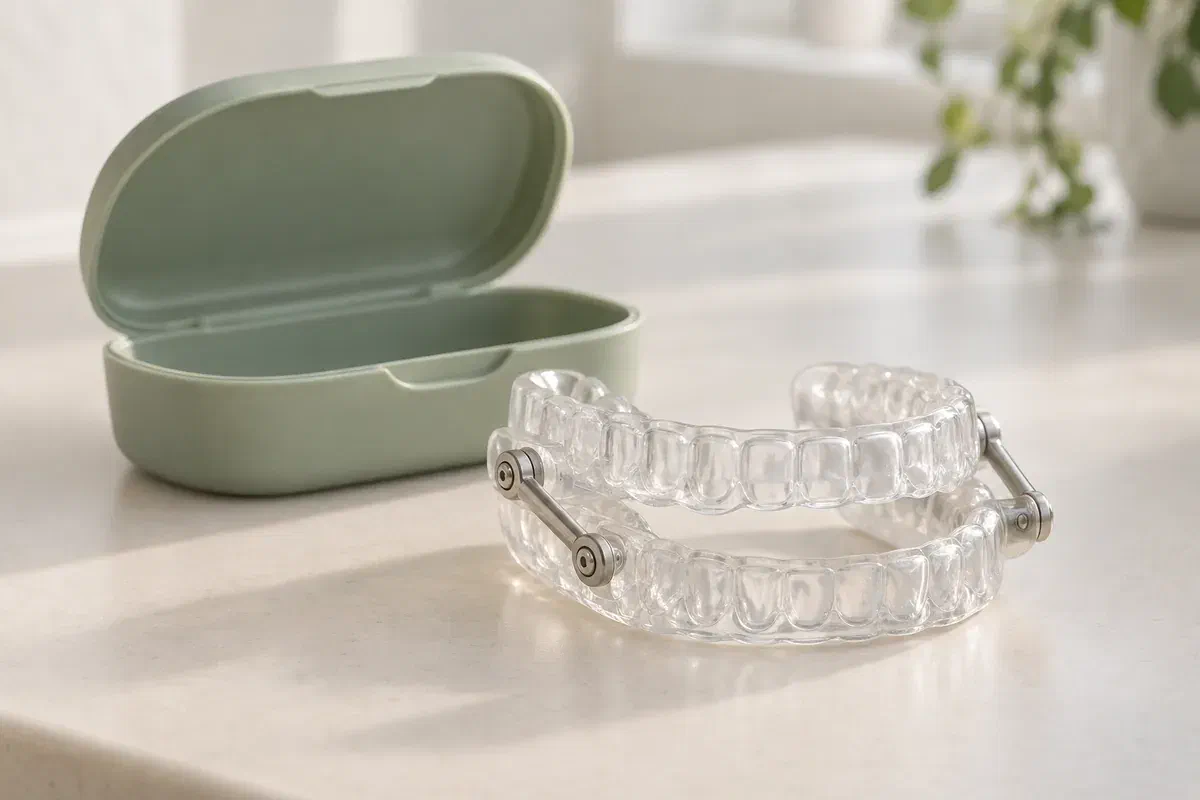
Illustrative connected upper and lower oral-appliance trays beside a pale sage storage case
What is behind the question

Convenience, comfort, or something not yet diagnosed?

Let us know about any medical sleep assessment and what was advised. A dentist can help with the appliance side but is not the one who diagnoses sleep apnea.

You snore on trips, and someone has noticed

A colleague or partner hearing you gasp or stop breathing, constant tiredness, or struggling to stay alert in meetings deserve a physician's attention. Snoring alone does not tell anyone whether sleep apnea is present or how serious it is. An assessment should come before any device.

Your machine is hard to live with on the road

Describe what makes travelling with it difficult, from packing to power to comfort. Your sleep-care team may have practical solutions and can say whether an oral appliance could serve as an alternative or a backup. Keep using your current treatment until they recommend a change.

Your dental work or jaw may complicate things

Bring up recent gum care, teeth that move, implants, dentures, bridges or any jaw pain. Each affects whether an appliance can be designed and how it would be watched. Ask whether dental treatment should be finished first.

In its position on oral appliance therapy, the Canadian Dental Association asks that a physician assess suspected sleep apnea and that dentists coordinate with that physician before providing an appliance.

Getting more than a lighter suitcase

A treatment decision that holds up at home and away

A consultation lets you hear, from both your physician and a dentist, whether an oral appliance fits your diagnosis and how it measures up against the treatment you use now. You can weigh what you gain in convenience against any limitations. The question that settles it is whether the appliance controls your sleep apnea, not how easily it travels.

It also clarifies responsibilities. The dental team fits and adjusts the device and keeps track of your teeth. The sleep-care team decides how and when breathing is retested. Settling this early prevents gaps, especially when your schedule is unpredictable.

Patient information: AASM and AADSM — custom appliances, dental oversight, and follow-up sleep testing

Chosen for medical reasons

Share your sleep report and any recommendations, and ask what else might be needed. The decision should rest on your diagnosis and history, with your sleep physician involved, rather than on size or convenience alone.

Designed around your teeth

Ask how the appliance would stay secure and whether your gums and jaw can tolerate the design. Mention other appliances and dental work you are planning. These details can change timing or design, or point to another provider.

Tested, not assumed

Ask when effectiveness will be checked and what testing is planned. Sleeping more soundly in a hotel room is encouraging but does not confirm control. Find out what the next step would be if the response is incomplete.

Fitting it around a busy calendar

Four stages you can plan for

Your physician's advice and our findings set the pace. Ask about each stage and its fees at the outset, covering assessment, fabrication, adjustments, dental reviews and the sleep follow-up arranged separately.

  1. Bring the medical picture

    We start with your sleep assessment, health history and treatment recommendations, and you explain any difficulty with current therapy. We confirm how your sleep-care provider will be kept informed and what you continue using while dental suitability is checked.

  2. Dental examination and impressions

    The clinician reviews teeth, gums, restorations and jaw function. If an appliance looks appropriate, you hear about the design and the records required. Ask whether a dentist with suitable training or a referral will be needed.

  3. Fitting and early adjustments

    At delivery, the fit and comfort are checked and you learn how to insert, remove, clean and pack the appliance. Make adjustments only as directed. Advancing it on your own before a trip, hoping for faster results, can cause problems.

  4. Checking results and booking reviews

    Effectiveness is assessed by your sleep-care provider, often with a follow-up test. Dental reviews keep track of the device, your teeth and your bite. Ask how both offices will share findings and what happens if control falls short.

Daily use, wherever you sleep

Pack it, clean it, and report changes early.

Instructions vary with the appliance and the agreed plan. Save contact details for both teams in your phone so problems reach the right clinician even when you are away.

Wear and care on the move

Follow your instructions for wear, adjustment, cleaning and storage, and always carry it in its case. Bring it to dental reviews. If it breaks while you are travelling, call the treating team for an interim plan rather than improvising a repair.

Tell us how your mouth responds

Mention tooth tenderness, sore gums, jaw discomfort that does not settle, or a bite that feels different in the morning. Ask which symptoms mean you should stop and be seen. Never force it into place or keep turning it when something feels off.

Keep sleep follow-up on the calendar

Tell your sleep-care team about returning symptoms, trouble wearing it or changes in health. Keep testing appointments even if the device feels comfortable. If you cannot use it, ask quickly what to do so your sleep apnea is not left untreated.

Patient information: American Academy of Dental Sleep Medicine — appliance discomfort and dental effects · NHLBI — sleep deficiency and its effects on driving and daily function

Mississauga treatment comparisons

Compare honestly, then decide with your physician.

The right fit reflects your diagnosis and its severity, your general health, how well current treatment works and the condition of your teeth. An oral appliance is one choice in that review.

When it remains the medical recommendation

Positive airway pressure, made easier

Travel-sized equipment, mask changes or other support may help. Ask your sleep-care team before giving up on it. A dental consultation should not set aside their recommendation on its own.

When both assessments support it

A custom appliance under shared follow-up

Go through the design, its limitations, the adjustment plan and how effectiveness will be tested. Ask how dental changes will be followed over time. A close fit is important, yet it cannot guarantee the appliance controls sleep apnea in every case.

When something different or additional is needed

Other measures or specialist referral

Depending on your diagnosis and response, your physician may suggest other steps or a specialist. Ask how these work with prescribed treatment and when to reassess. Changing your sleeping position or habits is not a stand-in for effective therapy unless your physician says so.

Patient information: NHLBI — sleep-apnea treatment options and individualized medical care

Questions from frequent travellers and others

Portability, time and testing

Bring your sleep-care records and a sense of your travel schedule. We will connect the practical concerns to the medical plan.

(905) 876-4488
Can I take my oral appliance on a plane in my carry-on?
Appliances are small and usually travel easily in their case, but check current airline and security rules before you fly. More important is following your treatment plan on every night away, whatever device your physician has prescribed.
Could I use an appliance on trips and CPAP at home?
Some people ask about this, and it is a question for your sleep physician. They can tell you whether a combined approach is appropriate for your diagnosis. Any such plan needs the appliance’s effectiveness confirmed first.
How long does it take from consultation to a working appliance?
It varies with dental findings, fabrication and how many adjustments are needed, and then testing follows. Ask for a realistic outline at the consultation so you can schedule appointments around work travel.
What if I break or lose the appliance while away?
Call the treating dental team and your sleep-care provider for advice on what to do until it is repaired or replaced. Do not try a home repair, and ask what interim treatment you should use.
Does a sleep appliance work for central sleep apnea?
Oral appliances are generally discussed for obstructive sleep apnea. If you have been told you have a different or mixed type, your sleep physician is the right person to explain which treatments apply to you.
Will I sound different or have trouble speaking with it in?
The appliance is worn during sleep, so it is normally removed before you speak much. Some people notice extra saliva or a dry mouth at first. Mention anything that bothers you at your adjustment visits.
For adults travelling from Mississauga

Plan the dental part around your schedule.

Call or write to our Bronte Street practice and have your sleep diagnosis and recommendations ready. We will discuss dental suitability, which records may be needed, and how coordination or referral would be arranged for oral-appliance care.

Suitability, who provides each part of care, retesting and fees are assessed individually. An oral appliance cannot guarantee sleep apnea control and should not be swapped in for prescribed treatment without advice from both teams.

Visit Milton Dental Clinic
Unit 1, 342 Bronte St. S, Milton, ON L9T 5B7
Get directions Clinic hours
Monday–Thursday
11am–7pm
Friday–Sunday
By appointment only

Areas we serve

  • Milton
  • Oakville
  • Mississauga
  • Georgetown
  • Halton Hills
  • Acton
  • Campbellville
  • Brampton
  • Burlington
  • Puslinch
  • Rockwood
  • Erin
  • Caledon
  • Etobicoke
  • Old Milton
  • Bronte Meadows
  • Timberlea
  • Dorset Park
  • Dempsey
  • Clarke
  • Beaty
  • Coates
  • Harrison
  • Scott
  • Willmott
  • Ford
  • Bowes
  • Cobden
  • Walker
  • Mountain View
  • Milton Heights
  • Hawthorne Village
  • Valley View
  • Fallingbrook
  • Nassagaweya
  • Trafalgar
  • Esquesing
  • Nelson
  • Brookville
  • Moffat
  • Glen Williams
  • Norval
  • Limehouse
  • Stewarttown
  • Ashgrove
  • Hornby
  • Silver Creek
  • Speyside
  • Scotch Block
  • North Oakville
  • River Oaks
  • Glen Abbey
  • West Oak Trails
  • Palermo
  • Bronte Creek
  • College Park
  • Joshua Creek
  • Uptown Core
  • Preserve
  • Iroquois Ridge
  • Lisgar
  • Meadowvale
  • Meadowvale Village
  • Churchill Meadows
  • Erin Mills
  • Central Erin Mills
  • Streetsville
  • East Credit
  • Creditview
  • Heartland
  • Sheridan
  • Mount Pleasant
  • Credit Valley
  • Huttonville
  • Churchville
  • Springbrook
  • Northwest Brampton
  • Bram West
  • Fletcher's Meadow
  • Fletcher's Creek South
  • Alton Village
  • Orchard
  • Millcroft
  • Headon Forest
  • Tansley
  • Brant Hills
  • Tyandaga
  • Kilbride
  • Lowville
  • Aberfoyle
  • Morriston
  • Arkell
  • Hillsburgh
  • Freelton
  • Carlisle
  • Waterdown
  • Flamborough
  • Mountsberg

How can we help?

Milton Dental Clinic

Have a question about your smile? Choose the option that works best for you.

For urgent dental concerns, please call.
Messages are reviewed during clinic hours.