

Illustrative patient discussing an oral appliance and care coordination with a dental clinician
Specialized Care

Custom Sleep Apnea Appliances in Old Milton

Years on CPAP can wear anyone down. If your sleep physician agrees an oral appliance is worth exploring, our practice near Old Milton can assess your teeth and jaw and explain how fitting and follow-up testing are shared.

When the mask has become a chore

Is there another way to treat the sleep apnea I already know I have?

Plenty of people were diagnosed long ago and have used positive airway pressure for years. Some still sleep well with it. Others find the straps, the noise or the dry mouth harder to accept as time goes on, and start to wonder whether a dental device could take its place.

A custom oral appliance can be an option for some adults with obstructive sleep apnea. The design most often used holds the lower jaw slightly forward while you sleep, which helps keep the airway open. Whether it suits you is a joint decision: your sleep physician judges the medical side, and a dental examination looks at whether your teeth, gums and jaw can support it.

In Old Milton, the town's historic downtown, many of the people we see have long dental histories, with crowns, bridges or partials. Bring those details along with your sleep reports. We will talk about suitability and coordination, and you keep using your current treatment while the question is explored.

Talk to us about a sleep appliance
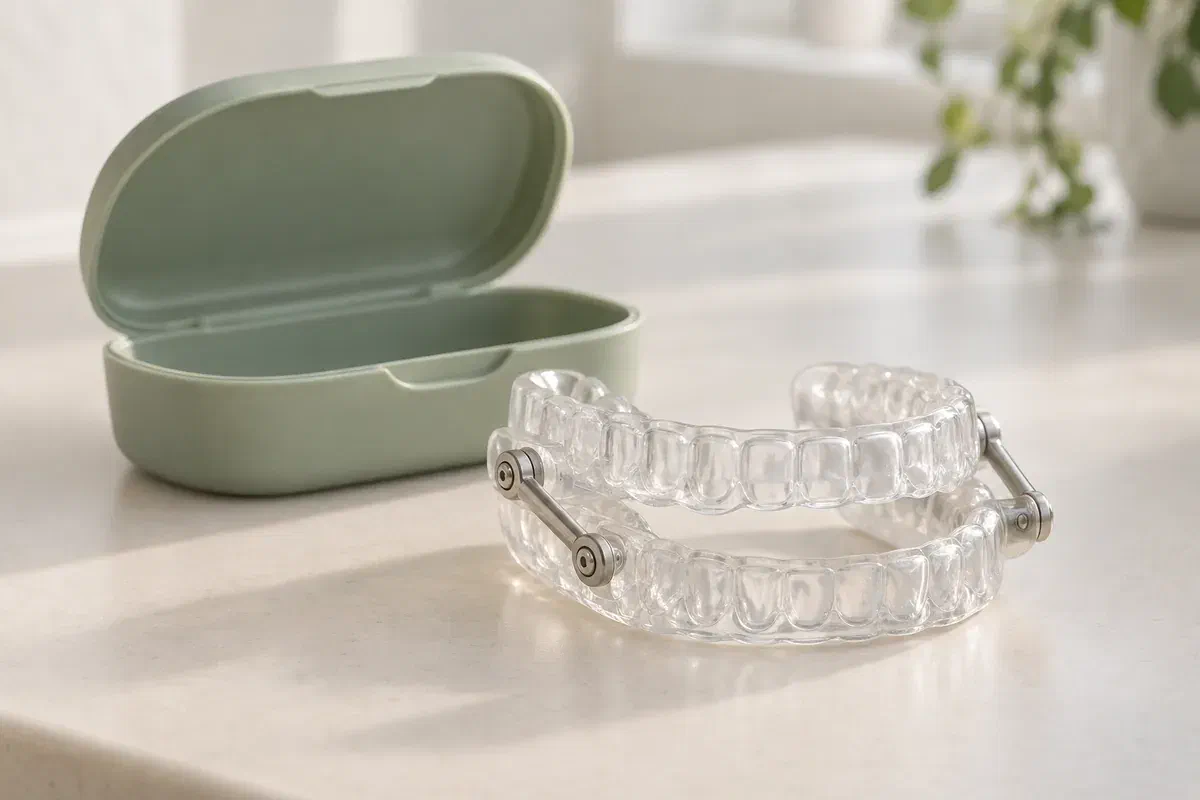
Illustrative connected upper and lower oral-appliance trays beside a pale sage storage case
Before you change anything

Sort out which of these sounds like you.

Your next step depends on where you are with medical care. We can help with the dental questions, though a dental visit never diagnoses sleep apnea.

A bed partner worries, but no one has tested you

Pauses in breathing that someone has witnessed, mornings that never feel restful, or dozing in the afternoon are worth raising with a physician. Snoring may or may not mean sleep apnea, so assessment comes before any device. Less noise does not prove the breathing problem is gone.

You have CPAP, but using it is wearing thin

Describe what has changed: the mask fit, comfort, or how often you actually wear it. Your sleep-care team may have fixes worth trying, and they can say whether an appliance is a reasonable alternative or an add-on. Carry on with the prescribed treatment until they advise a change.

Older dental work or tender joints

Crowns, bridges, implants, partial dentures, past gum treatment or a stiff jaw can all affect planning. Mention them early. Ask whether any repairs are wise first and how the bite and teeth would be checked once an appliance is in use.

Guidance from the Canadian Dental Association calls for a medical evaluation of suspected sleep apnea, and for dentist and physician to cooperate, before oral appliance therapy begins.

What you gain from asking properly

An honest comparison with the treatment you already know

After years with one treatment, a fair comparison is valuable. A consultation lets you ask your physician and dentist why an appliance might or might not suit your diagnosis, and what you would trade for the convenience. A device that is easier to pack still needs evidence that it controls your sleep apnea.

You also leave knowing the division of work. The dental side fits, adjusts and watches for changes in your teeth. The medical side decides how effectiveness is measured. Spelling that out early saves confusion later.

Patient information: AASM and AADSM — custom appliances, dental oversight, and follow-up sleep testing

Weighed against your sleep history

Bring your original sleep study, any later testing and your CPAP experience. The choice should reflect that history rather than a wish for something smaller. Make sure your sleep physician takes part in the decision.

Teeth and gums reviewed first

Ask how an appliance would stay in place on your current teeth and restorations, and whether your gums and jaw could tolerate it. Planned crowns or extractions may change the timing or design, or call for another provider.

Proof, not just a better feeling

Ask when and how your response will be tested. Sleeping more quietly or waking with more energy is encouraging but does not confirm control. Find out what the plan is if results come back short.

What happens, and in what order

From your sleep file to a confirmed result

Timing depends on medical advice and dental findings. Ask about each stage and its fees, from assessment and fabrication through adjustments, dental reviews and the separate sleep follow-up.

  1. Share your history

    Bring sleep reports, your health background and your physician's latest recommendations, along with an honest account of how CPAP has gone. We agree on how to reach your sleep-care provider and what you should keep using while we assess.

  2. Dental examination and records

    The clinician checks your teeth, gums, existing dental work and jaw movement. If an appliance seems suitable, you hear about the design and the impressions or scans required. Ask whether a dentist with training in this field or a referral is needed.

  3. Fitting and gradual adjustment

    When the appliance is delivered, comfort and fit are checked and you are shown how to insert, remove, clean and store it. Make changes only as instructed. Advancing it on your own to cut snoring faster is not safe.

  4. Testing and long-term reviews

    Your sleep physician arranges how effectiveness is assessed, which may include follow-up testing. Separate dental visits watch the device, your teeth and your bite. Ask how findings are passed between offices and what changes if control is inadequate.

Once it becomes part of bedtime

Small habits keep the appliance useful and your teeth healthy.

Care instructions vary with the device and your shared plan. Keep phone numbers for both teams within reach so each concern lands with the right clinician.

Wearing and caring for it

Follow the advice you are given on wear, adjustment, cleaning and storage. Keep it in its case when away from home and bring it to each dental review. If it breaks or stops fitting, call for an interim plan rather than fixing it yourself.

Watching for changes in your mouth

Mention sore teeth, gum irritation, ongoing jaw discomfort or a bite that feels altered in the morning. Ask which of these mean stopping and booking a review. Never force the device in or keep adjusting it when something feels wrong.

Staying in touch with your physician

Report symptoms that return, trouble wearing the appliance, and new health issues. Keep follow-up testing appointments even when everything feels comfortable. If you cannot use the device, ask right away what to do so treatment does not lapse.

Patient information: American Academy of Dental Sleep Medicine — appliance discomfort and dental effects · NHLBI — sleep deficiency and its effects on driving and daily function

Old Milton treatment choices

Three paths, chosen with your sleep physician

The best fit depends on the kind and severity of your sleep apnea, your general health, your past response to treatment and your dental situation. An oral appliance sits among several options.

When it remains the recommended medical treatment

Staying with positive airway pressure

Mask changes, humidity settings or other support may make CPAP easier. Ask your sleep-care team before setting it aside. A dentist cannot overrule the medical recommendation on their own.

When medical and dental findings both support it

Moving to a custom oral appliance

Go through the design, its limitations, how adjustments happen and how the result will be tested. Ask about monitoring for tooth and bite changes over the years. Good fit helps, but it does not guarantee the appliance controls sleep apnea for every person.

When something different or additional is needed

Other steps or a specialist opinion

Your physician may suggest other measures or referral, depending on findings and response. Ask how they combine with prescribed therapy and what would trigger a fresh look. Sleep position or lifestyle changes should not be assumed to replace effective treatment.

Patient information: NHLBI — sleep-apnea treatment options and individualized medical care

Common questions

Answers for people who have lived with sleep apnea a while

Bring your sleep records and the specific frustrations you want to solve. We will connect the dental questions to your medical plan.

(905) 876-4488
I have used CPAP for years. Can I simply switch to an oral appliance?
Any switch should be decided with your sleep physician, who knows your diagnosis and history. If they think an appliance is reasonable, a dental assessment checks suitability, and testing later shows whether it is working. Keep using CPAP until that plan is agreed.
My original sleep study is quite old. Will I need a new one?
That is a question for your sleep physician. They may want updated information before recommending a change in treatment. Bring whatever reports you have to the dental consultation so we can see what has already been done.
Can an appliance work if I have crowns or a bridge?
Often restorations can be planned around, but it depends on their condition and position, and on the health of the supporting teeth and gums. The examination looks at all of this. Ask what the findings mean before records are taken.
Does a partial denture rule out a sleep appliance?
Not necessarily, though fewer natural teeth can make it harder to hold an appliance securely. The clinician will look at how many teeth remain, how stable they are and whether another approach is wiser. Your sleep physician should know the outcome.
Can the appliance shift my teeth over time?
Changes in the bite or tooth position can happen with long-term use, which is why regular dental reviews are part of the plan. Report any change in how your teeth meet. The clinician can explain what to watch for with your particular device.
How do I know the appliance controls my sleep apnea as well as CPAP did?
Your sleep-care provider decides how to measure that, often with follow-up testing. Feeling rested is a good sign but not proof. Ask what result they are looking for and what happens if the appliance falls short.
Sleep appliances for Old Milton

Talk through a change with your history on the table

Contact our Bronte Street practice with your sleep reports and current recommendations. We can review dental suitability, the records required and how coordination or referral for an oral appliance would work.

We review every plan individually, from the diagnosis and your dental fitness to who provides which part, the testing schedule and the fees. No appliance is certain to control sleep apnea, and none should displace prescribed care unless both teams agree.

Visit Milton Dental Clinic
Unit 1, 342 Bronte St. S, Milton, ON L9T 5B7
Get directions Clinic hours
Monday–Thursday
11am–7pm
Friday–Sunday
By appointment only

Areas we serve

  • Milton
  • Oakville
  • Mississauga
  • Georgetown
  • Halton Hills
  • Acton
  • Campbellville
  • Brampton
  • Burlington
  • Puslinch
  • Rockwood
  • Erin
  • Caledon
  • Etobicoke
  • Old Milton
  • Bronte Meadows
  • Timberlea
  • Dorset Park
  • Dempsey
  • Clarke
  • Beaty
  • Coates
  • Harrison
  • Scott
  • Willmott
  • Ford
  • Bowes
  • Cobden
  • Walker
  • Mountain View
  • Milton Heights
  • Hawthorne Village
  • Valley View
  • Fallingbrook
  • Nassagaweya
  • Trafalgar
  • Esquesing
  • Nelson
  • Brookville
  • Moffat
  • Glen Williams
  • Norval
  • Limehouse
  • Stewarttown
  • Ashgrove
  • Hornby
  • Silver Creek
  • Speyside
  • Scotch Block
  • North Oakville
  • River Oaks
  • Glen Abbey
  • West Oak Trails
  • Palermo
  • Bronte Creek
  • College Park
  • Joshua Creek
  • Uptown Core
  • Preserve
  • Iroquois Ridge
  • Lisgar
  • Meadowvale
  • Meadowvale Village
  • Churchill Meadows
  • Erin Mills
  • Central Erin Mills
  • Streetsville
  • East Credit
  • Creditview
  • Heartland
  • Sheridan
  • Mount Pleasant
  • Credit Valley
  • Huttonville
  • Churchville
  • Springbrook
  • Northwest Brampton
  • Bram West
  • Fletcher's Meadow
  • Fletcher's Creek South
  • Alton Village
  • Orchard
  • Millcroft
  • Headon Forest
  • Tansley
  • Brant Hills
  • Tyandaga
  • Kilbride
  • Lowville
  • Aberfoyle
  • Morriston
  • Arkell
  • Hillsburgh
  • Freelton
  • Carlisle
  • Waterdown
  • Flamborough
  • Mountsberg

How can we help?

Milton Dental Clinic

Have a question about your smile? Choose the option that works best for you.

For urgent dental concerns, please call.
Messages are reviewed during clinic hours.