

Illustrative patient discussing an oral appliance and care coordination with a dental clinician
Specialized Care

Custom Sleep Apnea Appliances in Rockwood

A sleep apnea appliance becomes part of every bedtime and every morning. From Rockwood, see what living with one involves, from the medical diagnosis and dental fit to daily cleaning, repairs, reviews and testing of the result.

A device you live with

Brush, rinse, case, nightstand. Then the real work happens overnight.

Before deciding on an oral appliance, it helps to picture the routine. You put it in at bedtime, take it out in the morning, clean it, let it dry and store it in its case. Every so often it comes with you to a dental review. Over the years it may need repair, adjustment or replacement.

What it does overnight is the point. A custom appliance for obstructive sleep apnea is prescribed for selected adults, and the usual design holds the lower jaw a little forward to help keep the airway open. Your sleep physician decides whether it suits your diagnosis, a dental examination confirms your teeth and jaw can support it, and testing shows whether breathing is controlled.

From Rockwood, it is worth asking at the first visit how much of the routine can be handled at home and what needs an appointment. Have your sleep report and the physician's advice with you, and describe what you use now. We will cover suitability, records and coordination, and your prescribed treatment carries on meanwhile.

Ask what daily use involves
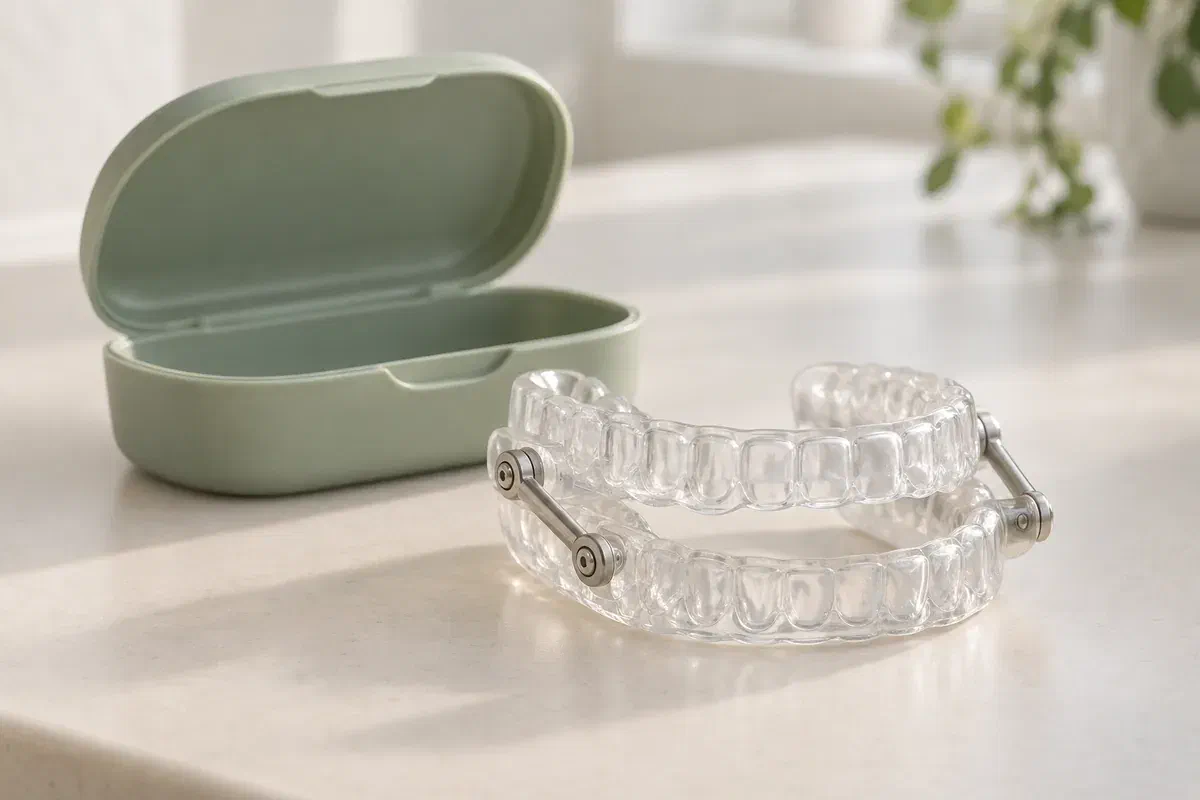
Illustrative connected upper and lower oral-appliance trays beside a pale sage storage case
Before the routine begins

Three questions to answer honestly

Has a physician assessed your sleep, and what did they advise? A dental team can plan an appliance with you, but sleep apnea is diagnosed by medical care.

Has anyone actually tested your sleep?

If breathing pauses have been noticed, you wake unrested, or you struggle to stay awake during the day, start with your family doctor. Snoring sometimes goes with sleep apnea and sometimes does not. An assessment comes before any device, and a quieter night is not a diagnosis.

Is your current treatment being used?

Explain what you were prescribed and what makes it hard to keep using. Your sleep-care team can help with those problems and say whether an appliance might be an alternative or a partner to it. Do not abandon prescribed treatment on your own.

Can your mouth manage a nightly appliance?

Mention loose teeth, gum treatment, dentures, implants, crowns or jaw discomfort. These influence suitability and design. Ask whether any dental care should happen first, and how the appliance's effect on your bite will be checked as time goes on.

The Canadian Dental Association advises that a physician evaluate snoring or suspected obstructive sleep apnea, and that the dentist and physician work together, before oral appliance therapy is provided.

Going in with realistic expectations

Know the commitment before you make it.

A consultation is a chance to understand the whole commitment. Ask your physician why an appliance may suit your diagnosis and how it compares with your current treatment, and ask us about the practical side: cleaning, storage, repair and review visits. A small device can be easier to live with, yet its worth depends on whether it controls sleep apnea.

It also makes responsibilities plain. We fit, adjust and maintain the appliance and watch your teeth. Your sleep-care provider arranges retesting and judges the result. Clear roles mean a cracked appliance and a returning symptom each go to the right place.

Patient information: AASM and AADSM — custom appliances, dental oversight, and follow-up sleep testing

A medical reason to proceed

Your sleep report and recommendations guide the decision; ask if more is needed. The appliance should be chosen because your physician thinks it fits the findings, not only because it is more compact.

A mouth ready for nightly wear

Ask how the appliance would hold on and whether your gums and jaw would tolerate it every night. Mention planned dental work and other appliances. What we find may change timing or design, or call for another provider.

A result that is measured

Ask when and how effectiveness will be checked. Waking more rested is worth reporting, though it does not confirm control. Ask what happens if the response is only partial.

Getting to the first night

From first conversation to a routine that works

Your physician's advice and our findings set the timing. Ask at the start what each step costs, including the assessment, fabrication, adjustment visits, ongoing dental reviews and sleep follow-up billed separately.

  1. Talk through diagnosis and lifestyle

    We look at your sleep results, health background and the treatment recommended, and you describe your nightly routine and any difficulties. We agree how your physician will be updated and which therapy you keep using.

  2. Examine and take records

    The clinician checks teeth, gums, restorations and jaw movement. If an appliance is suitable, you hear about the design and the impressions or scans needed. Ask whether a dentist with training in dental sleep care or a referral is involved.

  3. Fit it and learn the routine

    On delivery day, the clinician checks the fit and you practise putting it in and taking it out. You also learn how to clean, dry and store it. Adjust it only as directed; advancing it yourself is not safe.

  4. Check the result and maintain the device

    Effectiveness is judged on the medical side, which may involve a sleep study. Our reviews look at wear on the appliance and changes in your teeth and bite. Ask how findings are exchanged and what changes if control is inadequate.

Rockwood routines that last

Clean, dry, cased, and checked when it is due

Your instructions depend on the device and plan. Keep both teams' numbers handy, so problems with the appliance and questions about your sleep reach the right clinician.

Morning cleaning and safe storage

Clean the appliance as instructed, avoiding anything your instructions rule out, then let it dry and keep it in its case out of reach of pets. Bring it to each review. A crack, loose part or poor fit needs a call to us for interim advice, not glue.

Your teeth, gums and jaw

Report sore teeth, irritated gums, jaw ache that persists or a change in how your teeth meet. Ask at fitting which signs mean stopping use and coming in promptly. Do not force the device into place or keep making adjustments.

Your sleep-care provider

Tell them if symptoms return, if wearing it becomes hard or if your health changes. Go to testing even when the appliance feels fine. If you stop being able to wear it, ask promptly what to use instead.

Patient information: American Academy of Dental Sleep Medicine — appliance discomfort and dental effects · NHLBI — sleep deficiency and its effects on driving and daily function

Comparing what each option asks of you

Every treatment has a routine. Choose with your physician.

Your physician weighs how severe the sleep apnea is and what kind it is, along with your health, your response so far and what we find in your mouth. A custom appliance is one possibility among those.

When it is your physician's recommendation

Positive airway pressure, with support

Equipment, mask or routine problems are worth raising with the clinic that prescribed it, ideally before you stop. Adjustments, support or an alternative may be on offer. A dental consultation alone should not override them.

When medical and dental assessments agree

A custom appliance, maintained and reviewed

Discuss the design, its limits, the care it needs, the adjustment plan and the testing ahead. Ask how dental changes will be followed. Even a precise fit cannot guarantee that an appliance controls sleep apnea for everyone.

When another or added approach is needed

Other measures or specialist advice

Your physician may suggest other steps or a referral, depending on your findings and response. Ask how these fit with current therapy and when reassessment is due. Lifestyle or position changes should not replace effective treatment without review.

Patient information: NHLBI — sleep-apnea treatment options and individualized medical care

Everyday questions

Cleaning, storage, repairs and replacement

Bring your sleep-care information and any questions about the practical side. We will connect the routine to your physician's plan.

(905) 876-4488
How should I clean my sleep apnea appliance each morning?
Follow the instructions given for your specific appliance, since materials vary. Generally that means rinsing and gentle cleaning, then letting it dry before storing it in its case. Ask before using any product not on your instructions.
Can I use hot water or toothpaste on the appliance?
Some materials can warp with heat or be scratched by abrasive products, and a distorted appliance may no longer fit. Check the instructions for your appliance, and ask the dental team before trying anything new, including denture cleaners or soaking tablets.
What should I do if the dog chews my appliance?
Stop using it and call the dental team. A damaged appliance may not fit or work properly. Ask your sleep-care provider what treatment to use until it is repaired or replaced.
How long does a custom sleep appliance usually last?
It varies with the material, how it is cared for, whether you grind your teeth and changes in your mouth. Regular dental reviews help spot wear before it affects fit. Ask the clinician what to expect for your design, and let your physician know if a replacement is being planned.
Will I need a new appliance if I get a crown or lose a tooth?
Possibly. Changes to your teeth can affect fit. Tell the dental team before planned work and as soon as something changes, and bring the appliance with you.
Should the appliance come with me to every dental appointment?
Bring it to reviews and to any visit where dental work could affect its fit, such as fillings, crowns or extractions. That lets the clinician check the appliance and your teeth together, and spot early wear or a change in how it seats.
Sleep appliance consultations for Rockwood

Let's talk about what the routine would look like for you.

Reach our Bronte Street practice once you have a diagnosis and recommendations. We will review dental suitability, explain the records needed and describe how we coordinate with your physician or refer.

Diagnosis, oral health, provider roles, retesting and fees are reviewed individually. An appliance cannot guarantee sleep apnea control and should replace prescribed treatment only with coordinated advice.

Visit Milton Dental Clinic
Unit 1, 342 Bronte St. S, Milton, ON L9T 5B7
Get directions Clinic hours
Monday–Thursday
11am–7pm
Friday–Sunday
By appointment only

Areas we serve

  • Milton
  • Oakville
  • Mississauga
  • Georgetown
  • Halton Hills
  • Acton
  • Campbellville
  • Brampton
  • Burlington
  • Puslinch
  • Rockwood
  • Erin
  • Caledon
  • Etobicoke
  • Old Milton
  • Bronte Meadows
  • Timberlea
  • Dorset Park
  • Dempsey
  • Clarke
  • Beaty
  • Coates
  • Harrison
  • Scott
  • Willmott
  • Ford
  • Bowes
  • Cobden
  • Walker
  • Mountain View
  • Milton Heights
  • Hawthorne Village
  • Valley View
  • Fallingbrook
  • Nassagaweya
  • Trafalgar
  • Esquesing
  • Nelson
  • Brookville
  • Moffat
  • Glen Williams
  • Norval
  • Limehouse
  • Stewarttown
  • Ashgrove
  • Hornby
  • Silver Creek
  • Speyside
  • Scotch Block
  • North Oakville
  • River Oaks
  • Glen Abbey
  • West Oak Trails
  • Palermo
  • Bronte Creek
  • College Park
  • Joshua Creek
  • Uptown Core
  • Preserve
  • Iroquois Ridge
  • Lisgar
  • Meadowvale
  • Meadowvale Village
  • Churchill Meadows
  • Erin Mills
  • Central Erin Mills
  • Streetsville
  • East Credit
  • Creditview
  • Heartland
  • Sheridan
  • Mount Pleasant
  • Credit Valley
  • Huttonville
  • Churchville
  • Springbrook
  • Northwest Brampton
  • Bram West
  • Fletcher's Meadow
  • Fletcher's Creek South
  • Alton Village
  • Orchard
  • Millcroft
  • Headon Forest
  • Tansley
  • Brant Hills
  • Tyandaga
  • Kilbride
  • Lowville
  • Aberfoyle
  • Morriston
  • Arkell
  • Hillsburgh
  • Freelton
  • Carlisle
  • Waterdown
  • Flamborough
  • Mountsberg

How can we help?

Milton Dental Clinic

Have a question about your smile? Choose the option that works best for you.

For urgent dental concerns, please call.
Messages are reviewed during clinic hours.