

Illustrative patient discussing an urgent dental concern with a clinician
Specialized Care

Dental Abscess Treatment in Erin

Same tooth, same swelling, again. A problem that keeps returning is a sign the source has not been dealt with. From Erin or Hillsburgh, call to describe the pattern and we can discuss urgency and a thorough assessment.

Erin · a tooth that keeps flaring

Back again? Let’s find out why.

You recognise the feeling: a dull ache, a familiar swelling, maybe the same little bump on the gum you had last spring. It settled then, perhaps after a course of medicine, and now it is back. Recurrence often points to a dental abscess whose source has not been fully treated. An abscess is pus collected around infection in a tooth or its supporting tissue, and an examination is needed to confirm that and rule out conditions that behave in a similar way.

The first thing to settle is timing and setting: is this a flare that a dentist should see soon, or are there signs needing hospital care? The second is what will stop the cycle. Depending on the findings, treatment may involve drainage, care inside the tooth, an extraction when the tooth is not a reliable candidate for keeping, or care directed at the gum and nearby tissue.

From Erin, ring us and describe this episode and the earlier ones, including dates and anything that helped before. Urgent symptoms should not wait for a reply to a message; if we cannot be reached, contact another emergency dental provider.

Get to the root of it
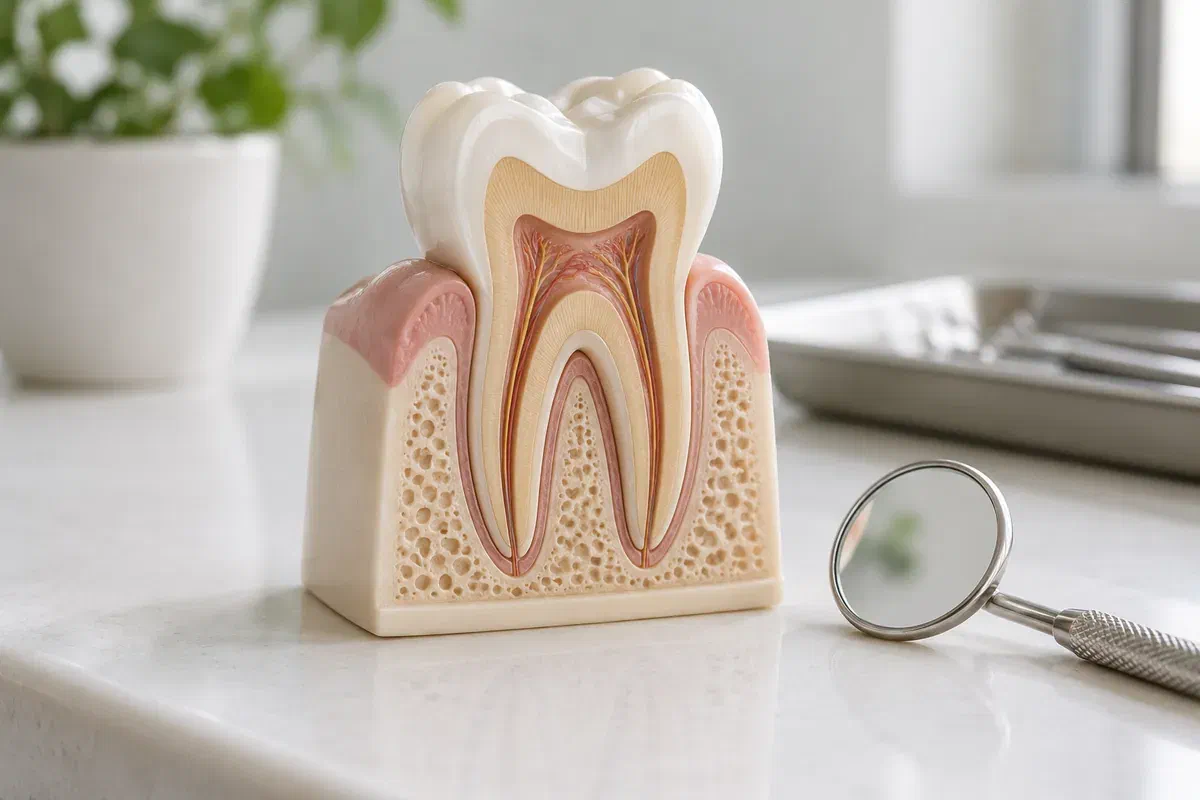
Illustrative physical model showing the inside of a tooth beside a dental mirror
Telling the whole story

Earlier episodes are part of the evidence

It is not up to you to prove it is an abscess. A history of the flare-ups, as well as what is happening now, helps the team judge urgency and prepare a more complete examination.

This flare and the last one

Say which area is involved and whether it is the same spot as before. Describe swelling, a gum bump, taste or pain on biting, and how fast it came on compared with last time. Leave the spot alone instead of pressing it to compare.

How unwell you feel this time

Report any fever, fatigue or swelling that has spread further than in earlier episodes. Include health conditions, regular medicines and recent treatment. A flare that is behaving differently, or a change in your health, can alter how quickly and where you should be seen.

What was done before

List earlier treatment of the tooth, antibiotics prescribed in past episodes and when, and any advice you were given. Note allergies. The fact that the problem improved and returned is useful information, more so than assuming each episode was a fresh, unrelated event.

Recurring or not, some symptoms need emergency medical care: trouble breathing or swallowing, swelling around the eye or vision changes, or facial or mouth swelling that is large or spreading fast. Call 911 or go to a hospital emergency department.

Breaking the cycle

Treat the source this time, not only the flare

After repeated episodes, the most useful thing an appointment can offer is a clear explanation of why the problem keeps returning. Ask what was found, whether the treatment you receive targets the source, and whether it is a first stage that needs completing. Settling symptoms has happened before; resolving the cause is the goal now.

The recommendation also has to suit the tooth and your health. Repeated infection may affect a tooth’s prospects, so ask why keeping or removing it is suggested, what each option cannot guarantee and how treatment would be ordered.

Patient information: American Dental Association — antibiotics and definitive dental treatment

A source that explains the pattern

Your history, the examination and any X-rays or tests that make sense are considered together. Ask which findings account for the recurrence. Sometimes a neighbouring tooth or the gum is involved, not only the tooth you have always suspected.

Why another course of medicine is not enough

Antibiotics do not replace treatment for the source, which is often why symptoms return after they finish. Whether medicine is suitable now depends on the diagnosis, signs of spread or illness, your health and how soon treatment can be carried out.

A plan you can see through

Confirm the next appointment, who will provide it and what to do if things change first. Ask for the estimate and referral details. Having the plan in writing helps make sure this episode is the last one.

What this assessment involves

Looking back before moving forward

The first visit depends on the findings and on what is possible that day. Ask which parts can be completed and which require another appointment or a specialist.

  1. Piece together the history

    We go over the current symptoms, earlier episodes, past dental work and any medicine taken, along with allergies and conditions. If you feel worse before your appointment, phone back or seek another suitable provider straight away.

  2. Examine with recurrence in mind

    The dentist examines the tooth, the neighbouring teeth and the gum, and decides whether X-rays or tests are needed. Ask what is clear and what is uncertain. A working diagnosis should explain why the problem keeps coming back.

  3. Choose treatment aimed at the cause

    You review the proposed care, comfort measures, other options, its limits and the fee. Depending on what is found, it may include drainage and treatment of the tooth or tissue at fault. Ask whether this finishes the job or begins a longer plan.

  4. Set a follow-up that sticks

    Before you leave, confirm the changes to expect and which signs need attention. Clarify how unfinished treatment will be completed. With a referral, ask what will be sent and who to contact.

So it does not happen again

Finish every stage this time

Recovery differs after drainage, root canal care, an extraction or gum treatment. Ask for directions specific to what was done, rather than relying on what you were told during a previous flare.

Complete the planned treatment

Book the next stage before you go. If it becomes hard to attend, phone to reschedule. Past episodes probably showed that feeling better does not mean the cause has gone.

Medicine as directed, not from the cupboard

Follow the prescription and ask a pharmacist about interactions or side effects. Do not reach for leftover antibiotics from a previous flare or someone else’s medicine. If you cannot take what was prescribed, tell the prescriber.

Report early signs of a repeat

Contact us if discomfort, swelling or feeling ill returns or worsens, or differs from what was explained. Mention the treatment date and the change. Avoid draining, pressing or squeezing a swelling at home.

Ending the recurrence

Which treatment addresses the cause for good?

Ask what each option is meant to achieve, what comes after and what delay could mean. A recurring abscess can have several possible sources, so no single procedure fits every case.

If the tooth is restorable

Root canal care or retreatment

When the source is inside a tooth that can be rebuilt, root canal treatment, or retreatment of an earlier one, may be discussed. Ask about stages and the restoration needed. Remaining structure and support weigh into the decision.

If repeated infection has made it unreliable

Removal and a replacement discussion

Extraction may be recommended when the tooth is unlikely to be treated or restored successfully. Ask why and what the appointment involves. Replacement options, timing and costs can then be planned separately.

If the source is in the gum or hard to find

Gum care or a specialist referral

Recurrent infection from the gums, or a case that is difficult to pin down, may need different treatment or a specialist. It is reasonable to ask what the referral should resolve.

Questions about repeat flare-ups

Why it keeps coming back, and what helps

Phone if your symptoms are urgent. These answers are for planning; the diagnosis and treatment come from your examination.

(905) 876-4488
Why does my abscess keep returning after antibiotics?
Medicine may calm the infection without treating its source in the tooth or gum. When the course ends, symptoms can come back. An assessment aims to find and treat the cause, so that the next flare is prevented rather than simply managed when it arrives.
Can a tooth be retreated if a previous root canal did not work?
Sometimes. The dentist considers the tooth’s structure, support and restoration. Ask whether retreatment, a specialist referral or another option is realistic in your case.
Is it worth keeping a tooth that has been infected several times?
That depends on the cause and the tooth’s condition. Ask for the reasons behind the recommendation and the alternatives, including what replacement would involve. For households in Erin who would rather group visits, ask how the stages of each option could be scheduled.
Should I keep a record of each flare-up?
Yes. Dates, symptoms, treatment and medicines for each episode help the dentist understand the pattern. Bring the record to your appointment. Even rough notes on a phone, such as the month, which side and what was prescribed, are better than trying to recall everything in the chair.
Can a recurring gum bump be from something other than an abscess?
It can. Several conditions cause gum bumps. The examination and any needed images help determine what it is and where it comes from.
Will finishing treatment stop the problem for good?
Completing the recommended treatment gives the best chance of dealing with the source, but no outcome can be promised. Ask what follow-up is advised and what signs to watch for.
Calling from Erin

Tell us about every flare, not only this one

Phone our Bronte Street practice to describe the recurring problem and ask when we can see you. Let us know about any change in swelling or your general health. If you need help right away and cannot reach us, contact another emergency dental provider.

Online requests suit non-urgent questions. Diagnosis, treatment, prescriptions, referrals and costs are determined after the examination, and urgent or same-day care cannot be guaranteed.

Visit Milton Dental Clinic
Unit 1, 342 Bronte St. S, Milton, ON L9T 5B7
Get directions Clinic hours
Monday–Thursday
11am–7pm
Friday–Sunday
By appointment only

Areas we serve

  • Milton
  • Oakville
  • Mississauga
  • Georgetown
  • Halton Hills
  • Acton
  • Campbellville
  • Brampton
  • Burlington
  • Puslinch
  • Rockwood
  • Erin
  • Caledon
  • Etobicoke
  • Old Milton
  • Bronte Meadows
  • Timberlea
  • Dorset Park
  • Dempsey
  • Clarke
  • Beaty
  • Coates
  • Harrison
  • Scott
  • Willmott
  • Ford
  • Bowes
  • Cobden
  • Walker
  • Mountain View
  • Milton Heights
  • Hawthorne Village
  • Valley View
  • Fallingbrook
  • Nassagaweya
  • Trafalgar
  • Esquesing
  • Nelson
  • Brookville
  • Moffat
  • Glen Williams
  • Norval
  • Limehouse
  • Stewarttown
  • Ashgrove
  • Hornby
  • Silver Creek
  • Speyside
  • Scotch Block
  • North Oakville
  • River Oaks
  • Glen Abbey
  • West Oak Trails
  • Palermo
  • Bronte Creek
  • College Park
  • Joshua Creek
  • Uptown Core
  • Preserve
  • Iroquois Ridge
  • Lisgar
  • Meadowvale
  • Meadowvale Village
  • Churchill Meadows
  • Erin Mills
  • Central Erin Mills
  • Streetsville
  • East Credit
  • Creditview
  • Heartland
  • Sheridan
  • Mount Pleasant
  • Credit Valley
  • Huttonville
  • Churchville
  • Springbrook
  • Northwest Brampton
  • Bram West
  • Fletcher's Meadow
  • Fletcher's Creek South
  • Alton Village
  • Orchard
  • Millcroft
  • Headon Forest
  • Tansley
  • Brant Hills
  • Tyandaga
  • Kilbride
  • Lowville
  • Aberfoyle
  • Morriston
  • Arkell
  • Hillsburgh
  • Freelton
  • Carlisle
  • Waterdown
  • Flamborough
  • Mountsberg

How can we help?

Milton Dental Clinic

Have a question about your smile? Choose the option that works best for you.

For urgent dental concerns, please call.
Messages are reviewed during clinic hours.