

Illustrative patient discussing an urgent dental concern with a clinician
Specialized Care

Dental Abscess Treatment in Puslinch

A tooth that feels a little high when you bite, a sour taste that lingers, a tender spot on the gum: early signs are easy to brush off. From Puslinch, call us to describe them and arrange a timely assessment.

Puslinch · catching it early

Small signs, worth a phone call

In a busy rural household, a tooth that feels slightly “tall” when you chew, or a bit of gum that stays tender, tends to get filed under later. Yet those quiet signs can be the start of a dental abscess, a pocket of pus formed by infection in a tooth or the tissue that surrounds it. It needs a dentist’s examination, both to confirm what is happening and to rule out other causes that feel similar.

Calling early gives you more say over the two questions that follow. How soon do you need to be seen, and in what setting? And what will treat the underlying cause? Depending on the findings, that might mean drainage, care inside the tooth, taking out a tooth that cannot reasonably be kept, or treatment focused on the gum and supporting tissue.

From Puslinch, a short call can save a rushed trip later. Tell us what you have noticed, when it began and whether you feel unwell, and we will discuss availability. Do not leave urgent symptoms waiting on an email. If we cannot be reached and things are worsening, seek another emergency dental provider.

Check that tooth early
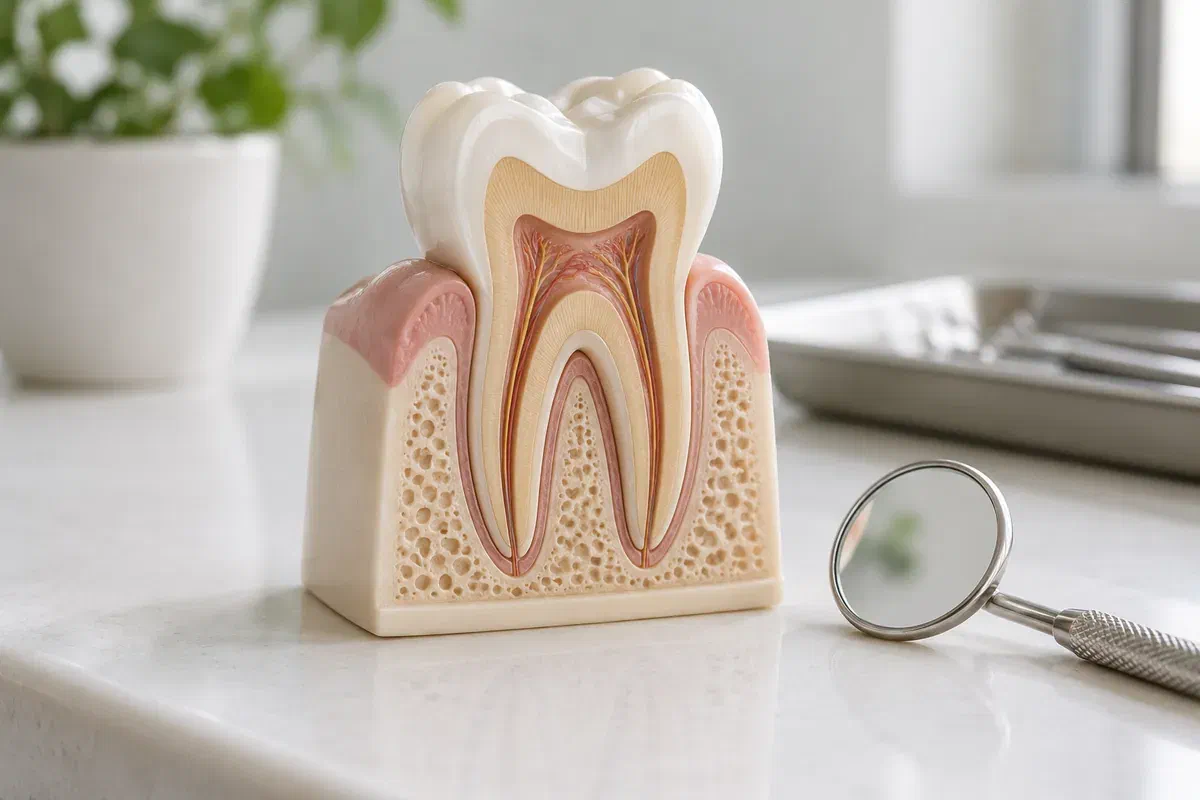
Illustrative physical model showing the inside of a tooth beside a dental mirror
Easy-to-miss signals

Mention the little things as well as the obvious ones

There is no need to be sure it is an abscess. Passing on small observations helps the team decide how soon you should be seen and what to look for.

Changes in how the tooth feels

Describe whether the tooth feels higher than its neighbours, aches on biting, or has a small bump or tender patch beside it. Note any taste that keeps returning. Leave it alone rather than tapping it to see if it still hurts.

How you are feeling in general

Even mild fever, tiredness or a slight puffiness in the cheek is worth mentioning. List medical conditions, regular medicines and recent treatment. These help judge urgency and setting, even when they seem to have nothing to do with a tooth.

What you have used to manage it

Say whether you have taken pain relievers or any prescription, from whom and since when. Keep medicine names and allergies handy. If the same area has bothered you before, settled, and returned, mention that; it says more than assuming it went away.

Mild signs can change. If you develop trouble breathing or swallowing, swelling near the eye or changes to your vision, or swelling of the face or mouth that is large or spreading quickly, call 911 or go to hospital emergency care.

Why early assessment helps

More options, fewer surprises

Being seen while symptoms are still modest can make planning easier. You find out what is going on, whether treatment is needed now, and if so whether it deals with the cause or begins a longer plan. Ask about each of those before you leave, even if the visit felt routine.

Recommendations will take account of the tooth’s condition and your general health. You are entitled to ask why keeping or removing it is suggested, what each choice cannot guarantee and what the order of treatment would be. Early or not, the reasoning should be clear.

Patient information: American Dental Association — antibiotics and definitive dental treatment

A source confirmed, not assumed

The dentist considers your account, the examination and any X-rays or checks the situation calls for. Ask which findings point to the cause. Mild discomfort can come from a neighbouring tooth or the gum rather than the one you suspect.

Medicine only where it fits

Antibiotics are not a replacement for necessary dental treatment. Whether they are suitable depends on what is diagnosed, whether infection seems to be spreading or affecting your health more widely, your medical history and how soon treatment can happen.

A plan that fits the season

Find out the next appointment, who will provide it and what to do if symptoms flare before then. Ask for the estimate and referral details. Writing it down helps when the household calendar is already full.

What to expect

How an early assessment is carried out

What happens at the first visit depends on the findings and on what can be done that day. Ask which parts are handled straight away and which need another appointment or a referral.

  1. Describe the early signs

    We ask when you first noticed the change, how it has developed, any past work on the tooth and medicines taken. Allergies and health conditions are noted. If symptoms speed up before your appointment, call back or seek another suitable provider.

  2. Examination and findings

    The dentist examines the tooth and gum, and decides whether X-rays or simple tests would help. Ask what the findings show and what remains unclear. Your symptoms should be tied to a working diagnosis before a treatment plan is set.

  3. Decide what to do now

    You review the proposed care, comfort options, alternatives, limits and cost. If an abscess is confirmed, treatment may include drainage and care of the tooth or tissue behind it. Ask whether this is the complete plan or a first stage.

  4. Plan the follow-up

    Before leaving, confirm what changes to expect and what would mean calling again. Check how remaining treatment will be scheduled. For a referral, ask what will be shared and who books the appointment.

After your appointment

Follow the advice for what was actually done

Aftercare after drainage is not the same as after root canal care, an extraction or gum treatment. Ask for instructions that match your treatment rather than using guidance from an unrelated visit years ago.

Arrange the next visit early

Pick a date that works around chores and work, and book it before you go. If it becomes difficult, phone to rearrange. A tooth that feels normal again may still need the planned treatment.

Use medicines as instructed

Follow the directions and ask a pharmacist about other medicines you take, side effects or uncertainty. Do not take antibiotics prescribed for another person or left over from before. If you cannot take a medicine, let the prescriber know.

Call if the signs come back

Contact the team if tenderness, swelling or feeling unwell returns or grows, or is different from what you were told to expect. Give the date of treatment and what changed. Do not try to drain or squeeze a swelling at home.

If treatment is needed

Options depend on what the examination finds

Ask what each choice aims to do, what follows it and what waiting could mean. No single procedure is right for every suspected abscess.

If the tooth can be restored afterward

Treating the inside of the tooth

When infection begins within a tooth that still has enough structure to rebuild, root canal treatment may be offered. Ask about stages and the restoration needed. The whole tooth and its support are part of the decision.

When keeping it is a poor prospect

Extraction, then replacement planning

Removal may be recommended when treatment or restoration is unlikely to work reliably. Ask why and what the appointment will involve. Replacement options, timing and costs can be discussed as their own step.

If the gums are the source or the case is complex

Gum treatment or a referral

Infection from the gums, or a less straightforward picture, may call for different care or a specialist. Ask what a referral would add. The aim is the right treatment for what is found.

Puslinch questions

Early signs and when to act on them

Call us for anything urgent. These answers help with planning, but the examination determines your diagnosis and treatment.

(905) 876-4488
Why does my tooth feel taller than the others when I bite?
Several dental problems can make a tooth feel high or tender on biting, including inflammation around the root. It is worth booking an assessment, especially if there is also swelling or a bad taste.
Is a lingering bad taste near one tooth worth mentioning?
Yes. A persistent taste can come from drainage linked to infection or from other causes. Mention where it seems to come from, how long it has been present and whether brushing or rinsing changes it.
Can an abscess start without much pain at all?
It can. Some people notice only mild tenderness, a gum bump or a taste. Pain is not a reliable measure of how serious the problem is, so other signs matter too.
How quickly should I book if the symptoms are mild?
Call to describe them and the team can advise on timing. Mild signs that are changing, or that come with feeling unwell, should be assessed sooner. Booking while things are still manageable usually gives you more choice of appointment times than waiting for a flare.
Could gum disease be causing the swelling instead of the tooth?
Yes, infections can arise in the gum and supporting tissue as well as inside a tooth. The examination helps tell them apart, and treatment differs depending on the source.
Do I need antibiotics for mild symptoms?
Not necessarily. Whether medicine is suitable depends on the findings and your health. Dental treatment is often what deals with the source, so ask what the plan involves.
Calling from Puslinch

Notice something small? Let’s take a look.

Phone our Bronte Street practice to describe the tooth and ask when we can examine it. Mention any change in swelling or how you feel. If urgent help is needed and you cannot reach us, contact another emergency dental provider.

Online requests are meant for non-urgent questions. Everything from diagnosis and treatment to prescriptions, referrals and fees follows the examination, and urgent or same-day appointments are not guaranteed.

Visit Milton Dental Clinic
Unit 1, 342 Bronte St. S, Milton, ON L9T 5B7
Get directions Clinic hours
Monday–Thursday
11am–7pm
Friday–Sunday
By appointment only

Areas we serve

  • Milton
  • Oakville
  • Mississauga
  • Georgetown
  • Halton Hills
  • Acton
  • Campbellville
  • Brampton
  • Burlington
  • Puslinch
  • Rockwood
  • Erin
  • Caledon
  • Etobicoke
  • Old Milton
  • Bronte Meadows
  • Timberlea
  • Dorset Park
  • Dempsey
  • Clarke
  • Beaty
  • Coates
  • Harrison
  • Scott
  • Willmott
  • Ford
  • Bowes
  • Cobden
  • Walker
  • Mountain View
  • Milton Heights
  • Hawthorne Village
  • Valley View
  • Fallingbrook
  • Nassagaweya
  • Trafalgar
  • Esquesing
  • Nelson
  • Brookville
  • Moffat
  • Glen Williams
  • Norval
  • Limehouse
  • Stewarttown
  • Ashgrove
  • Hornby
  • Silver Creek
  • Speyside
  • Scotch Block
  • North Oakville
  • River Oaks
  • Glen Abbey
  • West Oak Trails
  • Palermo
  • Bronte Creek
  • College Park
  • Joshua Creek
  • Uptown Core
  • Preserve
  • Iroquois Ridge
  • Lisgar
  • Meadowvale
  • Meadowvale Village
  • Churchill Meadows
  • Erin Mills
  • Central Erin Mills
  • Streetsville
  • East Credit
  • Creditview
  • Heartland
  • Sheridan
  • Mount Pleasant
  • Credit Valley
  • Huttonville
  • Churchville
  • Springbrook
  • Northwest Brampton
  • Bram West
  • Fletcher's Meadow
  • Fletcher's Creek South
  • Alton Village
  • Orchard
  • Millcroft
  • Headon Forest
  • Tansley
  • Brant Hills
  • Tyandaga
  • Kilbride
  • Lowville
  • Aberfoyle
  • Morriston
  • Arkell
  • Hillsburgh
  • Freelton
  • Carlisle
  • Waterdown
  • Flamborough
  • Mountsberg

How can we help?

Milton Dental Clinic

Have a question about your smile? Choose the option that works best for you.

For urgent dental concerns, please call.
Messages are reviewed during clinic hours.