

Illustrative patient discussing an implant concern with a clinician and dental model
Specialized Care

Dental Implant Emergencies in Acton

Partway through implant treatment, a healing cap pops out, a temporary crown comes loose, or the site feels sorer than expected. If that happens to you in Acton, phone first. We can sort out who should see you, how soon, and what to bring from your treatment so far.

Mid-treatment surprises

Something came loose before the implant was finished. Now what?

Implant treatment usually happens in stages, and a problem can turn up in between them. A small healing cap may work free, a temporary crown may loosen, or the gum may stay tender longer than you were told to expect. These are not the same as a failure of the post. Implants also involve a final crown, an abutment and the surrounding tissue, and an injury or inflammation can affect any of them. An examination is needed to see which part is involved.

When you call, explain where you are in treatment. Do you have a post with a healing cap, a temporary tooth, or a finished crown, bridge or implant-supported denture? Then describe what changed: something came off, the area is sore or swollen, there is movement, or your bite feels different. If you are partway through care with another provider, their name and the date of your last visit are especially useful.

Contact us soon after you notice the change and ask when an assessment can be arranged. If another clinician is managing your implant, it is usually wise to let them know as well, since they hold the treatment plan. We can handle the immediate concern and help coordinate with that clinician or a specialist.

Ask about a mid-treatment check
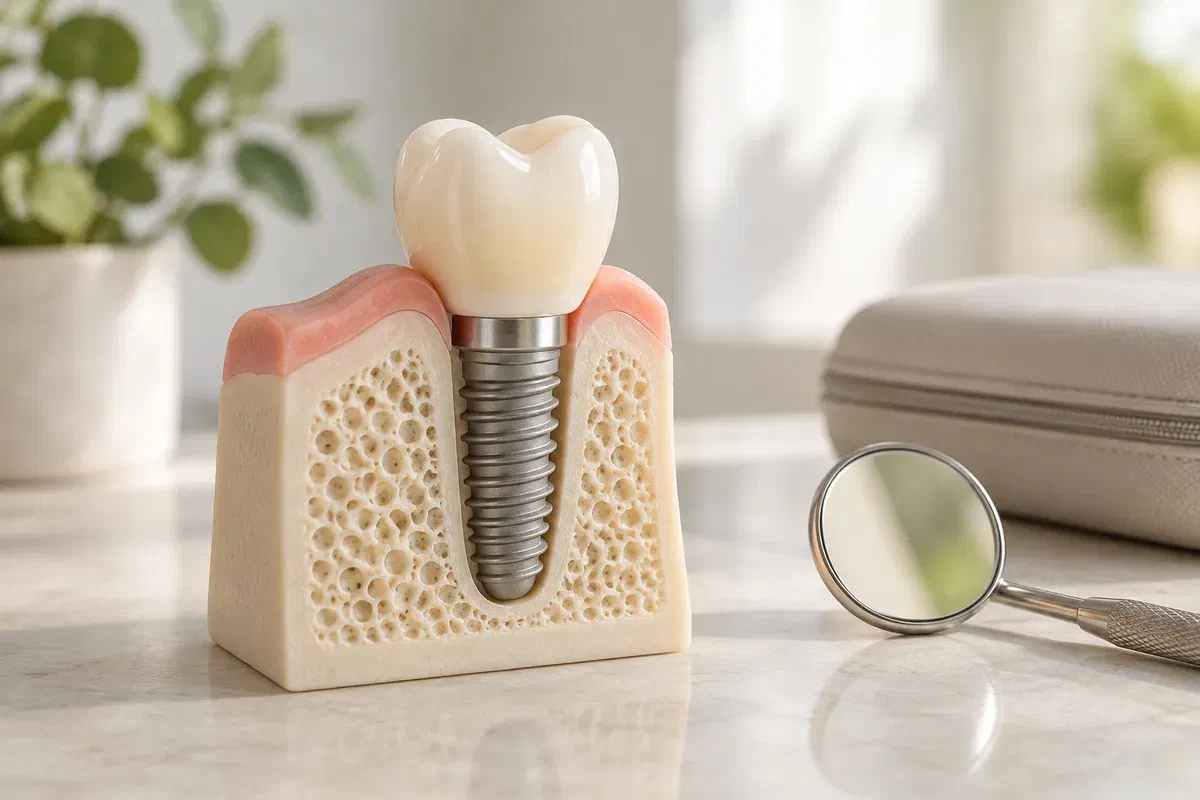
Illustrative model of a dental implant and attached crown within a bone-and-gum cross-section
What to tell us on the phone

Explain the stage, the symptom, and the timing.

Those three details help decide how urgent the visit is. A photo can show a missing cap or a swollen gum, but it says little about how the implant is healing in the bone.

A temporary or final tooth that moves

Say whether it loosened suddenly, after biting, or slowly. Try to keep from pressing on it, and avoid chewing on that side. Whether the temporary crown, a connecting part or the implant is moving has to be confirmed in person.

Soreness or swelling at the site

Tell us when it started, whether it is improving or worsening, and whether there is discharge or a bad taste. Tissue around a new or established implant can become inflamed. We look at the gum directly and take images if they are needed.

A cap or other small part has come out

Drop it into a clean container and bring it along. Mention any impact or recent procedure. Do not try to screw a healing cap back in, push a temporary crown into place, or use household glue.

An implant cannot decay, but the gum and bone around it can become diseased, and parts can loosen at any stage. Mention any new symptom, whether your implant is days old or decades old.

Why it helps to act quickly

Protect the site now, keep the treatment plan on track.

A timely visit can establish what needs care straight away and what should wait for the clinician managing your treatment. Ask whether the site can be protected or made comfortable during the appointment, and whether the next stage depends on records, specific parts, lab work, or a conversation with the original provider. Each step should be explained separately.

After the cause is clear, there may be more than one way to proceed. Any plan should take the implant, the temporary or final restoration, the gum and your other teeth into account. A fast fix without explanation can leave you unsure whether your treatment timeline has changed.

Clarity about what came off

Ask the clinician to explain whether the problem involves a healing cap, a temporary crown, an abutment or the implant. Knowing which piece is involved makes the next step easier to understand and avoids assuming the implant has failed.

Treatment notes that guide care

Your treatment plan, system details and recent X-rays help anyone who sees you mid-treatment. Ask how they can be shared with your consent. If you do not have them, mention it, and still call promptly about anything urgent.

Communication with your treating clinician

If another provider is managing your implant, the care you receive now should fit their plan. Ask who will contact them and what you should do until the next step. A clear handover keeps treatment from stalling.

How we handle a mid-treatment visit

Understand the stage, check the site, then coordinate

What we can do at the first appointment depends on what we find, the stage of your treatment, and access to suitable parts. Some situations are best completed by the clinician who began the treatment.

  1. Tell us where you are in treatment

    Describe the symptoms, when they began, and any recent knock or appointment. Share the name of the clinician managing the implant and the date of your last visit. Let us know about medical conditions and medicines, which may affect healing.

  2. Assess the site and the restoration

    The clinician examines the area, checks any temporary or final restoration, and considers images if appropriate. Ask what the findings mean for healing and whether anything still needs clarifying. The gum and bone are as important as the crown.

  3. Agree on interim care

    Discuss what can reasonably be done at this visit and what should be left to your treating clinician. Ask about options, any fees, and how to protect the site. If a part needs to be replaced, find out who will provide it.

  4. Confirm the handover

    Before you leave, be clear on who manages the next stage and how to reach them. Ask which symptoms should prompt an earlier call. Keep a copy of the visit notes for your treating clinician.

Until your next treatment stage

Protect the healing site and follow the plan.

Instructions differ for a new implant, a temporary crown, an inflamed gum, or an implant-supported denture. Ask for advice that fits your stage and finding.

Leave caps and crowns alone

Do not use tools, glue or pressure to reseat a healing cap or temporary tooth. Follow advice on chewing and on wearing any removable appliance. If something loosens again, call rather than trying to put it back yourself.

Keep the piece and your treatment details

Store a detached part in a clean container and keep it out of your mouth. Bring it with your treatment notes. Knowing when it came out helps explain the sequence, even if that part will not be reused.

Keep the site clean as instructed

Ask how to rinse or brush around a healing implant without disturbing it. Tell us if soreness makes this hard. Once the immediate concern is managed, confirm who will review the site and when your next treatment step takes place.

Patient information: Guy's and St Thomas' — swallowed or inhaled dental objects

Where the findings lead

Replace the part, treat the tissue, or step back and reassess.

You should learn what can be kept, what may need repair or replacing, and what is uncertain. Discuss how any option affects your overall treatment timeline before agreeing to it.

When a restorative part is the issue

Replacing a cap, temporary or component

A healing cap, temporary crown or final restoration may need to be reseated, replaced or remade. The approach depends on the stage of treatment and the part involved. Ask whether this changes your timeline and whether your treating clinician needs to be involved.

When the gum or bone is irritated

Treating inflammation at the site

Ask what the examination and images show, what is recommended, and how healing will be checked. Care may involve more than cleaning the visible area. The plan should explain what is known about the healing without promising that every implant will succeed.

When healing is uncertain

Specialist review or a revised plan

Further assessment may be needed before deciding on the next step. Ask what the referral will clarify and what to do in the meantime. If removal is discussed, replacement options and timing should be planned for you individually.

Acton implant questions

When treatment is still in progress

A setback during implant treatment can be discouraging. These answers help you prepare for an assessment without predicting how it will turn out.

(905) 876-4488
My healing cap came out. Is that an emergency?
It is worth a prompt call, because the gum can begin to close over the site. Keep the cap in a clean container, avoid poking the area, and let both us and your treating clinician know.
My temporary implant crown keeps coming loose. What should I do?
Call to describe it, and avoid chewing on that side. Do not glue it yourself. The cause needs to be found, and your treating clinician may need to be involved in the next step.
How much soreness is normal after an implant is placed?
Some tenderness is expected in the days after surgery, but pain or swelling that increases, or a fever, should be reported promptly. Follow your surgeon’s instructions and call if things are not improving.
Should I call you or the clinic that placed my implant?
If you can reach the clinic managing your treatment, start there. If you cannot, or the problem is urgent, call us to discuss it. We can help with the immediate concern and coordinate with them.
Can a new implant become inflamed even if I am cleaning carefully?
Yes, inflammation can develop for several reasons. Report swelling, bleeding, discharge or tenderness so the site can be assessed. Good cleaning helps, but it does not rule out problems.
Will this setback delay my final crown?
It might, depending on what is found. Ask how the issue affects your treatment plan and whether any stage needs to be repeated or rescheduled.
Implant concerns in Acton

A quick call keeps your treatment on course.

Phone our Bronte Street practice about a loose cap or temporary, a sore or swollen site, or a moving implant tooth. We can discuss when you can be seen and what treatment information to bring. If you need urgent care and cannot reach us, contact another available emergency provider.

Online requests are for non-urgent matters. What can be done, which parts fit, referral needs, fees, and the outlook for the implant all depend on the examination.

Visit Milton Dental Clinic
Unit 1, 342 Bronte St. S, Milton, ON L9T 5B7
Get directions Clinic hours
Monday–Thursday
11am–7pm
Friday–Sunday
By appointment only

Areas we serve

  • Milton
  • Oakville
  • Mississauga
  • Georgetown
  • Halton Hills
  • Acton
  • Campbellville
  • Brampton
  • Burlington
  • Puslinch
  • Rockwood
  • Erin
  • Caledon
  • Etobicoke
  • Old Milton
  • Bronte Meadows
  • Timberlea
  • Dorset Park
  • Dempsey
  • Clarke
  • Beaty
  • Coates
  • Harrison
  • Scott
  • Willmott
  • Ford
  • Bowes
  • Cobden
  • Walker
  • Mountain View
  • Milton Heights
  • Hawthorne Village
  • Valley View
  • Fallingbrook
  • Nassagaweya
  • Trafalgar
  • Esquesing
  • Nelson
  • Brookville
  • Moffat
  • Glen Williams
  • Norval
  • Limehouse
  • Stewarttown
  • Ashgrove
  • Hornby
  • Silver Creek
  • Speyside
  • Scotch Block
  • North Oakville
  • River Oaks
  • Glen Abbey
  • West Oak Trails
  • Palermo
  • Bronte Creek
  • College Park
  • Joshua Creek
  • Uptown Core
  • Preserve
  • Iroquois Ridge
  • Lisgar
  • Meadowvale
  • Meadowvale Village
  • Churchill Meadows
  • Erin Mills
  • Central Erin Mills
  • Streetsville
  • East Credit
  • Creditview
  • Heartland
  • Sheridan
  • Mount Pleasant
  • Credit Valley
  • Huttonville
  • Churchville
  • Springbrook
  • Northwest Brampton
  • Bram West
  • Fletcher's Meadow
  • Fletcher's Creek South
  • Alton Village
  • Orchard
  • Millcroft
  • Headon Forest
  • Tansley
  • Brant Hills
  • Tyandaga
  • Kilbride
  • Lowville
  • Aberfoyle
  • Morriston
  • Arkell
  • Hillsburgh
  • Freelton
  • Carlisle
  • Waterdown
  • Flamborough
  • Mountsberg

How can we help?

Milton Dental Clinic

Have a question about your smile? Choose the option that works best for you.

For urgent dental concerns, please call.
Messages are reviewed during clinic hours.