

Illustrative patient discussing an implant concern with a clinician and dental model
Specialized Care

Dental Implant Emergencies in Mississauga

An implant denture that no longer snaps in, a single implant tooth that rocks, or gum that throbs beside a post can each turn an ordinary day upside down. Coming from Mississauga, start with a phone call so we can understand the problem and plan a useful visit.

Crowns, bridges and implant dentures

The type of restoration you wear changes the first question we ask.

Picture a removable denture that used to click firmly onto two implants and now lifts when you speak. Or a fixed crown that has started to turn slightly. Both feel like the implant is failing, yet the cause could sit in a worn attachment, a loosened screw, the crown itself, the gum, or the post in the bone. The right care depends on which of these is involved, and that takes an examination to confirm.

So the most helpful thing you can tell us is what kind of implant work you have. A fixed single crown, a fixed bridge, and a denture you take out at night all fail in different ways. Beyond that, describe the change: rocking, soreness, a swollen spot, or a bite that no longer lines up. Do not worry if you cannot name the implant system. A treatment summary, if you kept one, is welcome.

Call soon after the problem starts and ask what assessment times are open. For Mississauga patients whose implants were placed or restored elsewhere, mention that and bring along any records. We will focus first on the immediate issue, then talk about whether the original clinic or a specialist should help with the repair.

Request an assessment time
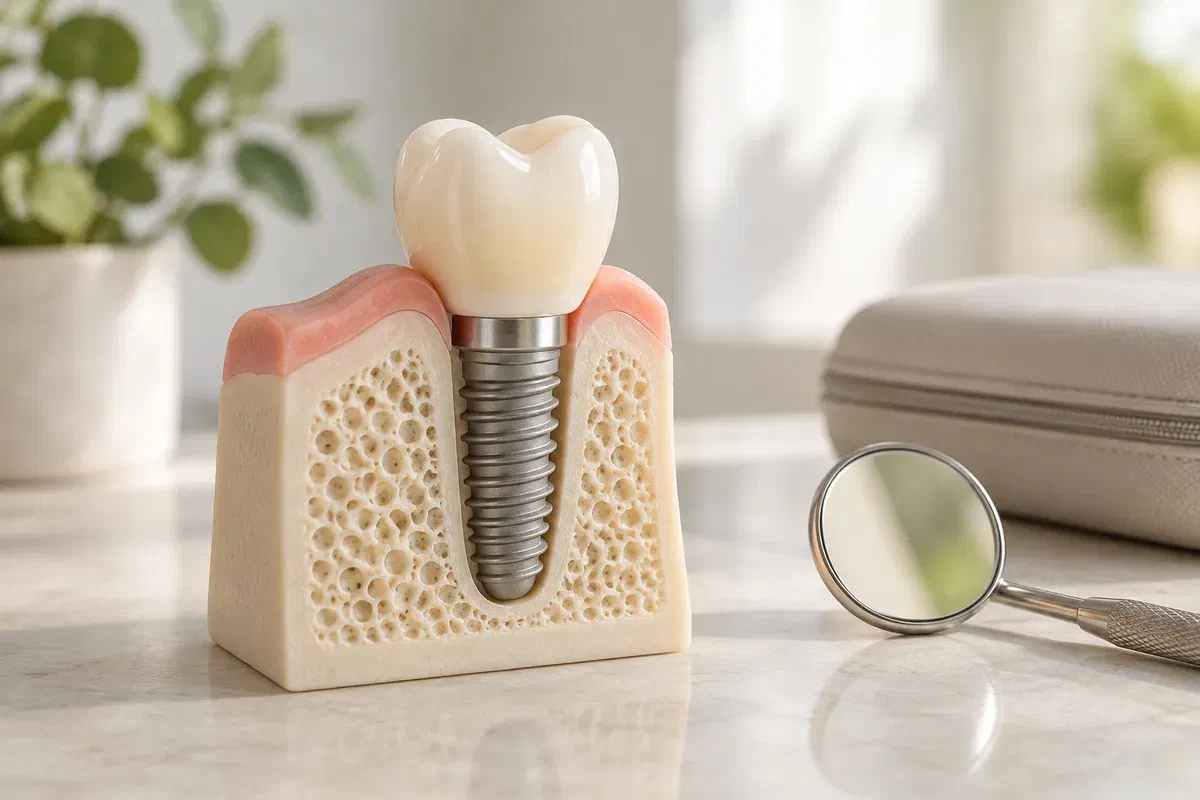
Illustrative model of a dental implant and attached crown within a bone-and-gum cross-section
Details we’ll ask about

Where, when, and how it changed

Those three details shape the conversation more than anything else. A phone photo is a helpful extra, but it cannot show us the implant or the tissue that supports it.

Rocking, lifting or rotating

Let us know whether it happened at once, after a firm bite, or gradually. For a removable denture, mention whether it still seats at all. Avoid working it back and forth. We need to pinpoint whether the restoration, an attachment, or the implant is the source.

A sore or swollen spot in the gum

Describe when the tenderness began and whether you have noticed pus, bleeding or an odd taste. Gum around implants can become inflamed, and the support underneath can be affected. We examine the tissue and take images where indicated instead of relying on the look of the crown.

A part that fell out, or an injury

Drop a loose cap, screw, attachment or crown into a clean container and bring it. Mention any fall, impact or recent treatment. Please do not force it back, tighten it with a screwdriver, or use any kind of household glue.

Implants don’t decay, but that does not make them trouble-free. The surrounding tissue can develop disease, and the parts on top can wear or come loose, even after many comfortable years.

The point of an early visit

Two timelines: making it safe, and making it right

The first visit is mainly about triage. What has to be handled today, and what still depends on information we do not have yet? It is worth asking whether the denture or crown can be made stable or comfortable before you leave, and whether the final repair needs records, a particular component, a lab, or a referral.

With the cause identified, there may be several reasonable ways forward. A careful plan looks at the implants, the restoration, the gum and your remaining teeth together. A quick adjustment with no explanation tends to leave people unsure what caused the problem or what to look out for next.

A clear map of the parts

Ask for a simple explanation of the crown or denture, the attachment or abutment, and the implant itself, plus which one is affected. With that in mind, the treatment proposal is easier to judge, and a worn clip is never confused with a lost implant.

Paperwork that helps the repair

System details, the year of placement, previous X-rays and lab information all support good treatment. Ask how records can be requested with your consent. If you have nothing on file, say so, and still phone right away about an urgent symptom.

Help connecting with other providers

Certain problems need specific parts, technical data or a specialist opinion. Ask who will organise the next step and how to manage until then. A proper handover beats being told only to call someone else.

Step by step

How we work through an implant emergency

The amount that can be done at the first appointment depends on the findings and on whether the right parts and expertise are available. Many implant problems need more than one visit.

  1. We listen to what changed

    You tell us about the symptoms, when they began, and any knock or recent treatment. Share who placed the implant if you know, and whether any piece has come out. Your medical history and medicines help us plan the visit safely.

  2. We examine the restoration and tissue

    The clinician looks at the area, checks how the restoration seats, and decides whether images or older records are needed. Ask what the findings mean and what remains unclear. The gum is examined as carefully as the crown or denture.

  3. We explain what is possible now and later

    You will hear what can reasonably be done today and where the limits are. Ask about the proposed repair, alternatives and an estimate of fees. If a part has to be identified or ordered, we will discuss how to cope in the meantime.

  4. We confirm the next appointment or referral

    Before you leave, it should be clear who looks after the next stage and how to contact them. Ask which symptoms mean you should call sooner. Hold on to copies of records so any future visit starts with the correct history.

While you wait for the repair

Keep it calm, keep it clean, and keep in touch.

A loose crown, an inflamed gum, a healing component and an implant denture all come with different instructions. Ask for advice that fits your finding rather than a general sheet.

No DIY adjustments

Tools, glue and repeated biting are not safe ways to secure an implant restoration. Wear any removable denture only as advised, and follow the guidance on chewing. If something loosens again, call and explain rather than attempting your own fix.

Store detached parts carefully

Put a loose part in a clean container and keep it out of your mouth. Bring it with any paperwork to the appointment. Noting when it came off may help explain what happened, even if the part will not be reused.

Clean as shown, and report soreness

Follow the cleaning method you were shown for the treated area, a temporary piece, or the denture. Tell us if pain makes that difficult. When the urgent concern is behind you, confirm the maintenance routine and who will review the implants going forward.

Patient information: Guy's and St Thomas' — swallowed or inhaled dental objects

Choosing the right repair

Worn hardware calls for one plan, unhealthy tissue for another.

Your clinician should explain what can be kept, what might be fixed or replaced, and what is not yet known. Understanding those trade-offs comes before agreeing to any definitive plan.

If the crown, attachment or connection has failed

New parts or a remade restoration

A worn denture attachment, loose abutment or damaged crown may be repaired, have a part swapped, or be remade. The approach depends on the design and condition. Ask whether the cause has been found and whether lab time or more visits are involved.

If inflammation or reduced support is present

Treatment for the gum and bone

Ask what the exam and X-rays show, what treatment is recommended, and how the response will be checked. It may involve more than cleaning around the visible tooth. The plan should be clear about the extent of the issue and stop short of promising every implant can be kept.

If the problem is complex or the outlook unclear

Specialist review or a new overall plan

Further assessment may come first. Ask what the referral will clarify and what to do while you wait. If removal is mentioned, replacement options and timing should be planned for your situation instead of being assumed.

Implant questions from Mississauga

When something gives way unexpectedly

A sudden change after years of good use can be stressful. These answers are here to help you prepare, not to predict what the examination will find.

(905) 876-4488
My implant denture no longer clicks into place. Is that an emergency?
It is worth calling promptly, particularly if it has become loose suddenly or is rubbing and causing soreness. Attachments can wear over time. Bring the denture to the visit, and avoid bending or adjusting any clips yourself.
Can I keep wearing my implant denture while I wait to be seen?
Ask the team when you call. If it is causing sores or will not seat properly, you may be advised to leave it out. Store it as you normally would and bring it to the appointment.
My single implant tooth has turned slightly. Has the post come loose?
Not necessarily. A crown can rotate if its screw or connection has loosened. Avoid twisting it and arrange an assessment so the source of the movement can be identified.
Is it worth bringing my old implant paperwork even if it is incomplete?
Yes. Partial records, an invoice, or a card with the system name can all help. Bring whatever you have, and do not delay a visit for an urgent change while you search for the rest.
Why would an implant site bleed when I brush?
Bleeding can be a sign of inflammation in the gum around the implant. It is worth having checked, especially if there is also swelling, tenderness or discharge. A healthy-looking crown does not rule out problems underneath.
Can an implant crown be fixed the same day it comes loose?
Sometimes, but not always. The findings, the implant system and the parts available decide what is possible. Ask what can be done straight away and what will need another visit or lab work.
Implant concerns from Mississauga

A phone call is the best first step.

Phone our Bronte Street practice if an implant tooth or denture is painful, moving, swollen or missing a piece. We can explain availability and which records are useful. If care cannot wait and we are not reachable, contact another available emergency provider.

Online requests are reviewed as non-urgent. Availability, component compatibility, referrals, fees, and whether an implant can be kept are decided at assessment.

Visit Milton Dental Clinic
Unit 1, 342 Bronte St. S, Milton, ON L9T 5B7
Get directions Clinic hours
Monday–Thursday
11am–7pm
Friday–Sunday
By appointment only

Areas we serve

  • Milton
  • Oakville
  • Mississauga
  • Georgetown
  • Halton Hills
  • Acton
  • Campbellville
  • Brampton
  • Burlington
  • Puslinch
  • Rockwood
  • Erin
  • Caledon
  • Etobicoke
  • Old Milton
  • Bronte Meadows
  • Timberlea
  • Dorset Park
  • Dempsey
  • Clarke
  • Beaty
  • Coates
  • Harrison
  • Scott
  • Willmott
  • Ford
  • Bowes
  • Cobden
  • Walker
  • Mountain View
  • Milton Heights
  • Hawthorne Village
  • Valley View
  • Fallingbrook
  • Nassagaweya
  • Trafalgar
  • Esquesing
  • Nelson
  • Brookville
  • Moffat
  • Glen Williams
  • Norval
  • Limehouse
  • Stewarttown
  • Ashgrove
  • Hornby
  • Silver Creek
  • Speyside
  • Scotch Block
  • North Oakville
  • River Oaks
  • Glen Abbey
  • West Oak Trails
  • Palermo
  • Bronte Creek
  • College Park
  • Joshua Creek
  • Uptown Core
  • Preserve
  • Iroquois Ridge
  • Lisgar
  • Meadowvale
  • Meadowvale Village
  • Churchill Meadows
  • Erin Mills
  • Central Erin Mills
  • Streetsville
  • East Credit
  • Creditview
  • Heartland
  • Sheridan
  • Mount Pleasant
  • Credit Valley
  • Huttonville
  • Churchville
  • Springbrook
  • Northwest Brampton
  • Bram West
  • Fletcher's Meadow
  • Fletcher's Creek South
  • Alton Village
  • Orchard
  • Millcroft
  • Headon Forest
  • Tansley
  • Brant Hills
  • Tyandaga
  • Kilbride
  • Lowville
  • Aberfoyle
  • Morriston
  • Arkell
  • Hillsburgh
  • Freelton
  • Carlisle
  • Waterdown
  • Flamborough
  • Mountsberg

How can we help?

Milton Dental Clinic

Have a question about your smile? Choose the option that works best for you.

For urgent dental concerns, please call.
Messages are reviewed during clinic hours.