

Illustrative patient describing a dental injury during a consultation
Specialized Care

Dental Trauma Treatment in Halton Hills

Dental trauma has two timelines: the urgent hours after the injury and the months of checks that follow. Call us from anywhere in Halton Hills, explain how and when it happened, and ask about assessment. A knocked-out adult tooth needs emergency dental care immediately.

The hours after, and the months after

Two timelines, one injury.

The first timeline is short. A tooth may have chipped, moved, cracked at the root or come out entirely, and the soft tissue around it may be cut or bruised. What happens in those first hours can affect the options available. The second timeline is longer, because an injured tooth’s response can take weeks or months to become clear.

Start with a phone call. Explain what happened, when, and whether the tooth is a baby or permanent one if you know. Tell us about any other injuries. A serious blow to the head, face or jaw can need hospital assessment before dental treatment is considered.

From Georgetown, Acton, Glen Williams or the surrounding hamlets, the call settles what to do next and when we can see you. Please don’t use an online form for a fresh injury. If we’re unreachable or can’t offer care quickly enough, seek another emergency dental provider, above all for a knocked-out permanent tooth.

Phone about a recent injury
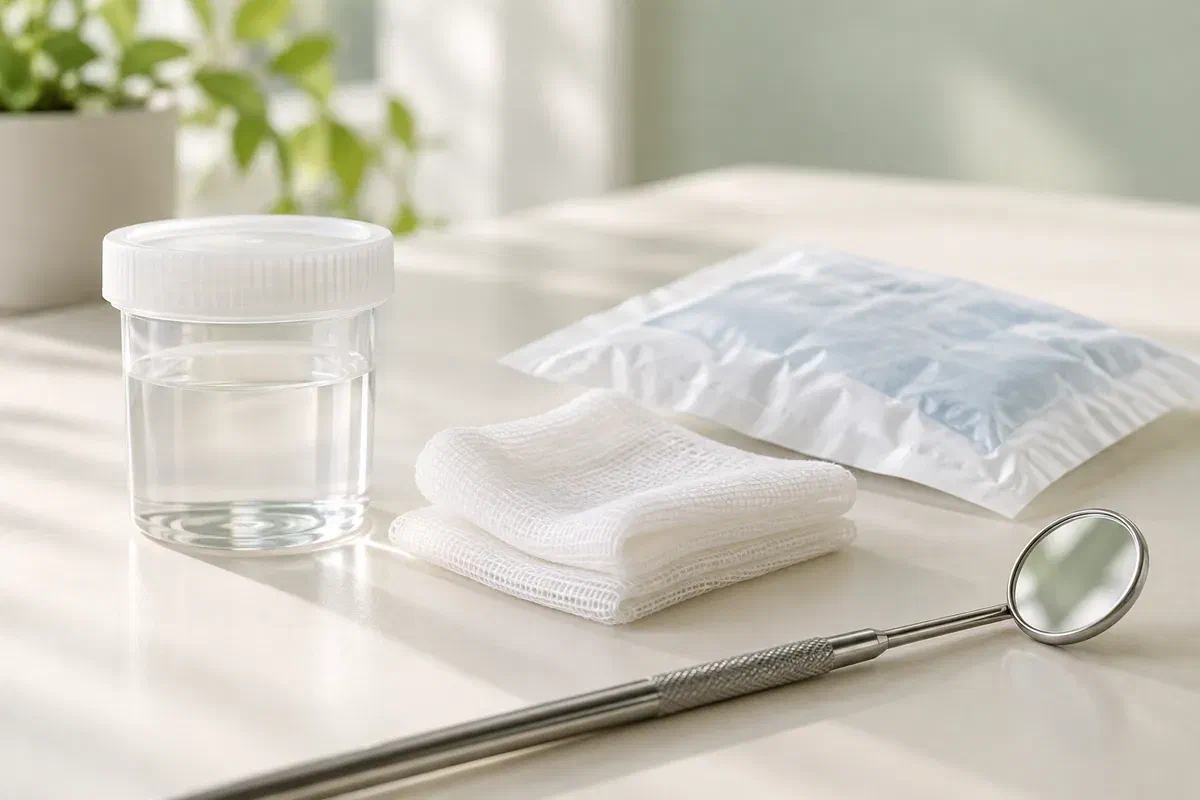
Illustrative dental first-aid supplies with a closed container, gauze, and cold compress
Timeline one: the first hour

Safety, then the tooth, then the phone.

Check the person for other injuries, then write down roughly when it happened and what you did. A missing tooth or fragment is worth mentioning; it may not be on the ground.

An adult tooth lying outside the mouth

Get emergency dental care now. Grip it by the crown, never the root. If it’s dirty, give it a short rinse in milk or saline and don’t scrub. If you’re confident it’s permanent and it’s safe, return it gently to the socket and bite on clean gauze. If not, keep it covered in milk and travel straight in.

A child’s tooth that might be a baby tooth

Never replant a baby tooth. If the type is unclear, place the tooth in milk and get professional advice without delay. Keep it out of the child’s mouth, where it could be swallowed or inhaled.

A tooth that has cracked, loosened or moved

Phone promptly and explain any change in its position, the way your teeth meet and how it feels. Resist checking it repeatedly, and don’t force it back. Save broken pieces in milk. Ask where the injury should be assessed and describe other symptoms.

Dial 911 or seek hospital emergency care for breathing difficulty, heavy bleeding that continues, a significant facial or jaw injury, or head-injury signs such as fainting, vomiting or double vision.

Timeline two: what the checks are for

The first visit answers what it can. Reviews answer the rest.

Your initial assessment should describe the injury as far as the findings allow and take care of anything that can’t wait. Ask which teeth and tissues are involved and what’s being done to protect them. A modest chip and a tooth that has shifted or been replanted lead to different plans.

Because some effects of trauma show up later, the first visit is a starting point. A tooth that’s comfortable the next week may still be healing, or may develop a problem the dentist needs to catch. Ask why each review is set when it is, and who to call if anything changes in between.

Patient information: American Association of Endodontists — updated trauma guidance and ongoing monitoring

A starting record to compare against

Timing, cause, position of the tooth and first aid all inform decisions, and the first findings become the baseline for later checks. Share what you know without guessing. If someone else examined the injury first, bring their notes.

A plan suited to the tooth’s development

Baby teeth, children’s permanent teeth with roots still growing, and fully formed adult teeth may each be handled in their own way. Ask how that affects your plan. Two injuries that look alike won’t always get the same treatment.

Reviews with a reason attached

Find out what every appointment will check and whether the plan may change. Reviews track healing and can detect complications not visible at the start. They’re worth discussing well before attention moves to how a repair looks.

The first appointment

Where the long timeline begins.

Depending on the injury, this visit can include assessment, stabilization, treatment or referral. Ask what has to happen today and which decisions can wait for more information.

  1. Recount the injury and earlier care

    Tell the dentist when it happened, how, and what first aid or treatment followed. List missing teeth or fragments, health conditions, medications and allergies. If you’ve had a medical assessment for other injuries, share the findings.

  2. Examine and record a baseline

    The dentist examines the injured area and considers the images and tests that are indicated. These findings help later reviews show change. Ask which teeth will be followed, including nearby ones that look unharmed, and why any referral is advised.

  3. Decide on first treatment and its limits

    Talk about the proposed care, comfort measures, alternatives and costs. Depending on findings, this may involve protecting a fracture, repositioning or stabilizing a tooth, or planning further care. Ask whether the result is provisional.

  4. Book the review schedule before you leave

    Confirm home-care, eating, activity and follow-up instructions. Ask how to contact the team if something needs attention. Put the review dates in your calendar right away, especially when care involves more than one provider.

Weeks one to many

The tooth may feel better long before it’s finished healing.

Your routine depends on the injury, the type of tooth and the treatment. A splinted tooth won’t follow the same plan as a bonded chip or an injured baby tooth, and their review schedules can differ too.

Follow the specific home-care plan

Ask how to clean near the injury or splint and what foods or activities to avoid. Don’t test recovery by biting something firm or moving the tooth. Phone if the advice is hard to follow or something feels loose.

Report changes between reviews

Increasing pain, swelling, drainage, a different bite or a new worry should prompt a call, rather than waiting for the next appointment. Give the injury date and treatment. The team can advise whether the review should move earlier.

Keep records and attend every check

Save the first treatment summary and bring it if another clinician is involved later. Ask about forms for school, sport, work or insurance. Paperwork supports continuity; the reviews stay focused on how the tooth is healing.

Treatment over time

Some decisions are made on day one. Others wait for healing.

Ask what the recommended step protects or restores, and when it might be revisited. The plan should match the injury and the tooth, and say plainly what can’t be predicted.

When a fracture can be restored

Repairing the broken part

A fracture may be sealed or rebuilt, depending on depth and the amount of tooth left. Ask if a saved fragment is helpful and whether the repair is interim or final. Looks matter, but the nerve, root and supporting bone matter as well.

When the tooth or its support is injured

Holding a moved tooth in place while it heals

Some injuries call for professional repositioning or a splint, followed by planned reviews. Ask what the splint is meant to achieve and roughly how long it will stay. Don’t adjust or remove it at home; call if it’s uncomfortable.

When healing points to another stage

Later treatment, referral or replacement

Reviews sometimes show that more care is needed, such as treatment inside the tooth. Some teeth can’t be kept. Ask what findings support the next step and how alternatives suit your age, dental development and long-term needs.

Halton Hills questions about the months after

Why the follow-up matters, and what to expect from it.

Phone us about a new injury and use emergency services if they’re needed. These answers help with planning but don’t replace an examination.

(905) 876-4488
How long are injured teeth usually monitored?
It varies with the injury and the tooth. Some need only a few checks, while others are followed for longer, particularly in children whose teeth are still developing. Ask the dentist to outline the schedule for your injury, what each visit is meant to show, and what would make the plan change.
What might a review find that wasn’t obvious at first?
Reviews look for signs of how the nerve, root and surrounding bone are healing. Some changes take time to appear. The dentist will explain what was checked and whether the plan needs to change.
Will I need X-rays at every review?
Not necessarily. The dentist decides which images are indicated at each stage, based on the injury and what is being monitored. Ask what an image is meant to show before it’s taken.
If a permanent tooth was out for some time before we found it, is it still worth acting?
Yes. Seek immediate dental assessment and bring the tooth, kept moist. Say roughly how many minutes or hours it spent out of the mouth and what it was kept in, whether milk, saline, a damp cloth or nothing at all. Don’t discard it or decide on your own that it’s too late.
The injured tooth stopped hurting after two days. Can we skip a review?
Please don’t. Being pain-free doesn’t show how the tooth and supporting tissues are healing. Mention the improvement at the visit, but keep the review in place.
Can follow-up appointments from Halton Hills be booked around school or work?
Ask when the schedule is set. The team can try to fit reviews around your commitments, within the timing the injury calls for. Mondays to Thursdays run 11am to 7pm, with Fridays to Sundays by appointment.
Dental injuries, Halton Hills

Make the call today. Keep the checks for months.

Ring our Bronte Street practice about a recent tooth injury and ask what assessment is available. Let us know when it happened and what’s changed. If you need care straight away and can’t reach us, contact another emergency dental provider.

Online forms are for non-urgent enquiries. How an injury is managed, referral, follow-up, fees and the chance of retaining a tooth depend on assessment; no outcome or immediate appointment is guaranteed.

Visit Milton Dental Clinic
Unit 1, 342 Bronte St. S, Milton, ON L9T 5B7
Get directions Clinic hours
Monday–Thursday
11am–7pm
Friday–Sunday
By appointment only

Areas we serve

  • Milton
  • Oakville
  • Mississauga
  • Georgetown
  • Halton Hills
  • Acton
  • Campbellville
  • Brampton
  • Burlington
  • Puslinch
  • Rockwood
  • Erin
  • Caledon
  • Etobicoke
  • Old Milton
  • Bronte Meadows
  • Timberlea
  • Dorset Park
  • Dempsey
  • Clarke
  • Beaty
  • Coates
  • Harrison
  • Scott
  • Willmott
  • Ford
  • Bowes
  • Cobden
  • Walker
  • Mountain View
  • Milton Heights
  • Hawthorne Village
  • Valley View
  • Fallingbrook
  • Nassagaweya
  • Trafalgar
  • Esquesing
  • Nelson
  • Brookville
  • Moffat
  • Glen Williams
  • Norval
  • Limehouse
  • Stewarttown
  • Ashgrove
  • Hornby
  • Silver Creek
  • Speyside
  • Scotch Block
  • North Oakville
  • River Oaks
  • Glen Abbey
  • West Oak Trails
  • Palermo
  • Bronte Creek
  • College Park
  • Joshua Creek
  • Uptown Core
  • Preserve
  • Iroquois Ridge
  • Lisgar
  • Meadowvale
  • Meadowvale Village
  • Churchill Meadows
  • Erin Mills
  • Central Erin Mills
  • Streetsville
  • East Credit
  • Creditview
  • Heartland
  • Sheridan
  • Mount Pleasant
  • Credit Valley
  • Huttonville
  • Churchville
  • Springbrook
  • Northwest Brampton
  • Bram West
  • Fletcher's Meadow
  • Fletcher's Creek South
  • Alton Village
  • Orchard
  • Millcroft
  • Headon Forest
  • Tansley
  • Brant Hills
  • Tyandaga
  • Kilbride
  • Lowville
  • Aberfoyle
  • Morriston
  • Arkell
  • Hillsburgh
  • Freelton
  • Carlisle
  • Waterdown
  • Flamborough
  • Mountsberg

How can we help?

Milton Dental Clinic

Have a question about your smile? Choose the option that works best for you.

For urgent dental concerns, please call.
Messages are reviewed during clinic hours.