

Illustrative patient and clinician discussing a tooth model before endodontic care
Specialized Care

Emergency Root Canal Treatment in Georgetown

Stopping the pain is the urgent part; rebuilding the tooth is what lets you use it again. If you're coming from Georgetown, we can diagnose the painful tooth, explain whether root canal care suits it, and plan the crown or other restoration from the very first visit.

Thinking past the emergency

Relief today, a restored tooth later

In the middle of a toothache, the only goal is making it stop. Yet the question that shapes the outcome comes a little later: can this tooth be rebuilt so you can chew on it for years? Emergency root canal care is considered when the examination finds the pulp, the soft inner tissue, is affected and there's enough sound tooth to make restoring it realistic.

Answering that takes a careful look, the tests and images that fit your symptoms, and an honest read of the remaining structure. When treatment goes ahead, the problem tissue is managed and the canals are prepared, filled and sealed. Urgent visits sometimes cover only the first part. After the canals, the tooth typically needs a crown or another restoration to protect it.

When you call from Georgetown, describe the pain and tell us what's already on the tooth: a large filling, a crown, a past injury or root canal work. We'll talk about a sensible next step and whether care here or a referral would serve you better. Each tooth's plan depends on what it has left to work with.

Book a painful-tooth assessment
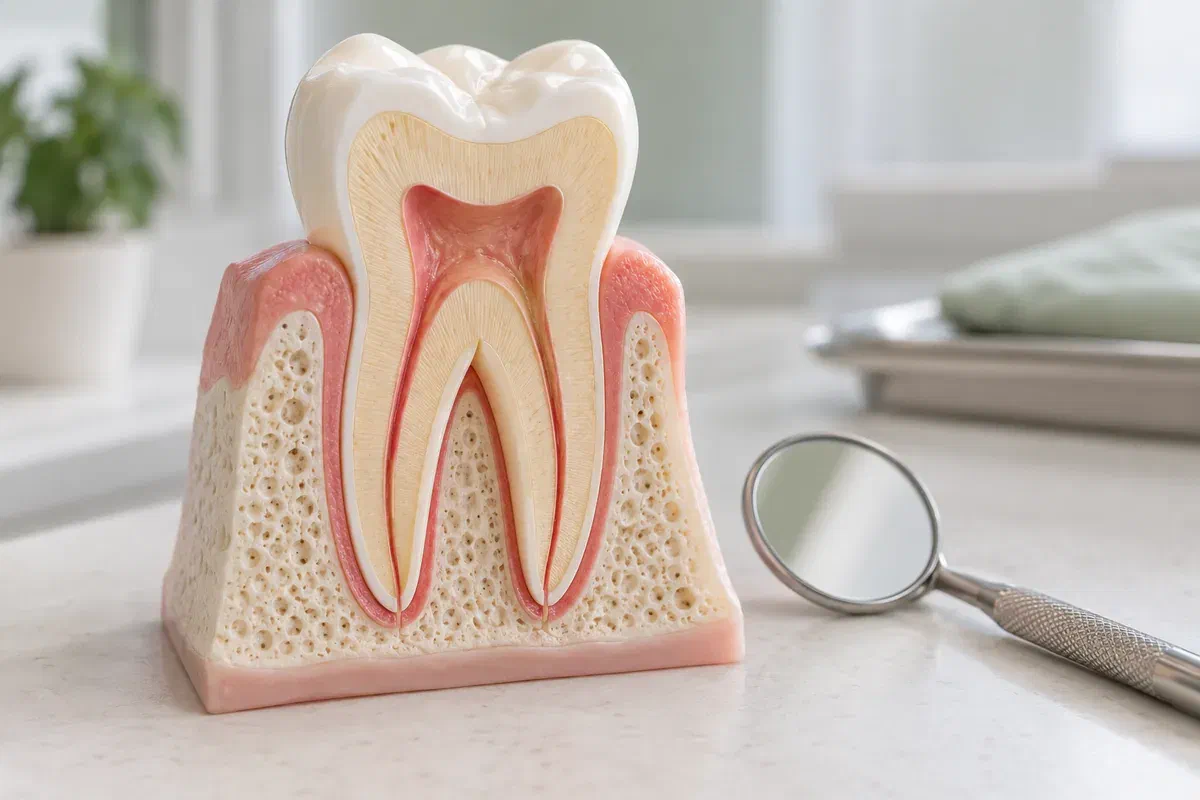
Illustrative physical molar cross-section showing the pulp chamber and root canals
What helps the dentist plan

Symptoms tell part of the story; the tooth's history tells the rest.

Avoid repeatedly checking the tooth by biting or tapping. A simple account of what you've noticed is enough. It works together with the examination findings and doesn't have to explain the problem on its own.

Pain that stays or shows up uninvited

Say whether the ache drags on after something hot or cold, appears without a trigger, or wakes you. Note when that started and whether medicine has eased it. Such details help the clinician pick appropriate tests and decide how soon to see you.

Sensitivity to biting or visible swelling

Tell us if the tooth feels high or bruised when you close, or if your gum or face has swollen or a spot is draining. Fever or feeling unwell matters as well. The tooth and the tissue around it are examined together.

How much of the tooth is original

Large fillings, crowns and old breaks all affect how a tooth can be restored after root canal care. Mention them, along with any painless chip. If root canal treatment began or was completed at another office, bring the details.

Call without delay about a painful or swollen tooth. Seek hospital emergency care at once for difficulty breathing or swallowing, swelling that is spreading substantially, or swelling involving the eye; call 911 if you need emergency help.

Planning for a tooth you can use

A good plan ends with a protected, working tooth.

Root canal treatment can only keep a tooth useful if what remains can be rebuilt well. Ask the dentist how the findings support treatment, and whether cracks, thin walls or the health of the gum and bone around the root affect the long-term outlook. A recommendation that accounts for the whole tooth is the one to trust.

Ask, too, how the steps connect. What is done urgently, who completes the canals, who places the crown or filling, and how soon should each happen? Is the restoration in the estimate? Relief after the first visit is welcome, but a tooth left without its final restoration remains vulnerable.

Patient information: American Association of Endodontists — management of endodontic emergencies

An honest assessment of restorability

Ask what makes the tooth a sound candidate and what might shorten its life. The dentist may need more information before committing to a recommendation and can explain why. Saving the tooth is assessed, never assured.

Comfort settled at the start

Mention difficulty getting numb in the past, any nervousness or relevant medical history. Ask what will be done to keep you comfortable and how to stop if needed. Speaking up during care is always welcome.

A precise outline of the urgent visit

Urgent treatment may address some of the pulp space or all of it, depending on the diagnosis and circumstances. Ask what this appointment covers and what follows. A first stage should come with a set plan to finish or review.

Georgetown · from diagnosis to crown

How a painful tooth becomes a finished one

The number and length of appointments vary with the tooth, the findings and whether a specialist joins in. Ask to see the whole sequence, including the restoration, at the start.

  1. Diagnose and judge restorability

    The dentist reviews your symptoms, examines the tooth and uses suitable tests and images. Ask whether the cause is clear and whether enough tooth remains for a lasting restoration. Raise doubts before deciding to keep it.

  2. Agree on treatment and comfort

    The procedure, alternatives, limitations and estimate are discussed. Freezing is used as appropriate, and a dental dam isolates the tooth during endodontic work. Share any concerns so you know what to expect.

  3. Treat the canals

    The clinician opens the tooth and treats the pulp space that needs care. The canals may be completed today or at another visit. Ask what was done and what is protecting the tooth in the meantime.

  4. Restore and protect

    Confirm who will finish any remaining canal work and who will place the crown or other restoration, and how soon. Ask how to look after the tooth until then. If an endodontist is involved, clarify records and visit order.

Protecting the tooth until it's rebuilt

An unrestored tooth needs extra care.

Instructions depend on the stage you received. Ask what you may feel over the next few days and what should prompt a call before your next appointment.

Spare it from heavy chewing

Eat only when the freezing has worn off, and keep hard biting away from the tooth until it's restored. Ask how to clean around it. A root-treated tooth without its final restoration can be more prone to breaking, so go easy.

Report a lost seal or new symptoms

Contact the treating clinician if the temporary filling comes out, your bite feels uneven, swelling appears, or strong pain lingers or returns. Say which stage was done and when. A review may be needed ahead of your booked visit.

Book the restoration promptly

Confirm the recommended timing and arrange the visits to complete the canals and restore the tooth. Ask whether the restoration is part of the estimate. The two stages work as a unit, so neither should be postponed indefinitely.

Patient information: American Association of Endodontists — care after treatment and reasons to call · American Dental Association — antibiotic decisions for pulpal and periapical pain

Choosing the path for the tooth

Keep and rebuild, seek a specialist view, or remove

Ask what each option would mean for the tooth, the visits and the final result. Urgent pain should lead to a clear explanation, not a choice made in a hurry.

Where the tooth can be rebuilt

Endodontic treatment followed by restoration

The plan may include an urgent stage, completing the canals, and then a crown, onlay or filling chosen for the remaining structure. Ask why that order and type of restoration are suggested and what might affect the result.

Where the case is less straightforward

Specialist assessment or another tooth-saving approach

Previous treatment, a complex diagnosis or unusual anatomy may justify referral. Ask what the specialist will assess and how to manage the tooth in the meantime. A referral should clarify options, not predetermine the outcome.

If rebuilding isn't realistic

Extraction with a separate replacement discussion

If there isn't enough tooth to rebuild or keeping it would be unwise, removal may be suggested. You can ask why, and what the alternatives are. Replacement options can then be weighed in their own time, with healing and your preferences in mind.

Georgetown questions

Crowns, fillings and finishing the tooth

Ask why a treatment is recommended and what each stage includes. The visit should establish the diagnosis and show the route from urgent relief to a fully restored tooth.

(905) 876-4488
Does every root canal tooth need a crown afterward?
Not every one. Back teeth often need a crown for strength, while some front teeth with plenty of structure may be restored with a filling. The dentist recommends based on your tooth.
How soon after the root canal should the crown be placed?
The timing depends on the tooth and the plan. Ask for a recommended window, and avoid leaving a tooth with only a temporary filling for longer than advised.
Can my existing crown be reused after treatment?
Sometimes the canals are reached through the crown and the opening is sealed. Other times the crown needs replacing. Ask what is likely for your tooth.
Why does a root-treated tooth sometimes darken?
A tooth can change colour after pulp problems or treatment. If appearance matters, ask about options such as a crown or whitening the tooth from inside when it’s suitable.
Will the first appointment include the final restoration?
Usually not. The urgent stage often ends with a temporary seal, and the permanent restoration follows once the canals are complete. Ask what was done today.
If the pain is gone, can I delay the crown for a while?
It’s best not to postpone beyond the advised timing. Without a proper restoration, the tooth can crack or leak. Ask what’s at stake for your tooth before deciding.
Emergency root canal care for Georgetown

Start with the pain, finish with a restored tooth.

Call our Bronte Street practice about the painful tooth and current assessment availability. We'll review your symptoms, explain the options and discuss whether treatment here or a referral is best. Should you need immediate care when we can't be reached, please turn to another available emergency provider.

Online requests are handled as non-urgent. Diagnosis, suitability, the treatment stages, the restoration, referral, fees and availability all depend on assessment. Retaining the tooth, or finishing in one visit, can't be guaranteed.

Visit Milton Dental Clinic
Unit 1, 342 Bronte St. S, Milton, ON L9T 5B7
Get directions Clinic hours
Monday–Thursday
11am–7pm
Friday–Sunday
By appointment only

Areas we serve

  • Milton
  • Oakville
  • Mississauga
  • Georgetown
  • Halton Hills
  • Acton
  • Campbellville
  • Brampton
  • Burlington
  • Puslinch
  • Rockwood
  • Erin
  • Caledon
  • Etobicoke
  • Old Milton
  • Bronte Meadows
  • Timberlea
  • Dorset Park
  • Dempsey
  • Clarke
  • Beaty
  • Coates
  • Harrison
  • Scott
  • Willmott
  • Ford
  • Bowes
  • Cobden
  • Walker
  • Mountain View
  • Milton Heights
  • Hawthorne Village
  • Valley View
  • Fallingbrook
  • Nassagaweya
  • Trafalgar
  • Esquesing
  • Nelson
  • Brookville
  • Moffat
  • Glen Williams
  • Norval
  • Limehouse
  • Stewarttown
  • Ashgrove
  • Hornby
  • Silver Creek
  • Speyside
  • Scotch Block
  • North Oakville
  • River Oaks
  • Glen Abbey
  • West Oak Trails
  • Palermo
  • Bronte Creek
  • College Park
  • Joshua Creek
  • Uptown Core
  • Preserve
  • Iroquois Ridge
  • Lisgar
  • Meadowvale
  • Meadowvale Village
  • Churchill Meadows
  • Erin Mills
  • Central Erin Mills
  • Streetsville
  • East Credit
  • Creditview
  • Heartland
  • Sheridan
  • Mount Pleasant
  • Credit Valley
  • Huttonville
  • Churchville
  • Springbrook
  • Northwest Brampton
  • Bram West
  • Fletcher's Meadow
  • Fletcher's Creek South
  • Alton Village
  • Orchard
  • Millcroft
  • Headon Forest
  • Tansley
  • Brant Hills
  • Tyandaga
  • Kilbride
  • Lowville
  • Aberfoyle
  • Morriston
  • Arkell
  • Hillsburgh
  • Freelton
  • Carlisle
  • Waterdown
  • Flamborough
  • Mountsberg

How can we help?

Milton Dental Clinic

Have a question about your smile? Choose the option that works best for you.

For urgent dental concerns, please call.
Messages are reviewed during clinic hours.