

Illustrative patient and clinician discussing a tooth model before endodontic care
Specialized Care

Emergency Root Canal Treatment in Oakville

Is it the nerve, the gum or a crack? For anyone coming from Oakville with a tooth that suddenly hurts, the first job is finding the real source. From there we can discuss whether root canal care can save the tooth and which stages would complete it.

Sorting out the source

Nerve, gum or crack?

Sharp tooth pain sends most people straight to one conclusion: it must be the nerve. Sometimes it is. Other times the trouble is a split cusp, an inflamed gum pocket or even a sinus pressing on upper roots. A root canal is only on the table once the dentist finds a problem in the pulp, the tissue inside the tooth, and judges the tooth worth keeping.

To get there, expect a careful examination, the tests that suit your symptoms, and usually an image of the roots. The dentist also weighs whether the tooth could support a solid restoration later. If root canal care goes ahead, the affected tissue is treated and the canals are cleaned, shaped, filled and sealed, sometimes over more than one visit, with a crown or other restoration to finish.

Calling ahead from Oakville lets us hear the story first. Mention previous fillings, crowns, injuries or root canal work on that tooth. We can then suggest a next step and say whether treatment with us or a referral seems more fitting, rather than treating every painful tooth the same way.

Request a tooth pain assessment
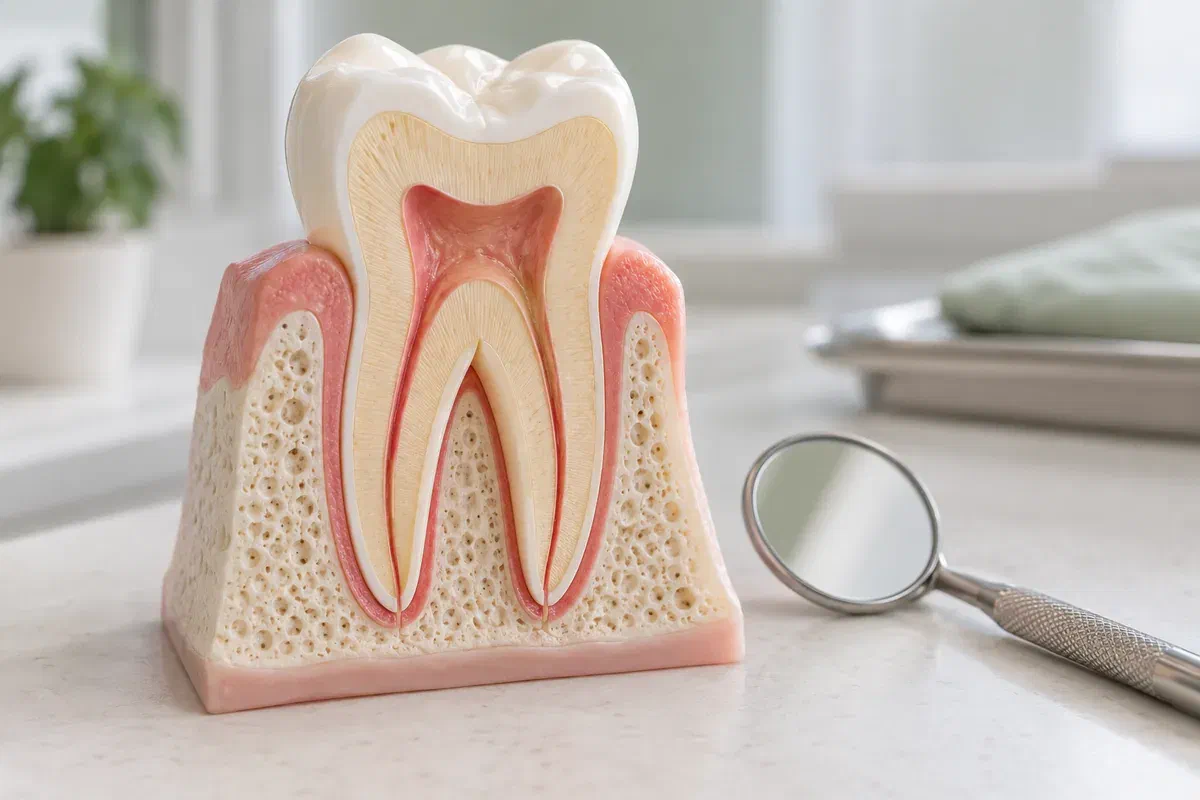
Illustrative physical molar cross-section showing the pulp chamber and root canals
Signs that point the examination

Three patterns worth describing in detail

Resist the urge to keep pressing or tapping the sore area. Tell us what you've noticed, and the dentist will combine your description with the examination rather than expecting it to answer everything.

Pain that outlasts the trigger, or needs none

A sting from ice water that fades quickly is different from an ache that keeps going for minutes, or one that starts while you sit still. Say which you have, when it changed and whether medicine helps. These clues help determine which tests are useful and how soon you should come in.

Sore to bite, swollen or a bump near the root

Tell the team if biting down hurts, if your face or gum looks puffy, or if there is a small spot that drains. Fever or feeling generally unwell should be mentioned too. The dentist examines both the tooth and its surroundings instead of leaning on one symptom.

A tooth with a past

Fillings, crowns and old injuries all change the picture, even a chip that never hurt. If someone else started or finished a root canal on the tooth, bring the details. Teeth that were treated before often need a different kind of assessment.

Call promptly about pain or swelling in a tooth. If you have trouble breathing or swallowing, swelling that is spreading fast, or swelling near the eye, go to a hospital emergency department immediately; call 911 if you need emergency assistance.

What you should walk away knowing

A diagnosis you understand and a plan with an end point

Ask the dentist to connect the findings to the recommendation. Why the pulp, and not the gum or a fracture? How much tooth is left, and is the support around it healthy? Each answer affects whether root canal care is likely to keep the tooth serving you, and the advice should reflect the whole tooth.

Then pin down the stages. Which part happens at the urgent visit, who will finish the canals, who will restore the tooth, and roughly when? What does the estimate cover? Feeling relief after the first appointment is good news, as long as it doesn't hide the fact that more work is planned.

Patient information: American Association of Endodontists — management of endodontic emergencies

Reasons, not assumptions, for keeping the tooth

A tooth may look savable yet carry a hidden crack or weak walls. Ask what supports treatment and what might limit it, and whether more assessment would help before a firm recommendation. Retaining a tooth is weighed case by case, never guaranteed.

Comfort settled before the first instrument

If numbing has been tricky for you, if you feel anxious, or if a health condition matters, mention it at the outset. Ask how local anaesthetic and other suitable measures will be used, and how to pause. You can speak up at any point.

Honesty about what today covers

Depending on the diagnosis and circumstances, urgent treatment may address part or all of the pulp space. Ask what is planned and what remains. A first stage should always tie into a set arrangement to complete or review the work.

Step by step

Confirm the cause, agree the plan, treat, then restore.

Some teeth need one longer appointment, others several, and a specialist may be involved. Ask for the full sequence so you aren't surprised that an urgent visit was only the beginning.

  1. Find the cause

    Your history is reviewed and the tooth is examined with appropriate tests and images. Ask whether the source of pain is confirmed and whether the tooth can take a final restoration. Uncertainty is discussed before choosing between keeping it and other paths.

  2. Agree and prepare

    The procedure, alternatives, limits and estimate are explained. Local anaesthetic and a dental dam are used as appropriate in endodontic care, the dam keeping the tooth isolated and dry. Voice concerns now so you know how the setup works and how to communicate.

  3. Treat the pulp space

    The clinician opens the tooth and treats the canals that need attention. Further cleaning, shaping and filling may be done in the same sitting or at a return visit. Ask what was completed and whether a temporary seal is in place.

  4. Close the loop

    Confirm who will complete remaining canal work and the restoration, and when. Ask how to look after the tooth until then. If an endodontist is part of your care, clarify how records are shared and the order of visits.

Until the tooth is fully restored

A temporary seal needs a little protection.

Your instructions depend on which stage was completed. Ask what you might feel over the following days and which changes warrant a call rather than waiting for your next visit.

Protect the unfinished tooth

Hold off eating while you're still numb, and keep hard biting away from the treated tooth. Ask how to clean around it. Feeling fine is not a reason to try popcorn kernels, ice or chewy candy on a temporary filling.

Speak up about changes

Contact the treating clinician if the temporary filling dislodges, your bite feels uneven, swelling appears, or significant pain continues or returns. Say what stage was done and when. Reviews are sometimes needed before the next booked appointment.

Follow through on completion

Confirm when the next visits should be and book them. Ask whether the final restoration is in the estimate or separate. The sealed canals and the restoration above them depend on each other, so make sure both are clearly scheduled.

Patient information: American Association of Endodontists — care after treatment and reasons to call · American Dental Association — antibiotic decisions for pulpal and periapical pain

Once the diagnosis is clear

There is usually more than one way forward.

For each option, ask how it affects the tooth, the visits and the final restoration. Urgent pain deserves a fast explanation, but the treatment choice should still be made with you.

Suitable when the tooth can be kept

Endodontic treatment followed by restoration

This may include an urgent stage, completion of the canals, and a crown or another appropriate restoration. Ask why that order is advised and what could affect the result. The restoration is chosen to suit the tooth's condition, not by default.

Useful when findings are complex

Specialist assessment or another way to preserve the tooth

An unclear diagnosis, earlier treatment or unusual anatomy can justify a referral. Ask what the specialist will look at and how to manage the tooth meanwhile. A referral should sharpen your options rather than decide them for you.

Considered when the tooth can't reasonably be kept

Extraction, with replacement as its own discussion

If restoring the tooth isn't feasible or keeping it would be unwise, removal may be suggested. Ask for the reasons and alternatives. Replacement, if you want it, can be planned later around healing, your other teeth, timing and preference.

Oakville questions, answered

Before you agree to a root canal, ask these.

It's reasonable to ask why a treatment is suggested and what each stage includes. The assessment should confirm the diagnosis and explain how the tooth moves from urgent care to a finished result.

(905) 876-4488
Could my tooth pain actually be coming from my sinuses?
It can, especially with upper back teeth. Sinus pressure, gum problems and cracks can all feel like a tooth problem. The dentist uses your history, an examination and appropriate tests to tell them apart before recommending treatment.
How does the dentist know whether the nerve is still alive?
Several tests can help, such as checking the response to cold or to gentle tapping, combined with images and your description. No single test decides it. Ask what the results suggested about your tooth and how certain the diagnosis is.
Is cold sensitivity alone a sign I need a root canal?
Not on its own. Brief sensitivity that fades quickly often has other causes, such as exposed root surfaces. Pain that lingers or starts without a trigger is more concerning. An assessment is the way to tell the difference.
What happens if I decide not to go ahead with the root canal?
The dentist can explain the other reasonable options, such as a specialist referral or extraction, and what each would mean for you. Ask what the risks of leaving an inflamed or infected pulp untreated would be, so that your decision is fully informed.
If the urgent visit ends the pain, can I cancel my follow-up?
Keep it unless the treating clinician changes the plan. Pain relief does not show that all the canal treatment or the final restoration is done. Ask what is still outstanding before considering the tooth finished.
Can I plan my visits from Oakville around work?
Mention your work schedule when you call. Our hours run Monday to Thursday from 11 a.m. to 7 p.m., with Friday to Sunday by appointment. Urgent symptoms still take priority, so call if things change before a planned visit.
Root canal assessment for Oakville

One call to describe the pain, and a plan to follow.

Phone our Bronte Street practice about the tooth that hurts and ask what assessment times are open. We'll listen to the details, explain suitable options and discuss whether treatment or referral makes sense. If you need care immediately and we can't be reached, seek another available emergency provider.

Online requests are non-urgent. Diagnosis, whether the tooth is suitable, treatment stages, restoration, referral, fees and availability depend on assessment. We can't guarantee the tooth will be kept or that care will be completed in a single visit.

Visit Milton Dental Clinic
Unit 1, 342 Bronte St. S, Milton, ON L9T 5B7
Get directions Clinic hours
Monday–Thursday
11am–7pm
Friday–Sunday
By appointment only

Areas we serve

  • Milton
  • Oakville
  • Mississauga
  • Georgetown
  • Halton Hills
  • Acton
  • Campbellville
  • Brampton
  • Burlington
  • Puslinch
  • Rockwood
  • Erin
  • Caledon
  • Etobicoke
  • Old Milton
  • Bronte Meadows
  • Timberlea
  • Dorset Park
  • Dempsey
  • Clarke
  • Beaty
  • Coates
  • Harrison
  • Scott
  • Willmott
  • Ford
  • Bowes
  • Cobden
  • Walker
  • Mountain View
  • Milton Heights
  • Hawthorne Village
  • Valley View
  • Fallingbrook
  • Nassagaweya
  • Trafalgar
  • Esquesing
  • Nelson
  • Brookville
  • Moffat
  • Glen Williams
  • Norval
  • Limehouse
  • Stewarttown
  • Ashgrove
  • Hornby
  • Silver Creek
  • Speyside
  • Scotch Block
  • North Oakville
  • River Oaks
  • Glen Abbey
  • West Oak Trails
  • Palermo
  • Bronte Creek
  • College Park
  • Joshua Creek
  • Uptown Core
  • Preserve
  • Iroquois Ridge
  • Lisgar
  • Meadowvale
  • Meadowvale Village
  • Churchill Meadows
  • Erin Mills
  • Central Erin Mills
  • Streetsville
  • East Credit
  • Creditview
  • Heartland
  • Sheridan
  • Mount Pleasant
  • Credit Valley
  • Huttonville
  • Churchville
  • Springbrook
  • Northwest Brampton
  • Bram West
  • Fletcher's Meadow
  • Fletcher's Creek South
  • Alton Village
  • Orchard
  • Millcroft
  • Headon Forest
  • Tansley
  • Brant Hills
  • Tyandaga
  • Kilbride
  • Lowville
  • Aberfoyle
  • Morriston
  • Arkell
  • Hillsburgh
  • Freelton
  • Carlisle
  • Waterdown
  • Flamborough
  • Mountsberg

How can we help?

Milton Dental Clinic

Have a question about your smile? Choose the option that works best for you.

For urgent dental concerns, please call.
Messages are reviewed during clinic hours.