

Illustrative adult patient discussing an oral tissue assessment with a clinician
Specialized Care

Frenectomy in Erin

The most useful frenectomy consultations start at the kitchen table, with a few notes about what is actually hard day to day. For households in Erin and Hillsburgh, we explain how to prepare, what the exam looks for, and how each option compares.

Getting ready, from Erin

A few notes at home make the exam far more useful.

Clinicians see a mouth for a short while; you see it at every meal, every bedtime, every conversation. That everyday knowledge is what turns an exam into a real assessment. The tissue in question is a frenulum, the band beneath the tongue or between a lip and the gum. Frenectomy takes it away, frenotomy releases it, and frenuloplasty reshapes it.

A frenulum only matters clinically when it is part of a problem. The exam looks at range and control of movement and whether either is connected to difficulty with eating, speech, cleaning, the gums, or the position of teeth. Its size, or someone calling it a tie, is not evidence on its own.

Erin households often plan appointments around work, school runs, and long days, so it pays to come prepared. Jot down what you have noticed, gather any reports, and list your questions. We can then spend the visit on assessment and discussion, and set up referral or shared care if another provider should be involved.

Plan a well-prepared consultation
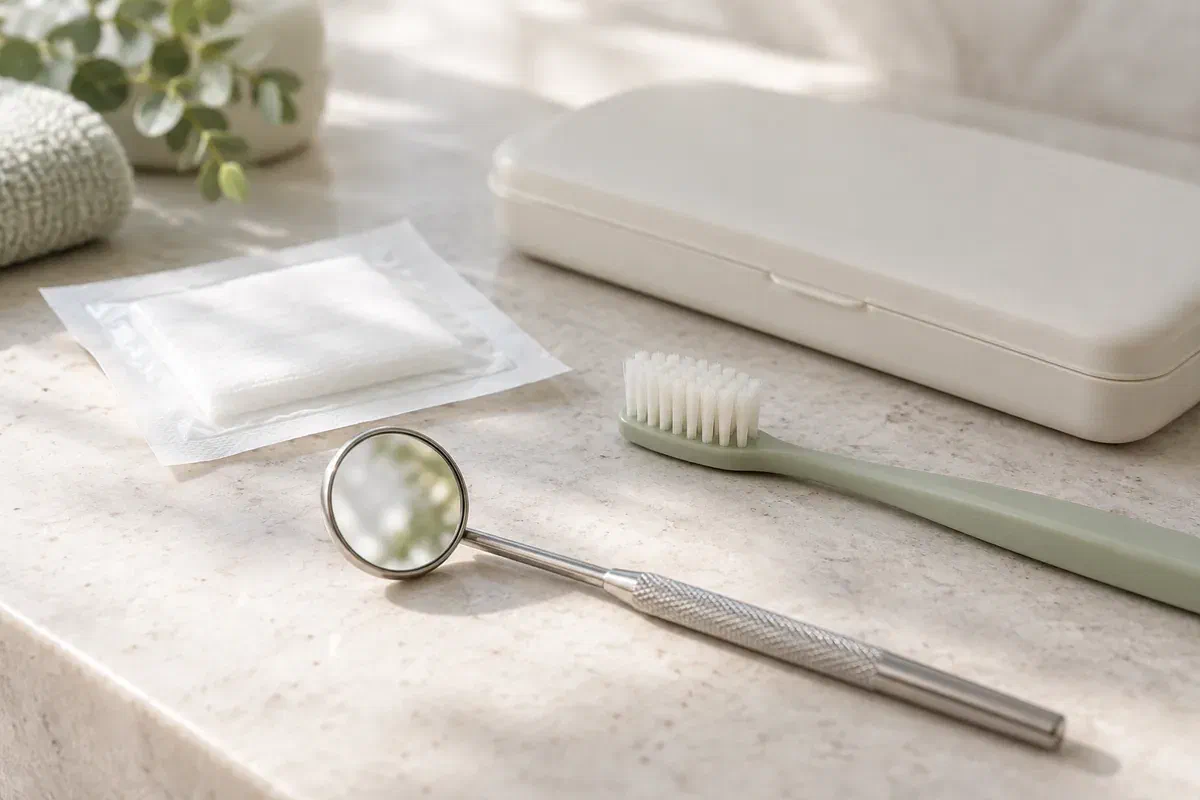
Illustrative dental mirror and gentle oral-care supplies beside a closed instrument case
Write it down first

Name the difficulty in your own words.

A short written description of the concern, plus copies of anything a physician, therapist, hygienist, or orthodontist has said, gives the assessment a clear starting point and saves repeated explanations.

Movement that seems limited

Note which movements look or feel restricted, when you first saw it, and whether it changes with tiredness or time of day. Ask how the clinician will test function. Your observations are more helpful than any comparison with pictures online.

Comments made during gum or orthodontic care

Write down exactly what was said and by whom. Ask which finding the procedure would target and how it fits with orthodontic timing. A gap between the front teeth, if that is the concern, is usually managed as part of a broader plan.

A child’s feeding or speech

List what is difficult at meals or in conversation, and bring any assessments. Feeding struggles need medical and feeding expertise, and speech is assessed by a speech-language pathologist. Seeing an attachment does not show that surgery will help.

When the concern crosses dental, feeding, speech, and orthodontic care, a shared plan helps settle whether a procedure is indicated and when. Normal frenula, which most are, need no treatment.

What you should take home

A goal you can write on one line, and its limits on the next.

If the assessment confirms a significant restriction or tissue-related problem, a procedure may form one part of the answer. Ask what should be different afterward and how anyone will check. If the expected benefit cannot be stated simply and specifically, or it drifts into promises about sleep, health, or behaviour, ask more questions.

Ask what the procedure would not touch. Therapy, feeding support, orthodontics, or gum care may still be needed. Writing those limits beside the goal gives you a fair, balanced picture to think over at home before making a decision.

The finding, in plain words

Write down the name of the tissue being discussed and the specific thing the clinician saw that makes it worth treating. You should come away understanding how it differs from the normal range of attachments. Where another assessment is advised, note what question it is meant to answer and who will arrange it.

Every option, including waiting

Observation, therapy, another professional’s view, or timing around orthodontic care may be reasonable. Ask what would happen if you postponed a decision. Timing should follow the concern and, for children, their development.

Procedure facts to think over

Note the technique, anaesthetic, whether stitches would be used, the risks, and the expected recovery. Ask who would carry it out and where. Some approaches, ages, or anaesthetic choices may require referral rather than care at our office.

On the day and after

Your notes, our exam, a shared decision.

The steps vary with the attachment, age, and concern. The assessment is a chance to understand; a procedure, if one is needed, is planned later.

  1. Go through your notes together

    We read your observations and any reports, and review medical history, medications, and allergies. Ask whether an assessment by another professional should happen first, and whether it can be arranged conveniently.

  2. Check function alongside appearance

    The clinician examines the attachment and movement, comparing what is seen with what you described. Ask whether the two match. If the indication is uncertain, you should hear why and what would clarify it.

  3. Weigh it up, then consent if you choose

    Review possible benefit, limits, alternatives, costs, and healing. If a frenectomy is appropriate, ask about its extent, whether stitches are needed, and how anaesthetic and setting are selected. Take the time you need to decide.

  4. Leave with a written plan

    Confirm aftercare instructions and a review of both healing and function. If you are travelling for several appointments, ask whether follow-up can be grouped with other family visits. Request a summary you can share with other providers, so therapists, physicians, or orthodontists stay informed.

Recovery in Erin

Keep the instruction sheet where everyone can see it.

Aftercare must fit the procedure and the person. Pin up the written instructions so every caregiver follows the same plan, and avoid routines borrowed from other ages or treatments.

Meals and cleaning

Ask how to clean the area, when brushing returns to normal, and how to look after any stitches. Follow the advice about numbness and soft foods. Phone the treating office if soreness makes the plan hard to follow.

Signs to watch, and who to call

Write down which symptoms are expected. Bleeding that continues, swelling that is getting worse, fever, or difficulty eating and drinking need a prompt call. For breathing or swallowing difficulty, seek emergency medical help right away.

Note what has changed

Keep noting the concern after healing, just as you did before. At the review, share what is different. A healed site is not proof of success, and continuing difficulty should be reassessed rather than put down to reattachment.

Patient information: American Academy of Pediatrics — infant frenotomy selection and aftercare

Comparing the paths

Three answers to one question.

Ask which option suits the concern you documented, and why. Everyone has frenula, so a recommendation to treat one should explain clearly what it will fix.

When no significant problem calls for surgery

Observe and recheck

Keep up your notes and return at an agreed time, or sooner if something changes. Ask which changes matter. Not operating is a well-reasoned plan whenever the exam does not show a problem that surgery would solve.

When feeding, speech, gums, or orthodontics need attention

Work on the function with the right help

A feeding team, speech-language pathologist, hygienist, or orthodontist may be the right lead, with dental care coming later or not at all. Ask how their role ties into the goal and how the providers will keep each other informed. Treating tissue should never replace understanding why something is hard.

When findings support intervention

A procedure with clear justification

Ask what operation is planned and what it should accomplish, then compare it with the alternatives. Risks include soreness, bleeding, infection, scarring, and the chance that symptoms remain. Ask what evidence supports the method; a device brand is not proof of anything.

Preparing for your visit

Questions about getting ready.

Bring your notes, any reports, and the questions on your mind. These answers help you prepare without assuming the attachment needs treatment.

(905) 876-4488
What should we write down at home before the appointment?
Note what is difficult, when it happens, how long it has been going on, and what you have tried. A few specific examples from meals, speech, or tooth brushing are more useful than general impressions.
Is a short video of feeding or speaking helpful to bring?
It can be. A brief clip may show something that does not happen during the appointment. Bring it along, and the clinician can decide how useful it is alongside the examination.
Should both parents or caregivers come to the consultation?
If possible, it helps. Different people often notice different things, and decisions are easier when everyone hears the same explanation. Otherwise, take notes or ask for a written summary.
Can photos of the attachment show whether treatment is needed?
Not on their own. Appearance does not reliably predict function, and two attachments that look alike in a photo can behave very differently. The assessment focuses on movement in real time and whether it relates to a specific concern. Photos can still be useful for tracking change, so feel free to bring them.
Is surgery likely to prevent problems that haven’t happened yet?
Procedures done only to prevent a possible future problem, without a current functional concern, are generally not recommended. Decisions should address a documented difficulty with realistic expectations.
What if I think of a question after the visit?
Call the office. It is common to think of something on the drive home. A written summary of the findings and options can also help you review the discussion later.

Patient information: AAPD — procedure definitions and orthodontic timing considerations · Royal Cornwall — avoiding preventive tongue-tie procedures without a current functional indication

Booking from Erin or Hillsburgh

Come prepared and leave with a plan you understand.

Phone our Bronte Street practice to book a frenectomy consultation or ask about an attachment you have noticed. Bring your notes and any reports so the visit can focus on assessment, alternatives, and any shared or specialist care.

Indication, age suitability, technique, anaesthetic, where treatment is provided, referral, fees, and expected benefit are decided individually. No improvement in feeding, speech, spacing, or function is guaranteed.

Visit Milton Dental Clinic
Unit 1, 342 Bronte St. S, Milton, ON L9T 5B7
Get directions Clinic hours
Monday–Thursday
11am–7pm
Friday–Sunday
By appointment only

Areas we serve

  • Milton
  • Oakville
  • Mississauga
  • Georgetown
  • Halton Hills
  • Acton
  • Campbellville
  • Brampton
  • Burlington
  • Puslinch
  • Rockwood
  • Erin
  • Caledon
  • Etobicoke
  • Old Milton
  • Bronte Meadows
  • Timberlea
  • Dorset Park
  • Dempsey
  • Clarke
  • Beaty
  • Coates
  • Harrison
  • Scott
  • Willmott
  • Ford
  • Bowes
  • Cobden
  • Walker
  • Mountain View
  • Milton Heights
  • Hawthorne Village
  • Valley View
  • Fallingbrook
  • Nassagaweya
  • Trafalgar
  • Esquesing
  • Nelson
  • Brookville
  • Moffat
  • Glen Williams
  • Norval
  • Limehouse
  • Stewarttown
  • Ashgrove
  • Hornby
  • Silver Creek
  • Speyside
  • Scotch Block
  • North Oakville
  • River Oaks
  • Glen Abbey
  • West Oak Trails
  • Palermo
  • Bronte Creek
  • College Park
  • Joshua Creek
  • Uptown Core
  • Preserve
  • Iroquois Ridge
  • Lisgar
  • Meadowvale
  • Meadowvale Village
  • Churchill Meadows
  • Erin Mills
  • Central Erin Mills
  • Streetsville
  • East Credit
  • Creditview
  • Heartland
  • Sheridan
  • Mount Pleasant
  • Credit Valley
  • Huttonville
  • Churchville
  • Springbrook
  • Northwest Brampton
  • Bram West
  • Fletcher's Meadow
  • Fletcher's Creek South
  • Alton Village
  • Orchard
  • Millcroft
  • Headon Forest
  • Tansley
  • Brant Hills
  • Tyandaga
  • Kilbride
  • Lowville
  • Aberfoyle
  • Morriston
  • Arkell
  • Hillsburgh
  • Freelton
  • Carlisle
  • Waterdown
  • Flamborough
  • Mountsberg

How can we help?

Milton Dental Clinic

Have a question about your smile? Choose the option that works best for you.

For urgent dental concerns, please call.
Messages are reviewed during clinic hours.