

Illustrative adult describing a dental concern to a clinician in a consultation room
Specialized Care

Gum Abscess Treatment in Milton

Found a sore, swollen spot on your gum this morning? Phone our Milton office so we can talk through how urgent it seems, what kind of assessment fits, and what care should follow once the first problem settles.

Gum swelling, explained for Milton

A new bump on the gum is worth a phone call today.

Most people notice it while brushing or chewing: a tender, raised spot beside one tooth, perhaps with a salty or unpleasant taste. That spot is often a gum abscess, which means infection has gathered in the gum or in the tissue that holds a tooth in place. Where it sits on the gum does not, on its own, tell anyone where it started.

Two quite different problems can look alike from the outside. One begins in a pocket between the gum and the tooth; the other begins inside the tooth and drains outward. Each calls for its own treatment, so the clinician needs to look at the swelling, test the tooth and check its support. Easing the pressure brings relief, but it does not settle the cause.

Call our Milton team and describe what the swelling is doing, whether it is growing, shrinking or draining. We can talk about availability and the sensible next step. When we cannot see you soon enough and the problem needs immediate dental attention, contact another emergency dental provider instead of waiting on an online message.

Ask about a gum swelling assessment
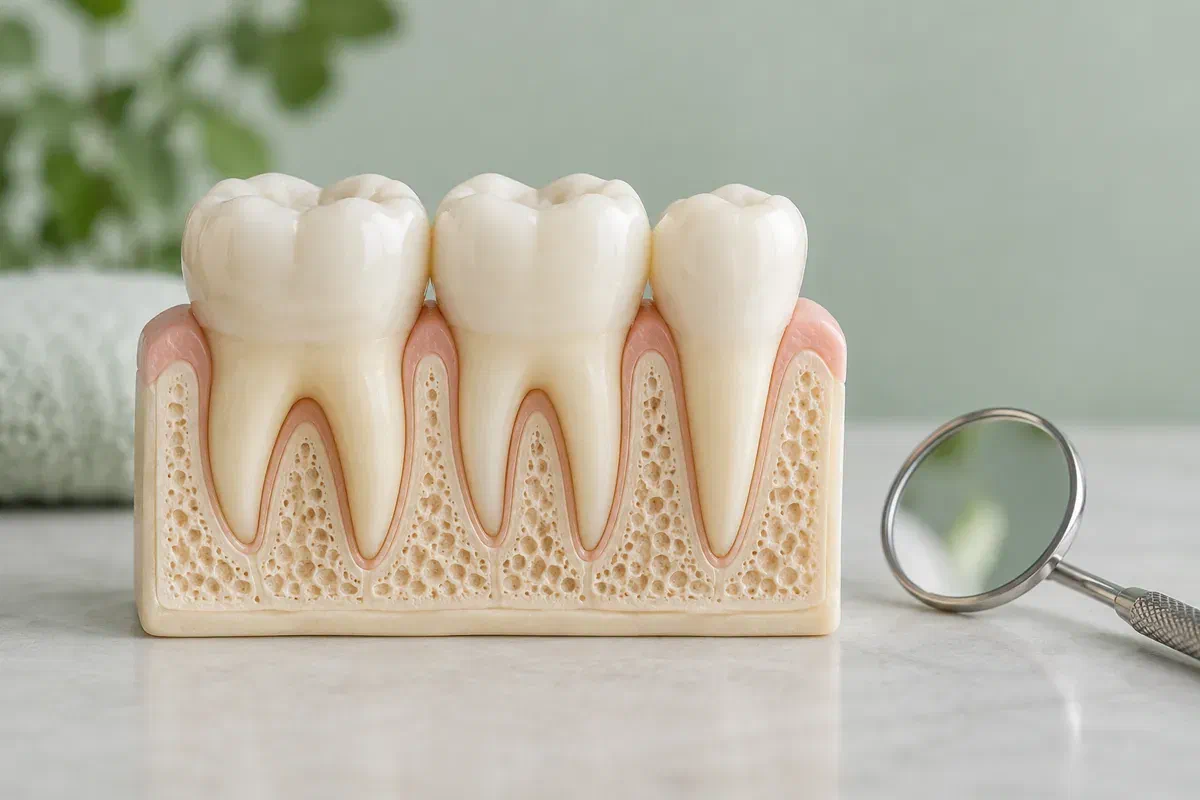
Illustrative physical model showing teeth supported by gum tissue and underlying bone
Before you call

A few details help us judge how quickly you need to be seen.

Have a rough timeline ready: when the swelling appeared, how it has changed and how you feel in general. Tell us about health conditions and medicines, particularly any that make infections harder to fight.

A sore swelling next to one tooth

Say which tooth it is near and whether it hurts to touch or to bite on. It helps to know about past gum pockets, recent dental work in that spot, or food that may have wedged under the gum. These clues shape the visit, though only an examination identifies the source.

Fluid, a bad taste or sudden relief

Let us know if the lump has leaked or gone down. When pressure drops, pain often changes even though treatment has not happened. An opened swelling is still a reason to keep your appointment. Please leave the area alone rather than pressing or poking it to drain more.

Signs the infection is reaching further

Tell us right away about swelling in your face, a fever, feeling generally ill, or trouble opening your mouth wide. Those changes can mean a different setting is needed. If things have worsened since you booked, say so clearly instead of assuming the first plan still fits.

Get emergency medical care for difficulty breathing, speaking or swallowing, swelling or pain near the eye, any change in vision, or major swelling in the mouth that makes opening hard. For an immediate emergency, call 911 rather than filling in a callback form.

What the first visit is for

Relief now, then a plan for what caused it.

An urgent appointment usually centres on how serious the infection is and on local treatment that suits it. Ask the clinician to separate what happens today from what will still be outstanding. Feeling better after that visit is welcome, but it is not proof that every part of the care is finished.

Much depends on the health of the tooth and the tissue around it. Ask whether the findings suggest the tooth can be kept, and whether you need further gum treatment or a root canal assessment. A single swelling, however alarming it looks, does not settle the future of that tooth by itself.

Patient information: SDCEP — local treatment and appropriate antibiotic use for dental abscesses · SDCEP — periodontal abscess management and review

Care aimed at the actual cause

For an infection in the gum, local care may mean draining and cleaning the area. An infection from inside the tooth usually needs another approach. Ask which source was found and what today’s treatment is meant to achieve, since two swellings that look the same can need different procedures.

A reasoned view on antibiotics

A prescription cannot replace treatment of the local source. Your clinician weighs whether infection is spreading, whether you are unwell overall, whether drainage is possible and what your medical history involves. Ask for the reasoning behind a prescription, or behind not giving one, instead of expecting the same medicine every time.

A clear review rather than a cycle of quick fixes

Find out when the area will be checked again and what may come next once the acute stage is under control. If a deep pocket or a damaged tooth is still there, the plan should say how it will be handled. A swelling that keeps returning needs a fresh look, even if earlier episodes faded.

Your appointment, step by step

How we move from the swelling to a diagnosis.

The order of things depends on what we find and how unwell you feel. A spreading or severe infection may need care somewhere other than a dental chair, while a contained one can usually be handled with a suitable dental plan.

  1. Talk through how it began

    We ask when the swelling started, how the pain has shifted, whether anything drained and whether you have had a fever or facial symptoms. We go over medicines, allergies, conditions and recent treatment. Mention any antibiotics you have already taken, why they were prescribed and what changed.

  2. Look closely at the gum and tooth

    The clinician examines the area and may test the tooth, measure the gum around it or take suitable X-rays to narrow down the source. Ask what those findings show and what is still uncertain. The swelling you can see is only one piece of the diagnosis.

  3. Agree on and carry out urgent care

    You will hear about the proposed local treatment, comfort options, its limits and the fees. Depending on the cause, care may focus on a gum pocket, an infected tooth or something else that was found. If you need a referral or hospital assessment, we explain why and what happens next.

  4. Plan the review and the rest of treatment

    Before you leave, confirm what should improve, which symptoms mean calling straight away and when you should be seen again. Ask whether treatment is complete or only the urgent part is done. Any further gum, filling, root canal or extraction discussion should be written into the plan.

The days after treatment

Look after the site gently and keep your review.

What you do at home depends on the treatment you had and where the infection came from. Ask for instructions that match your own care, not advice borrowed from a friend’s extraction, root canal or gum surgery.

Keep the area clean without poking at it

Ask how to brush and clean near the treated spot and whether your usual routine needs a short change. Avoid prodding or pressing the gum to see how it is doing. If the suggested cleaning is too sore to manage, call the treating team for a practical alternative.

Take medicines exactly as agreed

Before picking a pain reliever, tell your clinician or pharmacist about other medicines and conditions. If you are given an antibiotic, follow the directions and raise any side effects. Never use old antibiotics, share someone else’s prescription or take extra because the area still aches.

Keep track of how recovery goes

Watch whether swelling, comfort and chewing improve the way you were told they would. Get in touch if symptoms worsen, return or follow a different path. Attend the review even if you feel fine, so the source and any remaining treatment can be checked.

Possible treatment routes

The right treatment depends on what is behind the swelling.

Ask how each recommendation ties back to the diagnosis and to the state of the tooth. You may receive local care now and a different kind of treatment once the acute episode has passed.

When a gum pocket or the supporting tissue is involved

Gum treatment when the infection sits around the tooth

Local treatment may be followed by a recheck and care for the gum condition underneath. Ask what still needs attention after drainage or cleaning, how the tooth’s support affects its outlook, and whether seeing a periodontal specialist would help.

When the infection is traced to inside the tooth

Root canal treatment when the tooth is the source

For a tooth that is suitable, root canal treatment may be discussed, followed by a lasting restoration. Pus showing on the gum does not make it simply a gum-cleaning job. Ask whether the tooth can be restored, what alternatives exist and whether an endodontist should be involved.

When keeping the tooth is not suitable or the infection needs escalation

Removal or a higher level of care

A badly damaged tooth may need to come out, and a spreading infection can call for urgent care outside a regular dental office. Ask why the suggested option matches what was found. The choice should rest on clinical need, the alternatives and your health, not on one rule for every abscess.

Common questions

What people ask us about gum abscesses.

These answers can help you get ready for an assessment. They cannot tell you what caused your own swelling or how urgent it is without an examination and a conversation about your symptoms.

(905) 876-4488
The swelling burst while I was asleep. Is my appointment still necessary?
Yes, keep it. Drainage relieves pressure, which often eases pain, but the infection’s source is usually still there. Tell the clinician when it happened and how your symptoms changed afterward, so the cause can be found and a plan for treatment and review put in place.
Can I go to work or school with a gum abscess?
Many people with a contained swelling carry on with their day while waiting for an assessment, but that depends on how you feel. A fever, feeling unwell or swelling that is growing are reasons to call promptly rather than push through. Serious symptoms need emergency medical care.
Is a gum abscess the same thing as a mouth ulcer?
No. An ulcer is usually a shallow sore on the surface of the lining of the mouth, while an abscess is a pocket of infection that tends to form a raised, tender swelling. Because the two can be confused, an unexplained or persistent lump should be examined.
What should I tell you when I phone about the swelling?
Say where the swelling is, when you first noticed it and whether it is getting bigger. Mention drainage, fever, facial swelling, difficulty opening your mouth, relevant health conditions and current medicines. That information helps us talk about urgency and the right next step.
Could a gum abscess clear up without treatment?
Symptoms can come and go, especially after the swelling drains, which can make it seem resolved. The cause, such as a deep pocket or an infected tooth, often remains and the swelling may return. An assessment is the way to find out what still needs treating.
Why would you take an X-ray for a swelling I can already see?
The visible swelling does not show the bone or the inside of the tooth. A suitable radiograph, together with tooth tests and gum measurements, can help show whether the infection started in a gum pocket or inside the tooth, which changes the treatment.
Book in Milton

Phone us and describe the swelling so we can talk about timing.

Reach our Bronte Street practice at (905) 876-4488 to discuss an urgent gum problem and current availability. Tell us plainly about any spreading swelling or feeling unwell. Online requests and email are best kept for non-urgent questions.

We cannot guarantee urgent availability. When needed, contact another emergency dental provider, or seek emergency medical care for serious symptoms.

Visit Milton Dental Clinic
Unit 1, 342 Bronte St. S, Milton, ON L9T 5B7
Get directions Clinic hours
Monday–Thursday
11am–7pm
Friday–Sunday
By appointment only

Areas we serve

  • Milton
  • Oakville
  • Mississauga
  • Georgetown
  • Halton Hills
  • Acton
  • Campbellville
  • Brampton
  • Burlington
  • Puslinch
  • Rockwood
  • Erin
  • Caledon
  • Etobicoke
  • Old Milton
  • Bronte Meadows
  • Timberlea
  • Dorset Park
  • Dempsey
  • Clarke
  • Beaty
  • Coates
  • Harrison
  • Scott
  • Willmott
  • Ford
  • Bowes
  • Cobden
  • Walker
  • Mountain View
  • Milton Heights
  • Hawthorne Village
  • Valley View
  • Fallingbrook
  • Nassagaweya
  • Trafalgar
  • Esquesing
  • Nelson
  • Brookville
  • Moffat
  • Glen Williams
  • Norval
  • Limehouse
  • Stewarttown
  • Ashgrove
  • Hornby
  • Silver Creek
  • Speyside
  • Scotch Block
  • North Oakville
  • River Oaks
  • Glen Abbey
  • West Oak Trails
  • Palermo
  • Bronte Creek
  • College Park
  • Joshua Creek
  • Uptown Core
  • Preserve
  • Iroquois Ridge
  • Lisgar
  • Meadowvale
  • Meadowvale Village
  • Churchill Meadows
  • Erin Mills
  • Central Erin Mills
  • Streetsville
  • East Credit
  • Creditview
  • Heartland
  • Sheridan
  • Mount Pleasant
  • Credit Valley
  • Huttonville
  • Churchville
  • Springbrook
  • Northwest Brampton
  • Bram West
  • Fletcher's Meadow
  • Fletcher's Creek South
  • Alton Village
  • Orchard
  • Millcroft
  • Headon Forest
  • Tansley
  • Brant Hills
  • Tyandaga
  • Kilbride
  • Lowville
  • Aberfoyle
  • Morriston
  • Arkell
  • Hillsburgh
  • Freelton
  • Carlisle
  • Waterdown
  • Flamborough
  • Mountsberg

How can we help?

Milton Dental Clinic

Have a question about your smile? Choose the option that works best for you.

For urgent dental concerns, please call.
Messages are reviewed during clinic hours.