

Illustrative patient discussing a gum-health assessment with a clinician
Specialized Care

Gum Disease Assessment in Etobicoke

Making the trip from Etobicoke works best when one visit answers a lot. Our gum disease assessment gathers your records in advance, then measures inflammation and tooth support, weighs risk factors, and maps out any treatment or monitoring so later appointments are few and well planned.

Planning from Etobicoke

Make the trip count.

When the clinic is not around the corner, nobody wants to discover at the end of an appointment that an X-ray from last spring was needed, or that a second visit is required just to hear results. A well-prepared gum disease assessment avoids that. It combines your history, a thorough examination of the gums, and images where justified, to find out whether there is inflammation, lost support, or another problem.

The reason for booking varies. Bleeding gums, a tooth that has started to move, a referral letter you never acted on, or a sense that it has simply been too long since anyone looked closely. Each is valid, and none can be settled by how your mouth feels or by a photo taken at home.

Before you travel, call ahead so the team can request earlier records and tell you what to bring. At the visit, ask which areas need attention, what care is suggested, and how many further trips it is likely to involve. The goal is to go home with a diagnosis, a sequence, and no loose ends.

Plan your assessment
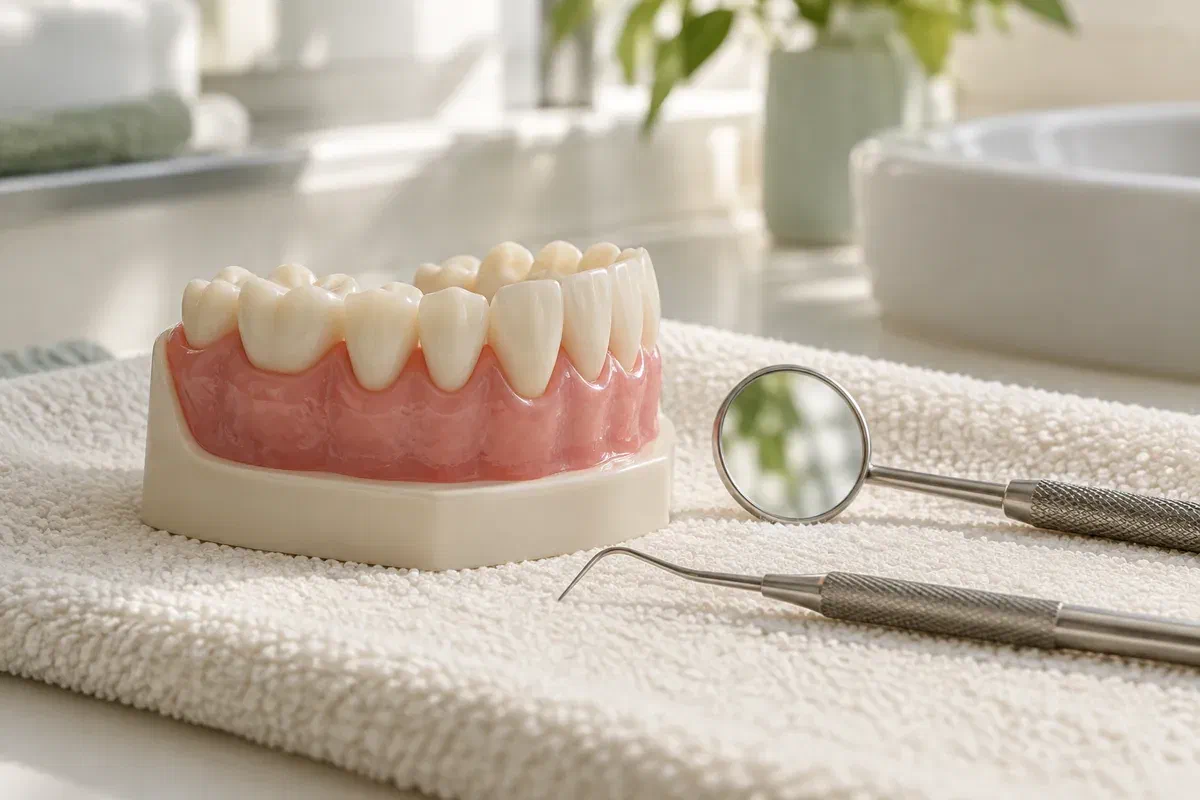
Illustrative tooth-and-gum model beside a periodontal probe and dental mirror
Before you set out

Pack the right information, and the right questions.

There is no need to arrive with a diagnosis. Describe what you have noticed, and gather any treatment plan, chart, or letter recommending deep cleaning or a periodontist, so the reasoning behind it can be reviewed on the same day.

Bleeding, gum recession, or a gumline that has changed

Make a note of where it happens and how long it has been going on, so nothing is forgotten at the chair. Include soreness, trapped food, and spots that are awkward to clean. The examination then connects these observations to the gum and bone beneath them.

A tooth that feels loose or meets its neighbour differently

Write down when you notice it, such as during meals or when you wake. Avoid testing the tooth by pushing it. The clinician looks at the tooth and the structures supporting it as a unit, and can explain whether more than one cause is likely.

Records, medicines, and health history

List earlier gum treatment, smoking, diabetes, medicines, and recent changes in your health. Give the team your previous dental office's details ahead of time so images and charts can be requested. Risk factors help with planning but cannot replace an examination of your own mouth.

Severe gum pain, swelling, or pus is not a reason to set out on a long trip without calling first. Phone us to describe it, and seek closer urgent or emergency care if you cannot be seen promptly.

What one good visit gives you

Enough information to plan the rest without guesswork

The numbers on a periodontal chart are only useful if someone explains them. Ask which readings matter most and how they connect with bleeding, recession, and bone level. Taken together these give a picture of each tooth's support; taken one at a time, they can mislead.

The visit also gives you a documented baseline. Ask what can be decided today and what genuinely requires a re-measurement or earlier records. Knowing this in advance means any follow-up has a real purpose, and you are not making the trip from Etobicoke for a visit that could have been avoided.

Patient information: American Academy of Periodontology — the components of a comprehensive periodontal evaluation

A clear diagnosis behind the symptom

Bleeding is a sign, while gingivitis and periodontitis are diagnoses reached by assessment. Ask which applies and whether it affects a few teeth or many. That distinction often explains why the plan differs from a standard cleaning.

Investigations done once, for a reason

If images or added measurements are proposed, ask what each will tell the clinician. Arranging for earlier records to arrive beforehand can prevent duplication. Each test should serve the assessment rather than be part of an automatic set.

A timeline you can plan around

Ask which visits are for treatment, which for re-evaluation, and which for maintenance. Discuss how many appointments are expected, the fees, and whether a referral closer to home might be sensible. Seeing the timeline helps you organise work and travel.

How the day unfolds

Prepared ahead, completed in the chair

What the visit includes depends on your reason for coming and the records already received. Let the clinician know early if you feel anxious or tender, and settle on a simple way to ask for a break.

  1. Records requested before you arrive

    When you book, share your previous dental office's details and any recommendation you were given. On the day, you describe bleeding, gum changes, chewing, or tooth movement, and review past treatment, your routine, health history, and medicines.

  2. A full periodontal examination

    The clinician inspects your gums and uses a thin probe to measure the pockets around your teeth. Signs such as bleeding and recession help put the measurements into context. If a spot is tender, say so before it is checked.

  3. Images only where they add something

    Where indicated, and where suitable records have not already arrived, images may be taken to assess the bone supporting your teeth. They are considered with the examination and your history. Ask which conclusions are firm and whether anything else would help.

  4. A plan and a schedule before you leave

    You discuss which areas need care, what treatment would achieve, and how its success will be checked. Ask about alternatives, the effect of postponing, and how visits can be grouped. Confirm the purpose and approximate timing of each upcoming appointment.

Back home

Carry the plan with you between trips.

Your assessment may begin a course of care rather than complete it. Stick to the agreed steps, and call before changing a routine or deciding a follow-up is not worth the journey.

Work on the areas that were pointed out

Ask which cleaning tools suit the specific sites identified, and request a demonstration while you are in the chair, since a return visit for that alone is inconvenient. Mention hand pain, tight spaces, or dental work so the advice suits your mouth.

Group appointments where it makes clinical sense

Treatment, re-measurement, and maintenance have different purposes, and some cannot be combined. Ask which can be scheduled together and which need time between them. If travel, work, or cost makes the plan hard, raise it early.

Call before travelling if something changes

If swelling appears, discomfort increases, or a tooth feels looser, phone before setting out so the team can advise whether to come in or seek care closer to home. Mention any new medicines or medical diagnoses as well.

What the findings lead to

Light-touch care, a treatment course, or a specialist nearer home

Ask what evidence supports the recommended path and how success will be judged. The choice depends on the diagnosis, affected sites, tooth support, risk factors, prior care, and practical considerations such as travel.

When a less extensive approach is appropriate

Prevention and management of inflamed gums

Professional cleaning and tailored home-care advice may be suggested where suitable. Ask which areas to concentrate on and when a review is needed. Prevention still needs a clear aim and should not be a way to put off symptoms that seem minor.

When periodontitis has been diagnosed

Periodontal treatment with a scheduled review

Care may be directed at the affected sites, followed by a planned visit to check healing and remaining needs. Ask how the stages are spaced and how maintenance intervals are chosen. Treatment may extend over more than one appointment.

When complexity or uncertainty warrants a specialist

A periodontist referral or coordinated care

A periodontist can help with advanced, complex, or persistent concerns. Ask what the referral is meant to answer, which records will go with it, and whether a specialist nearer to Etobicoke would be practical. Clarify who coordinates follow-up.

Planning questions

Getting the most from a longer trip

Good questions connect each finding to a diagnosis and each diagnosis to a step. Bring earlier reports so you can see how this advice compares with what you heard before.

(905) 876-4488
How can I avoid an extra trip just to get my gum assessment results?
Ask when you book whether findings will be explained at the same visit, and arrange for earlier records to be sent beforehand. In most cases the clinician can discuss what was found before you leave, with any further investigation explained and justified.
What should I bring to a gum disease assessment?
Bring a list of medicines, any earlier periodontal charts or treatment plans, and the contact details of your previous dental office. A short note of your symptoms and questions helps too, so nothing important is missed during the appointment.
Can my previous dentist send X-rays ahead of the appointment?
Often they can, with your consent. Give the team the office details when booking. Whether those images are enough depends on how recent and clear they are and on the clinical question, which the clinician can explain.
What if my gum suddenly swells and the clinic is too far to reach quickly?
Phone the clinic for advice, and seek urgent or emergency care closer to home if you cannot be seen promptly. Difficulty breathing or swallowing, or swelling spreading toward the eye, needs emergency medical care straight away.
Does gum disease always cause pain?
No. It frequently develops with few noticeable symptoms, which is one reason a measured examination is useful. The assessment can show changes you have not felt and clarify whether treatment or monitoring suits you.
If a periodontist is recommended, does it have to be one near Milton?
Not necessarily. Ask the clinician whether a specialist closer to where you live would be suitable, which records would be sent, and how the specialist’s advice would come back to your general dental care.
Book from Etobicoke

One well-prepared visit, then a plan you can follow

Call our Bronte Street practice to book a gum and tooth-support assessment and to arrange for earlier records to be requested. Bring your periodontal history, medication list, and the questions you most want answered on the day.

Assessment scope, imaging, treatment, maintenance intervals, and specialist referral are decided individually, guided by your findings and how you respond to care.

Visit Milton Dental Clinic
Unit 1, 342 Bronte St. S, Milton, ON L9T 5B7
Get directions Clinic hours
Monday–Thursday
11am–7pm
Friday–Sunday
By appointment only

Areas we serve

  • Milton
  • Oakville
  • Mississauga
  • Georgetown
  • Halton Hills
  • Acton
  • Campbellville
  • Brampton
  • Burlington
  • Puslinch
  • Rockwood
  • Erin
  • Caledon
  • Etobicoke
  • Old Milton
  • Bronte Meadows
  • Timberlea
  • Dorset Park
  • Dempsey
  • Clarke
  • Beaty
  • Coates
  • Harrison
  • Scott
  • Willmott
  • Ford
  • Bowes
  • Cobden
  • Walker
  • Mountain View
  • Milton Heights
  • Hawthorne Village
  • Valley View
  • Fallingbrook
  • Nassagaweya
  • Trafalgar
  • Esquesing
  • Nelson
  • Brookville
  • Moffat
  • Glen Williams
  • Norval
  • Limehouse
  • Stewarttown
  • Ashgrove
  • Hornby
  • Silver Creek
  • Speyside
  • Scotch Block
  • North Oakville
  • River Oaks
  • Glen Abbey
  • West Oak Trails
  • Palermo
  • Bronte Creek
  • College Park
  • Joshua Creek
  • Uptown Core
  • Preserve
  • Iroquois Ridge
  • Lisgar
  • Meadowvale
  • Meadowvale Village
  • Churchill Meadows
  • Erin Mills
  • Central Erin Mills
  • Streetsville
  • East Credit
  • Creditview
  • Heartland
  • Sheridan
  • Mount Pleasant
  • Credit Valley
  • Huttonville
  • Churchville
  • Springbrook
  • Northwest Brampton
  • Bram West
  • Fletcher's Meadow
  • Fletcher's Creek South
  • Alton Village
  • Orchard
  • Millcroft
  • Headon Forest
  • Tansley
  • Brant Hills
  • Tyandaga
  • Kilbride
  • Lowville
  • Aberfoyle
  • Morriston
  • Arkell
  • Hillsburgh
  • Freelton
  • Carlisle
  • Waterdown
  • Flamborough
  • Mountsberg

How can we help?

Milton Dental Clinic

Have a question about your smile? Choose the option that works best for you.

For urgent dental concerns, please call.
Messages are reviewed during clinic hours.