

Illustrative patient discussing a gum-health assessment with a clinician
Specialized Care

Gum Disease Assessment in Old Milton

Decades of fillings, crowns and bridges can make gum changes harder to read. For people in Old Milton, a gum disease assessment sorts out inflammation, the support under older dental work, your risk factors, and whether treatment or monitoring is sensible.

Gum health in Old Milton

A long dental history deserves a careful reading.

Teeth that have carried crowns, bridges, or large fillings for many years bring their own questions. Is the edge of that old crown irritating the gum? Has a site treated long ago stayed stable? A gum disease assessment looks at the tissues holding each tooth, combining your history, a close examination, and images where justified, to establish what is happening now.

Plenty of people arrive with a specific worry: a bridge that traps food, a gum that has crept back over the years, or a note from a previous dentist about deep pockets. Others simply have not had a thorough gum check in some time. Neither the absence of pain nor a quick glance in the mirror can answer these questions on its own.

For anyone in Old Milton, Milton's historic downtown, a return visit to our Bronte Street practice for a re-check can fit into an ordinary week. Ask the clinician to tie every finding to a decision. You should leave knowing the diagnosis, the areas involved, and how progress will be measured.

Ask about a gum assessment
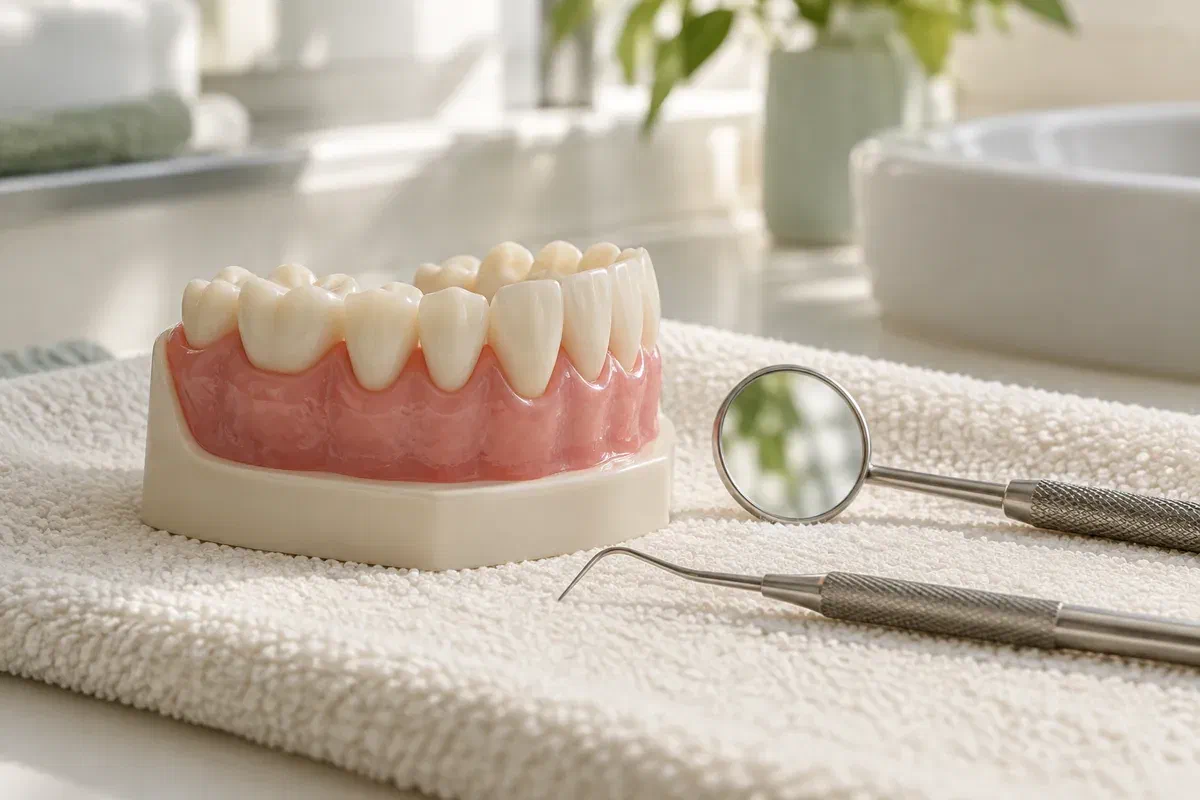
Illustrative tooth-and-gum model beside a periodontal probe and dental mirror
Worth raising at the visit

Older dental work, newer gum changes

Describe what you have noticed in your own words; you do not have to diagnose it. If an earlier dentist recommended deep cleaning or a periodontist, bring the letter or chart so the reasoning can be reviewed alongside today's findings.

Bleeding or receding gums near crowns and bridges

Show where it happens and whether it began recently or has been around for years. Food that packs under a bridge, a tender spot, or a margin that is hard to clean is useful to mention. The examination then shows how the visible change relates to the gum and bone underneath the restoration.

A tooth that has started to feel less firm

Say when you notice it, whether while biting or simply at rest. Avoid wiggling the tooth to check on it. The clinician assesses the tooth, its support, and any restoration on it together, and can explain whether more than one factor might be contributing to the change.

Past gum treatment or a shift in your health

Mention gum care you had years ago, tobacco use now or in the past, diabetes, new medicines, or recent medical changes. Old records help if you can find them. Such factors guide planning, but the condition of your mouth today can only be established by examining it.

Report a painful swelling of the gum, pus, or symptoms that are getting worse quickly when you book. An urgent infection visit may come first, ahead of a longer review of your gum health.

Why the assessment matters

Separate old history from current disease.

When a mouth has a long story, it can be hard to tell which changes are recent and which have been stable for years. The clinician can point out the measurements that matter most and explain how pocket depth, bleeding, recession, and bone levels combine. No one reading should be taken as the full answer.

This visit also produces a record you can be compared against next time. Ask which conclusions are firm today and which depend on a re-measurement or older charts. A reliable baseline helps everyone judge how you respond to care, without assuming every site will follow the same course.

Patient information: American Academy of Periodontology — the components of a comprehensive periodontal evaluation

A named condition, not only a symptom

Bleeding is something observed; gingivitis or periodontitis is a diagnosis drawn from the full assessment. Ask which applies and whether it is limited to a few teeth or spread more widely. That can explain why the suggested care differs from cleanings you have had for years.

Tests that answer a clear question

If X-rays or extra charting are proposed, ask what each will reveal. Records from a previous office may still be useful when they are recent enough and of suitable quality. Nothing should be presented as automatic; each investigation should serve the assessment.

A plan with treatment, review, and upkeep

Ask which steps target active disease and which support long-term monitoring. Talk about the expected visits, fees, and any chance of referral. Knowing the order helps you tell a course of treatment apart from the maintenance appointments that may follow it.

Step by step

History first, then measurements, images, and a conversation.

The scope is set by your reason for coming and the records already on hand. If you are uneasy or a spot is tender, say so before starting, and agree on a way to pause whenever you need to.

  1. Go over your story

    Explain changes in bleeding, gum level, chewing, or how firm a tooth feels. The clinician asks about earlier gum treatment, your home routine, health conditions, and medicines. If someone else recommended care, share that report so this assessment can address the question they raised.

  2. Chart the gums

    The gums are examined and a periodontal probe gently checks the space around each tooth, including along the edges of crowns and bridges. Bleeding, recession, and other signs help explain the readings. Mention sensitive spots in advance, and ask questions whenever something is unclear.

  3. Look at the bone and the restorations

    Images may be taken where they are indicated, to view supporting bone and the fit of existing dental work. They are read together with the examination and your history. Ask which findings are confirmed and whether further records or a specialist opinion would help.

  4. Settle on priorities together

    The clinician explains which areas need attention, the aim of any treatment, and how response will be judged. Ask about alternatives and the consequences of waiting. Confirm the purpose of your next booking so assessment, treatment, and maintenance are clearly separated.

After you go home

Put the advice to work around your existing dental work.

The assessment is often a first step. Follow the plan you agreed on, and ask before dropping a recommended routine or deciding that a follow-up visit can be skipped.

Clean the sites that were flagged

Ask which tools suit the areas identified, especially under bridges and around crown edges. A floss threader or small interdental brush may be suggested, and you can ask for a demonstration. Mention stiff fingers or tight spaces so the advice works for you in practice.

Keep track of each visit's purpose

A treatment appointment, a re-measurement, and a maintenance cleaning each do a different job. Write down which is which. If timing or cost makes the plan hard, raise it early and ask the team to explain which steps carry the most weight for your situation.

Tell the team about new symptoms or health news

Swelling, growing discomfort, or a tooth that feels looser should prompt a call rather than a wait. Changes in medicines or medical care matter too. New information may change how the original findings are understood, and the plan can be revisited.

Where the findings lead

Three directions the plan can take

Ask what evidence supports the recommendation and how success will be judged. The right direction depends on the diagnosis, the sites involved, remaining support, risk factors, and treatment you have already had.

When a lighter approach fits the findings

Preventive care and inflammation control

Professional cleaning and home-care advice suited to your restorations may be discussed. Ask which spots to focus on and when they will be re-checked. Prevention still needs a goal; it is not a reason to overlook symptoms because they seem small.

When periodontitis has been confirmed

Periodontal treatment and a follow-up review

Treatment may be directed at the affected sites, followed by a check on healing and what still needs attention. Ask what each stage involves and how the maintenance interval will be chosen. The course of care may continue past the first treatment visit.

When the case is complex or the picture is uncertain

Referral to a periodontist or shared care

A periodontist may assess advanced, complicated, or persistent problems, including those around extensive dental work. Ask what the referral is meant to clarify and which records will be sent. Find out how the specialist's advice and your regular care will be coordinated.

Old Milton gum questions

What people with older dental work tend to ask

Useful questions connect what was measured with what was diagnosed and what happens next. Bring older reports so you can see how today's advice compares with the past.

(905) 876-4488
Can an old crown or bridge contribute to gum problems around it?
It can make an area harder to clean, and plaque that collects along a margin may irritate the gum. The assessment looks at the tissues around the restoration and whether its fit or shape plays a part. Ask the clinician to show you the specific site.
I had gum treatment years ago. Do I need a full assessment again?
A fresh assessment shows how things stand now and gives a new baseline. Earlier treatment is useful history, but gum conditions can change over time. Bring any old charts or letters so the clinician can compare.
My gums have receded slowly for years. Is that the same as gum disease?
Not always. Recession can have several causes, and it is only one part of the picture. The clinician compares it with pocket readings, bleeding, and bone levels to judge the support around the tooth and whether active disease is present.
Is one high pocket reading a sign my whole mouth is affected?
No. A single reading is interpreted with the rest of the findings at that site and across your mouth. Ask whether the problem is limited to one area or more general, and what evidence supports the conclusion.
Why would I need images if my old dentist took X-rays?
You may not. Imaging should match the clinical question and what is already available. If recent X-rays exist, give the team the details so they can request them, and ask why any new views would add information.
What does periodontal maintenance mean once treatment is done?
It refers to regular visits after active treatment that check the gums, re-measure where needed, and clean areas that are difficult to manage at home. How often depends on your findings and response, which the clinician will explain.
Visit us from Old Milton

See how your gums are holding up, around every crown and filling.

Get in touch with our Bronte Street practice to set up a gum review that takes your crowns, bridges, and fillings into account. Bring older periodontal charts or letters if you have them, and jot down the questions that matter most to you.

What the assessment includes, whether imaging is needed, and decisions about treatment, maintenance timing, or referral are made individually and guided by your findings and response.

Visit Milton Dental Clinic
Unit 1, 342 Bronte St. S, Milton, ON L9T 5B7
Get directions Clinic hours
Monday–Thursday
11am–7pm
Friday–Sunday
By appointment only

Areas we serve

  • Milton
  • Oakville
  • Mississauga
  • Georgetown
  • Halton Hills
  • Acton
  • Campbellville
  • Brampton
  • Burlington
  • Puslinch
  • Rockwood
  • Erin
  • Caledon
  • Etobicoke
  • Old Milton
  • Bronte Meadows
  • Timberlea
  • Dorset Park
  • Dempsey
  • Clarke
  • Beaty
  • Coates
  • Harrison
  • Scott
  • Willmott
  • Ford
  • Bowes
  • Cobden
  • Walker
  • Mountain View
  • Milton Heights
  • Hawthorne Village
  • Valley View
  • Fallingbrook
  • Nassagaweya
  • Trafalgar
  • Esquesing
  • Nelson
  • Brookville
  • Moffat
  • Glen Williams
  • Norval
  • Limehouse
  • Stewarttown
  • Ashgrove
  • Hornby
  • Silver Creek
  • Speyside
  • Scotch Block
  • North Oakville
  • River Oaks
  • Glen Abbey
  • West Oak Trails
  • Palermo
  • Bronte Creek
  • College Park
  • Joshua Creek
  • Uptown Core
  • Preserve
  • Iroquois Ridge
  • Lisgar
  • Meadowvale
  • Meadowvale Village
  • Churchill Meadows
  • Erin Mills
  • Central Erin Mills
  • Streetsville
  • East Credit
  • Creditview
  • Heartland
  • Sheridan
  • Mount Pleasant
  • Credit Valley
  • Huttonville
  • Churchville
  • Springbrook
  • Northwest Brampton
  • Bram West
  • Fletcher's Meadow
  • Fletcher's Creek South
  • Alton Village
  • Orchard
  • Millcroft
  • Headon Forest
  • Tansley
  • Brant Hills
  • Tyandaga
  • Kilbride
  • Lowville
  • Aberfoyle
  • Morriston
  • Arkell
  • Hillsburgh
  • Freelton
  • Carlisle
  • Waterdown
  • Flamborough
  • Mountsberg

How can we help?

Milton Dental Clinic

Have a question about your smile? Choose the option that works best for you.

For urgent dental concerns, please call.
Messages are reviewed during clinic hours.