

Illustrative patient discussing a daily gum-care routine with a dental clinician
Specialized Care

Gum Disease Prevention in Campbellville

By bedtime after a long day, flossing is often the first thing to go. For households in Campbellville, we can examine your gums, trim your routine down to the steps that matter most, and plan reviews you can fold into a regular trip into town.

Rural routines, Campbellville style

Ten o’clock, tired, and the floss is still in the drawer

Long days outdoors, early starts, animals or a property to look after: by the time the house is quiet, a full cleaning routine can feel like one chore too many. Preventing gum disease does not demand perfection. It needs dependable plaque removal at home, focused where it counts, and an examination often enough to catch what you would not notice.

A shorter routine works better when it is aimed precisely. Perhaps two or three spaces need an interdental brush, the front teeth suit floss, and the rest are well served by a soft brush along the gumline. Crowding, bridges, recession, or stiff hands all change that map. Pushing harder or buying a stronger rinse will not substitute for the right aid.

From Campbellville, many people prefer to combine dental visits with other errands in Milton. Bring the aids you keep at home and let us know which teeth you tend to skip. We will examine your gums, show you the essential steps for your mouth, and explain when it would be useful to come back.

Get a routine that fits a long day
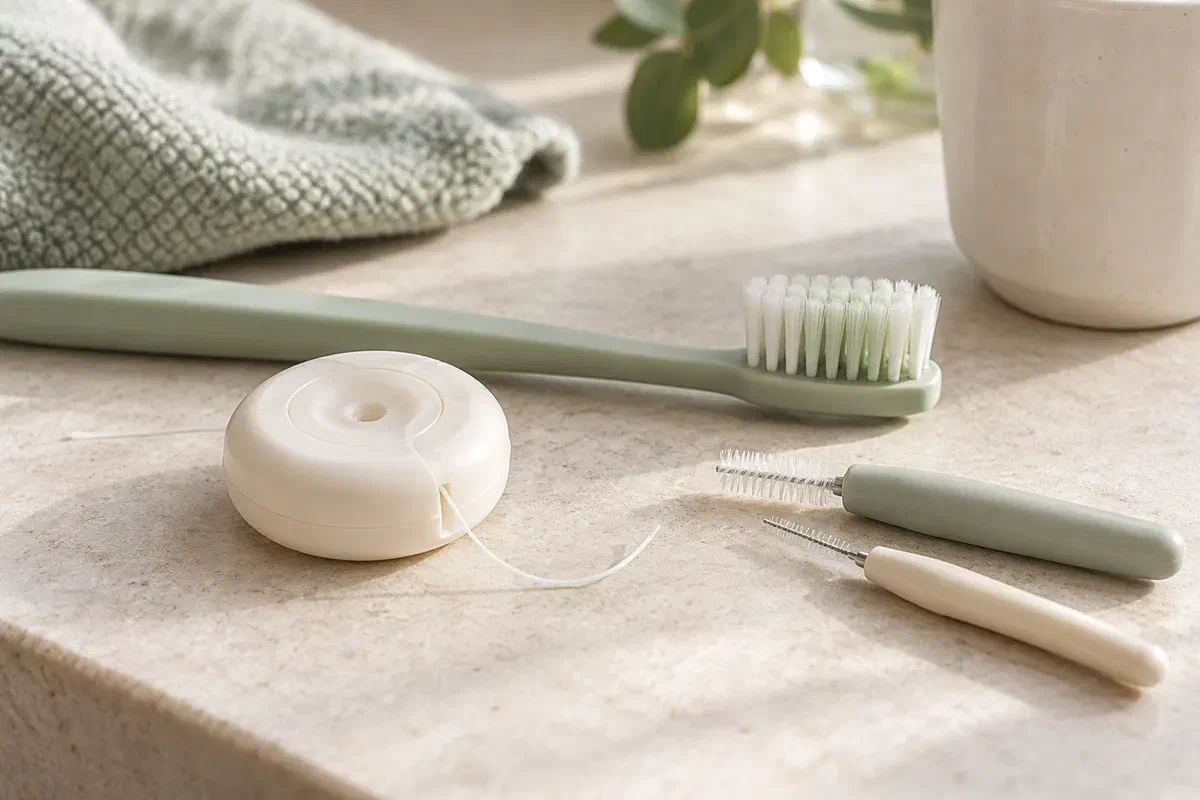
Illustrative soft toothbrush, floss, and interdental brushes arranged beside a ceramic cup
The usual obstacles

Fatigue, awkward spaces, and gums that bleed

Your routine can be patchy when you arrive. Tell us when you actually clean, what gets left out, and what would make it realistic at the end of a demanding day.

Spots that need more time than you have

Show us the teeth where floss is slow or frustrating, where a brush will not fit, or where food packs in after supper. Mention any crowns or bridges. If we know where to focus, the routine can be shorter without losing what matters.

Bleeding you have learned to ignore

If you see blood when you brush, it is worth having checked rather than accepting it. Tell us where and for how long. The clinician can examine the gums, look at your technique, explain the likely reason, and say plainly whether treatment is needed.

Health factors and past gum treatment

Share medical conditions, medications, tobacco use, and any previous periodontal care. Diabetes and smoking are examples of factors that can influence gum health. Knowing them helps set a review interval that suits you, not a standard calendar.

A busy life is not a failing. Gum health depends on many factors, and the visit is about finding steps that will realistically help from now on.

What a focused plan does

Fewer steps, better aimed

When time and energy are limited, precision matters. Ask which teeth deserve the most attention and how to check that an aid is actually reaching them. If a step feels too fiddly to keep up at night, tell us; there may be a simpler option or a better time of day.

Some changes in the gums are only visible to a clinician. Gum disease can develop with little discomfort, so a mouth that feels fine is not a guarantee that a review can be skipped. Ask how your findings and history set your recommended examination and cleaning schedule.

Patient information: Canadian Dental Association — plaque control, professional cleaning, and gum-disease review

An efficient home routine

Cover gentle brushing with fluoride toothpaste and a between-teeth aid for the spaces that need one most. Ask for coaching on angle and pressure there. A routine you can manage when tired is more valuable than a thorough one you abandon.

Professional removal of hardened deposits

Once tartar forms, no home routine will lift it. The team can show you where it has built up and whether your gums need more than preventive care. Ask what the appointment adds and which findings will be compared at your next visit.

Review spacing you can plan around

Your interval may differ if you have had periodontitis treated in the past. Ask why a particular spacing is suggested and what could change it. Knowing the reason makes it easier to plan the trip and keep it.

What happens on the day

We narrow the routine down to what matters for your mouth.

Plan on an examination, some coaching, and professional cleaning if it suits what we find. It is worth asking beforehand what will be covered and whether any treatment would need to be booked on another day.

  1. Tell us what a real evening looks like

    Describe when you brush, whether cleaning between teeth happens at all, and what usually stops it. Bring your aids. Mention bleeding, trapped food, a dry mouth, any earlier gum care, and recent health or medication changes.

  2. Examine and map the priority teeth

    We check the gums, and the bone and attachment around the teeth when appropriate, then show which sites matter most. Ask whether the findings fit prevention or active disease. That way a shorter routine is never mistaken for treatment you need.

  3. Practise the essentials

    Try the recommended method on the priority teeth with guidance. If an aid is awkward with tired or rough hands, ask for another. Where relevant, talk about tobacco support or coordinating with your doctor, leaving prescribed treatment unchanged.

  4. Plan the next trip with a reason

    Pick the first change to make and confirm what the next visit is for. Ask which symptoms should prompt you to call before driving in. At review, tell us what stuck and what did not, so we can trim or adjust further.

At home in Campbellville

A routine that still happens on the hardest days

Habits hold when aids are close at hand, the steps are few, and there is a natural moment for them. Let us know early if the plan is not working.

Move the routine to a better moment

If evenings are hopeless, try cleaning between your teeth after breakfast or before supper. Keep the aids where you will see them. Ask which items are essential so the routine does not rely on a cluttered shelf.

Ease off if something hurts

Do not force a brush into a tight space or scrub sore gums harder. Note where the discomfort is and ask for a different aid or size. If bleeding or tenderness persists, book an assessment instead of waiting it out.

Revisit the plan as things change

New dental work, an injury to your hands, or gum symptoms returning may mean the routine needs adjusting. Mention these at your next visit or sooner if needed. A plan should fit your life as it is now.

Sorting out the kind of care

Is it maintenance, treatment, or prevention you need?

Ask which fits your findings. A consistent home routine supports all three, but it cannot make them equivalent or stand in for a diagnosis.

Protecting healthy gums and spotting early changes

Prevention for gums free of established disease

Agree on cleaning, coaching, and review spacing that reflects what was found. Ask which teeth to watch and how change will be measured. The plan supports ongoing health, although nothing can promise to eliminate every future risk.

When the examination finds a current problem

Treatment for active inflammation or disease

Professional treatment may be needed alongside improved home cleaning. Ask what the findings mean and how they change your routine. Preventive steps support treatment and should not become a reason to put it off.

When gum disease has been treated before

Periodontal maintenance after treatment

After active care, maintenance appointments monitor the tissues and address what remains. Ask what sets them apart from an ordinary cleaning and why your interval suits your history. Comfort does not mean treated sites can be left unchecked.

Campbellville gum questions

Straight answers for busy rural households

Bring your aids, show us where you struggle, and ask for a demonstration. The best advice fits your teeth, your dental work, and your days.

(905) 876-4488
Is cleaning between teeth once a day really enough?
For many people, a thorough once-daily clean between the teeth is the usual recommendation, but your needs depend on your findings. Ask what is suitable for you and which areas to prioritise. A careful pass through the spaces that matter usually beats a rushed attempt at every tooth, and the clinician can tell you which ones those are.
Does it matter if I brush in the morning but not at night?
Brushing twice a day is generally recommended. If nights are difficult, tell us. The clinician can help you find a version of the routine that you can keep, and explain which parts matter most for your gums.
Can outdoor work or dust affect my gums?
Your job is not usually the main issue, but long days can disrupt routines and hydration. Mention your work pattern so advice can be practical. Sipping water through the day and keeping a small kit handy may help some people.
What if I can only manage the trip in a couple of times a year?
Discuss it with the clinician. They can explain what interval your findings support and how to group care where appropriate, so that each trip does as much as it sensibly can. If symptoms appear between visits, call for advice rather than waiting for the next booking.
Can I skip a review if my gums look fine in the mirror?
Not safely. Gum disease can progress without obvious signs or pain, and much of what matters sits below the gumline where a mirror cannot show it. Keep to the recommended interval, and phone us earlier if bleeding keeps happening or a gum puffs up.
How do I keep my appointment from Campbellville efficient?
Bring a medicine list, your aids, and notes on any bleeding or food traps. Ask our Bronte Street practice whether your examination, cleaning, and coaching can happen in one visit.
Planning your visit

Bring the drawer of half-used floss. We will help you choose.

Reach our Bronte Street practice to arrange a gum-prevention visit, ask about teeth that are hard to clean, or talk through past periodontal treatment. The appointment begins with your real routine and what you want to know.

Recommendations, cleaning, any treatment, and how often you return depend on your examination. No home routine guarantees you will never develop gum disease.

Visit Milton Dental Clinic
Unit 1, 342 Bronte St. S, Milton, ON L9T 5B7
Get directions Clinic hours
Monday–Thursday
11am–7pm
Friday–Sunday
By appointment only

Areas we serve

  • Milton
  • Oakville
  • Mississauga
  • Georgetown
  • Halton Hills
  • Acton
  • Campbellville
  • Brampton
  • Burlington
  • Puslinch
  • Rockwood
  • Erin
  • Caledon
  • Etobicoke
  • Old Milton
  • Bronte Meadows
  • Timberlea
  • Dorset Park
  • Dempsey
  • Clarke
  • Beaty
  • Coates
  • Harrison
  • Scott
  • Willmott
  • Ford
  • Bowes
  • Cobden
  • Walker
  • Mountain View
  • Milton Heights
  • Hawthorne Village
  • Valley View
  • Fallingbrook
  • Nassagaweya
  • Trafalgar
  • Esquesing
  • Nelson
  • Brookville
  • Moffat
  • Glen Williams
  • Norval
  • Limehouse
  • Stewarttown
  • Ashgrove
  • Hornby
  • Silver Creek
  • Speyside
  • Scotch Block
  • North Oakville
  • River Oaks
  • Glen Abbey
  • West Oak Trails
  • Palermo
  • Bronte Creek
  • College Park
  • Joshua Creek
  • Uptown Core
  • Preserve
  • Iroquois Ridge
  • Lisgar
  • Meadowvale
  • Meadowvale Village
  • Churchill Meadows
  • Erin Mills
  • Central Erin Mills
  • Streetsville
  • East Credit
  • Creditview
  • Heartland
  • Sheridan
  • Mount Pleasant
  • Credit Valley
  • Huttonville
  • Churchville
  • Springbrook
  • Northwest Brampton
  • Bram West
  • Fletcher's Meadow
  • Fletcher's Creek South
  • Alton Village
  • Orchard
  • Millcroft
  • Headon Forest
  • Tansley
  • Brant Hills
  • Tyandaga
  • Kilbride
  • Lowville
  • Aberfoyle
  • Morriston
  • Arkell
  • Hillsburgh
  • Freelton
  • Carlisle
  • Waterdown
  • Flamborough
  • Mountsberg

How can we help?

Milton Dental Clinic

Have a question about your smile? Choose the option that works best for you.

For urgent dental concerns, please call.
Messages are reviewed during clinic hours.