

Illustrative patient and clinician discussing options beside a small gum model
Specialized Care

Gum Grafting

A gum graft needs a clear purpose and realistic expectations. Discuss an assessment in Milton to understand recession, tissue thickness, possible root coverage, and whether monitoring, another approach, or specialist grafting care fits your situation.

A closer look at gum grafting

Start with the tissue concern and the change a graft is meant to achieve.

Gum grafting adds or repositions soft tissue around a tooth when an assessment supports a particular treatment goal. That goal may involve increasing tissue thickness, covering some exposed root surface, or improving the conditions for comfortable cleaning. Different grafting approaches do not necessarily aim to produce the same change.

Recession is one reason the discussion begins, but the visible gumline is only part of the assessment. The clinician considers the surrounding support, tissue characteristics, tooth position, inflammation, and possible contributing factors. A photograph of another person's result cannot establish what would be achievable or appropriate in your mouth.

At Milton Dental Clinic, bring the area that concerns you and any recommendation you have received. We can discuss the assessment, what a proposed graft is intended to address, and whether specialist periodontal care is needed. The decision should include alternatives, recovery, limitations, and a clear explanation of the expected benefit.

Discuss a gum-grafting assessment
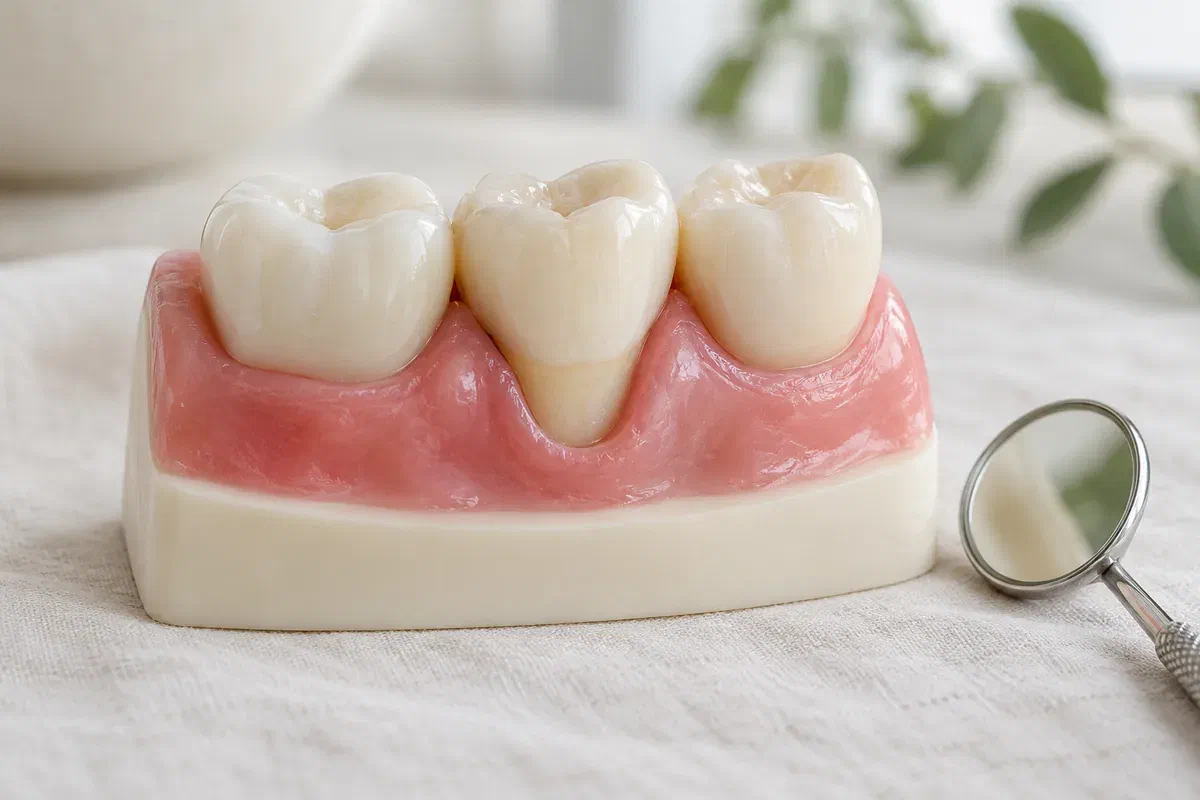
Illustrative physical tooth-and-gum model showing a localized lowered gum margin
Why the area needs assessment

A receded gumline can raise several different questions.

Explain whether the concern is sensitivity, appearance, cleaning difficulty, or a change noted by another clinician. Your priorities help frame the discussion, while the examination establishes which treatment goals are realistic.

An exposed root or a gumline that appears to have changed

Point out the tooth and describe when you first noticed the difference. Earlier photographs or dental records may help provide context. Ask whether the area appears stable, what factors may be contributing, and what information is needed before deciding between observation and intervention.

Sensitivity or difficulty cleaning a particular site

Describe which activities cause discomfort and whether it affects your ability to clean. Sensitivity can have more than one explanation, so it should not automatically be attributed to recession. Ask whether a nonsurgical approach could address the symptom and what a graft would add in your case.

A recommendation related to thin tissue or another treatment

If grafting has been proposed before orthodontic, restorative, or other dental care, ask how the treatments fit together. Clarify the goal for the tissue, the intended timing, and who will coordinate the sequence. A recommendation should explain the local concern rather than rely on the word thin alone.

A gum graft is a soft-tissue procedure. It should not be described as automatically rebuilding all bone or attachment already lost through periodontal disease, and complete root coverage cannot be assumed.

Define the intended benefit

Ask whether the priority is tissue thickness, root coverage, or another specific goal.

The meaning of a successful result depends on why the procedure is chosen. In one area, the main objective may be improving tissue characteristics; in another, covering an exposed root may be a reasonable goal. Ask the clinician to describe the expected change at your particular tooth and explain what may remain unchanged.

An informed discussion also includes the causes or habits that need attention alongside surgery. If inflammation or an unsuitable cleaning technique contributes to the concern, those issues still need management. Grafting should fit a broader care plan rather than be presented as a permanent exemption from maintenance.

Patient information: Cambridge University Hospitals — soft-tissue grafting goals, procedure, and risks

A site-specific expectation

Ask how the condition of the neighbouring tissues affects the achievable outcome. The answer may differ between teeth in the same mouth. A useful explanation identifies the intended improvement, the uncertainty, and how the result will be reviewed rather than promising an identical gumline everywhere.

An explanation of the proposed tissue source

Some procedures use tissue from another area of your mouth, commonly the palate; other materials or approaches may be considered in suitable circumstances. Ask what is proposed, why it fits the goal, and whether there will be a second healing site. Material choice should be part of consent.

A practical discussion of recovery and limits

Review likely discomfort, eating and cleaning restrictions, stitches, review visits, and possible complications. Ask how the timing fits work, travel, and other treatment. No technique removes every risk, and further care may be needed if healing or the final tissue position differs from the intended result.

From assessment to a considered decision

Clarify the indication before choosing a technique or a date.

The assessment and surgery may be provided by different clinicians. Ask where each stage would take place and how records and follow-up would be coordinated before making arrangements for treatment.

  1. Review the concern and examine the tissue

    Discuss symptoms, earlier gum care, cleaning habits, relevant medical history, and medicines. The clinician assesses the recession and surrounding support. Ask whether additional records or a periodontal referral are needed to establish the indication and the range of reasonable options.

  2. Agree on the goal and compare alternatives

    Review observation, nonsurgical measures, and the proposed surgical approach where appropriate. Ask what would happen if treatment were deferred and what improvement is realistically expected. Discuss the tissue source, possible donor site, anaesthetic, fees, and any care required before the procedure.

  3. Carry out the planned grafting procedure if indicated

    The treating clinician explains how the recipient area will be prepared and how tissue will be placed and secured. Local anaesthetic is commonly used, with any additional arrangements assessed individually. The exact technique and treatment setting depend on the site, goal, and provider's plan.

  4. Protect healing and review the tissue response

    Receive written instructions for the graft site and any donor area, including cleaning, eating, medicines, and stitches. Confirm when the clinician will review healing and when normal routines can resume. Longer-term evaluation should return to the original goal as well as the appearance of the wound.

After gum-grafting surgery

Protect the treated tissue and follow instructions for each healing site.

Recovery advice must match the procedure you actually received. Ask for clarification if the instructions for the graft and the donor area differ, and keep the treating provider's contact details available.

Avoid disturbing the graft to inspect it

Do not repeatedly pull the lip or cheek away to look at the site, press on the tissue, or test whether it is attached. Ask the clinician how the area will be checked at review. A photograph taken by stretching the tissues is not worth disrupting the healing plan.

Use the prescribed cleaning and eating approach

The surgical site may need a temporary change from ordinary brushing and interdental cleaning. Follow the treating clinician's instructions about where to clean, any rinse, suitable food, and when to resume normal methods. Do not apply a general brushing routine directly to a new graft without clearance.

Attend review and report unexpected symptoms

Ask what discomfort and swelling to expect and how to manage them safely with your health history. Contact the provider about persistent bleeding, increasing pain, fever, or other concerns. Keep the review for stitches and tissue assessment even if the site seems comfortable.

Patient information: Guy's and St Thomas' — protecting a gum graft and following postoperative instructions

Choosing the appropriate response

A visible recession site does not automatically require one particular operation.

Ask which option addresses the documented concern and how it compares with the alternatives. The plan should account for symptoms, stability, tissue characteristics, tooth support, and your priorities.

When observation is appropriate for the assessed site

Monitoring with changes to local care

The clinician may recommend documenting the area, refining cleaning, and reviewing it over time. Ask which changes would justify reconsidering treatment and how the site will be compared. Monitoring should have a clear purpose and follow-up arrangement rather than simply leaving the concern unexplained.

When another approach addresses the immediate need

Nonsurgical management of a symptom or contributing factor

Sensitivity care, management of inflammation, or an adjustment to daily cleaning may be discussed where indicated. These approaches do not necessarily replace missing tissue, so ask what each can and cannot achieve. The symptom and the structural concern may need different parts of the plan.

When the examination supports a surgical benefit

A suitably planned soft-tissue graft

Compare the expected tissue change with the risks and recovery involved. Ask about the proposed technique and whether a periodontist should provide care. The presence of a grafting service page does not establish suitability, in-house specialist availability, or a guarantee of complete coverage.

Gum-grafting questions

A clear goal helps you evaluate the recommendation.

Bring the tooth or area you want discussed and ask the clinician to explain the proposal using your own findings. These questions can help separate the intended benefit from assumptions about surgery.

(905) 876-4488
Does every gum graft aim to cover all of the exposed tooth root?
No. Some grafts primarily aim to improve tissue thickness or other local tissue characteristics, while root coverage may be a goal in suitable sites. Ask which outcome is intended for your tooth and what limits the achievable coverage. Complete coverage should not be promised automatically.
Will gum grafting necessarily require tissue from the roof of my mouth?
Not in every situation. The approach and tissue source depend on the goal, site, and clinician’s recommendation. Ask whether your own tissue or another material is proposed, why it is suitable, and what that choice means for healing and consent.
Can a gum graft be assumed to replace bone lost around a tooth?
No. Soft-tissue grafting and treatment aimed at regenerating deeper supporting tissues are different discussions. Ask exactly which structures the proposed procedure addresses. A change in gum coverage should not be presented as proof that all underlying support has been restored.
Should I pull my lip back each day to photograph a new gum graft?
No. Pulling on the tissues can disturb healing. Follow the treating clinician’s instructions and allow the site to be assessed at the planned review. If you are concerned about its appearance or symptoms, contact the provider rather than repeatedly stretching the area for inspection.
Can I discuss gum grafting even if my main concern is cleaning discomfort rather than appearance?
Yes. Explain the activity that is difficult and where it occurs. The clinician can assess the cause, discuss nonsurgical measures, and consider whether grafting offers an appropriate benefit. A functional concern deserves an individual assessment rather than an assumption that the procedure is only cosmetic.
What should I clarify before scheduling a graft around several teeth?
Ask which sites need treatment, whether their goals differ, how the procedure may be staged, and what recovery support is needed. Review fees, tissue source, alternatives, and follow-up. Several teeth should not be treated as identical simply because they appear on the same treatment plan.
Gum-grafting assessment in Milton

Understand the purpose of a graft before deciding to proceed.

Contact our Bronte Street practice to discuss recession, a tissue concern, or a gum-grafting recommendation. We can review the assessment needed and any coordination with a periodontal specialist or another treating clinician.

Indication, technique, tissue source, treatment availability, referral, fees, recovery, and expected coverage require individual assessment.

Visit Milton Dental Clinic
Unit 1, 342 Bronte St. S, Milton, ON L9T 5B7
Get directions Clinic hours
Monday–Thursday
11am–7pm
Friday–Sunday
By appointment only

How can we help?

Milton Dental Clinic

Have a question about your smile? Choose the option that works best for you.

For urgent dental concerns, please call.
Messages are reviewed during clinic hours.