

Illustrative patient and clinician discussing options beside a small gum model
Specialized Care

Gum Grafting in Campbellville

Before deciding on a gum graft, it helps to know exactly what you'd want it to fix. From Campbellville, you can sit down with us to sort out your priorities, learn what grafting can and can't change, and plan any visits so they fit around a rural household's routine.

Know what you're asking for

Comfort, appearance or protection: pick your priority.

Ask three people why they're considering a gum graft and you may hear three different reasons: a tooth that looks too long in photos, a spot that aches with cold water, or a dentist's warning about thin tissue. Each of those leads to a slightly different conversation, so it's worth naming yours at the start.

Grafting itself is a soft-tissue procedure that adds or repositions gum at a tooth. Depending on the case, the aim may be firmer tissue, partial cover for an exposed root, or a margin that's more comfortable to clean. A single technique is generally chosen for one of these, not all three.

From Campbellville, you might prefer to line this visit up with other family appointments. Bring your list of priorities and any earlier records. We'll examine the tooth and its support, look at contributing factors and explain whether grafting, monitoring, nonsurgical care or a periodontal referral best matches what you want.

Plan a gum visit from Campbellville
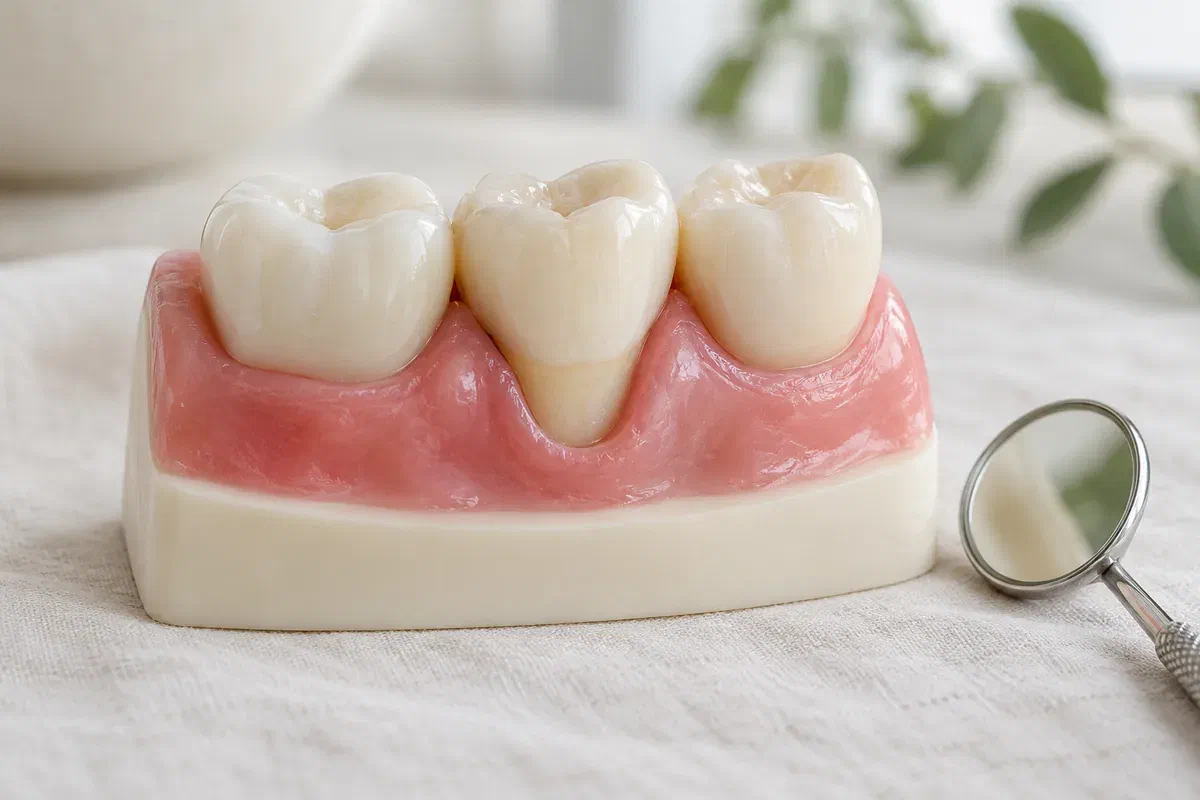
Illustrative physical tooth-and-gum model showing a localized lowered gum margin
Naming the concern

Which of these sounds most like you?

Your main reason might be appearance, sensitivity, cleaning trouble or advice you've been given. Telling us which comes first helps us focus, and the examination then shows which goals are realistic.

The tooth looks longer than the ones beside it

Show us which tooth and roughly when it began to look different. Photos from past years, or records from a previous dentist, can reveal whether the change is ongoing. Then we'll discuss what may be contributing and what's needed before choosing between watching and treating.

It's sensitive, or the brush never feels right there

Describe the trigger and whether you've started avoiding that area. Exposed root is a common reason for sensitivity, but not the only one. We'll look at whether a simpler measure might help first and what a graft would genuinely add.

Someone mentioned thin gum before other treatment

If a graft came up ahead of braces, a crown or another procedure, ask how the steps connect, what order makes sense and who's in charge of coordinating it. The reason should describe the specific site, not just repeat the word thin.

Gum grafting works on soft tissue. Bone and attachment that gum disease has taken away are not rebuilt by it, and complete coverage of an exposed root is never assured, whatever your priority happens to be.

Matching goal to procedure

A graft can do some things well and other things not at all.

Once your priority is clear, ask whether the proposed graft is actually designed to deliver it. If appearance is the goal, how much root coverage is realistic? If sensitivity is the issue, is the graft expected to help, or would other care do more? Ask what's likely to stay as it is.

Whatever caused the recession still needs managing. Brushing pressure, inflammation and other habits don't stop because a graft was placed. Surgery fits into a longer-term plan of home care and regular cleanings rather than closing the chapter on maintenance.

Patient information: Cambridge University Hospitals — soft-tissue grafting goals, procedure, and risks

An expectation set for your tooth

Surrounding tissue and bone shape what's achievable, and different teeth can have different prospects. Ask what improvement is expected, how sure the clinician is, and what the follow-up will measure.

The source of the graft tissue

Tissue is commonly taken from the palate, which leaves a second spot to heal; some cases may suit other materials. Ask what's planned and why it fits your priority. This is part of consenting to the procedure.

Recovery on a rural schedule

Ask about soreness, food and cleaning limits, stitches, review visits and possible complications. Think about outdoor work, early starts, dust and cold air, and who can help with chores at home for a day or two. Some risk always remains, and an unexpected healing result could mean another appointment.

How it comes together

Priorities, exam, options, procedure

Assessment and surgery may be done by different clinicians in separate offices. Ask which steps happen where, and how your records will be passed along, before you set aside the time.

  1. Talk about priorities and examine the gum

    We start with what bothers you and why, then move through previous gum treatment, cleaning habits, health history and the medicines you take. The exam looks at how far the gum has moved and how well the tooth is supported underneath. If additional records or a periodontist's view would help, we'll explain why and how to arrange it.

  2. Match the goal to the right option

    Monitoring, nonsurgical care and grafting are weighed against your priority. Ask what waiting would mean and what gain surgery could realistically provide. Cover tissue source, donor site, anaesthetic, fees and anything that should happen beforehand.

  3. Proceed with grafting if indicated

    On the day, the clinician doing the surgery talks you through getting the area ready and securing the new tissue so it can knit in. Local anaesthetic is common; other arrangements are considered individually. Ask how long the appointment takes so you can plan the day.

  4. Heal and check the priority was met

    Follow the written notes for cleaning, eating, medicines and stitches at the graft and any donor spot. Confirm review dates and when routines can resume. Later reviews should ask whether your original priority was addressed, not only how the gum looks.

In the days that follow

Let it heal without interference.

Recovery advice should be specific to your procedure. If two sites were treated, check that you understand the instructions for each, and keep the treating office's number by the phone.

Keep fingers and mirrors away from it

Pulling back your lip to look, pressing on the graft or testing whether it's attached can upset healing. The clinician will check it properly at review. However tempting, a quick look isn't worth the risk.

Stick to the cleaning and meal plan

You may need to pause regular brushing and flossing at the treated site for a while. Follow guidance on where to clean, any rinse, soft foods and when to return to normal. Don't brush the new graft the usual way until you're told it's fine.

Call early, and don't miss reviews

Before you leave, find out what amount of tenderness is normal and which pain relief suits your health history. Phone the treating provider about bleeding that won't settle, increasing pain, fever or other concerns. It's easier to call before driving in than to arrive unsure.

Patient information: Guy's and St Thomas' — protecting a gum graft and following postoperative instructions

Choices to weigh

The right option depends on what you want to change.

Ask which option targets the documented concern, and how well each one serves your priority. A sound plan accounts for symptoms, stability, the tissue and bone around the tooth, and your preferences.

When the site is stable and your priority allows

Monitoring alongside adjusted home care

The site can be recorded and rechecked over time while your cleaning is refined, possibly at visits already planned for the household. Agree on what change would reopen the conversation about grafting so each recheck has a purpose.

When sensitivity is the main concern

Nonsurgical care for comfort

Desensitizing products, managing inflammation or a lighter brushing approach may help where suitable. These won't replace missing tissue, so ask what each can do for your priority. Relief from a symptom and a structural fix are different things.

When surgery clearly serves the priority

A soft-tissue graft chosen for your goal

Think about how much difference the graft would make to the thing you care about most, then set that against what surgery and healing would ask of you. Ask about the method and whether a periodontist should provide care, and where those appointments would be. A service listing on a website doesn't establish suitability, on-site specialist care or a fully covered root.

Questions about goals

Getting clear before you decide

Bring your priorities and the tooth you're concerned about, and ask that any advice be linked to your own findings. These questions help match the procedure to what you want.

(905) 876-4488
Can a gum graft improve how my smile looks in photos?
In some cases, partial root coverage may make a tooth look less long. How much change is realistic depends on the site. Ask what improvement to expect at your tooth and whether appearance is a reasonable primary goal there.
If my main concern is cosmetic, is grafting still a medical decision?
Yes. Any surgery involves assessment, risk and consent. A cosmetic priority is valid, but the clinician should still examine the site, discuss alternatives and explain what’s achievable before recommending a graft.
Could several family members be seen on the same day?
Often that’s possible for routine visits, and grouping appointments can save trips from Campbellville. Ask when booking; grafting consultations may need a longer slot, so mention it so the schedule can be planned properly.
Does every gum graft aim for full root coverage?
No. Some focus on improving tissue thickness, and the amount of coverage possible varies by site. Ask what’s intended for your tooth and what may limit it rather than expecting complete coverage.
Would a graft help if my gum problem is caused by gum disease?
Active gum disease usually needs to be managed first. A soft-tissue graft doesn’t replace bone or attachment lost to the disease. Ask how your gum health will be addressed before any grafting is considered.
What happens if the graft doesn't meet my goal?
Results can vary, and sometimes further care or another procedure is discussed. Ask at the outset how the outcome will be judged, what options exist if it falls short, and what that might involve in time and visits. Knowing this beforehand makes it easier to decide with realistic expectations.
Campbellville gum consultations

Start with what matters to you.

Contact our Bronte Street practice about a receding gum, a tooth that's become sensitive, or a graft that's been proposed. We'll explain what the assessment covers and how we involve a periodontal specialist when appropriate.

Need for a graft, technique, tissue source, referral, fees, recovery and achievable coverage are all decided after individual assessment.

Visit Milton Dental Clinic
Unit 1, 342 Bronte St. S, Milton, ON L9T 5B7
Get directions Clinic hours
Monday–Thursday
11am–7pm
Friday–Sunday
By appointment only

Areas we serve

  • Milton
  • Oakville
  • Mississauga
  • Georgetown
  • Halton Hills
  • Acton
  • Campbellville
  • Brampton
  • Burlington
  • Puslinch
  • Rockwood
  • Erin
  • Caledon
  • Etobicoke
  • Old Milton
  • Bronte Meadows
  • Timberlea
  • Dorset Park
  • Dempsey
  • Clarke
  • Beaty
  • Coates
  • Harrison
  • Scott
  • Willmott
  • Ford
  • Bowes
  • Cobden
  • Walker
  • Mountain View
  • Milton Heights
  • Hawthorne Village
  • Valley View
  • Fallingbrook
  • Nassagaweya
  • Trafalgar
  • Esquesing
  • Nelson
  • Brookville
  • Moffat
  • Glen Williams
  • Norval
  • Limehouse
  • Stewarttown
  • Ashgrove
  • Hornby
  • Silver Creek
  • Speyside
  • Scotch Block
  • North Oakville
  • River Oaks
  • Glen Abbey
  • West Oak Trails
  • Palermo
  • Bronte Creek
  • College Park
  • Joshua Creek
  • Uptown Core
  • Preserve
  • Iroquois Ridge
  • Lisgar
  • Meadowvale
  • Meadowvale Village
  • Churchill Meadows
  • Erin Mills
  • Central Erin Mills
  • Streetsville
  • East Credit
  • Creditview
  • Heartland
  • Sheridan
  • Mount Pleasant
  • Credit Valley
  • Huttonville
  • Churchville
  • Springbrook
  • Northwest Brampton
  • Bram West
  • Fletcher's Meadow
  • Fletcher's Creek South
  • Alton Village
  • Orchard
  • Millcroft
  • Headon Forest
  • Tansley
  • Brant Hills
  • Tyandaga
  • Kilbride
  • Lowville
  • Aberfoyle
  • Morriston
  • Arkell
  • Hillsburgh
  • Freelton
  • Carlisle
  • Waterdown
  • Flamborough
  • Mountsberg

How can we help?

Milton Dental Clinic

Have a question about your smile? Choose the option that works best for you.

For urgent dental concerns, please call.
Messages are reviewed during clinic hours.