

Illustrative patient and clinician discussing options beside a small gum model
Specialized Care

Gum Grafting in Georgetown

Can you fit a gum graft around a full work week, school pickups and meals at your desk? From Georgetown, you can find out what recovery might ask of you, what the graft is meant to change, and whether watching the area, another approach or specialist care would suit your life better right now.

Grafting around real life

Timing matters almost as much as technique.

A graft recommendation often arrives at an inconvenient moment, right before a busy season at work, a family trip or a stretch of early mornings. It's sensible to ask what the procedure is for and what recovery will look like before you decide when, or whether, to go ahead.

The procedure places or repositions gum tissue at a tooth to meet a specific aim, such as thicker tissue, partial cover for an exposed root, or a margin that's easier and more comfortable to clean. Those aims are distinct. Knowing which one applies to you helps you judge whether it's worth rearranging your calendar.

For a first visit from Georgetown, bring your questions about time off, meals and speaking, along with any records about the tooth. We'll examine the area and its support, look at what might be contributing, and explain whether grafting, monitoring, nonsurgical care or a referral to a periodontist makes the most sense.

Book a grafting consult from Georgetown
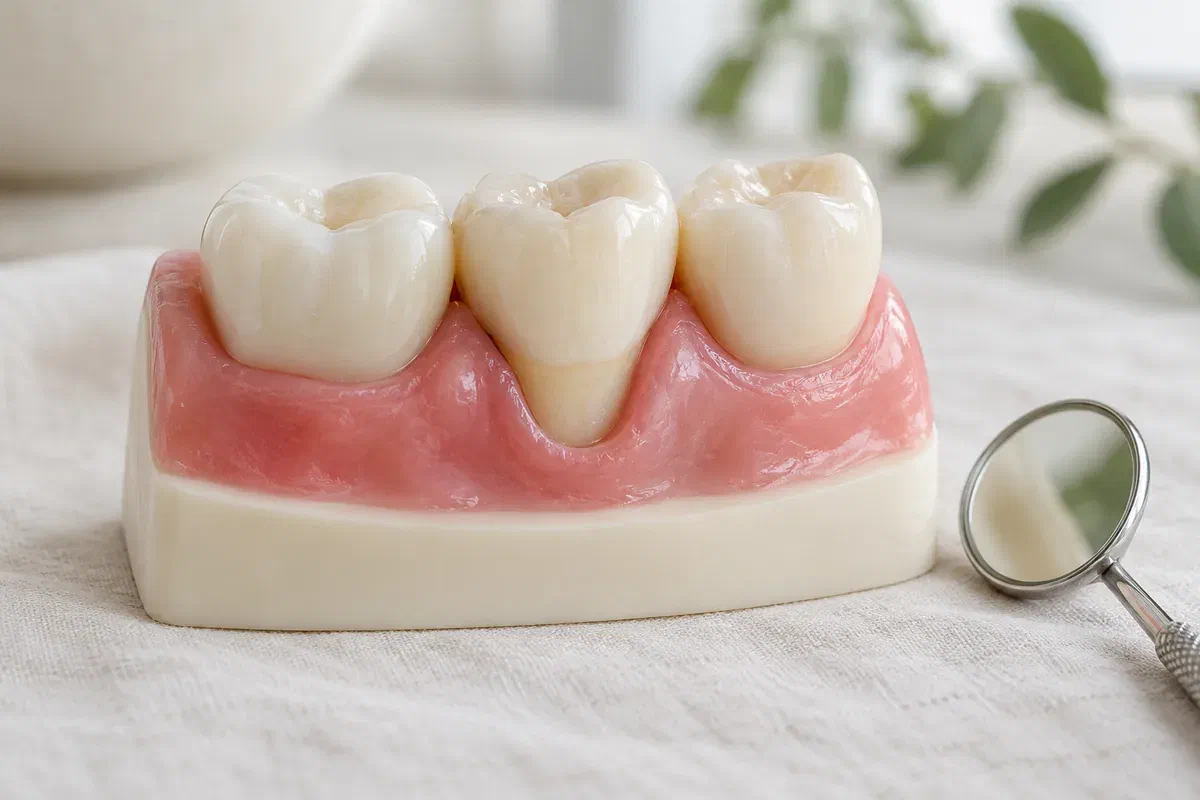
Illustrative physical tooth-and-gum model showing a localized lowered gum margin
Starting points

What made you start asking about grafts?

Tell us which matters most: the look of a tooth, a sensitive spot, cleaning trouble, or a suggestion from another office. That steers the conversation, and the exam then shows which outcomes are within reach for you.

A tooth that now shows more root

Point it out and tell us when you first noticed the difference. Old photos, even casual ones, or past dental records help us judge whether it's progressing. Then we can talk about likely contributors and what to check before deciding whether to observe or treat.

Sensitivity or a hard-to-clean area that's slowing you down

Describe what sets it off and whether you've started skipping that spot when brushing. Sensitivity can come from several sources besides recession. We'll explore whether a nonsurgical measure could help and what grafting would add for you.

A recommendation tied to other planned work

If a graft was proposed before braces, crowns or other treatment, ask how the timelines interact and who's coordinating them. The recommendation should describe the actual concern at that tooth rather than resting on a single word like thin.

Gum grafting treats soft tissue. It cannot be expected to rebuild bone or attachment already lost through periodontal disease, and complete coverage of a root is not something to take for granted.

Is it worth the downtime?

Weigh the benefit, then plan the week.

A graft's value depends on its purpose. For one tooth, it may be about tissue that holds up better over time. For another, partial coverage of an exposed root could be achievable. Ask what change you can expect at your tooth, what likely won't change, and how much recovery that improvement will cost you.

Underlying causes need a plan too. Brushing pressure, inflammation and other habits can keep influencing the gum after surgery. A graft belongs inside continuing care alongside cleanings and good daily habits; it doesn't let you skip them later.

Patient information: Cambridge University Hospitals — soft-tissue grafting goals, procedure, and risks

A realistic picture for your tooth

The tissue and bone around neighbouring teeth affect what any graft can do, and outlooks may vary across your mouth. Ask what should improve, where the doubts are, and how the outcome will be judged at follow-up appointments.

Clarity about the tissue source

Tissue often comes from the palate, though other materials may suit some cases. Ask which is planned and why, and whether a second area will be healing at the same time. A donor site can affect eating and comfort at work, so include it in your decision.

Recovery that fits your schedule

Ask about likely soreness, food and cleaning changes, stitches, reviews and possible complications. Consider meetings, phone calls, physical work and childcare in the days after. No method is free of risk, and if healing goes differently than planned, extra appointments could follow.

What to expect along the way

Assess, choose, treat, heal

You might see one clinician for the assessment and another for the surgery, in different offices. Ask where each step happens and how records and reviews will be shared before booking time off.

  1. Start with history and an examination

    We ask about symptoms, past gum care, cleaning habits, medical history and medicines, then examine the recession and supporting tissue. If extra records or a periodontist's opinion would help confirm the need, we'll say so and explain why.

  2. Pick a goal and a sensible time

    Monitoring, nonsurgical care and grafting are compared where each applies. Ask whether waiting a few months would change anything and what improvement is realistic. Cover the tissue source, any donor site, anaesthetic, fees and any preparatory treatment.

  3. Proceed with the graft if it's indicated

    Your surgeon explains how the site will be readied and how the new tissue will be fixed in place. Local anaesthetic is typical, and any further arrangements are assessed individually. Ask how long the appointment will take so you can plan the rest of the day.

  4. Heal, return and check the purpose

    You should go home with written notes on cleaning, eating, medicines and stitches at every treated spot. Confirm review dates and when your normal routine can resume. Later visits should measure the result against the reason for the graft, not only appearance.

Back to your routine, gradually

A few careful days protect the result.

Aftercare should match the procedure you had. If the graft and donor-site instructions differ, ask for clarification, and keep the treating office's number in your phone for questions during the work day.

Don't check it between meetings

Pulling your lip back in a washroom mirror, pressing on the tissue or testing its attachment can disturb healing. The clinician will assess it at review. Resisting the urge to look is part of the recovery.

Plan meals and cleaning ahead

Normal brushing and flossing may need to pause at the surgical site. Pack soft foods if you'll be eating at work, and follow advice on rinses and when to return to your usual cleaning. A new graft shouldn't get normal brushing until you're cleared.

Know what's normal and when to call

Ask how much soreness and swelling to expect and which pain relief is safe with your health history. Contact the treating provider about ongoing bleeding, increasing pain, fever or other concerns. Keep the stitch and tissue review even if you feel fine.

Patient information: Guy's and St Thomas' — protecting a gum graft and following postoperative instructions

Choosing what's next

Now, later, or not at all?

Ask which option suits the concern documented at your tooth and what you'd gain or give up with each. Symptoms, whether the site is changing, the tissue around it, tooth support and your own priorities all belong in the plan.

When the area appears stable

Watching the site and adjusting home care

The site can be documented and reviewed over time while you refine your cleaning. Ask what would prompt revisiting a graft and how measurements will be compared. Monitoring can be a good fit during a busy period, as long as it has a review date.

When comfort is the immediate goal

Managing the symptom without surgery

Desensitizing products, treating inflammation or a gentler brushing technique may help where appropriate. These don't rebuild tissue, so ask what each can and can't do. Easing sensitivity now doesn't rule out grafting later if it's needed.

When the exam supports surgery

A soft-tissue graft planned for the right time

Compare the expected tissue change with the risks and recovery, and choose a date you can protect. Find out what method is planned and who would perform it, including whether a specialist is the better fit. A grafting page online isn't confirmation of suitability, in-house specialist care or full coverage.

Recovery and timing questions

Planning a graft around work and home

Bring your calendar along with your questions, and ask for the recommendation to be tied to what we actually see at your tooth. The answers below focus on fitting treatment into everyday life.

(905) 876-4488
How many days off should I plan after a gum graft?
It depends on the procedure and your work. Many people plan a quieter day or two, but the treating clinician should give guidance specific to you. Ask about speaking, eating and physical activity so you can plan accordingly.
Will a graft affect how I speak during meetings or calls?
Some people notice tenderness or stitches that make speaking feel different for a short time, especially with a palate donor site. Ask what to expect and whether timing the procedure before a lighter week would help.
Can I exercise or do physical work after a graft?
The treating clinician may advise limiting strenuous activity for a short period. Ask when it’s safe to return to the gym, sports or heavy lifting at work, and what signs would mean you should stop.
Is it safe to delay a recommended graft for a few months?
Sometimes, depending on the site and how quickly it seems to be changing. Ask what the risk of waiting is for your tooth, and whether monitoring or nonsurgical care in the meantime would make sense.
Does every graft aim for full root coverage?
No. Some grafts primarily improve tissue thickness, and coverage varies by site. Ask which result is intended for your tooth and what might limit it, rather than expecting full coverage.
Can grafting be scheduled on a Friday to recover over the weekend?
Ask the treating office about availability. Our own Friday to Sunday hours are by appointment only, so scheduling depends on the provider and the stage of care. Make sure follow-up contact is available during your recovery.
Georgetown grafting consultations

Plan the graft around your life, not the other way round.

Reach our Bronte Street practice to talk about a receding gum, a sensitive tooth or a graft another office has proposed. We'll outline the assessment and explain how we coordinate with a periodontist when one is needed.

Whether a graft is needed, its technique, tissue source, timing, referral, fees, recovery and expected coverage depend on individual assessment.

Visit Milton Dental Clinic
Unit 1, 342 Bronte St. S, Milton, ON L9T 5B7
Get directions Clinic hours
Monday–Thursday
11am–7pm
Friday–Sunday
By appointment only

Areas we serve

  • Milton
  • Oakville
  • Mississauga
  • Georgetown
  • Halton Hills
  • Acton
  • Campbellville
  • Brampton
  • Burlington
  • Puslinch
  • Rockwood
  • Erin
  • Caledon
  • Etobicoke
  • Old Milton
  • Bronte Meadows
  • Timberlea
  • Dorset Park
  • Dempsey
  • Clarke
  • Beaty
  • Coates
  • Harrison
  • Scott
  • Willmott
  • Ford
  • Bowes
  • Cobden
  • Walker
  • Mountain View
  • Milton Heights
  • Hawthorne Village
  • Valley View
  • Fallingbrook
  • Nassagaweya
  • Trafalgar
  • Esquesing
  • Nelson
  • Brookville
  • Moffat
  • Glen Williams
  • Norval
  • Limehouse
  • Stewarttown
  • Ashgrove
  • Hornby
  • Silver Creek
  • Speyside
  • Scotch Block
  • North Oakville
  • River Oaks
  • Glen Abbey
  • West Oak Trails
  • Palermo
  • Bronte Creek
  • College Park
  • Joshua Creek
  • Uptown Core
  • Preserve
  • Iroquois Ridge
  • Lisgar
  • Meadowvale
  • Meadowvale Village
  • Churchill Meadows
  • Erin Mills
  • Central Erin Mills
  • Streetsville
  • East Credit
  • Creditview
  • Heartland
  • Sheridan
  • Mount Pleasant
  • Credit Valley
  • Huttonville
  • Churchville
  • Springbrook
  • Northwest Brampton
  • Bram West
  • Fletcher's Meadow
  • Fletcher's Creek South
  • Alton Village
  • Orchard
  • Millcroft
  • Headon Forest
  • Tansley
  • Brant Hills
  • Tyandaga
  • Kilbride
  • Lowville
  • Aberfoyle
  • Morriston
  • Arkell
  • Hillsburgh
  • Freelton
  • Carlisle
  • Waterdown
  • Flamborough
  • Mountsberg

How can we help?

Milton Dental Clinic

Have a question about your smile? Choose the option that works best for you.

For urgent dental concerns, please call.
Messages are reviewed during clinic hours.