

Illustrative patient and clinician discussing options beside a small gum model
Specialized Care

Gum Grafting in Mississauga

A treatment plan listing grafts on several teeth can feel overwhelming. From Mississauga, you can bring it in for a second look: which sites truly need attention, whether their goals differ, how work might be staged, and where monitoring, nonsurgical care or a periodontist fits into the picture.

A second opinion on grafting

Several teeth on one plan don't share one answer.

It's common to leave an appointment with a printout that lists four or five teeth for grafting and very little explanation of why. Getting another opinion is reasonable. A careful review looks at each site on its own merits rather than treating the list as a single package.

Grafting adds or repositions gum tissue at a tooth for a specific purpose. One site might need thicker tissue to hold up better, another might be a candidate for partial root coverage, and a third might mainly need to become easier to clean. The goal can genuinely differ from tooth to tooth.

If you're coming from Mississauga, bring the plan, any X-rays or photos, and your own questions; the western neighbourhoods of the city are the ones nearest our office. We'll examine each listed area and the support around it, note what may be contributing, and explain which sites look like they'd benefit, which might be watched, and whether a periodontal specialist should be involved.

Request a second opinion from Mississauga
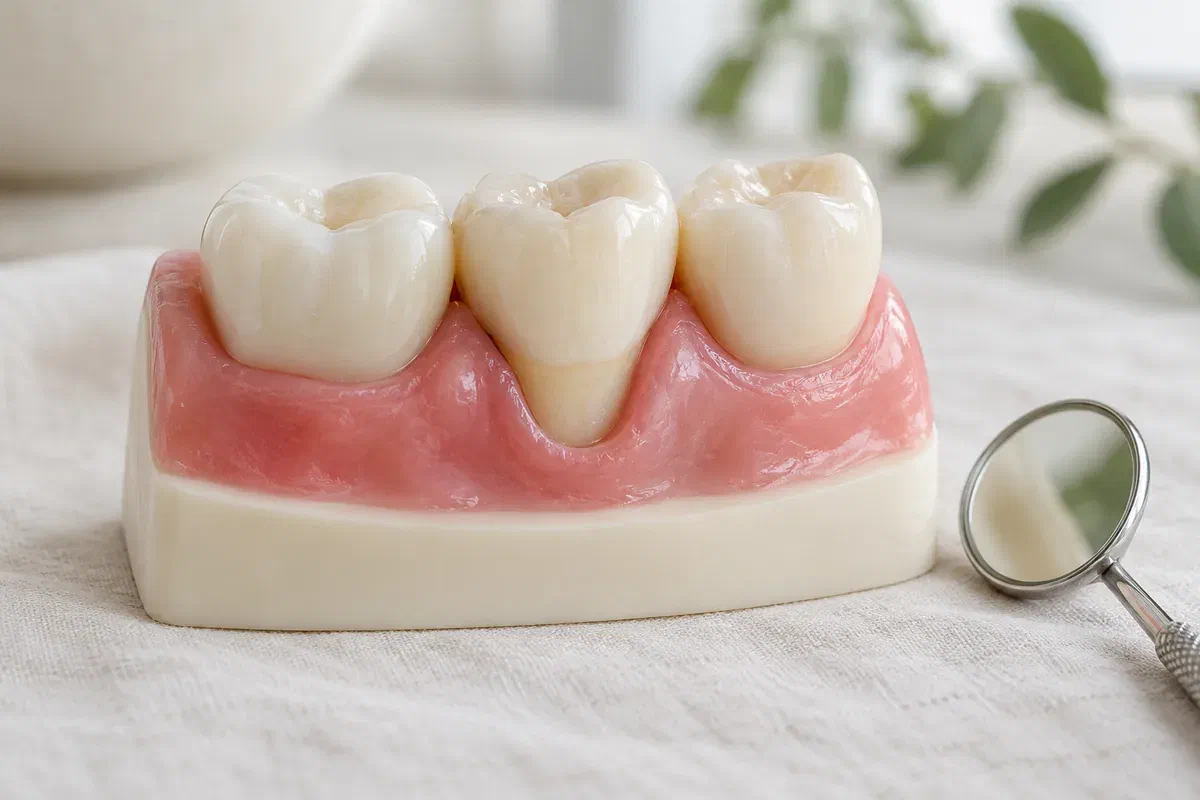
Illustrative physical tooth-and-gum model showing a localized lowered gum margin
Questions behind the plan

Why these teeth, and why now?

Tell us what prompted the recommendation and what matters most to you, whether that's comfort, appearance, cleaning or protecting a tooth for future treatment. That shapes the review, and the exam shows what can realistically change.

Visible recession at more than one tooth

Point out the areas you've noticed and roughly when. If the previous office provided measurements or photos, they help show whether sites are changing or have stayed put. We can then discuss likely causes and what's needed to choose between observing and treating each one.

One sensitive or hard-to-clean site among several

Often a single tooth is the real nuisance. Describe what triggers it and whether it gets in the way of brushing. Sensitivity isn't always caused by recession, so we'll consider whether a nonsurgical approach could help and what a graft would add.

A plan that links grafting with other work

If grafts are listed ahead of crowns, implants nearby or orthodontics, ask how the pieces depend on each other and who is managing the order. Each site's recommendation should describe a specific concern rather than repeating thin tissue across the list.

Gum grafting is soft-tissue treatment. It doesn't rebuild bone or attachment already lost to periodontal disease, and full coverage of each root can't be promised in advance.

Site by site

What should improve at each tooth?

With a multi-site plan, ask for the expected change at every tooth listed. For one, success may simply mean more resilient tissue. For another, some root coverage could be realistic. Knowing what's expected, and what probably won't change, helps you decide whether each site is worth treating.

Look at the causes too. If inflammation, brushing pressure or other habits contributed, they still need managing once the grafts heal. Surgery should sit within a broader care plan; it doesn't remove the need for maintenance, home care or regular review.

Patient information: Cambridge University Hospitals — soft-tissue grafting goals, procedure, and risks

A realistic forecast for every site

The tissue and bone around each tooth influence what's possible, and outlooks can differ across the same plan. Ask for the intended improvement, the uncertainty, and how each result will be reviewed rather than expecting the same gumline everywhere.

Tissue source and how much is needed

Treating several teeth may involve more donor tissue, often from the palate, or the use of other materials where suitable. Ask what's proposed and whether multiple donor areas or sessions would be required. This belongs in your consent discussion.

Recovery across one visit or several

Ask about discomfort, eating and cleaning limits, stitches, reviews and complications for each stage. Consider how staged treatment fits work and family commitments. No technique removes all risk, and further care may be needed if healing differs from the plan.

How a review works

From printout to a plan you understand

Assessment, surgery and reviews may be spread across different offices. Ask where each would happen and how records will travel between them before you agree to dates.

  1. Go through the existing plan and examine each site

    We review the recommendation, your symptoms, earlier gum care, cleaning habits, medical history and medicines. Each listed tooth is assessed along with its supporting structures. We'll say if additional records or a periodontist's opinion would help.

  2. Rank the sites and compare options

    Monitoring, nonsurgical care and grafting are weighed for each area. Ask which sites are most pressing and what deferring the others would mean. Tissue source, donor areas, anaesthetic, fees and any preparatory care should be laid out clearly.

  3. Carry out grafting where indicated, possibly in stages

    The treating clinician explains how each site will be prepared and how tissue will be placed and secured, and whether sites will be treated together or separately. Local anaesthetic is common; other arrangements are assessed individually.

  4. Heal and review each area against its goal

    Expect written instructions for the grafts and any donor site covering cleaning, food, medicines and stitches. Confirm review dates for each stage, and ask when the next site can be scheduled if treatment is staged. Over time, each tooth should be checked against its own purpose, not just its appearance in the mirror.

Caring for treated sites

More than one site means following each set of instructions.

Aftercare should match the specific procedure. If several areas or a donor site were treated, ask whether the instructions differ between them, and keep the treating office's details close by.

Leave every graft undisturbed

Avoid pulling the lip or cheek away, pressing the tissue or checking attachment at any treated site. The clinician will look at each one at review. With several areas healing at once, the temptation to check is stronger, and so is the reason to resist.

Clean and eat around the healing areas

Normal brushing and flossing may need to pause at treated teeth while you keep cleaning elsewhere. Follow the specific advice on rinses, soft foods and when to resume. It can help to note which teeth are off-limits so nobody in the house hands you the wrong instructions. Don't brush any new graft the usual way without the go-ahead.

Watch for warning signs and attend reviews

Ask what discomfort and swelling are expected and how to manage them safely with your health history. Contact the treating office about persistent bleeding, worsening pain, fever or other concerns. Keep every stitch and tissue check.

Patient information: Guy's and St Thomas' — protecting a gum graft and following postoperative instructions

Options for each tooth

Treat some sites, watch others.

Ask which approach matches the documented concern at each tooth and how the options compare. A sound plan accounts for symptoms, stability, tissue type, tooth support and your own priorities.

When a listed site appears stable

Observation and better home care

Some sites may be recorded and reviewed over time while your cleaning is fine-tuned. Ask what change would move a tooth from watching to treating and how comparisons will be made, whether by measurements, photos or both. Each monitored site should have a reason and a follow-up plan, so that waiting is a decision rather than a gap in care.

When the need at a site is different

Nonsurgical help for symptoms or causes

Desensitizing care, inflammation management or adjusting your brushing may suit certain teeth. These don't replace tissue, so ask what each can accomplish. A symptom at one tooth and a structural concern at another might need different approaches.

When the exam supports surgery at that site

Grafting where it brings a clear benefit

For each tooth proposed, compare the expected change with risks and recovery. Ask about technique and whether a periodontist should do the work. Inclusion on a plan or a website doesn't prove suitability, on-site specialist care or complete coverage.

Second-opinion questions

Testing a multi-tooth grafting plan

Have the printout handy and ask for every listed tooth to be explained in terms of what was actually found there. The questions below can help you sort the urgent recommendations from the optional ones, and make it easier to decide what to do first.

(905) 876-4488
Is it reasonable to get a second opinion on a gum-graft plan?
Yes. Grafting is elective in many situations, and understanding the reasoning is part of consent. Bring the original plan and any records so the review can build on what was already found rather than starting from scratch.
Do all the teeth on my plan need to be grafted at once?
Not necessarily. Some plans stage treatment, and some sites may be suitable for monitoring. Ask which areas are most pressing, whether sites can be grouped into fewer sessions, and what waiting on lower-priority teeth would mean for them over the next year or two.
Why would two neighbouring teeth have different expected results?
Each site’s tissue, bone support and position can differ, which affects what a graft can achieve. Ask for the expected outcome at each tooth rather than assuming they’ll all respond the same way.
Should I expect every treated root to be fully covered?
No. Some grafts mainly aim to improve tissue thickness, and coverage depends on the site. Ask what’s intended at each tooth and what might limit it. Complete coverage shouldn’t be assumed.
Will treating several sites mean more donor tissue from my palate?
It might, depending on the technique and materials. Ask whether your own tissue or an alternative is proposed, how much would be needed, and whether that affects staging, healing or comfort.
Do grafts restore the bone that has been lost?
No. Soft-tissue grafts and treatments aimed at regenerating deeper support are different. Ask which structures each procedure addresses, and don’t take improved coverage as proof that lost support has returned.
Mississauga second opinions

Understand each site before agreeing to the whole list.

Get in touch with our Bronte Street practice about a grafting plan, recession or a sensitive area. We'll explain the review involved and how we'd liaise with a periodontist or whoever drew up your original plan.

Each site's need for grafting, the technique, tissue source, staging, fees, recovery and likely coverage depend on individual assessment.

Visit Milton Dental Clinic
Unit 1, 342 Bronte St. S, Milton, ON L9T 5B7
Get directions Clinic hours
Monday–Thursday
11am–7pm
Friday–Sunday
By appointment only

Areas we serve

  • Milton
  • Oakville
  • Mississauga
  • Georgetown
  • Halton Hills
  • Acton
  • Campbellville
  • Brampton
  • Burlington
  • Puslinch
  • Rockwood
  • Erin
  • Caledon
  • Etobicoke
  • Old Milton
  • Bronte Meadows
  • Timberlea
  • Dorset Park
  • Dempsey
  • Clarke
  • Beaty
  • Coates
  • Harrison
  • Scott
  • Willmott
  • Ford
  • Bowes
  • Cobden
  • Walker
  • Mountain View
  • Milton Heights
  • Hawthorne Village
  • Valley View
  • Fallingbrook
  • Nassagaweya
  • Trafalgar
  • Esquesing
  • Nelson
  • Brookville
  • Moffat
  • Glen Williams
  • Norval
  • Limehouse
  • Stewarttown
  • Ashgrove
  • Hornby
  • Silver Creek
  • Speyside
  • Scotch Block
  • North Oakville
  • River Oaks
  • Glen Abbey
  • West Oak Trails
  • Palermo
  • Bronte Creek
  • College Park
  • Joshua Creek
  • Uptown Core
  • Preserve
  • Iroquois Ridge
  • Lisgar
  • Meadowvale
  • Meadowvale Village
  • Churchill Meadows
  • Erin Mills
  • Central Erin Mills
  • Streetsville
  • East Credit
  • Creditview
  • Heartland
  • Sheridan
  • Mount Pleasant
  • Credit Valley
  • Huttonville
  • Churchville
  • Springbrook
  • Northwest Brampton
  • Bram West
  • Fletcher's Meadow
  • Fletcher's Creek South
  • Alton Village
  • Orchard
  • Millcroft
  • Headon Forest
  • Tansley
  • Brant Hills
  • Tyandaga
  • Kilbride
  • Lowville
  • Aberfoyle
  • Morriston
  • Arkell
  • Hillsburgh
  • Freelton
  • Carlisle
  • Waterdown
  • Flamborough
  • Mountsberg

How can we help?

Milton Dental Clinic

Have a question about your smile? Choose the option that works best for you.

For urgent dental concerns, please call.
Messages are reviewed during clinic hours.