

Illustrative young adult discussing a wisdom-tooth assessment with a dental clinician
Specialized Care

Impacted Wisdom Teeth Removal in Brampton

When an orthodontist or dentist mentions your teenager's wisdom teeth, the next questions are usually yours. For Brampton households, here is how an impacted tooth is assessed in a young person, why removal is or is not advised, and how surgery, consent and recovery would be arranged.

For parents of teens and young adults

Your child's X-ray shows an impacted wisdom tooth. Here is what that means.

Wisdom teeth usually come through, if they do, in the late teens or early twenties, and X-rays taken for braces or a checkup often show them well before then. One described as impacted is not on track to come in normally, because the jaw is short of space or the tooth is angled. It may stay under bone or gum, or partly emerge later. The word itself does not decide whether surgery is needed.

The recommendation should come from the same considerations used for adults: symptoms, any disease, effects on the second molar, how likely trouble is later on, and what surgery itself could risk. Age and root development can also enter the conversation about timing. Some teeth are best monitored; others have a clear reason to come out. You should hear which applies, and why.

For a Brampton household juggling school and activities, the first visit can be simple. Bring your teen, any images from the orthodontist or another office, and a note of symptoms they have mentioned. We will explain what we see, the care available, and whether a referral to an oral and maxillofacial surgeon is wise. Both of you should understand the purpose, alternatives, recovery, and risks before agreeing to anything.

Book a wisdom-tooth assessment for your teen
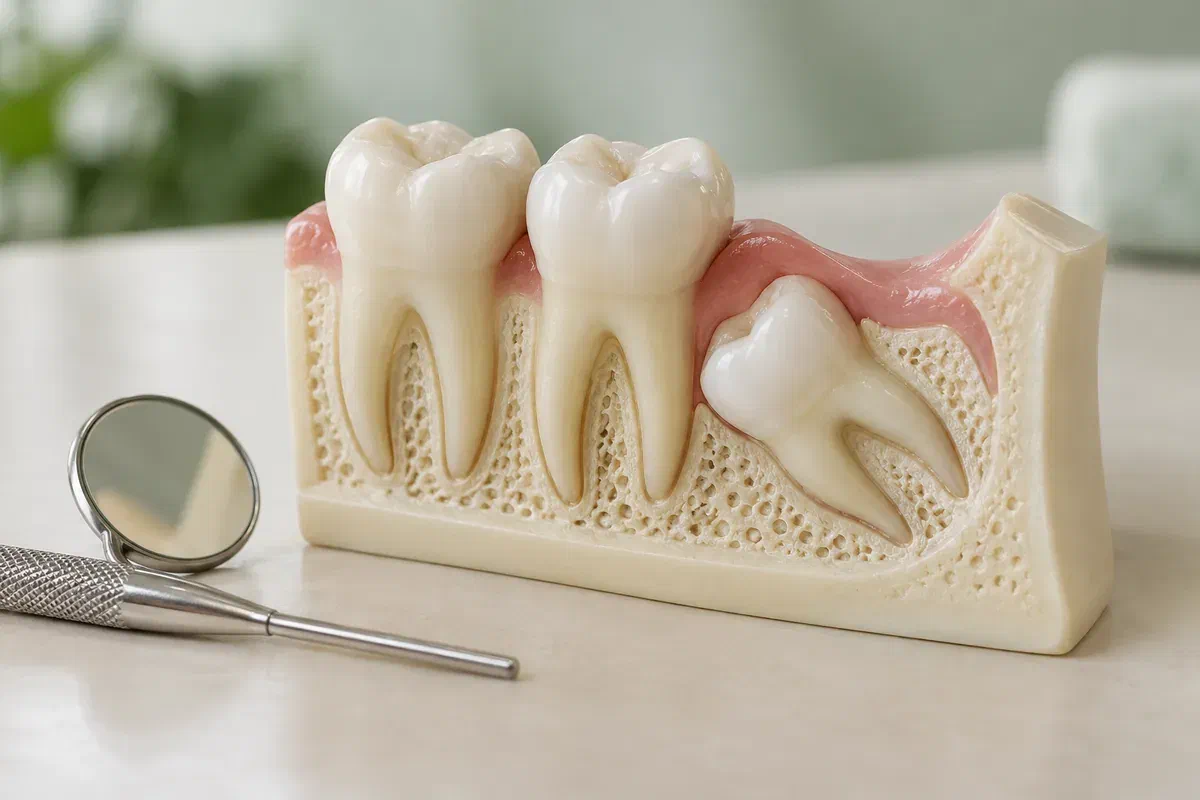
Illustrative physical jaw model with an angled wisdom tooth behind two upright molars
What a parent might notice

Sometimes they complain. Often they do not.

Ask your teen whether the back of the mouth has hurt, felt swollen, or tasted bad, and pass along anything the orthodontist said. That helps separate an active problem from a finding that deserves a thoughtful talk about monitoring and risk.

Soreness behind the back molars

Teens may mention a sore spot, pain when chewing, or trouble brushing at the very back, sometimes only when asked. Note any earlier episodes and how they were handled. A flare-up may need care before a surgical decision, and swelling that keeps increasing or difficulty opening should be reported quickly rather than left for a routine visit.

Concern for the second molar

An impacted tooth tilted against the molar in front can affect it in ways that only images show. Ask whether that tooth shows decay or other changes. If it also needs treatment, find out how the care would be ordered.

Spotted during orthodontic records

Orthodontic X-rays often show wisdom teeth before they cause any feeling. It is fair to ask if the images show any disease, which possible problem down the road is on the clinician's mind, and how keeping an eye on it would work. Having had braces does not by itself mean the wisdom teeth must come out, and a lack of symptoms does not settle the question either.

Call us promptly if your teen has growing swelling, a fever, or increasing difficulty opening. Swelling near the eye, swelling that spreads quickly, or any difficulty breathing or swallowing needs emergency medical care immediately, not a wait for a dental appointment.

What surgery could and could not do

Removal should answer a real problem.

If removal is advised, it should target a specific source of disease or a carefully weighed risk. Ask which problem the procedure is meant to address and whether other treatment would still be needed. A common worry is that wisdom teeth will undo orthodontic work; removal should not be presented as a guaranteed way to keep teeth straight or to solve unrelated jaw pain.

Impacted teeth differ in depth, angle, and root shape. Lower teeth can lie near the nerve that gives feeling to the lip, while upper ones can sit against the sinus, and each raises its own questions. The consultation is the place to learn how those factors shape the technique, the setting, and whether a specialist should treat your teen.

Patient information: British Association of Oral and Maxillofacial Surgeons — impacted wisdom-tooth treatment decisions and risks

The case for waiting and the case for removing

Ask what could happen if the tooth stays and what removal would risk, using your teen's own findings. A rule that every wisdom tooth must go is not a reason. If monitoring is reasonable, ask what change would bring the decision back.

Anatomy-based planning

Depth, angle, and how close the tooth lies to nerves, the sinus, and the next molar all shape the surgical plan. A more detailed scan is only worth taking if its answer could change what happens. Ask what any extra image adds rather than assuming it is routine for teens.

Clear information about healing and risks

Cover swelling, soreness, bleeding, dry socket, infection, and location-specific risks. For lower teeth, altered sensation can occasionally persist. Ask how the risk is judged for your teen and what follow-up is available. Young people deserve a full consent conversation too, and should be part of it.

How we plan it with you

From first look to the ride home

Nobody is booked for surgery just by coming in for an assessment. What happens next reflects your teen's symptoms, anatomy, and health history, the treatment on offer, and whether a specialist opinion or further investigation comes first.

  1. Gather health details and records

    Share your teen's history of pain, swelling, or infections, plus medicines, allergies, and relevant medical conditions. Bring orthodontic or other earlier images. Mention anxiety or past experiences with anaesthetic so comfort can be planned honestly.

  2. Explain findings to both of you

    We go over the reason for any treatment, whether monitoring is an option, and any alternative suited to the tooth. Ask how the tooth's depth and angle change the risk and whether a surgeon should see your teen. Fees, the likely number of visits, and consent questions should be clear before you decide.

  3. Carry out the procedure where it fits

    Taking out an impacted tooth sometimes means a small cut in the gum, removing a little bone, and splitting the tooth into pieces so each comes out with control. The approach and anaesthetic plan are explained beforehand. Sedation or general anaesthesia is only used after a suitability assessment and when the provider can offer it.

  4. Send you home prepared

    Written aftercare covers bleeding, brushing, meals, medicines, activity, and any stitches. Confirm the review plan and how to reach the team with a concern. After sedation, an adult escort and supervision are typically required; follow the treating provider's specific rules on driving and activity.

Helping your teen recover

A few calm days at home, with someone keeping watch.

Follow the written instructions given for the procedure and your teen's health. Healing varies, so ask what is expected and which symptoms should prompt a call, rather than comparing with an older sibling's experience.

Gentle cleaning and soft choices

Ask how your teen should clean the rest of the mouth while protecting the socket and any stitches. Discourage poking at the site with a tongue, finger, or improvised tool. Offer the foods recommended and restart normal brushing when the treating team says.

Medicines, rest, and supervision

Give pain relief only as the clinician or pharmacist directs, with your teen's health history in mind. Continue prescribed medicines unless told otherwise. Plan for an adult to be around if required, and check anaesthetic restrictions before school, sports, or driving.

Changes that mean you should call

Phone the treating provider if bleeding carries on despite the steps you were shown, if pain or swelling starts climbing, if a fever appears, or if your teen reports a worrying change in feeling. Pain that worsens after initially improving needs a review. Not every hard recovery is normal, and antibiotics are not automatically required.

Paths to discuss together

Watch it, remove it, or consider coronectomy?

Your teen's wisdom teeth may not all need the same answer. Weigh what each choice could gain against what it could cost, and what it would mean for later checkups, symptoms, and care.

When observation is supported

Monitoring as your teen grows

If nothing currently calls for surgery, the tooth can be looked at during regular dental visits, with an X-ray only when there is a reason for one. Find out what is being watched and which findings would change the advice. Monitoring is a deliberate plan, not a promise that problems will never develop.

When removal clearly benefits this tooth

Removal of the impacted tooth

Go through what the surgery involves, the risks for this particular tooth, the anaesthetic plan, and where it would happen. Ask if a specialist is the better choice and whether each of the other wisdom teeth has its own reason. A sound recommendation explains why this tooth, not simply all four together.

Mainly for lower teeth near the nerve

Coronectomy

A surgeon may remove the crown and leave suitable roots in place to reduce a specific nerve-injury risk. It is not right for every tooth. Ask whether it applies to your teen at all, how retained roots are monitored, and whether later surgery might be needed.

Patient information: British Association of Oral and Maxillofacial Surgeons — coronectomy selection and retained-root considerations

Brampton parents ask

Questions about teens and wisdom teeth

Bring orthodontic or other X-rays, or let us know which office holds them. The most useful conversation ties any proposed treatment to the tooth, its anatomy, and your teen's health.

(905) 876-4488
Will wisdom teeth push my teen's straightened teeth out of line?
Wisdom teeth are not considered a reliable cause of crowding after braces, and removal is not usually recommended for that reason alone. If your orthodontist has a specific concern, bring it to the assessment so the findings can be discussed together.
Is it easier to remove wisdom teeth when someone is younger?
Surgeons sometimes discuss timing because roots and bone change with age, which can affect complexity and healing. That is a factor in planning, not a reason to remove a tooth that has no indication. The decision still rests on your teen’s findings.
Can my teen agree to treatment, or do I need to?
In Ontario, consent depends on whether the person understands the treatment and its risks, not on a fixed age. We involve both your teen and you in the discussion so that everyone understands the plan.
How much school might my teen miss?
It varies with the type of surgery, the anaesthetic used, and your teen’s healing. Many people plan a few quieter days. Ask for an estimate based on the actual plan, and check any restrictions on sports or activities.
If the orthodontist suggested taking out all four, does that mean all four must go?
Not necessarily. Each tooth needs its own reason. Sometimes several are treated together for practical reasons, but you should hear the findings for each tooth and how combining them affects anaesthetic and recovery.
Does my teen need to be supervised after surgery?
After sedation or general anaesthesia, a responsible adult is usually required for a period set by the treating provider. Even after local anaesthetic, it helps to have someone around for the first evening. Follow the specific instructions you receive.
Teen and adult wisdom-tooth care for Brampton

Talk it through together before deciding.

Contact our Bronte Street practice to arrange an assessment for an impacted wisdom tooth, recurring soreness at the back of the mouth, or a recommendation from an orthodontist or surgeon. Mention worsening swelling or pain when you call, and bring earlier records if you have them.

Whether monitoring, removal, or coronectomy is appropriate, along with imaging, anaesthetic, setting, referral, and individual risk, depends on clinical assessment, and neither a procedure nor an urgent appointment can be promised.

Visit Milton Dental Clinic
Unit 1, 342 Bronte St. S, Milton, ON L9T 5B7
Get directions Clinic hours
Monday–Thursday
11am–7pm
Friday–Sunday
By appointment only

Areas we serve

  • Milton
  • Oakville
  • Mississauga
  • Georgetown
  • Halton Hills
  • Acton
  • Campbellville
  • Brampton
  • Burlington
  • Puslinch
  • Rockwood
  • Erin
  • Caledon
  • Etobicoke
  • Old Milton
  • Bronte Meadows
  • Timberlea
  • Dorset Park
  • Dempsey
  • Clarke
  • Beaty
  • Coates
  • Harrison
  • Scott
  • Willmott
  • Ford
  • Bowes
  • Cobden
  • Walker
  • Mountain View
  • Milton Heights
  • Hawthorne Village
  • Valley View
  • Fallingbrook
  • Nassagaweya
  • Trafalgar
  • Esquesing
  • Nelson
  • Brookville
  • Moffat
  • Glen Williams
  • Norval
  • Limehouse
  • Stewarttown
  • Ashgrove
  • Hornby
  • Silver Creek
  • Speyside
  • Scotch Block
  • North Oakville
  • River Oaks
  • Glen Abbey
  • West Oak Trails
  • Palermo
  • Bronte Creek
  • College Park
  • Joshua Creek
  • Uptown Core
  • Preserve
  • Iroquois Ridge
  • Lisgar
  • Meadowvale
  • Meadowvale Village
  • Churchill Meadows
  • Erin Mills
  • Central Erin Mills
  • Streetsville
  • East Credit
  • Creditview
  • Heartland
  • Sheridan
  • Mount Pleasant
  • Credit Valley
  • Huttonville
  • Churchville
  • Springbrook
  • Northwest Brampton
  • Bram West
  • Fletcher's Meadow
  • Fletcher's Creek South
  • Alton Village
  • Orchard
  • Millcroft
  • Headon Forest
  • Tansley
  • Brant Hills
  • Tyandaga
  • Kilbride
  • Lowville
  • Aberfoyle
  • Morriston
  • Arkell
  • Hillsburgh
  • Freelton
  • Carlisle
  • Waterdown
  • Flamborough
  • Mountsberg

How can we help?

Milton Dental Clinic

Have a question about your smile? Choose the option that works best for you.

For urgent dental concerns, please call.
Messages are reviewed during clinic hours.