

Illustrative young adult discussing a wisdom-tooth assessment with a dental clinician
Specialized Care

Impacted Wisdom Teeth Removal in Burlington

A gum flap at the back of your mouth that swells, aches and settles, then does it all again, is often how an impacted wisdom tooth makes itself known. From Burlington, get the flare-up looked at first, then a calm discussion of whether removal is the right long-term answer.

When the back gum flares again

Settle today's swelling. Decide about the tooth afterward.

It often starts with a dull ache when you chew, a sour taste, or a ridge of puffy gum behind your last molar. Those episodes are common around a wisdom tooth that is impacted, meaning it has not been able to come fully into position because of limited space or a tilted path. Part of it may sit above the gum while the rest stays covered by gum or bone.

A flare-up is a reason to be seen, but not automatically a reason for surgery. Once the area calms down, the longer-term decision looks at how often episodes happen, whether there is disease, how the molar in front is doing, what is likely next, and the risks of taking the tooth out. For some people, the pattern makes a strong case for removal. For others, monitoring remains fair.

When you call from Burlington, tell us how long this has been going on, what has helped, and whether anyone has already suggested removal. Bring earlier images if you can. We will look at the area, explain what we find and the care available, and discuss whether an oral surgeon should be involved. Any plan should make clear its purpose, the alternatives, the recovery, and the risks for your particular anatomy.

Get a flaring wisdom tooth checked
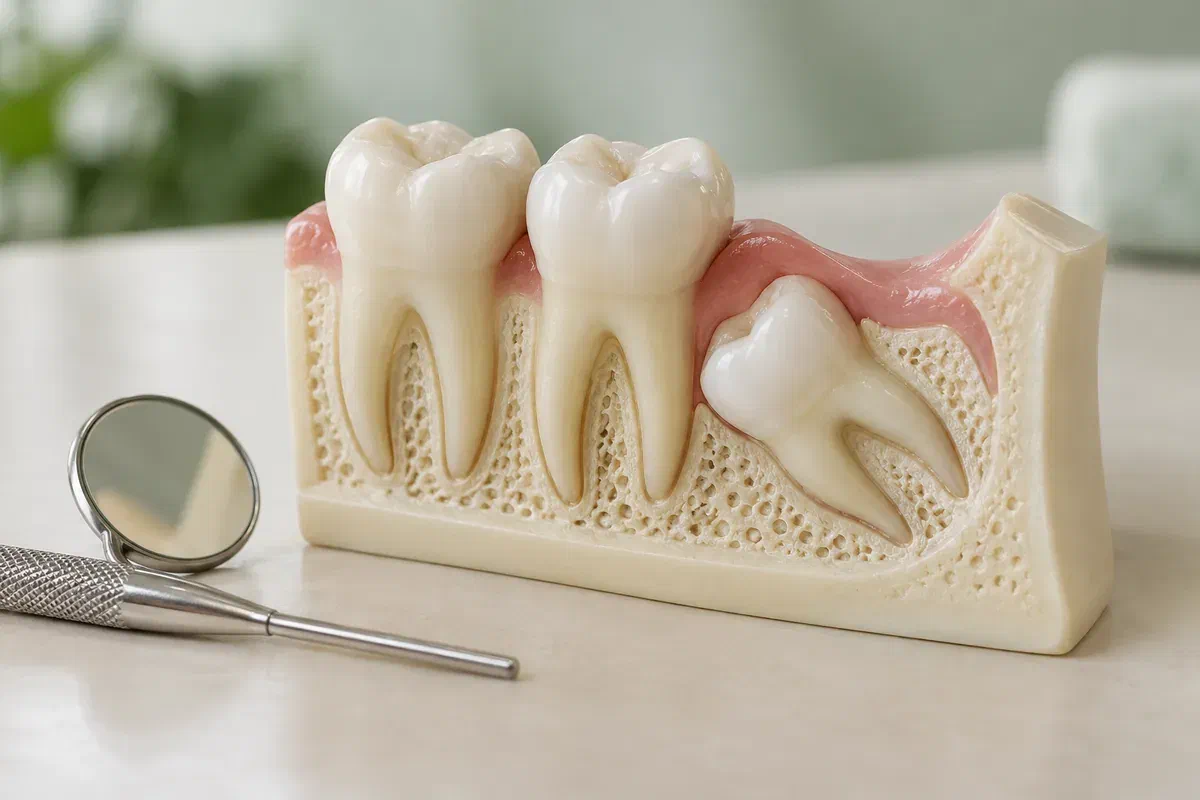
Illustrative physical jaw model with an angled wisdom tooth behind two upright molars
Reading the pattern

One bad week, or a cycle that keeps returning?

Frequency matters. Let us know whether this is a first episode, the latest of several, or whether a different tooth issue brought you in. That history helps us separate an active infection from a longer-term question of risk.

Swelling and tenderness over a half-visible tooth

Food and bacteria can collect under the gum covering part of the tooth, leading to soreness, a bad taste, or pain when biting. Note earlier episodes and any treatment, such as cleaning or medicine. An active flare-up may need care before a surgical decision, and swelling that keeps growing or a jaw that opens less each day should be reported promptly.

Effects on the tooth just in front

A wisdom tooth that keeps trapping debris can affect the back surface of the second molar. Ask whether the images show decay or bone changes there. If that tooth needs treatment, discuss how it would be timed alongside any extraction.

A different tooth, with no complaints

Sometimes the sore side gets all the attention, while an impacted tooth on the other side has never caused trouble. Ask whether that quieter tooth shows disease and what monitoring it would need. It deserves its own decision rather than being swept into the plan for the painful one.

Call us the same day if swelling is getting bigger, you develop a fever, or it is harder to open your mouth. Swelling spreading toward the eye or neck, or any trouble breathing or swallowing, needs emergency medical care straight away rather than a dental booking.

What removal could change

Ending a cycle of infection is a concrete aim.

When episodes keep coming back, removing the tooth is often discussed because it addresses the area where the problem starts. Even so, ask exactly what the procedure would resolve and whether other care, such as treatment on the neighbouring molar, would still follow. Taking out a wisdom tooth will not settle jaw pain from a different cause.

No two impacted teeth present the same challenge. A lower tooth near the nerve that gives feeling to the lip and chin is a different case from an upper tooth near the sinus. At the consultation, ask how those details affect the technique, where the procedure should take place, and whether a specialist is the better choice.

Patient information: British Association of Oral and Maxillofacial Surgeons — impacted wisdom-tooth treatment decisions and risks

A balanced look at removal versus keeping it

Ask what you can expect if the tooth stays, given how often it has flared, and what removing it would risk. Your own history and images should drive the answer. If monitoring is chosen, find out what would prompt another discussion.

Planning around bone, nerves, and sinus

The clinician considers where the tooth sits relative to its neighbours, the bone, and nearby nerves or the sinus. Another image may help if it would answer a question that changes the plan. Ask what that image adds rather than assuming it is routine.

Knowing what recovery may involve

Discuss swelling, soreness, bleeding, dry socket, infection, and risks related to the tooth's position. Lasting changes in sensation are uncommon but possible with lower teeth. Ask about your own risk and what follow-up is in place. Consent matters even for a frequently performed procedure.

After the flare-up settles

A four-part path from sore gum to a decision

Being seen for an episode does not mean surgery happens at the same visit. The plan depends on symptoms, anatomy, medical history, what can be offered, and whether a specialist opinion or more tests are needed.

  1. Record the episodes

    Note roughly when flare-ups began, how often they return, and what you have used to manage them. Bring your medicines, allergies, health conditions, and any earlier images. Tell the clinician about dental anxiety or past experiences with anaesthetic so comfort can be planned fairly.

  2. Talk through findings and alternatives

    We explain what the examination shows, whether removal is advisable, whether monitoring could work, and any other option for this tooth. Ask how its position changes the risk and whether a referral fits. Cover fees, the number of visits, and anything still unclear before deciding.

  3. Remove the tooth in the right setting, if agreed

    The procedure can involve opening the gum, removing some bone around the tooth, and cutting it into pieces for controlled removal. You will be told the approach and anaesthetic plan in advance. Sedation or general anaesthesia is considered only after a suitability check and when a provider can confirm it.

  4. Plan the first days of healing

    Leave with instructions for bleeding, cleaning, eating, medicines, activity, and any stitches. Confirm when you will be seen again and how to reach help. If sedation was used, follow the provider's directions on escort, supervision, driving, and activity.

Once the tooth is out

Healing should trend in one direction.

Rely on the written instructions for your procedure and health. Recovery is not the same for everyone, so ask what is expected for you and what should make you call, instead of using a relative's experience as the guide.

Protect the socket while you clean

Ask how to brush the rest of your mouth and when rinsing is appropriate, keeping the socket and stitches undisturbed. Avoid touching the site with fingers, tongue, or tools. Eat the foods suggested and go back to normal cleaning when the treating team advises.

Set up pain relief and support

Use pain medicine as directed by your clinician or pharmacist, considering your health history. Do not stop blood thinners or other prescriptions without advice. Have help ready if you need it, and check anaesthetic restrictions before work, driving, or exercise.

Watch for a change in direction

Contact the treating provider if bleeding persists after the measures you were shown, if pain or swelling increases, or if you develop fever or an unusual change in sensation. Pain that grows again after easing is worth assessing. Not every uncomfortable recovery is normal, and antibiotics are not always required.

Choosing a direction

Is the cycle enough of a reason?

Base the choice on this tooth alone. Ask how the expected benefit measures up against the risks, and what each option means for reviews, future flare-ups, and further care.

When flare-ups are rare and no disease is found

Monitoring between episodes

If the tooth has no ongoing problem, regular clinical checks with imaging when justified may be reasonable. Ask what is being watched and what would change the advice. This is a deliberate plan, not a promise that the area will never flare again.

When repeated problems support extraction

Removing the impacted tooth

Go over the procedure, risks for this tooth, anaesthetic, and the setting. Ask whether an oral surgeon should be involved and whether your other wisdom teeth need separate assessment. The plan should explain why removal fits this tooth instead of treating all four as one package.

When a lower tooth sits close to the nerve

Coronectomy

In selected cases, a surgeon removes the crown and leaves suitable roots in place to reduce a specific nerve-injury risk. It is not right for every tooth. Ask about eligibility, how the roots would be followed, and whether more surgery might be needed later.

Patient information: British Association of Oral and Maxillofacial Surgeons — coronectomy selection and retained-root considerations

Burlington questions about flare-ups

When the same spot keeps getting sore

Bring any images you have, or tell us where they were taken. The best discussion links the plan to the tooth, its surroundings, and your health, rather than to the flare-up alone.

(905) 876-4488
What causes the gum around a wisdom tooth to swell up?
Often it is inflammation called pericoronitis. Food and bacteria collect under the flap of gum covering part of the tooth, and the area becomes sore and swollen. It can come and go. An examination confirms the cause and whether anything else needs attention.
Can I manage a mild flare-up at home until my appointment?
Gentle cleaning of the area and warm salt-water rinses are commonly suggested, along with pain relief that suits your health. Call us to arrange an assessment. If swelling grows, fever develops, or opening becomes difficult, contact us promptly, and seek emergency care for any breathing or swallowing difficulty.
Will antibiotics fix the problem?
Antibiotics may be used in some cases, such as spreading infection, but they do not change the position of the tooth. Many flare-ups are managed by cleaning the area. The longer-term decision is about whether the tooth is likely to keep causing episodes.
How many flare-ups does it take before removal is recommended?
There is no set number. Repeated or severe episodes often strengthen the case for removal, but the decision also weighs disease, the neighbouring tooth, your health, and surgical risk. Ask how your history fits into that balance.
Can the tooth be removed while the gum is still infected?
That depends on the situation. Sometimes the infection is settled first and surgery is planned afterward. Your clinician will explain the timing that makes sense for your symptoms and the tooth’s position.
Pain was improving after removal but has now worsened. Who should I contact?
Call the provider who treated you, particularly if there is swelling, fever, a bad taste, or trouble opening. Several different healing problems can cause this, and they are managed differently. Do not pack the socket yourself or assume more antibiotics are needed.
Wisdom-tooth care for Burlington

Get the flare-up seen, then plan the next step.

Call our Bronte Street practice about a sore wisdom tooth, gum swelling that keeps returning, or a recommendation for removal. Let us know if swelling or pain is getting worse when you call, and bring any previous records you have.

Monitoring, extraction, coronectomy, imaging, anaesthetic, setting, referral, and personal risk all need clinical assessment first. We cannot guarantee a procedure or an urgent appointment.

Visit Milton Dental Clinic
Unit 1, 342 Bronte St. S, Milton, ON L9T 5B7
Get directions Clinic hours
Monday–Thursday
11am–7pm
Friday–Sunday
By appointment only

Areas we serve

  • Milton
  • Oakville
  • Mississauga
  • Georgetown
  • Halton Hills
  • Acton
  • Campbellville
  • Brampton
  • Burlington
  • Puslinch
  • Rockwood
  • Erin
  • Caledon
  • Etobicoke
  • Old Milton
  • Bronte Meadows
  • Timberlea
  • Dorset Park
  • Dempsey
  • Clarke
  • Beaty
  • Coates
  • Harrison
  • Scott
  • Willmott
  • Ford
  • Bowes
  • Cobden
  • Walker
  • Mountain View
  • Milton Heights
  • Hawthorne Village
  • Valley View
  • Fallingbrook
  • Nassagaweya
  • Trafalgar
  • Esquesing
  • Nelson
  • Brookville
  • Moffat
  • Glen Williams
  • Norval
  • Limehouse
  • Stewarttown
  • Ashgrove
  • Hornby
  • Silver Creek
  • Speyside
  • Scotch Block
  • North Oakville
  • River Oaks
  • Glen Abbey
  • West Oak Trails
  • Palermo
  • Bronte Creek
  • College Park
  • Joshua Creek
  • Uptown Core
  • Preserve
  • Iroquois Ridge
  • Lisgar
  • Meadowvale
  • Meadowvale Village
  • Churchill Meadows
  • Erin Mills
  • Central Erin Mills
  • Streetsville
  • East Credit
  • Creditview
  • Heartland
  • Sheridan
  • Mount Pleasant
  • Credit Valley
  • Huttonville
  • Churchville
  • Springbrook
  • Northwest Brampton
  • Bram West
  • Fletcher's Meadow
  • Fletcher's Creek South
  • Alton Village
  • Orchard
  • Millcroft
  • Headon Forest
  • Tansley
  • Brant Hills
  • Tyandaga
  • Kilbride
  • Lowville
  • Aberfoyle
  • Morriston
  • Arkell
  • Hillsburgh
  • Freelton
  • Carlisle
  • Waterdown
  • Flamborough
  • Mountsberg

How can we help?

Milton Dental Clinic

Have a question about your smile? Choose the option that works best for you.

For urgent dental concerns, please call.
Messages are reviewed during clinic hours.