

Illustrative young adult discussing a wisdom-tooth assessment with a dental clinician
Specialized Care

Impacted Wisdom Teeth Removal in Campbellville

For many people, the hardest part of wisdom-tooth surgery is the thought of it. In Campbellville, here is a plain account of how an impacted tooth is assessed, which anaesthetic and sedation options may be discussed, who needs to drive you home, and how recovery is planned.

If the thought of surgery makes you uneasy

Knowing what will happen tends to make it easier.

Nervousness about wisdom teeth is very common, and it often comes from not knowing what the procedure involves or whether it is even necessary. Start there. An impacted wisdom tooth is one that could not erupt properly, usually because the jaw had too little space or the tooth grew at an angle. It may lie under gum or bone, or partly show. That alone does not mean you need surgery.

What settles the question is a set of specifics: symptoms, any disease, the state of the molar beside it, the likelihood of future problems, and the risks the procedure would carry. Some teeth are reasonably watched. Some have a clear reason to come out. If yours is one of the latter, the next conversation is about how to make the experience manageable.

From Campbellville, Nassagaweya, or elsewhere in rural Milton, bring any previous images and a note about your worries as well as your symptoms. We will explain the findings, the care available, and whether an oral surgeon should be involved, including when sedation is part of the discussion. You should understand the purpose, alternatives, recovery, and risks for your anatomy before deciding.

Talk through your wisdom tooth, and your worries
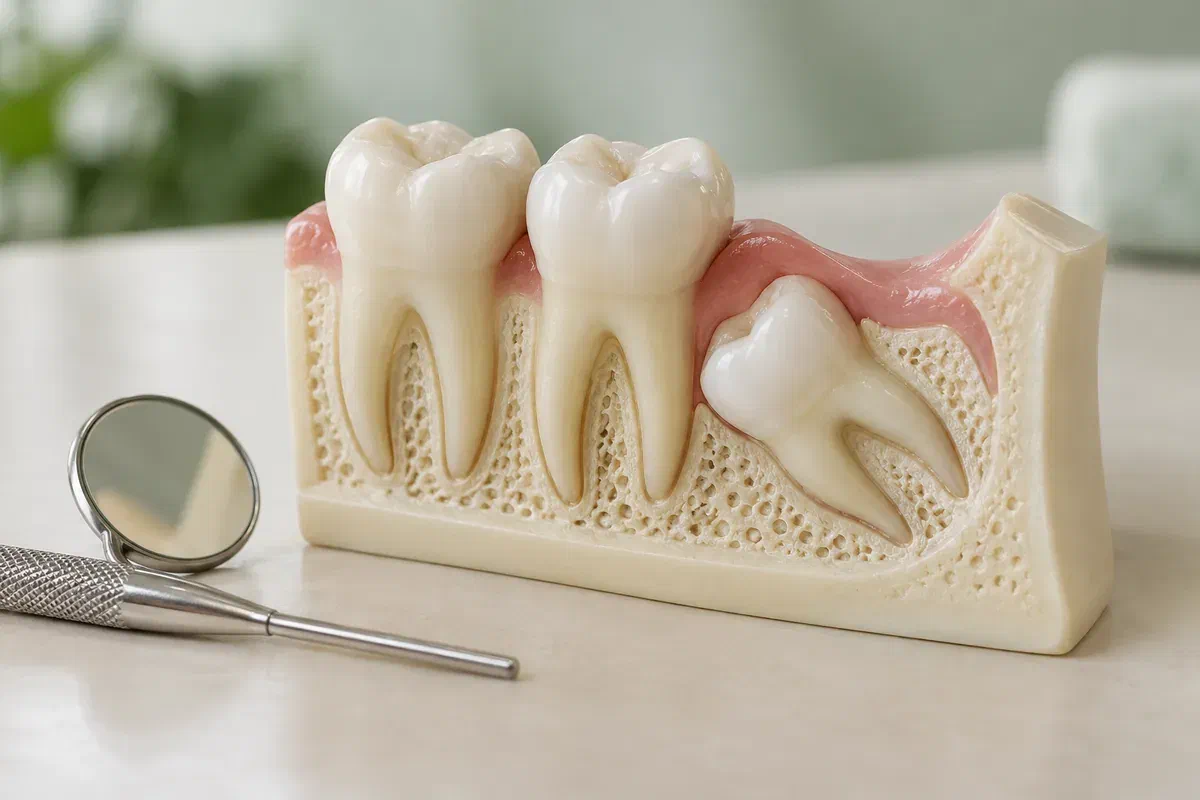
Illustrative physical jaw model with an angled wisdom tooth behind two upright molars
Why the tooth has come up

Is something wrong, or was it just noticed?

Tell us whether the area has hurt repeatedly, changed lately, or never caused any sensation. Knowing this helps tell a problem that needs attention from one that can be discussed calmly over time.

An ache or swelling at the back

Puffy, tender gum around a partly visible tooth, food trapped beneath it, or soreness when chewing are common reasons people call. Note any earlier episodes and how they settled. A flare-up may need care first, and swelling that grows or difficulty opening should be reported soon rather than left until a planned visit.

Concerns about the molar ahead of it

An impacted tooth can affect the second molar without any warning sign you would notice. Ask whether the images show decay or bone changes there, and how any treatment for that tooth would fit with the wisdom-tooth decision.

Found by chance, with no symptoms

Many impacted teeth are discovered on a routine X-ray. Ask whether there is disease, what future concern is being considered, and what watching it would mean. Feeling nothing is not proof that all is well, and the word impacted is not proof that surgery is needed.

Do not wait if swelling is getting worse, you develop a fever, or it is becoming hard to open your mouth; call us. If swelling spreads quickly, affects the eye, or makes breathing or swallowing difficult, go for emergency medical care immediately.

Making the reason clear

A clear purpose is the best reassurance.

When removal is recommended, it should target a specific source of disease or a risk that has been carefully weighed. Knowing that purpose often makes the decision feel more solid. Ask what the procedure would fix and whether any further care would follow. It is not a remedy for unrelated jaw pain or a guarantee about how your teeth will line up later.

The difficulty of removing an impacted tooth varies. A lower tooth near the sensory nerve and an upper tooth beside the sinus each bring different considerations. Those details also influence the setting, the anaesthetic that suits, and whether a specialist should provide care, so ask how they apply to you.

Patient information: British Association of Oral and Maxillofacial Surgeons — impacted wisdom-tooth treatment decisions and risks

Knowing why, before deciding how

Ask what could happen if the tooth stays and what removal would risk, based on your own examination and images. A general policy is not a reason. If monitoring is sensible, ask which changes would bring the topic back.

A plan built on your anatomy

The clinician reviews how the tooth sits relative to its neighbours, bone, and nerves or sinus. Additional imaging is worthwhile only when it would alter the plan. Ask what a proposed scan would show.

Clear expectations about healing

Talk about swelling, soreness, bleeding, dry socket, infection, and position-related risks. With lower teeth, altered feeling can occasionally persist. Ask how your risk is assessed and what follow-up exists. Being informed is part of feeling in control.

What to expect, step by step

Nothing happens without an explanation first.

An assessment is not surgery. The plan depends on your symptoms, anatomy, health history, the treatment available, and whether a specialist visit or further imaging is needed, and you can take time to decide.

  1. Tell us about your health and your nerves

    Describe past pain, swelling, or infections in the area. Bring your medicines, allergies, medical conditions, and earlier X-rays. Be open about dental anxiety, fainting, or difficult past anaesthetic experiences so comfort options can be discussed honestly.

  2. Hear the findings and the comfort options

    We explain why treatment is or is not recommended, whether monitoring could work, and any alternative for this tooth. Ask which anaesthetic approach would suit and whether referral to a surgeon is advised. Fees, visit numbers, and other questions should be answered before you choose.

  3. Treatment, with the approach agreed in advance

    Surgery may involve opening the gum, removing some bone, and dividing the tooth so it can be lifted out gently and in a controlled way. Local anaesthetic numbs the area; sedation or general anaesthesia is not assumed and depends on suitability and on a provider who can offer it.

  4. Going home with a plan and a driver

    You receive guidance on bleeding, cleaning, food, medicines, activity, and stitches, and you confirm who to contact. After sedation, a responsible adult must take you home and stay as instructed; in a rural household, arrange that driver well ahead of the day.

Recovering at home

Rest, protect the site, and keep the phone close.

Follow the written instructions you are given. Healing varies from one person to the next, so ask what to expect for you and which symptoms should prompt a call.

Look after the socket

Ask how to clean the rest of your mouth without disturbing the socket or stitches. Leave the site alone rather than probing it. Eat the foods suggested, and resume normal brushing near the area as your treating team advises.

Have medicines and help organised

Use pain relief as your clinician or pharmacist directs, with your medical history in mind. Do not stop blood thinners or other prescribed medicines on your own. Arrange someone to be with you if required, and check driving, work, and exercise limits after anaesthetic.

Know when to call

Contact the treating provider about bleeding that does not settle with the steps shown, increasing pain or swelling, fever, or a change in sensation that worries you. Pain that worsens after easing deserves assessment. Some discomfort is expected, but not every pattern is normal, and antibiotics are not always the answer.

Options to weigh

Three approaches, each with its own reasoning

Decide for this tooth on its own. Ask how the benefit compares with the risk and what each option would mean for future checkups, symptoms, and treatment.

When there is no current reason for surgery

Monitoring

A tooth without an indication for removal can be checked at regular visits, with imaging when justified. Ask what you are watching for and what would change the advice. Monitoring is a plan, not a promise of no future problems.

When taking it out clearly helps

Removal

Discuss the procedure, the risks for this tooth, your anaesthetic preferences, and the setting. Ask whether a surgeon should treat you and whether any other wisdom tooth needs its own decision rather than being included by default.

When a lower tooth sits very near the nerve

Coronectomy

In selected cases, a surgeon removes the crown and leaves suitable roots in place to reduce the chance of nerve injury. It is not right for every tooth. Ask about eligibility, monitoring of the roots, and possible later treatment.

Patient information: British Association of Oral and Maxillofacial Surgeons — coronectomy selection and retained-root considerations

Campbellville questions

Questions people ask when they are nervous

Bring previous X-rays if you have them, or let us know which office took them. The best answers link the plan to your tooth, its anatomy, your health, and your comfort.

(905) 876-4488
Will I feel pain during the procedure?
Local anaesthetic is used to numb the area, so most people feel pressure and movement rather than sharp pain. Let the clinician know if you feel discomfort so more anaesthetic can be given or the approach adjusted.
What is the difference between sedation and general anaesthesia?
With sedation, you are relaxed and drowsy but still breathing on your own and able to respond. General anaesthesia means being fully unconscious, usually in a hospital or specialist setting. Both need assessment, preparation, and an escort afterward.
Can I signal to stop if I need a break?
Yes. Agree on a simple signal before starting, such as raising a hand. The clinician can pause when it is safe to do so.
Who needs to drive me home?
After sedation or general anaesthesia, you need a responsible adult to take you home and stay with you for the time the treating provider specifies. You should not drive yourself. With local anaesthetic only, ask whether driving is fine for you.
Is it normal to feel anxious about wisdom-tooth surgery?
Very. Telling us early lets us explain each step, discuss comfort options, and plan breaks. Anxiety is one of the factors considered when choosing an anaesthetic approach, along with complexity and your health.
What if my wisdom tooth has never hurt? Should I still worry about it?
Not necessarily. An absence of symptoms is one factor alongside disease, the neighbouring tooth, future risk, and surgical risk. Ask what the images show and what monitoring would involve if keeping the tooth is reasonable.
Wisdom-tooth assessments for Campbellville

Start with a conversation, not a procedure.

Call our Bronte Street practice to discuss an impacted wisdom tooth, a recurring sore spot, or a surgical recommendation, and mention any anxiety you have. If swelling or pain is getting worse, tell us when you get in touch, and bring any earlier records.

Monitoring, removal, coronectomy, imaging, anaesthetic or sedation options, setting, referral, and individual risk depend on clinical assessment. No procedure, sedation option, or urgent appointment can be guaranteed.

Visit Milton Dental Clinic
Unit 1, 342 Bronte St. S, Milton, ON L9T 5B7
Get directions Clinic hours
Monday–Thursday
11am–7pm
Friday–Sunday
By appointment only

Areas we serve

  • Milton
  • Oakville
  • Mississauga
  • Georgetown
  • Halton Hills
  • Acton
  • Campbellville
  • Brampton
  • Burlington
  • Puslinch
  • Rockwood
  • Erin
  • Caledon
  • Etobicoke
  • Old Milton
  • Bronte Meadows
  • Timberlea
  • Dorset Park
  • Dempsey
  • Clarke
  • Beaty
  • Coates
  • Harrison
  • Scott
  • Willmott
  • Ford
  • Bowes
  • Cobden
  • Walker
  • Mountain View
  • Milton Heights
  • Hawthorne Village
  • Valley View
  • Fallingbrook
  • Nassagaweya
  • Trafalgar
  • Esquesing
  • Nelson
  • Brookville
  • Moffat
  • Glen Williams
  • Norval
  • Limehouse
  • Stewarttown
  • Ashgrove
  • Hornby
  • Silver Creek
  • Speyside
  • Scotch Block
  • North Oakville
  • River Oaks
  • Glen Abbey
  • West Oak Trails
  • Palermo
  • Bronte Creek
  • College Park
  • Joshua Creek
  • Uptown Core
  • Preserve
  • Iroquois Ridge
  • Lisgar
  • Meadowvale
  • Meadowvale Village
  • Churchill Meadows
  • Erin Mills
  • Central Erin Mills
  • Streetsville
  • East Credit
  • Creditview
  • Heartland
  • Sheridan
  • Mount Pleasant
  • Credit Valley
  • Huttonville
  • Churchville
  • Springbrook
  • Northwest Brampton
  • Bram West
  • Fletcher's Meadow
  • Fletcher's Creek South
  • Alton Village
  • Orchard
  • Millcroft
  • Headon Forest
  • Tansley
  • Brant Hills
  • Tyandaga
  • Kilbride
  • Lowville
  • Aberfoyle
  • Morriston
  • Arkell
  • Hillsburgh
  • Freelton
  • Carlisle
  • Waterdown
  • Flamborough
  • Mountsberg

How can we help?

Milton Dental Clinic

Have a question about your smile? Choose the option that works best for you.

For urgent dental concerns, please call.
Messages are reviewed during clinic hours.