

Illustrative young adult discussing a wisdom-tooth assessment with a dental clinician
Specialized Care

Impacted Wisdom Teeth Removal in Mississauga

Exams, a new job, a trip already booked: impacted wisdom teeth rarely pick a convenient moment. For Mississauga adults, here is how a removal decision is made, how surgery and anaesthetic are arranged, and how to plan recovery around the rest of your life.

Fitting a decision into a busy calendar

Timing matters, but the reason matters more.

Most people in their late teens and twenties hear about wisdom teeth at some point, often with a question about when to deal with them. An impacted one has been held back from erupting normally, usually by crowding or an angled path, and may stay hidden in bone, sit under the gum, or break through only partway. That is a description of where it is, and nothing more.

Whether it should come out is decided by symptoms, any disease present, the state of the second molar, the chance of trouble later, and the risks of the surgery. Some teeth can sensibly be watched; some have a firm reason for removal. A gap in your schedule is a good time to act on a decision, but it is not itself the reason to have surgery.

Mississauga students and working adults often want to know early how much time to set aside. Bring any images or past recommendations and tell us what you have felt. We will explain our findings, the treatment available, and whether a referral to a surgeon makes sense, so that before booking anything you know why treatment is proposed, what else could be done, what recovery involves, and which risks your anatomy brings.

Plan a wisdom-tooth assessment
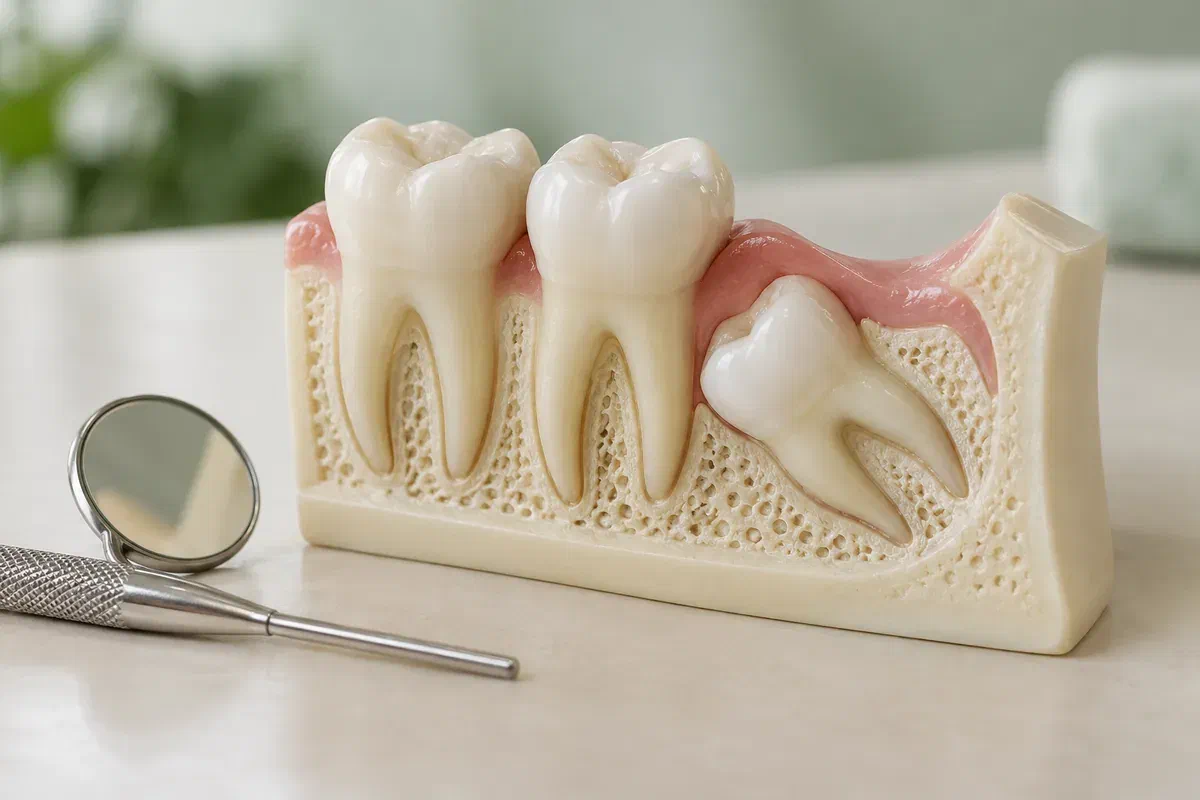
Illustrative physical jaw model with an angled wisdom tooth behind two upright molars
What might be going on

Three situations that bring a wisdom tooth up

Tell us whether the tooth has caused trouble more than once, started bothering you recently, or has never been noticed. That helps us distinguish something that needs attention now from a finding to weigh calmly.

Tender gum during a busy stretch

Soreness, swelling, or food caught under the gum at the back can be easy to ignore when life is full. Mention past episodes and what helped. A current flare-up may need care before any surgery is planned, and swelling that spreads or a jaw that is stiffening should be reported quickly, even in the middle of exams.

A neighbouring molar at risk

The tooth in front can be affected by an impacted wisdom tooth leaning into it, often without obvious signs. Ask whether the images show decay or other changes on that molar. If it needs treatment too, find out how both pieces of care would be scheduled.

A routine X-ray finding

Many people learn about an impacted tooth at a regular checkup with no symptoms at all. Ask whether there is disease, what future concern is in mind, and what monitoring would look like. A pain-free tooth is not automatically safe to ignore, and impacted does not automatically mean remove.

Call promptly if swelling grows, a fever starts, or opening your mouth becomes harder. If swelling affects your breathing, swallowing, or eye, or spreads quickly, go for emergency medical care rather than waiting for a scheduled dental visit.

Why removal might be recommended

A clear target makes surgery easier to plan around.

Removal is worth it when it addresses a defined source of disease or a risk that has been carefully judged. Ask what problem the surgery should solve and whether any other treatment would still be needed. It is not the answer to unrelated jaw aches, and it should not be presented as protection against every change in your bite.

Each impacted tooth has its own level of difficulty. A lower tooth near the sensory nerve and an upper tooth close to the sinus raise different questions. The consultation should cover how those details affect the method, the setting, and whether a specialist should take on the procedure, which in turn affects how much time you plan for recovery.

Patient information: British Association of Oral and Maxillofacial Surgeons — impacted wisdom-tooth treatment decisions and risks

What happens if you wait, versus what surgery risks

You should hear the likely course if the tooth stays and the risks if it is taken out, based on your own findings. A general rule to remove all wisdom teeth is not a reason. If watching is reasonable, ask what change would reopen the decision.

A plan shaped by the tooth's surroundings

Its position relative to other teeth, bone, nerves, and the sinus guides the surgical approach. More imaging may be suggested if it would answer a question that alters the plan. Ask what that view would show rather than assuming everyone gets the same scan.

Realistic recovery expectations

Healing may bring swelling and soreness, and complications such as bleeding, dry socket, or infection are possible, along with risks tied to where the tooth sits. For lower teeth, numbness occasionally lingers. Find out how your own risk is judged and what follow-up you can expect. Being young and healthy does not replace an informed consent conversation.

Planning it around your schedule

Assess. Decide. Treat. Recover.

An assessment does not lock you into surgery that day. What comes next hinges on your symptoms, anatomy, and medical history, on what treatment can be offered, and on whether a specialist visit or more tests come first, which is worth knowing before you set dates.

  1. Start with your history and dates

    Describe any pain, swelling, or infections and what treatment you have had. Bring a medicine and allergy list, relevant health details, and earlier images. Mention anxiety or past anaesthetic experiences, and any fixed dates such as exams or travel, so planning can be realistic.

  2. Understand the findings and the choices

    We explain the reason for treatment, whether monitoring is an option, and any alternative for this tooth. Ask how its position affects risk and whether referral is advised. Fees, the expected number of appointments, and open questions should be sorted out before you decide.

  3. Book the procedure in a suitable setting

    The surgeon may need to open the gum, take away a little bone, and cut the tooth into sections so it can be removed with control. The approach and anaesthetic are explained in advance. Sedation or general anaesthesia is never a given and depends on suitability and the provider's availability.

  4. Leave with aftercare and a contact plan

    Expect written guidance about bleeding, keeping clean, eating, medicines, activity, and any stitches. Confirm your review and how to raise concerns. If sedation was used, follow the provider's rules on having an escort, supervision, driving, and activity, including when you can return to class or work.

The recovery stretch

Clear some space, then notice how healing goes.

Follow the written instructions given for your procedure and health. Recovery differs between people, so ask what to expect and which symptoms mean you should call, rather than going by a classmate's or co-worker's story.

Look after the socket and eat with care

Ask how to clean the rest of your mouth while protecting the extraction site and stitches. Do not probe the socket or try to clean it out with improvised tools. Choose the recommended foods and resume normal brushing as your treating team directs.

Arrange medicines, rest, and help

Take pain relief following your clinician's or pharmacist's directions and your medical history. Do not stop prescribed medicines, including blood thinners, without guidance. Line up help if you need it and confirm anaesthetic-related restrictions before planning shifts, driving, sports, or the gym.

Speak up when something changes

Let the treating provider know if bleeding keeps going despite the advised measures, if pain or swelling worsens, if you run a fever, or if sensation changes unexpectedly. Pain that builds again after improving should be checked. Not every painful recovery is normal, and not all of them call for antibiotics.

Your options

Watching, removing, or a partial approach

Decide tooth by tooth. Ask how the expected benefit weighs against the risks and what each choice means for future reviews, symptoms, and further treatment.

If observation is a reasonable choice

Keep it under review

When nothing currently justifies surgery, the tooth can simply be reviewed at your regular checkups, with imaging if there is a reason. Ask what is being tracked and what would tip the advice toward removal. Watching is a plan, not a guarantee the tooth will never become a problem.

If removal brings a clear benefit

Take the tooth out

Cover what the procedure involves, the risks particular to this tooth, the anaesthetic, and where it would happen. Ask whether a surgeon should perform it and whether your remaining wisdom teeth deserve their own decisions. The reason should fit this tooth rather than an automatic plan to remove all four.

If a lower tooth lies close to the nerve

Coronectomy

In some lower teeth, the crown can be taken off while suitable roots are deliberately left behind, to reduce a particular nerve-injury risk. It is not an option for every tooth. Ask about eligibility, monitoring of the roots, and the chance of later surgery.

Patient information: British Association of Oral and Maxillofacial Surgeons — coronectomy selection and retained-root considerations

Questions from Mississauga

Practical questions about timing and recovery

Bring any X-rays you have, or tell us where they were taken. The most helpful conversation links the proposed treatment to your tooth, its anatomy, and your health, as well as your schedule.

(905) 876-4488
Is it better to have wisdom teeth out before starting university or a new job?
Only if there is a reason to remove them. Timing can make recovery easier to manage, but the decision itself should rest on your findings, not your calendar. If removal is recommended, we can talk through how much time to plan around it.
How soon can I go back to sports or the gym?
It depends on the procedure, the anaesthetic, and how healing goes. Strenuous exercise is usually limited for a short time afterward. Ask the treating provider for guidance that fits your surgery and your activity, especially contact sports.
Can I drive myself home after the procedure?
With local anaesthetic alone, often yes, but ask first. After sedation or general anaesthesia, you will need an escort and must not drive for the period the treating provider specifies.
Should I avoid travelling right after surgery?
It is wise to stay within reach of the treating provider for the first days, in case bleeding, swelling, or worsening pain needs a review. If you have a trip planned, mention it early so timing can be discussed.
Can the gum look fine even if the tooth underneath is causing a problem?
Yes. The gum surface does not show the roots, bone, or the side of the molar in front. Examination and suitable imaging give a better picture. Ask which findings matter in your case.
Do I need to be fully asleep to have an impacted tooth removed?
No. Local anaesthetic is often suitable. Sedation or general anaesthesia depends on complexity, health, anxiety, and the setting, and needs assessment and confirmed availability. Ask what is proposed and what it requires on the day.
Wisdom-tooth assessments for Mississauga

Know the plan before you clear your calendar.

Get in touch with our Bronte Street practice about an impacted wisdom tooth, recurring soreness, or a removal recommendation. Let us know about worsening swelling or pain when you contact us, and bring any earlier records.

The right choice between monitoring, removal, or coronectomy, as well as imaging, anaesthetic, setting, referral, and personal risk, depends on clinical assessment. We cannot guarantee procedures or urgent appointments.

Visit Milton Dental Clinic
Unit 1, 342 Bronte St. S, Milton, ON L9T 5B7
Get directions Clinic hours
Monday–Thursday
11am–7pm
Friday–Sunday
By appointment only

Areas we serve

  • Milton
  • Oakville
  • Mississauga
  • Georgetown
  • Halton Hills
  • Acton
  • Campbellville
  • Brampton
  • Burlington
  • Puslinch
  • Rockwood
  • Erin
  • Caledon
  • Etobicoke
  • Old Milton
  • Bronte Meadows
  • Timberlea
  • Dorset Park
  • Dempsey
  • Clarke
  • Beaty
  • Coates
  • Harrison
  • Scott
  • Willmott
  • Ford
  • Bowes
  • Cobden
  • Walker
  • Mountain View
  • Milton Heights
  • Hawthorne Village
  • Valley View
  • Fallingbrook
  • Nassagaweya
  • Trafalgar
  • Esquesing
  • Nelson
  • Brookville
  • Moffat
  • Glen Williams
  • Norval
  • Limehouse
  • Stewarttown
  • Ashgrove
  • Hornby
  • Silver Creek
  • Speyside
  • Scotch Block
  • North Oakville
  • River Oaks
  • Glen Abbey
  • West Oak Trails
  • Palermo
  • Bronte Creek
  • College Park
  • Joshua Creek
  • Uptown Core
  • Preserve
  • Iroquois Ridge
  • Lisgar
  • Meadowvale
  • Meadowvale Village
  • Churchill Meadows
  • Erin Mills
  • Central Erin Mills
  • Streetsville
  • East Credit
  • Creditview
  • Heartland
  • Sheridan
  • Mount Pleasant
  • Credit Valley
  • Huttonville
  • Churchville
  • Springbrook
  • Northwest Brampton
  • Bram West
  • Fletcher's Meadow
  • Fletcher's Creek South
  • Alton Village
  • Orchard
  • Millcroft
  • Headon Forest
  • Tansley
  • Brant Hills
  • Tyandaga
  • Kilbride
  • Lowville
  • Aberfoyle
  • Morriston
  • Arkell
  • Hillsburgh
  • Freelton
  • Carlisle
  • Waterdown
  • Flamborough
  • Mountsberg

How can we help?

Milton Dental Clinic

Have a question about your smile? Choose the option that works best for you.

For urgent dental concerns, please call.
Messages are reviewed during clinic hours.