Illustrative young adult discussing a wisdom-tooth assessment with a dental clinician
Specialized Care

Impacted Wisdom Teeth Removal in Puslinch

A wisdom tooth that has never hurt can still end up on a treatment plan. If you are coming from Puslinch, this page sets out how a pain-free impacted tooth is judged, what removing it to prevent problems would and would not achieve, and what a real monitoring plan looks like.

A pain-free tooth on the treatment plan

Should a tooth that never hurt come out?

Careful clinicians can reach different views on this, and the honest answer is that it depends. An impacted wisdom tooth has been stopped from erupting into place, usually by a shortage of room or by its angle, so it remains in the bone, under the gum, or only half through. Plenty of them stay quiet for years. Some eventually cause trouble. The label does not predict which.

To decide, the clinician looks for signs of disease, checks the molar in front, considers how likely future problems are, and sets that against the risks surgery would bring for this tooth. Age, health, and anatomy all play a part. Removal to prevent problems is sometimes reasonable, and monitoring is sometimes the wiser choice; the reasoning should be specific to you.

For a Puslinch household that groups appointments to save trips, a monitoring plan can often ride along with routine checkups. Bring any earlier images and mention anything you have noticed, however minor. We will go over the findings, explain the options, and say whether a referral makes sense, so the purpose, alternatives, recovery, and risks are clear before any decision.


Weigh up a pain-free wisdom tooth
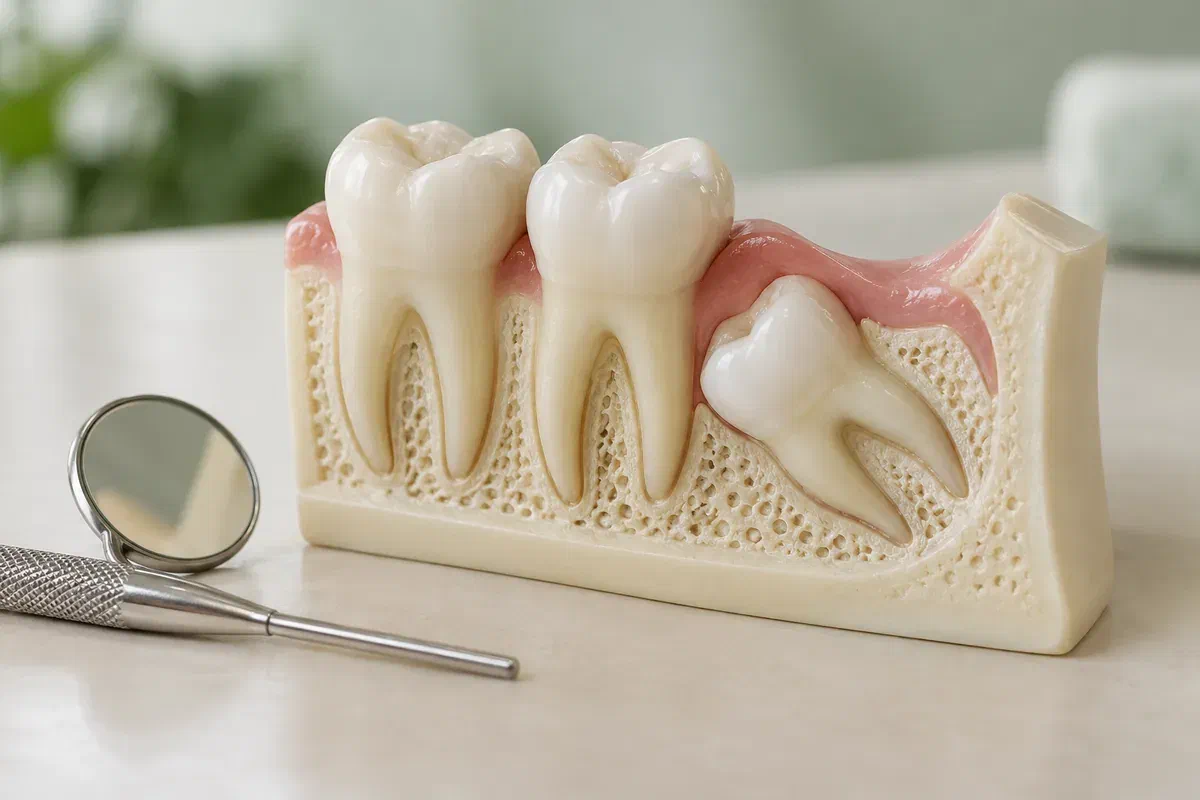
Illustrative physical jaw model with an angled wisdom tooth behind two upright molars
Looking past the lack of pain

Quiet does not always mean healthy, or unhealthy.

Tell us if the tooth has ever caused a twinge, a flare-up, or a bad taste, even once, or if it has truly never been noticed. Small details help us tell whether the advice is about current disease or about weighing future risk.

Occasional gum irritation you shrugged off

A brief sore spot behind the last molar, a bit of swelling that faded, or food that catches now and then can hint at a partly erupted tooth. Mention it, even if it settled. If an episode is happening now and the swelling is spreading or opening is harder, phone us that day rather than waiting.

Changes on the second molar

A symptom-free wisdom tooth can still be linked to decay or bone loss on the molar ahead of it. Ask whether the images show anything there. If they do, that may shift the balance, and you should hear how both teeth would be treated.

Nothing found except the position

Sometimes the only finding is that the tooth is impacted. Ask what future concern, if any, is driving a recommendation, and what monitoring would involve. The absence of disease is meaningful, but it does not guarantee things will stay that way.

If swelling increases, a fever appears, or your jaw stiffens, contact us promptly. Swelling that moves toward the eye, spreads fast, or interferes with breathing or swallowing is an emergency: go to emergency medical care straight away.

What preventive removal can offer

Fewer future problems, at the cost of surgery now

Removing a symptom-free impacted tooth is intended to head off a specific risk, such as future infection or damage to the neighbouring molar. Ask how likely that risk is in your case and what the procedure would realistically prevent. It is not a way to stop unrelated jaw pain or to keep other teeth from shifting.

The surgical side of the balance varies from tooth to tooth. Roots near the sensory nerve in the lower jaw, or an upper tooth close to the sinus, raise the stakes. The consultation should explain how those features affect the technique, the setting, and whether specialist care would be wise, because that is part of the cost you are weighing.

Patient information: British Association of Oral and Maxillofacial Surgeons — impacted wisdom-tooth treatment decisions and risks

Two futures compared

Ask what is likely if the tooth remains and what the surgery itself could cause. That comparison should come from your images and examination. If you choose monitoring, ask which findings would prompt you to reconsider.

Imaging that earns its place

The clinician considers the tooth's relationship to neighbouring teeth, bone, nerves, and the sinus. A detailed scan is worth taking only if it could change the recommendation. Ask what it would add before agreeing to it.

Recovery costs, stated honestly

Even planned surgery brings swelling, soreness, and some risk of bleeding, dry socket, or infection. In the lower jaw, altered sensation occasionally lasts. Ask how your personal risk compares and what follow-up you would have. For a preventive procedure, these details matter even more.

Reaching a decision

Weigh it, then choose, without pressure.

Nothing needs to be decided on the day. The plan follows from your findings, anatomy, health history, what treatment can be offered, and whether a specialist opinion or more detailed imaging would help.

  1. Fill in the background

    Mention any past symptoms, even minor ones, and treatment near the tooth. Bring a list of medicines, allergies, and health conditions, along with earlier X-rays. Let us know about worries or past experiences with anaesthetic so comfort can be considered properly.

  2. Compare removal and monitoring side by side

    We set out what the images show, whether there is a current reason to treat, and how monitoring would work. Ask how the tooth's depth and angle change surgical risk and whether a specialist should see it. Fees, visits, and questions should be settled before you choose.

  3. If removal is chosen, treat in the right setting

    The tooth may be reached by opening the gum and removing a little bone, then divided so it comes out in a controlled way. You will know the method and anaesthetic plan beforehand. Sedation or general anaesthesia is considered only after a suitability check and when a provider can offer it.

  4. Leave knowing how to heal and who to call

    Written instructions cover bleeding, rinsing and brushing, meals, medicines, activity, and any stitches. Confirm your review and the contact route for concerns. After sedation, follow the escort, supervision, and driving rules the provider gives you.

Healing after a planned removal

Planned surgery still needs careful aftercare.

Your instructions are tailored to your procedure and health. Healing differs between people, so ask what to expect and which symptoms mean you should call instead of waiting it out.

Leave the socket to settle

Ask how to keep your other teeth clean while the socket and any stitches heal. Avoid checking the area with your tongue or tools. Stick to the foods recommended and return to normal brushing nearby when advised.

Plan rest around work and home

Take pain relief as your clinician or pharmacist directs, considering your medical history. Do not stop a blood thinner or other medicine without advice. If your work is physical, check anaesthetic and activity limits, and arrange help with chores for the first days.

Notice when healing changes direction

Call the treating provider if bleeding continues despite the measures you were shown, or if pain, swelling, fever, or numbness gets worse instead of better. Pain that returns after a few improving days needs a look. Not every setback is normal, and not every one needs antibiotics.

Two main paths, plus one

For a quiet tooth, monitoring is a real option.

This decision belongs to this tooth alone. Ask how the expected benefit compares with the risks, and what each path means for future checkups, possible symptoms, and treatment.

If no disease is present

A structured monitoring plan

The tooth is checked at routine visits, with imaging only when justified, so it can often fit with appointments you already have. Ask what is being looked for and what would change the plan. Monitoring is a choice with a purpose; it cannot promise the tooth will never act up.

If the future risk outweighs surgery

Preventive removal

Talk through the procedure, risks for this tooth, anaesthetic, and setting. Ask whether a specialist is better suited and whether each of your other wisdom teeth deserves its own assessment. The reasoning should be specific, not a habit of removing every wisdom tooth.

If treatment is needed near the nerve

Coronectomy

For some lower teeth, a surgeon removes the crown and deliberately leaves suitable roots to lower the chance of nerve damage. It is only appropriate in selected cases. Ask about eligibility, root monitoring, and the possibility of further surgery.

Patient information: British Association of Oral and Maxillofacial Surgeons — coronectomy selection and retained-root considerations

Puslinch questions

Asking about a tooth that feels fine

Bring earlier X-rays or tell us which office has them. Good answers link any recommendation to this tooth, its surroundings, and your health rather than to a general rule.

(905) 876-4488
Is it standard to remove impacted wisdom teeth before they cause problems?
Not as a blanket rule. Many guidelines support removing a tooth when there is a specific reason, and monitoring when there is not. Some clinicians weigh preventive removal more favourably in particular situations, so ask how the reasoning applies to you.
What are the chances a quiet impacted tooth will cause trouble later?
It varies with the tooth’s position and whether it is partly exposed. Some never cause a problem; others develop issues years later. No one can predict it with certainty, which is why monitoring includes clear signs to watch for.
Can monitoring happen during my regular checkups?
Usually, yes. The tooth and nearby gum can be checked at routine visits, with imaging only when justified. Ask how often you should be reviewed and what would bring you in sooner.
If I wait, will surgery be harder later?
It can become more complex with age for some people, as roots finish forming and bone changes. That possibility is one factor, not a reason on its own. Ask how it applies to your tooth.
Should I remove a pain-free tooth because the other side needs surgery?
Only if it has its own reason. Combining procedures can be practical, but each tooth should be judged separately. Ask what the images show for the quiet tooth and how treating both would affect recovery.
Do I need general anaesthesia for a preventive removal?
Not necessarily. Local anaesthetic is often suitable, and other options depend on complexity, health, anxiety, and the setting. They require assessment and confirmed availability, plus escort and recovery arrangements.
Wisdom-tooth reviews for Puslinch

Make an informed choice about a quiet tooth.

Contact our Bronte Street practice to discuss a pain-free impacted wisdom tooth, a preventive removal recommendation, or any symptoms you have noticed. Let us know right away if swelling or pain develops, and bring earlier records if available.

Whether to monitor, remove, or consider coronectomy, plus imaging, anaesthetic, setting, referral, and personal risk, depends on clinical assessment. We cannot guarantee procedures or urgent appointments.

Visit Milton Dental Clinic
Unit 1, 342 Bronte St. S, Milton, ON L9T 5B7
Get directions Clinic hours
Monday–Thursday
11am–7pm
Friday–Sunday
By appointment only

Areas we serve

  • Milton
  • Oakville
  • Mississauga
  • Georgetown
  • Halton Hills
  • Acton
  • Campbellville
  • Brampton
  • Burlington
  • Puslinch
  • Rockwood
  • Erin
  • Caledon
  • Etobicoke
  • Old Milton
  • Bronte Meadows
  • Timberlea
  • Dorset Park
  • Dempsey
  • Clarke
  • Beaty
  • Coates
  • Harrison
  • Scott
  • Willmott
  • Ford
  • Bowes
  • Cobden
  • Walker
  • Mountain View
  • Milton Heights
  • Hawthorne Village
  • Valley View
  • Fallingbrook
  • Nassagaweya
  • Trafalgar
  • Esquesing
  • Nelson
  • Brookville
  • Moffat
  • Glen Williams
  • Norval
  • Limehouse
  • Stewarttown
  • Ashgrove
  • Hornby
  • Silver Creek
  • Speyside
  • Scotch Block
  • North Oakville
  • River Oaks
  • Glen Abbey
  • West Oak Trails
  • Palermo
  • Bronte Creek
  • College Park
  • Joshua Creek
  • Uptown Core
  • Preserve
  • Iroquois Ridge
  • Lisgar
  • Meadowvale
  • Meadowvale Village
  • Churchill Meadows
  • Erin Mills
  • Central Erin Mills
  • Streetsville
  • East Credit
  • Creditview
  • Heartland
  • Sheridan
  • Mount Pleasant
  • Credit Valley
  • Huttonville
  • Churchville
  • Springbrook
  • Northwest Brampton
  • Bram West
  • Fletcher's Meadow
  • Fletcher's Creek South
  • Alton Village
  • Orchard
  • Millcroft
  • Headon Forest
  • Tansley
  • Brant Hills
  • Tyandaga
  • Kilbride
  • Lowville
  • Aberfoyle
  • Morriston
  • Arkell
  • Hillsburgh
  • Freelton
  • Carlisle
  • Waterdown
  • Flamborough
  • Mountsberg

How can we help?

Milton Dental Clinic

Have a question about your smile? Choose the option that works best for you.

For urgent dental concerns, please call.
Messages are reviewed during clinic hours.