

Illustrative young adult discussing a wisdom-tooth assessment with a dental clinician
Specialized Care

Impacted Wisdom Teeth Removal in Rockwood

Most of what people read about wisdom teeth concerns the lower jaw. An impacted upper tooth raises its own questions, especially about the sinus just above it. For Rockwood adults, here is how that tooth is assessed, when removal is advised, and how surgery and healing would be handled.

The top row is a different story

Upper wisdom teeth sit beneath the sinus, and that shapes the plan.

Run your tongue along the very top back corner of your mouth and you may feel nothing at all, even if an upper wisdom tooth is there. Impacted upper teeth are often tucked high in the bone or angled toward the cheek, unable to come down into place because the arch is short of room. Some break through partly. The word impacted simply records that position.

Whether that tooth should be removed comes down to symptoms, disease, its effect on the molar in front, how likely future problems are, and what removal would risk. For upper teeth, the closeness of the roots to the sinus floor is part of that risk picture, just as the nerve is for lower teeth. Monitoring is reasonable for many; removal is justified for others.

Before a Rockwood appointment, gather any images, a note of symptoms such as pressure or a bad taste, and any history of sinus problems. We will go through the findings, outline the care available, and discuss whether a specialist should take on the procedure. You should leave understanding its purpose, the alternatives, recovery, and the risks for your particular anatomy.

Have an upper wisdom tooth assessed
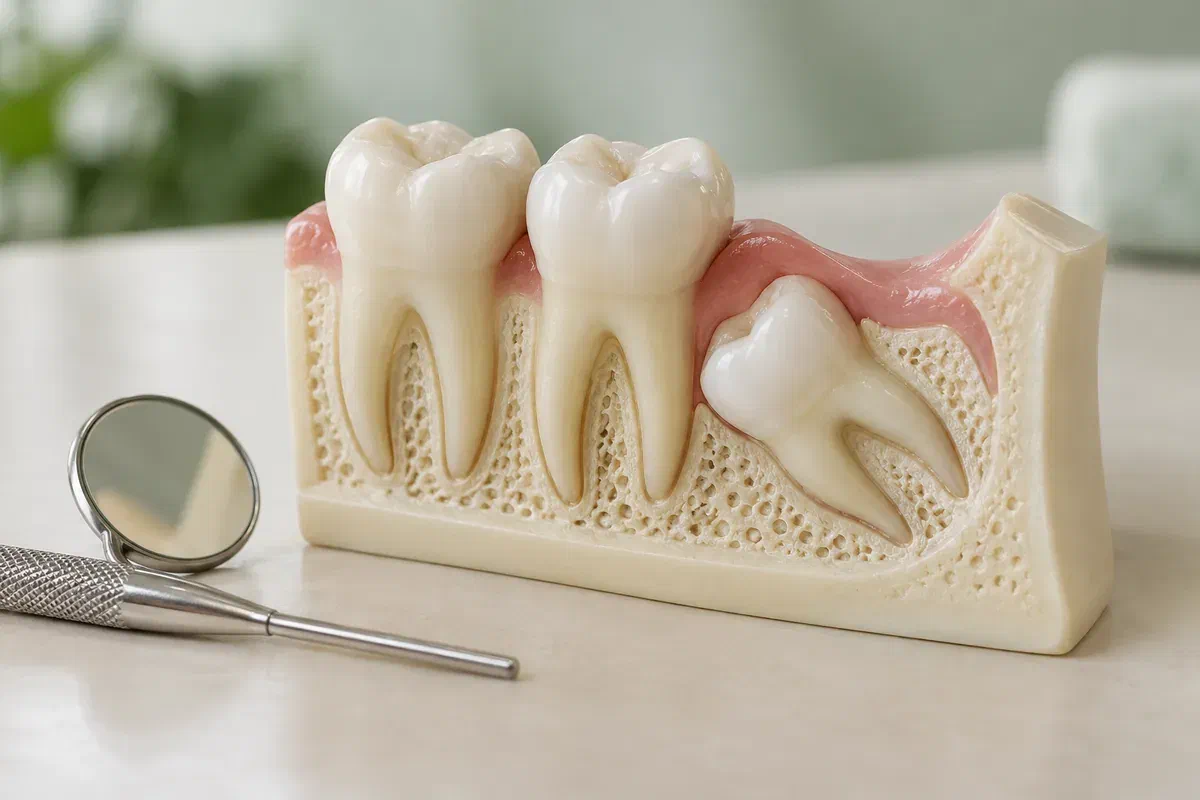
Illustrative physical jaw model with an angled wisdom tooth behind two upright molars
What brings an upper tooth to attention

Cheek soreness, food traps, or a surprise on the X-ray

Let us know whether you have felt pain, swelling, or pressure up at the back, whether it is new, or whether the tooth was simply spotted on an image. That helps separate an active problem from a finding that deserves a careful talk about risk.

Soreness at the top back corner

A partly erupted upper tooth can irritate the gum or the inside of the cheek, trap food, or become inflamed. Describe how often this happens and what has helped. An episode may need care before a surgical decision, and swelling that keeps building or a jaw that is harder to open should be raised with us quickly.

Effects on the upper second molar

An angled upper wisdom tooth can make the back of the neighbouring molar hard to clean, leading to decay that only images reveal. Ask whether that tooth is affected and how its treatment would fit with the decision about the wisdom tooth.

A finding with nothing to feel

Upper impacted teeth often turn up on routine X-rays. Ask whether disease is present, what future concern is being considered, and what monitoring would involve. Comfort alone is not a reason to ignore it, nor is the label a reason to remove it.

Contact us promptly if swelling is spreading, you run a fever, or opening is becoming harder. Swelling near the eye, quickly worsening swelling, or difficulty breathing or swallowing requires emergency medical attention right away, not a wait for a dental slot.

When removing an upper tooth helps

The goal should be specific, and so should the plan.

Removal is appropriate when it resolves a particular problem, such as recurrent inflammation or damage to the next molar, or a risk that has been weighed with care. Ask what the procedure is meant to fix and whether further treatment would still be needed. It is not a cure for sinus symptoms with other causes or for unrelated jaw pain.

Upper teeth often sit in less dense bone than lower ones, but their roots can lie close to the sinus. In some cases, removal leaves a small opening between mouth and sinus that needs specific aftercare or repair. The consultation is where you learn how likely that is for your tooth, and how it affects the technique, the setting, and whether a specialist is advisable.

Patient information: British Association of Oral and Maxillofacial Surgeons — impacted wisdom-tooth treatment decisions and risks

Leaving it versus taking it out

Ask what the likely course is if the tooth stays and what removal would risk for your anatomy. A rule to remove every wisdom tooth is not a reason. If monitoring fits, ask what would make you revisit the decision.

Imaging focused on the sinus question

The clinician reviews how the tooth relates to the molar in front, the surrounding bone, and the sinus floor. A more detailed scan may help when standard images leave that relationship unclear and the answer matters. Ask what it would show.

Recovery and complications in plain terms

Expect swelling, soreness, and some risk of bleeding, dry socket, or infection, along with any sinus-related precautions. If lower teeth are also involved, their nerve risk needs separate discussion. Ask how your risk is assessed and what follow-up is planned.

Getting to a plan

Four steps, at your pace

Being assessed does not commit you to surgery. The plan depends on your symptoms, anatomy, medical history, what can be offered, and whether further imaging or a specialist opinion would help.

  1. Describe symptoms and sinus history

    Tell us about pain, swelling, or pressure at the back of the upper jaw, plus any sinus problems you have had. Bring your medicines, allergies, health details, and earlier images. Mention anxiety or previous trouble with anaesthetic so comfort can be planned.

  2. Review the images together

    We explain what the X-rays show about the tooth and the sinus, whether removal is advised or monitoring is reasonable, and any alternative. Ask whether a specialist should provide care. Fees, likely visits, and any open questions should be clear before you decide.

  3. Remove the tooth in a suitable setting

    Depending on its position, the procedure may involve lifting the gum, removing a little bone, or dividing the tooth. The approach and anaesthetic plan are explained in advance. Sedation or general anaesthesia needs an assessment of suitability and a provider able to confirm it.

  4. Leave with sinus-aware aftercare

    You may be given specific advice such as avoiding forceful nose-blowing for a period, alongside guidance on bleeding, cleaning, eating, medicines, and stitches. Confirm your review and how to raise concerns. After sedation, follow the escort and driving instructions you receive.

Healing at the top of the mouth

Protect the socket and follow any sinus precautions.

Your written instructions are specific to your procedure and health. Healing varies, so ask what to expect and which symptoms mean you should call, rather than relying on general online advice.

Keep the area clean and undisturbed

Ask how to brush and rinse without disturbing the socket or stitches. Avoid prodding the area with your tongue or any tool. Eat what was recommended and return to normal cleaning near the site when advised.

Medicines, rest, and sinus care

Use any pain medicine following professional advice and your health history. Do not stop prescribed medicines, including blood thinners, without guidance. Follow the sinus precautions you were given, arrange help if needed, and check anaesthetic restrictions before work or driving.

Changes worth reporting

Call the treating provider if bleeding does not ease with the measures shown, or if pain, swelling, fever, or an unusual sensation gets worse. Air or fluid passing between mouth and nose, or a persistent nosebleed, should also be reported. Pain that returns after improving needs review, and antibiotics are not always needed.

Options for an upper wisdom tooth

Keep watching, or remove it?

Decide for this tooth alone. Ask how the benefit compares with the risks, and how each choice would affect reviews, symptoms, and further treatment. Coronectomy is mainly a lower-tooth option, but ask about it if a lower tooth is also involved.

If there is no current indication

Monitoring

An upper tooth without a reason for surgery can be reviewed at checkups and imaged when justified. Ask what is being watched and what change would alter the advice. Monitoring is planned, not a promise of no future problems.

If the benefit outweighs the risk

Removal

Discuss the procedure, risks such as sinus involvement, anaesthetic, and where treatment would take place. Ask whether a specialist is the right choice and whether your other wisdom teeth need their own decisions instead of a default plan for all four.

For selected lower teeth only

Coronectomy

If a lower wisdom tooth is also under discussion and its roots are close to the nerve, a surgeon may consider removing only the crown and leaving suitable roots. Ask about eligibility, monitoring, and the possibility of later surgery for that tooth.

Patient information: British Association of Oral and Maxillofacial Surgeons — coronectomy selection and retained-root considerations

Rockwood questions

What people ask about upper wisdom teeth

Bring any X-rays or scans, or let us know which office took them. The clearest answers connect the plan to this tooth, its relationship to the sinus, and your health.

(905) 876-4488
Can an upper wisdom tooth cause sinus pressure?
Sometimes dental problems in the upper back teeth can feel like sinus discomfort, and sinus problems can feel like toothache. An examination helps tell which is which before any treatment is decided.
What is a sinus opening after extraction?
Occasionally, removing an upper tooth whose roots sit close to the sinus leaves a small connection between mouth and sinus. Small ones often close with care; some need repair. Your clinician will explain the risk for your tooth and what to watch for.
Why should I avoid blowing my nose after an upper extraction?
If the sinus is close to the socket, forceful nose-blowing can put pressure on the healing area. You may be advised to avoid it for a period. Follow the specific instructions you receive.
Are upper impacted wisdom teeth monitored the same way as lower ones?
The principles are similar: review at checkups, imaging when justified, and attention to symptoms. What is being watched may differ, such as the relationship to the sinus or the cheek. Ask what applies to you.
Does an upper wisdom tooth need to come out if the lower one is removed?
Not automatically. An upper tooth without a partner below can sometimes over-erupt or rub the cheek, which may be a reason to discuss it, but each tooth still needs its own justification.
Can the gum look healthy while the upper tooth is causing a problem?
Yes. Upper wisdom teeth can be hard to see, and the gum surface does not show the roots or the back of the neighbouring molar. Examination and imaging give a clearer picture.
Wisdom-tooth care for Rockwood

Get clear answers about the tooth above.

Reach our Bronte Street practice to discuss an impacted upper or lower wisdom tooth, recurring soreness, or a surgical recommendation. Tell us about any worsening swelling or pain as soon as you get in touch, and bring earlier images if possible.

Monitoring, removal, coronectomy, imaging, anaesthetic, setting, referral, and individual risks, including sinus-related ones, depend on clinical assessment. Procedures and urgent appointments cannot be guaranteed.

Visit Milton Dental Clinic
Unit 1, 342 Bronte St. S, Milton, ON L9T 5B7
Get directions Clinic hours
Monday–Thursday
11am–7pm
Friday–Sunday
By appointment only

Areas we serve

  • Milton
  • Oakville
  • Mississauga
  • Georgetown
  • Halton Hills
  • Acton
  • Campbellville
  • Brampton
  • Burlington
  • Puslinch
  • Rockwood
  • Erin
  • Caledon
  • Etobicoke
  • Old Milton
  • Bronte Meadows
  • Timberlea
  • Dorset Park
  • Dempsey
  • Clarke
  • Beaty
  • Coates
  • Harrison
  • Scott
  • Willmott
  • Ford
  • Bowes
  • Cobden
  • Walker
  • Mountain View
  • Milton Heights
  • Hawthorne Village
  • Valley View
  • Fallingbrook
  • Nassagaweya
  • Trafalgar
  • Esquesing
  • Nelson
  • Brookville
  • Moffat
  • Glen Williams
  • Norval
  • Limehouse
  • Stewarttown
  • Ashgrove
  • Hornby
  • Silver Creek
  • Speyside
  • Scotch Block
  • North Oakville
  • River Oaks
  • Glen Abbey
  • West Oak Trails
  • Palermo
  • Bronte Creek
  • College Park
  • Joshua Creek
  • Uptown Core
  • Preserve
  • Iroquois Ridge
  • Lisgar
  • Meadowvale
  • Meadowvale Village
  • Churchill Meadows
  • Erin Mills
  • Central Erin Mills
  • Streetsville
  • East Credit
  • Creditview
  • Heartland
  • Sheridan
  • Mount Pleasant
  • Credit Valley
  • Huttonville
  • Churchville
  • Springbrook
  • Northwest Brampton
  • Bram West
  • Fletcher's Meadow
  • Fletcher's Creek South
  • Alton Village
  • Orchard
  • Millcroft
  • Headon Forest
  • Tansley
  • Brant Hills
  • Tyandaga
  • Kilbride
  • Lowville
  • Aberfoyle
  • Morriston
  • Arkell
  • Hillsburgh
  • Freelton
  • Carlisle
  • Waterdown
  • Flamborough
  • Mountsberg

How can we help?

Milton Dental Clinic

Have a question about your smile? Choose the option that works best for you.

For urgent dental concerns, please call.
Messages are reviewed during clinic hours.