

Illustrative patient discussing an infected tooth and treatment choices with a clinician
Specialized Care

Infected Tooth Extraction in Georgetown

Diabetes, a blood thinner, a heart condition or a weakened immune system can all change how an infected tooth is handled. From Georgetown, you can have the tooth assessed with your health in view and, if removal is needed, a plan coordinated safely.

Your health, your tooth

The rest of your medical picture belongs in this decision.

An infected tooth is a local problem with effects that can reach further, especially for someone living with a chronic condition. Before talking about removal, the dentist identifies the tooth at the root of it and looks at its structure and support. Swelling by itself never proves extraction is the only answer.

Your medicines and conditions then shape the how and the when. Someone on anticoagulants, managing blood sugar or receiving treatment that lowers immunity may need extra steps, timing changes or a word with their physician. Any antibiotics you have taken already are worth noting, though less pain is not the same as a resolved source.

Call to talk about the tooth and your health, and to ask about availability. Tell us at once if swelling is spreading or you feel unwell. We can discuss the options and whether referral is wise. If immediate care is needed and we are not able to see you, contact another emergency dental provider.

Discuss an infected tooth and your health
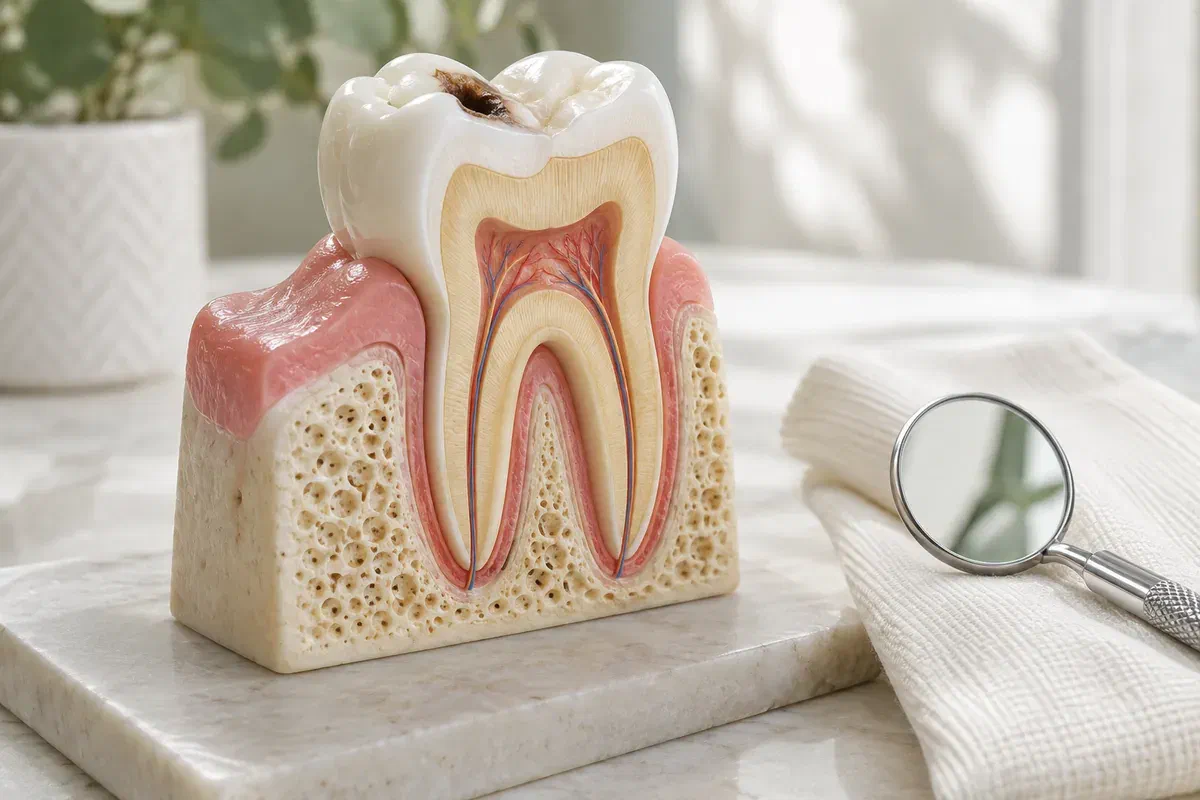
Illustrative physical molar cross-section showing decay within a supported tooth model
Information to have ready

A medicine list may matter as much as the X-ray.

Bring your current prescriptions, any recent antibiotic, and records or advice from earlier dental care. The dentist weighs the tooth’s condition alongside your health before recommending whether, when and where it should come out.

The pattern of the infection

Explain when swelling, drainage or soreness began and how each treatment affected it. A recurring blister on the gum or a persistent taste suggests the source is still present. Short-lived improvement is common, which is why it pays to ask what treatment would fix the underlying cause.

The state of the tooth

Describe fractures, previous root canal work, large restorations and anything mentioned about the gum or bone around it. Ask which present findings stand in the way of keeping it. The tooth’s history gives context; today’s examination sets the prognosis.

Conditions and medicines that change the approach

Include blood thinners, diabetes medicines, steroids, bone-related drugs and anything affecting immunity, along with past surgical or bleeding problems and antibiotic reactions. Never stop a prescribed medicine on your own. The team will explain if your doctor should be consulted before treatment.

Certain signs need emergency medical care rather than a dental visit: difficulty breathing or swallowing, swelling that spreads rapidly or affects the eye, or severe difficulty opening the mouth. If it is immediate, call 911.

The purpose of removal

Clearing the source with your wider health protected

Where the tooth cannot reasonably be kept, removing it addresses the dental source of infection that was diagnosed. Ask what else might need treatment or monitoring and how healing will be followed. For people with medical conditions, that follow-up can be especially important, and the dentist should be candid about what recovery may involve.

Plan for the space as well. Its position, your health and your own goals decide whether a replacement is considered now, later or not at all. Some health factors influence replacement choices too, so it is reasonable to raise them early, without delaying care for the infection.

Patient information: American Dental Association — source-directed dental care and antibiotic decisions

Saving the tooth, if your situation suits it

For some teeth, root canal care, retreatment or another approach is realistic. The comparison should include the structure left, supporting tissue, the restoration needed and the follow-up. For some people, avoiding a surgical procedure is itself a consideration worth discussing.

Antibiotics chosen with care

A prescription can be appropriate in certain situations, including spreading or systemic infection, and some health conditions alter that judgement. It does not treat the source. Ask why a medicine is or is not being prescribed and what it is meant to achieve.

An extraction planned around your health

Discuss freezing, likely difficulty, risks specific to you and whether a specialist or hospital-based setting would be safer. Ask how bleeding will be managed if you take an anticoagulant, what happens if extra surgical steps are needed, and who to call afterward.

Coordinated care

Examine. Consult if needed. Treat. Follow up.

Timing and setting depend on severity, anatomy, your health and the care available. No single rule says an infected tooth must come out at once, or only after another treatment has been completed.

  1. A full review of the tooth and your health

    The dentist goes through your medical history, examines the area and uses suitable tests and images. Mention fever, spreading swelling or trouble eating and opening. Ask what the findings mean for urgency and whether a different level of care is needed.

  2. Options, coordination and consent

    You review the prognosis and alternatives, and the team explains whether your physician or a specialist should be involved. If extraction is chosen, confirm the tooth, approach, risks, fees and aftercare. Ask questions until the reasoning makes sense to you.

  3. Treatment with precautions in place

    The dentist selects freezing and an extraction technique suited to you. Mention anxiety or previous difficulty getting numb, and agree on a stop signal. When surgical steps or referral are likely, that should already be built into your plan.

  4. Recovery guidance and a review date

    Instructions cover bleeding, cleaning, eating, medicines and any stitches, with notes specific to your health. Ask when the site will be rechecked and how to get help outside regular hours. Confirm any further visits for the rest of your treatment or replacement.

Healing with a health condition

Recovery may need a little more attention, and that is normal.

Follow the guidance written for your extraction and health. Not every symptom after removing an infected tooth is part of normal healing, and new discomfort does not automatically call for antibiotics.

Managing bleeding and the socket

Use the pressure technique you were taught and avoid disturbing the wound. If you take a blood thinner, follow the specific advice you were given. Ask when rinsing and brushing nearby can begin, and call the provider if bleeding does not settle as described.

Combining new and regular medicines

New prescriptions sit alongside the ones you already take, so check with the dentist or pharmacist how they interact before the first dose, then follow the directions closely. Avoid leftover medicines and do not raise doses out of worry. Keep taking your regular medicines unless the clinician responsible has advised a change.

Reporting changes early

Contact the provider about worsening pain, returning swelling, fever, persistent bleeding or changes in sensation, mentioning your health conditions and the date of the extraction. Attend the review even if you feel well, because healing and any lingering infection still need checking.

Patient information: Royal Devon — bleeding advice and prescribed anticoagulant precautions

Choosing a path safely

Which route suits the tooth and your health?

The diagnosis, the condition of the tooth, the severity of the infection and your medical situation all point toward one option or another. Urgent care may come first, followed by another stage to finish treatment.

When the tooth’s outlook supports it

Root canal care for a tooth worth keeping

A root canal or other indicated treatment may be advised, followed by a restoration and periodic checks. A specialist opinion can be useful when the decision is close. Keeping the tooth should mean a dependable long-term plan, not a short pause in the infection.

When removal is appropriate after alternatives

Extraction with medical precautions

The dentist should explain why keeping the tooth is not suitable, or confirm that you prefer removal after hearing the options. Review the procedure, the precautions your health requires, the risks and the space. Ask what replacement planning must come first.

When infection or health concerns call for it

Specialist or hospital-based treatment

Severe infection, significant medical conditions or complex anatomy may make another setting safer. Ask what the referral is for and how urgent it is. Escalation should go ahead promptly, even if a different location would have been your first choice.

Georgetown questions

Health conditions and tooth removal

Bring your medicine list and any earlier dental records. These answers help you prepare, but only an examination can determine whether your tooth should be removed.

(905) 876-4488
Should I stop my blood thinner before an infected tooth is pulled?
Do not stop or change it yourself. Tell the dental team exactly what you take, and they will advise whether to coordinate with the doctor who prescribes it. Many extractions can be planned with precautions in place.
Does diabetes affect how an infected tooth is treated?
It can influence healing and how infection is managed, so the dentist will want to know how it is controlled and what medicines you take. Bring that information to your visit.
I take a medicine for bone density. Is that relevant to an extraction?
Yes, it is worth mentioning. Some bone-related medicines are taken into account when planning extractions. Tell the team the name and how long you have taken it.
Will I need antibiotics because of my medical condition?
That depends on your condition, the infection and current guidance. Some people need specific precautions; many do not. Ask the dentist, who may also consult your physician.
Can my infected tooth be saved instead of removed?
Possibly. The remaining structure, its support and any earlier treatment decide whether root canal care is realistic. Ask what restoration would follow and how your health factors into the choice.
Could my extraction need to happen in a hospital?
Occasionally, when infection is severe or health concerns call for more support. The dentist will explain if a referral is advisable and how urgently it should happen.
Booking from Georgetown

Your prescriptions and your questions are both welcome here.

Ring (905) 876-4488 to reach our Bronte Street team, describe your symptoms and health, and find a suitable time. For anyone heading down from Georgetown, it helps to mention in that call whether your physician has given any advice already, so the visit can focus on decisions rather than gathering details. If you need urgent care before we can see you, please contact another emergency dental provider.

Extraction, timing, antibiotics, referral and replacement depend on an individual assessment of the tooth and your health. Email and online forms are for non-urgent questions.

Visit Milton Dental Clinic
Unit 1, 342 Bronte St. S, Milton, ON L9T 5B7
Get directions Clinic hours
Monday–Thursday
11am–7pm
Friday–Sunday
By appointment only

Areas we serve

  • Milton
  • Oakville
  • Mississauga
  • Georgetown
  • Halton Hills
  • Acton
  • Campbellville
  • Brampton
  • Burlington
  • Puslinch
  • Rockwood
  • Erin
  • Caledon
  • Etobicoke
  • Old Milton
  • Bronte Meadows
  • Timberlea
  • Dorset Park
  • Dempsey
  • Clarke
  • Beaty
  • Coates
  • Harrison
  • Scott
  • Willmott
  • Ford
  • Bowes
  • Cobden
  • Walker
  • Mountain View
  • Milton Heights
  • Hawthorne Village
  • Valley View
  • Fallingbrook
  • Nassagaweya
  • Trafalgar
  • Esquesing
  • Nelson
  • Brookville
  • Moffat
  • Glen Williams
  • Norval
  • Limehouse
  • Stewarttown
  • Ashgrove
  • Hornby
  • Silver Creek
  • Speyside
  • Scotch Block
  • North Oakville
  • River Oaks
  • Glen Abbey
  • West Oak Trails
  • Palermo
  • Bronte Creek
  • College Park
  • Joshua Creek
  • Uptown Core
  • Preserve
  • Iroquois Ridge
  • Lisgar
  • Meadowvale
  • Meadowvale Village
  • Churchill Meadows
  • Erin Mills
  • Central Erin Mills
  • Streetsville
  • East Credit
  • Creditview
  • Heartland
  • Sheridan
  • Mount Pleasant
  • Credit Valley
  • Huttonville
  • Churchville
  • Springbrook
  • Northwest Brampton
  • Bram West
  • Fletcher's Meadow
  • Fletcher's Creek South
  • Alton Village
  • Orchard
  • Millcroft
  • Headon Forest
  • Tansley
  • Brant Hills
  • Tyandaga
  • Kilbride
  • Lowville
  • Aberfoyle
  • Morriston
  • Arkell
  • Hillsburgh
  • Freelton
  • Carlisle
  • Waterdown
  • Flamborough
  • Mountsberg

How can we help?

Milton Dental Clinic

Have a question about your smile? Choose the option that works best for you.

For urgent dental concerns, please call.
Messages are reviewed during clinic hours.